

Epistemological Instability in Materialist Cosmology
Swami Karpatri Ji’s Critique of Dialectical Materialism,
Evolutionism, and Scientific Overreach
- Architectural Foundations of Classical Hindu Epistemology (Pramāṇa Śāstra)
In classical Indian philosophy (Darśana [दर्शन]), Pramāṇa Śāstra [प्रमाण शास्त्र]: the formal inquiry into the valid means of knowledge, serves as the epistemological framework upon which all ontological and metaphysical architectures are sustained. Before any philosophical tradition can legitimately assert claims regarding the fundamental nature of reality, consciousness, or the cosmos, it must first establish the validity of the cognitive instruments (pramāṇas [प्रमाण]) through which those claims are derived and verified. Epistemology is thus not a mere ancillary discipline within Indian thought; it is the indispensible prerequisite for all ontology. The scope of what a school (darśana) considers real is strictly governed by the boundary conditions of what it considers knowable. Whether orthodox (āstika [आस्तिक]) or heterodox (nāstika[नास्तिक]), the logical boundaries of each system are defined by its accepted list of pramāṇas, ensuring that metaphysical commitments remain anchored to systematic criteria of validity.
Deconstructing Pratyakṣa Pramāṇa (Direct Perception)
Pratyakṣa Pramāṇa [प्रत्यक्ष प्रमाण] is defined as direct, unmediated cognition arising from the contact of sense organs (indriyas [इंद्रियाँ]) with their corresponding objects (indriyārthasannikarṣa [इन्द्रियार्थसन्निकर्ष]). Across almost all classical schools, direct is regarded as the primary and foundational means of valid knowledge, captured in the classic epistemological maxim pratyakṣo hi pramāṇānāṃ mukhyatamah (“प्रत्यक्षो हि प्रमाणानां मुख्यतमः।”, “perception is chief among all proofs”). This primary status derives from its cognitive immediacy (aparokṣatva [अपरोक्षत्व]), providing unmediated certainty without requiring intervening logical operations. Classical epistemology divides direct perception into two primary sub-divisions:
- Laukika (लौकिक Ordinary Perception): Cognition generated through empirical channels, encompassing external perception via the five physical senses (sight, hearing, smell, taste, touch) and internal perception via the mind (manas), which senses internal emotional and cognitive states such as pleasure, pain, and volition.
- Alaukika (अलौकिक Extraordinary Perception): Cognition transcending standard physical sensory channels, including yogaja-pratyakṣa (योगज-प्रत्यक्ष intuitive, immediate perception developed through refined meditative practice) and ārṣa-pratyakṣa (आर्ष-प्रत्यक्ष the supersensuous, cognitive vision attributed to ancient rishis).
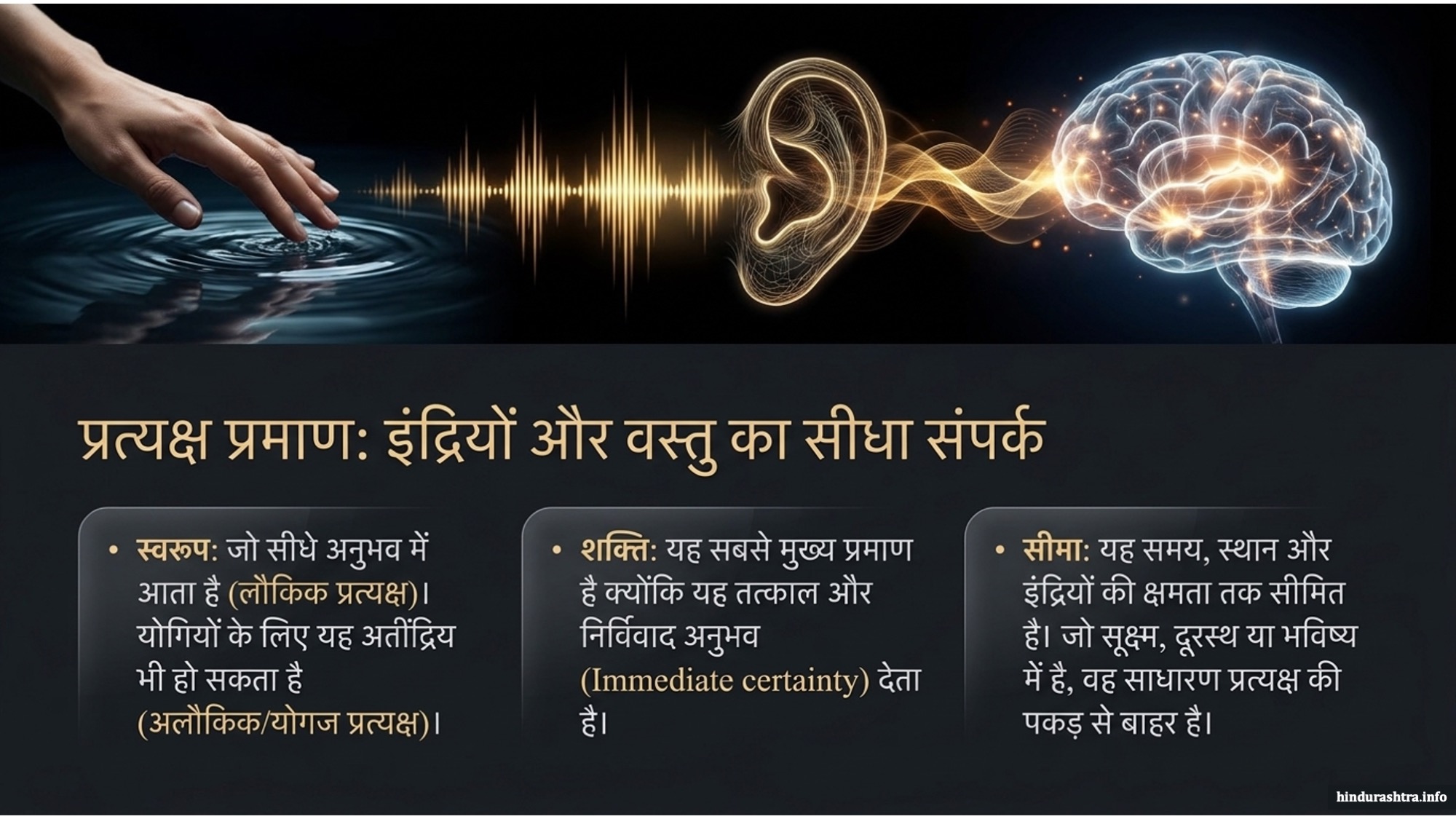
Despite its foundational role, classical epistemology explicitly recognizes the structural limitations of Pratyakṣa [प्रत्यक्ष]. Ordinary perception is strictly bounded by temporal, spatial, and physiological conditions. It cannot apprehend realities that are subtle (sūkṣma [सूक्ष्म]), spatially concealed or distant (vyavahita [व्यवहित]), or temporally displaced (atīta-anāgata[अतीत-अनागत]). Furthermore, physical sensory perception is intrinsically vulnerable to perceptual errors (bhrama or bhrānti[भ्रम या भ्रान्ति]); exemplified by optical illusions such as mistaking a rope for a snake or viewing a straight stick as bent in water. Consequently, while Pratyakṣa provides immediate data regarding present, accessible objects, it cannot independently establish unobservable principles.
Analyzing Anumāna Pramāṇa (Inferential Knowledge)
Anumāna [अनुमान], literally translating to “measuring after” or “subsequent cognition”, is the process of deriving valid knowledge regarding an unobserved object (sādhya [साध्य]) from the observation of a distinct sign or reason (liṅga [लिंग] or hetu [हेतु]). Rather than relying on direct sensory contact, inferential cognition moves systematically from the observed present to the unobserved cause or accompaniment.
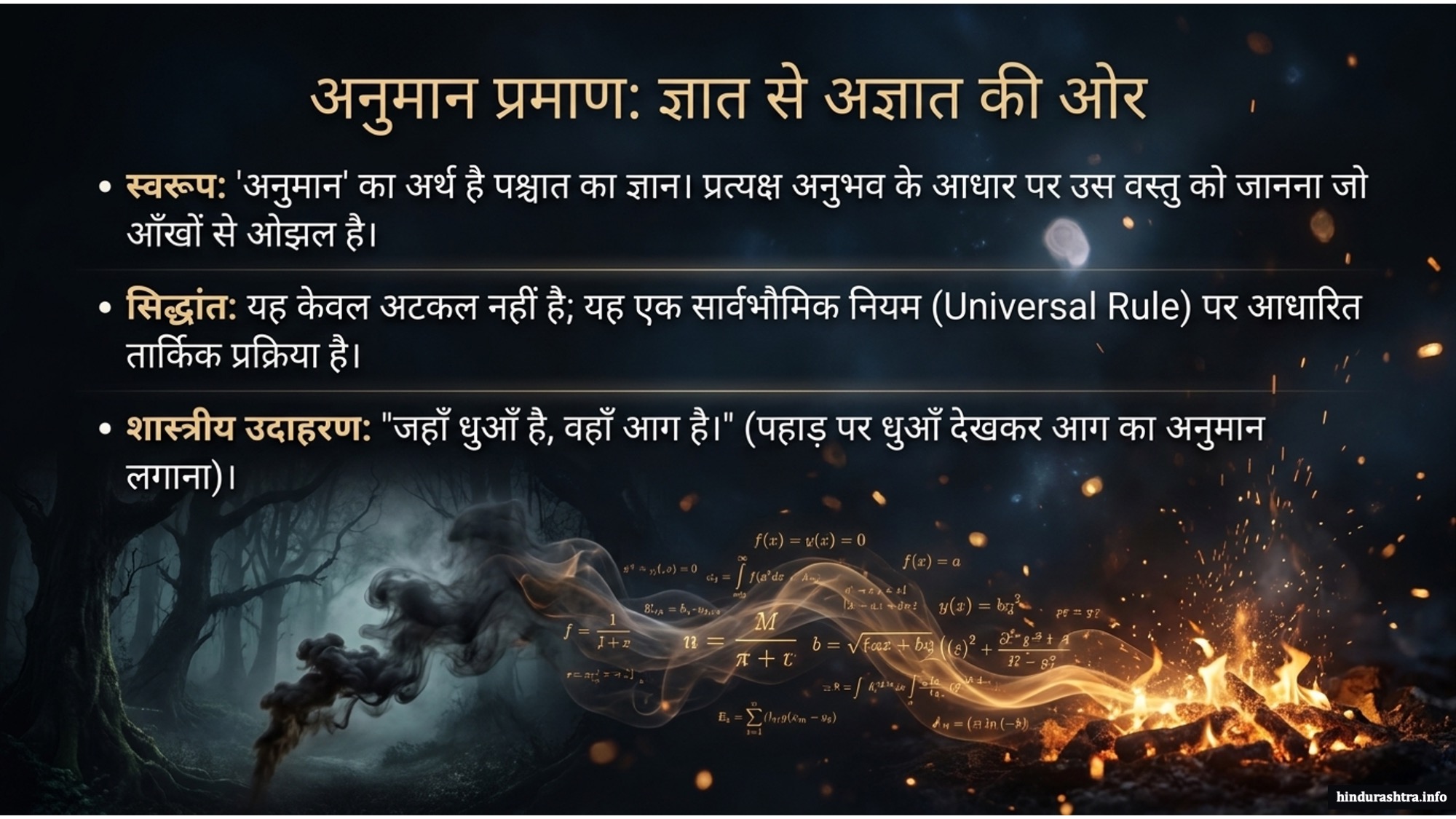
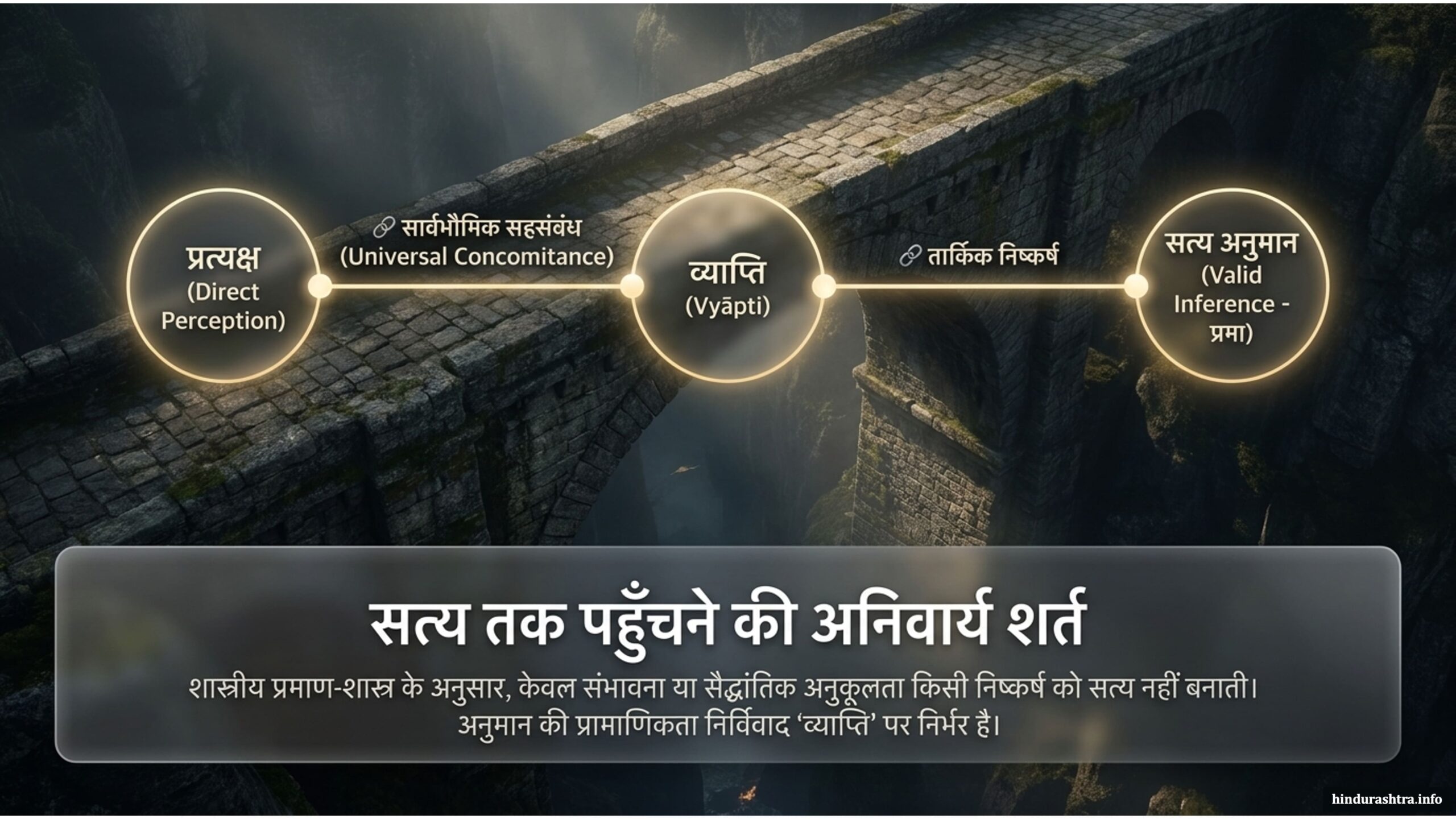
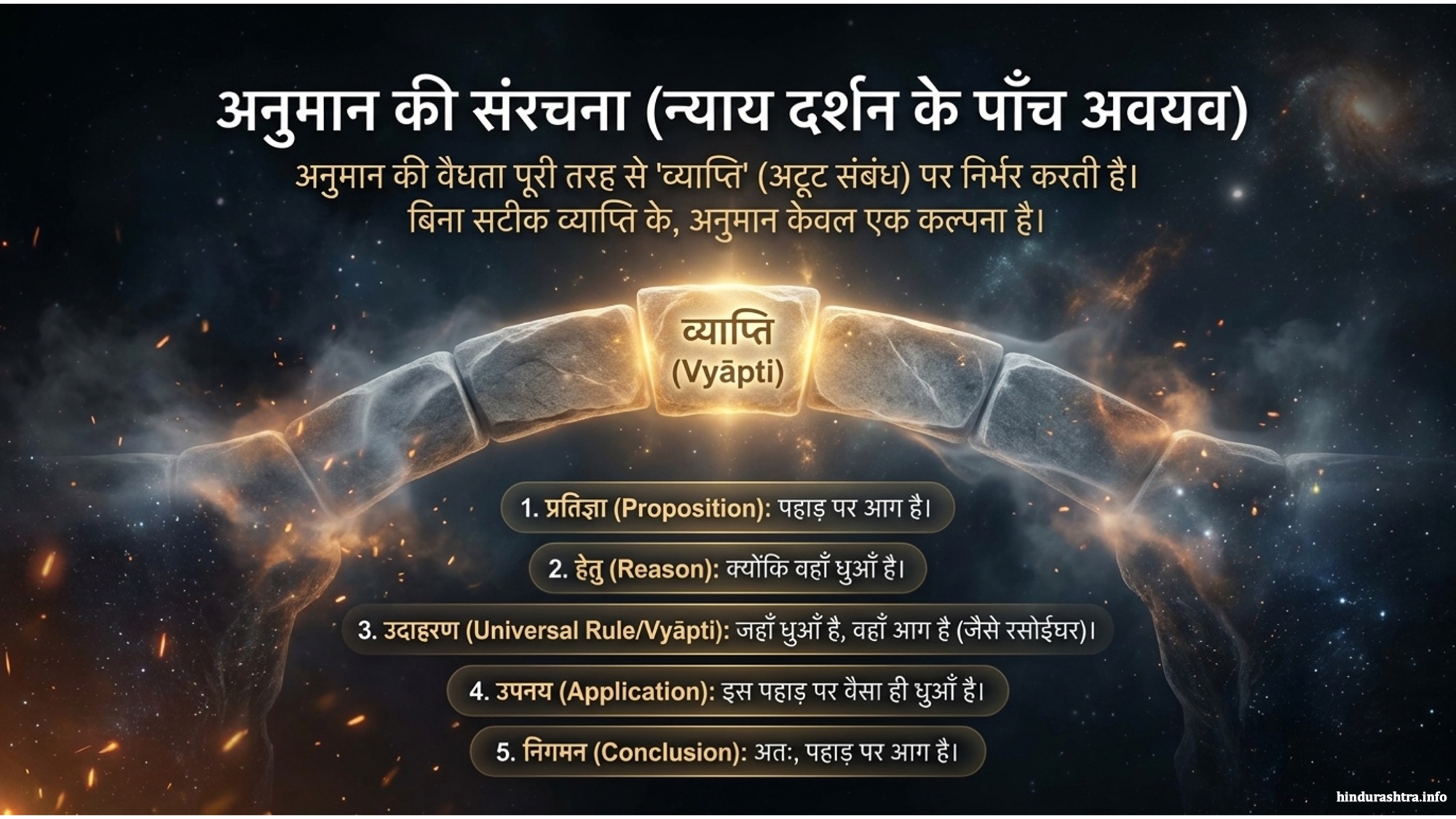
The core logical foundation of all valid Anumāna is Vyāpti [व्याप्ति], the invariable, universal concomitance between the inferential sign (hetu [हेतु]) and the inferred property (sādhya [साध्य]). Vyāpti represents an exceptionless relationship established through prior experience; if the Vyāpti is flawed, unanchored, or conditional (sopādhika [सोपाधिक]), the entire inferential chain devolves into logical error. To demonstrate formal inferences for public debate (parārthānumāna [परार्थानुमान]), the classical Nyāya school formalized the five-membered syllogism (pañcāvayava-vākya [पञ्चावयव-वाक्य]):
|
Sanskrit Term |
Logical Function |
Classical Exemplar (Smoke/Fire) |
|
Pratijñā [प्रतिज्ञा] |
Initial Proposition / Thesis Statement |
The mountain contains fire. |
|
Hetu [हेतु] |
Reason / Inferential Sign |
Because it possesses smoke. |
|
Udāharaṇa [उदाहरण] |
Universal Rule backed by Vyāpti and Exemplar |
Wherever there is smoke of that nature, there is fire, as in a kitchen hearth. |
|
Upanaya [उपनय] |
Application of the Universal Rule to the Case |
This mountain possesses smoke which is invariably concomitant with fire. |
|
Nigamana [निगमन] |
Final Conclusion |
Therefore, this mountain contains fire. |
Comparative Survey of Pramāṇa [प्रमाण] Acceptance Across Darśanas [दर्शन]
The degree to which an Indian philosophical tradition engages in metaphysical speculation or accepts transcendent principles is directly dictated by the number and nature of the pramāṇas it recognizes:
|
School (Darśana) |
Accepted Pramāṇas (Count) |
Specific Means Recognized |
|
Cārvāka [चार्वाक] |
1 |
Pratyakṣa (प्रत्यक्ष Direct Perception only) |
|
Vaiśeṣika [वैशेषिक] |
2 |
Pratyakṣa, Anumāna [अनुमान] |
|
Sāṃkhya [सांख्य] |
3 |
Pratyakṣa, Anumāna, Āptavacana [आप्तवचन] / Śabda [शब्द] (Verbal / Scriptural Testimony) |
|
Yoga [योग] |
3 |
Pratyakṣa, Anumāna, Āgama (आगम Scriptural Testimony) |
|
Nyāya [न्याय] |
4 |
Pratyakṣa, Anumāna, Upamāna (उपमान Analogy/Comparison), Śabda |
|
Advaita Vedānta & Mīmāṃsā [अद्वैत वेदान्त और मीमांसा] |
6 |
Pratyakṣa, Anumāna, Upamāna, Śabda, Arthāpatti (अर्थापत्ति Postulation), Anupalabdhi (अनुपलब्धि Non-perception) |
Traditions that restrict validity strictly to sensory perception (such as radical materialist Cārvāka [चार्वाक]) reject metaphysical extrapolation, maintaining that unperceived entities cannot be proven. Conversely, systems accepting Anumāna, Śabda (शब्दप्रमाण authoritative testimony), and additional pramāṇas (such as Sāṃkhya, Nyāya, and Advaita Vedānta) build extensive cosmological and ontological frameworks. These schools utilize rigorous inferential logic anchored in Vyāpti [व्याप्ति] and authoritative revelation (āptavacana [आप्तवचन]) to analyze unobservable empirical causes (parokṣa [परोक्ष]) as well as transcendent realities.
This systematic delineation of sensory limits and inferential logic in Pramāṇa Śāstra [प्रमाण शास्त्र] offers an instructive framework for evaluating the empirical methods and theoretical inferences developed within modern natural science.
- The Architecture and Epistemic Scope of Modern Scientific Empirical Reasoning
Modern scientific methodology is a refined empirical and mathematical framework designed to investigate, model, and predict the structural mechanisms of the physical universe. Historically pivoting away from unverified scholastic rationalism, the modern scientific enterprise relies on systematic empirical observation coupled with inductive, deductive, and abductive inferential models. Within the terminology of classical comparative epistemology, modern science operates predominantly within the realm of transactional reality (Vyāvahārika Satya [व्यावहारिक सत्य]), deploying rigorous empirical observation alongside sophisticated theoretical modeling.
Scientific Observation and Instrumental Extension
In scientific methodology, empirical observation serves as the raw baseline for data collection. However, scientific observation differs fundamentally from unassisted human Pratyakṣa [प्रत्यक्ष]. To transcend the physiological limitations of human sensory organs, science utilizes calibrated instrumentation, ranging from particle accelerators and mass spectrometers to radio telescopes and electron microscopes; extending sensory registration into microscopic, subatomic, and non-visible electromagnetic domains.
This extension introduces a distinct epistemic transformation. Whereas ordinary Pratyakṣa involves direct, unmediated awareness, instrument-mediated scientific observation requires complex chains of theoretical calibration, mathematical processing, and systematic error analysis. An operational display on a laboratory instrument is not merely perceived; its output must be interpreted through validated theoretical models, environmental controls, and statistical checks to distinguish authentic physical signals from instrumental noise or measurement artifacts. Modern scientific perception is thus inherently theory-laden, blending direct instrumental readings with accepted physical principles.
The Inferential Mechanism of Modern Science
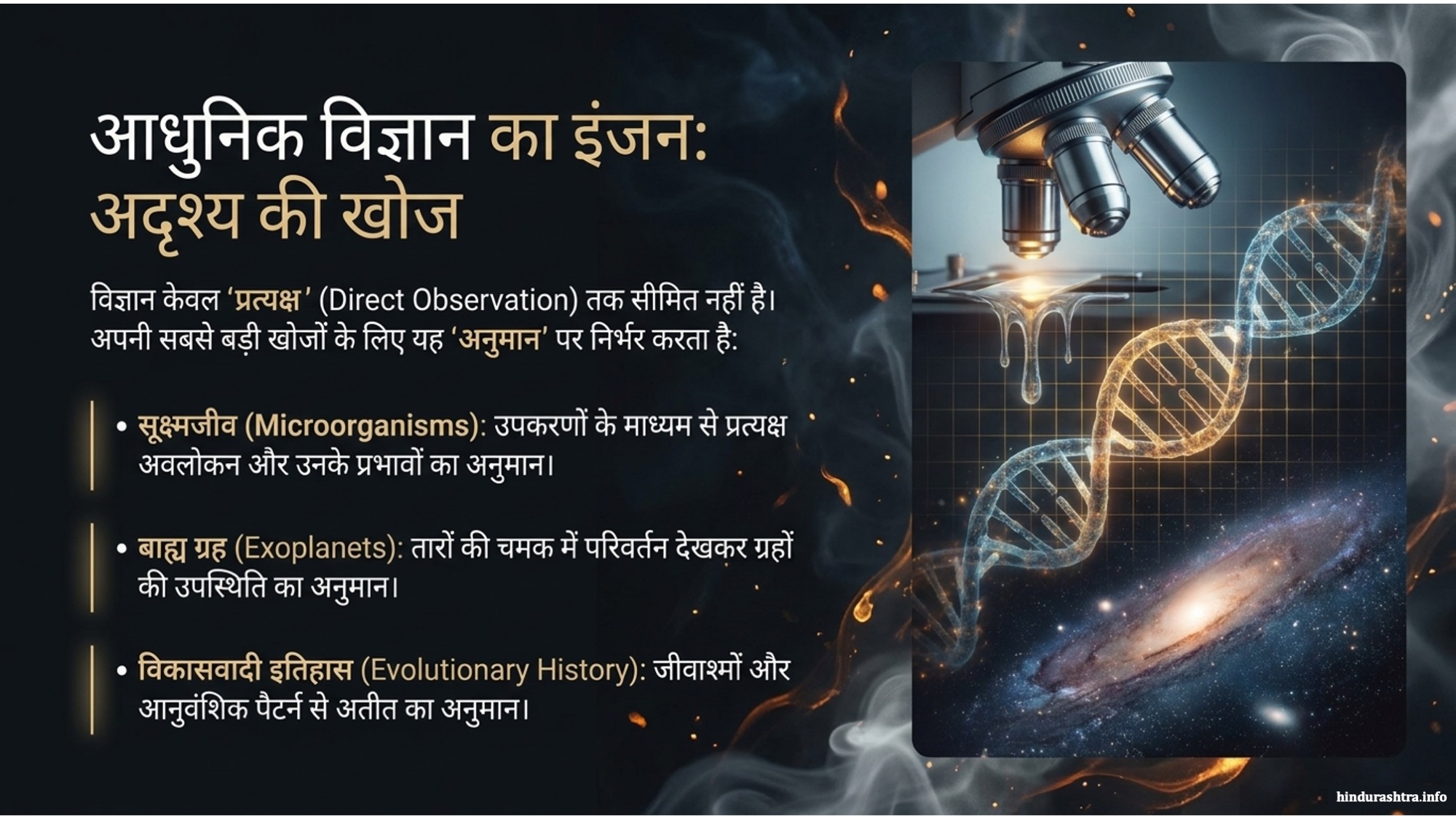
Because the underlying causes of natural phenomena are frequently hidden from direct observation (parokṣa [परोक्ष]), modern science relies on Anumāna [अनुमान], in the form of hypothesis testing, quantitative modeling, and theoretical inference to construct explanatory frameworks. Scientific inference operates continuously across major empirical domains:
- Microbiology: Pathogenic dynamics and sub-cellular molecular operations cannot be observed directly by the unaided eye. Scientists register physical proxy indicators through high-resolution imaging and biochemical assays, inferring causal viral or bacterial mechanisms through controlled experimental comparisons and concordant biological responses.
- Astrophysics: The presence of exoplanets in distant star systems is rarely established through direct optical resolution. Astronomers infer their mass, radius, and orbital trajectory by measuring periodic dips in a host star’s luminosity (the transit method) or minute spectral shifts caused by gravitational reflex motion (the radial velocity method).
- Evolutionary Biology: Past macro-evolutionary transformations and deep ancestral lineages cannot be observed in real time. Evolutionary biologists infer historical phylogenetic relationships by analyzing comparative structural morphology, fossil stratigraphy, and cross-species genetic sequences.
It is critical to emphasize that science’s reliance on Anumāna does not render its findings inherently speculative. Scientific inferences operating within Vyāvahārika Satya are continually tested against multi-line converging evidence, mathematical rigor, and predictive success. The historical evolution of scientific theories, such as the transition from Newtonian mechanics to Einsteinian general relativity reflects a capacity for empirical self-correction and refinement within the physical domain, rather than an inherent invalidity of inferential reasoning itself.
Epistemic Criteria for Scientific Validity
To ensure that theoretical inferences remain grounded in physical reality and do not dissolve into arbitrary conjecture, the scientific method enforces strict evaluative criteria:
- Empirical Reproducibility: Experimental results and observational protocols must yield consistent outcomes when independently replicated under equivalent conditions.
- Predictive Accuracy: A theoretical model must generate quantitative predictions regarding previously unobserved phenomena that can subsequently be verified or falsified.
- Multi-Line Converging Evidence: Inferential claims gain epistemic force when independent lines of investigation (e.g., genomic analysis and paleontological data) converge on the same explanatory model.
- Vulnerability to Self-Correction: Scientific claims remain provisional in principle, structured to undergo revision or replacement when confronted with contradictory empirical data or broader explanatory frameworks.
Because modern science relies on combining sensory instrumentation with theoretical inference, a formal cross-system alignment with classical Pramāṇa Śāstra helps clarify where these methodologies overlap and where their epistemic jurisdictions diverge.
- Comparative Epistemic Mapping: Classical Pramāṇa vs. Scientific Empiricism
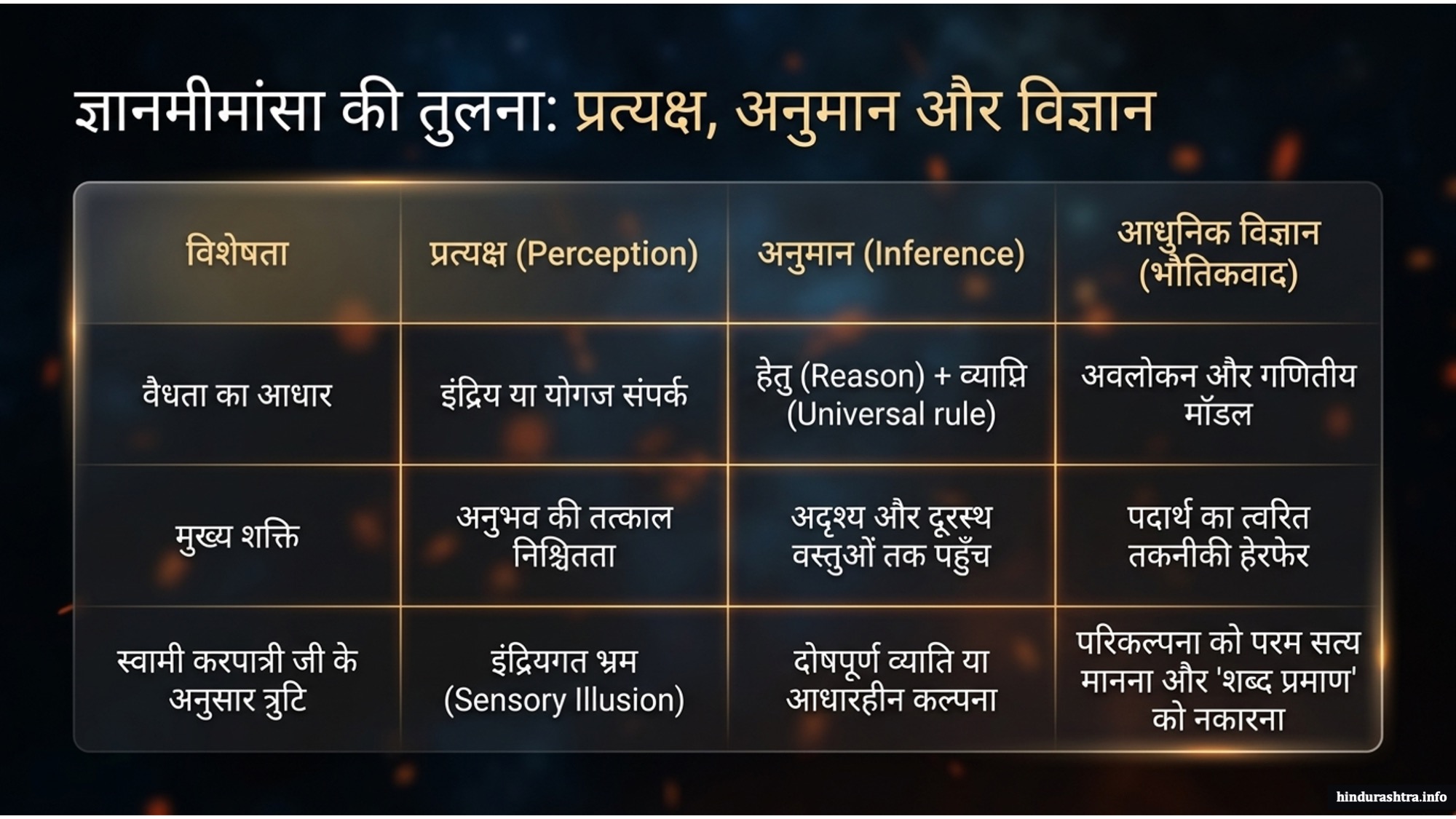
Mapping classical Indian epistemological categories alongside modern scientific methodologies demonstrates significant structural alignments in logical reasoning, while highlighting fundamental distinctions regarding epistemic boundaries, authoritative sources, and ultimate targets of knowledge.
Comparative Epistemological Architecture
|
Epistemic Dimension |
Pratyakṣa (Direct Perception) |
Anumāna (Inference) |
Modern Scientific Approach |
|
Source of Validity |
Direct sensory contact (indriyārthasannikarṣa [इन्द्रियार्थसन्निकर्ष]) or extraordinary yogic perception (alaukika [अलौकिक]). |
Inferential sign (hetu) linked to an unobserved property (sādhya[साध्य]) via universal concomitance (vyāpti). |
Calibrated instrumental observation integrated with mathematical modeling and hypothesis testing. |
|
Primary Epistemic Function |
Provides immediate, unmediated certainty of present, accessible empirical or internal objects. |
Extends cognition to unobserved, distant, past, subtle, or microscopic physical realities. |
Generates predictive explanatory models enabling physical manipulation and technological application. |
|
Mechanisms of Verification |
Absence of physiological defects, appropriate environmental conditions, and absence of illusion (bhrama [भ्रम]). |
Establishment of a faultless, exceptionless vyāpti and verification of initial perceptual premises. |
Empirical reproducibility, predictive verification, multi-line converging evidence, and statistical controls. |
|
Potential Vulnerabilities / Pitfalls |
Sensory illusions (bhrānti [भ्रान्ति]), observational limitations, or physical impairment of sensory organs. |
Fallacious middle terms (anumānābhāsa [अनुमानाभास]), unanchored assumptions, or speculative leaps (utprekṣā [उत्प्रेक्षा]). |
Conflating predictive empirical models with exhaustive ontological truth; materialist overextension. |
|
Domain of Application |
Present, localized physical phenomena and direct subjective internal experiences. |
Unobserved physical causes (parokṣa) and logical deductions regarding empirical relationships. |
Measurable material mechanisms, physical forces, and functional causal operations within Vyāvahārika Satya. |
Delineations in Handling Unobservable Realities
Both classical Indian logic (such as Nyāya [न्यायदर्शन] and Advaita Vedānta [अद्वैत वेदान्त]) and modern scientific methodology acknowledge that unobserved entities and causes (parokṣa) must be established through inferential means. However, their ultimate targets and epistemic limits diverge significantly:
- Scientific Inferences: Restrict their target domain to functional, physical, and structural causes operating within the empirical universe (Vyāvahārika Satya). Science infers unobserved material entities (such as subatomic particles or dark matter) strictly to account for observed physical effects and predict future empirical states.
- Classical Metaphysical Inferences: Differentiate between functional physical causes and ultimate ontological reality (Pāramārthika Satya [परमार्थिक सत्य]). Systems such as Advaita Vedānta maintain that while empirical inference (anumāna) is fully valid for investigating physical causal chains within Vyāvahārika Satya, it cannot independently establish or refute transcendent realities, such as the fundamental nature of consciousness (Ātman [आत्मा]) or ultimate unconditioned reality (Brahman [परब्रह्म]). Transcendent truths lie beyond the sensory reach of physical signs (hetu) and require self-reflexive logical inquiry (vicāra [आत्म-विचार]) aligned with revealed testimony (Śabda Pramāṇa [शब्दप्रमाण] / Āgama [आगम]).
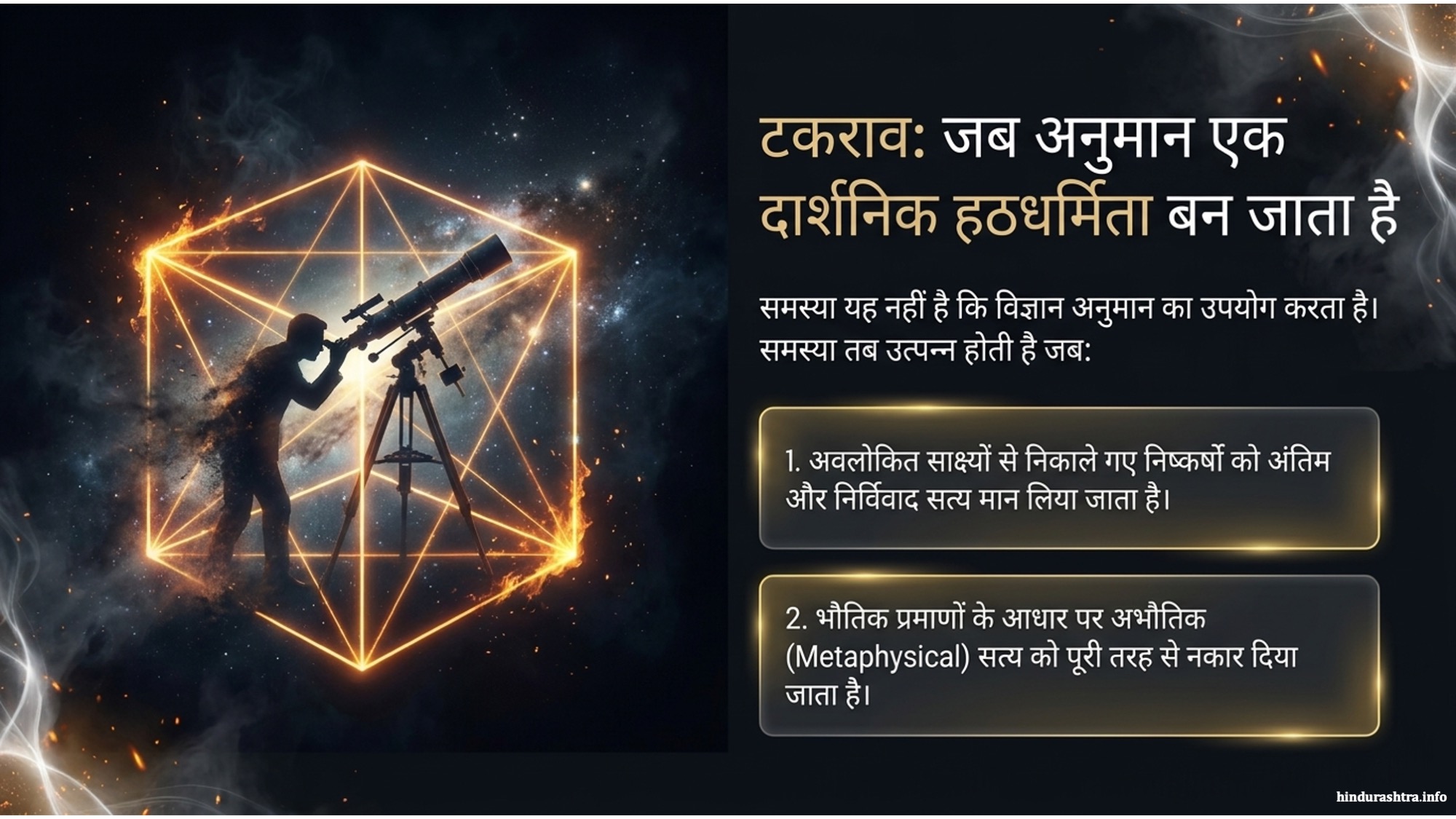
This precise boundary between valid empirical inference and the ungrounded extension of materialist logic forms the core of traditionalist critiques of modern scientific overreach.

- Swami Karpatri Ji’s Epistemological Critique of Scientific Overreach
Swami Karpatri Ji (1907–1982) was a preeminent 20th-century traditionalist scholar of Sanātana Dharma, Advaita Vedānta, and classical Pramāṇa Śāstra. In landmark works such as Veda Svarūpa aur Prāmāṇya [वेद स्वरूप और प्रामाण्य], Vēdārtha Pārijāta [वेदार्थ पारिजात], Vikasvāda (विकासवाद The Theory of Evolution, within his exhaustive philosophical analysis of dialectical materialism in Mārksavāda aur Rāmrājya (मार्क्सवाद और रामराज्य Marxism and Ramrajya), Karpatri Ji presented a rigorous epistemological evaluation of modern materialist claims. His central critique does not reject empirical observation or logical reasoning within their legitimate limits; rather, it targets the ideological transformation of scientific method into scientism; a philosophical position that overextends, inflates, and unanchors Anumāna(inference/hypothesis) from observed Vyāpti, while dismissing revealed testimony (Śabda Pramāṇa) and higher forms of perception.
Deconstructing Utprekṣā and Unanchored Speculation
In Vēdārtha Pārijāta and Veda Svarūpa aur Prāmāṇya, Karpatri Ji critically analyzed the tendency of materialist philosophy to elevate provisional working hypotheses (परिकल्पना parikalpanā) and speculative conjectures (utprekṣā [उत्प्रेक्षा] or uoha [ऊह]) to the status of settled ontological facts.
In classical Indian logic, an inference (anumāna) is epistemically valid only if it rests upon an absolute, unshakeable, and observed universal concomitance (vyāpti) between the sign (hetu) and the inferred property (sādhya). Karpatri Ji argued that when materialist paradigms project sweeping conclusions regarding deep cosmic origins, unobservable geological ages, or macro-evolutionary origins, they frequently construct long chains of nested inferences. By stacking speculative premise upon speculative premise, these models move further away from direct perceptual grounding (Pratyakṣa), replacing verifiable logical deduction with unanchored conjecture (utprekṣā).
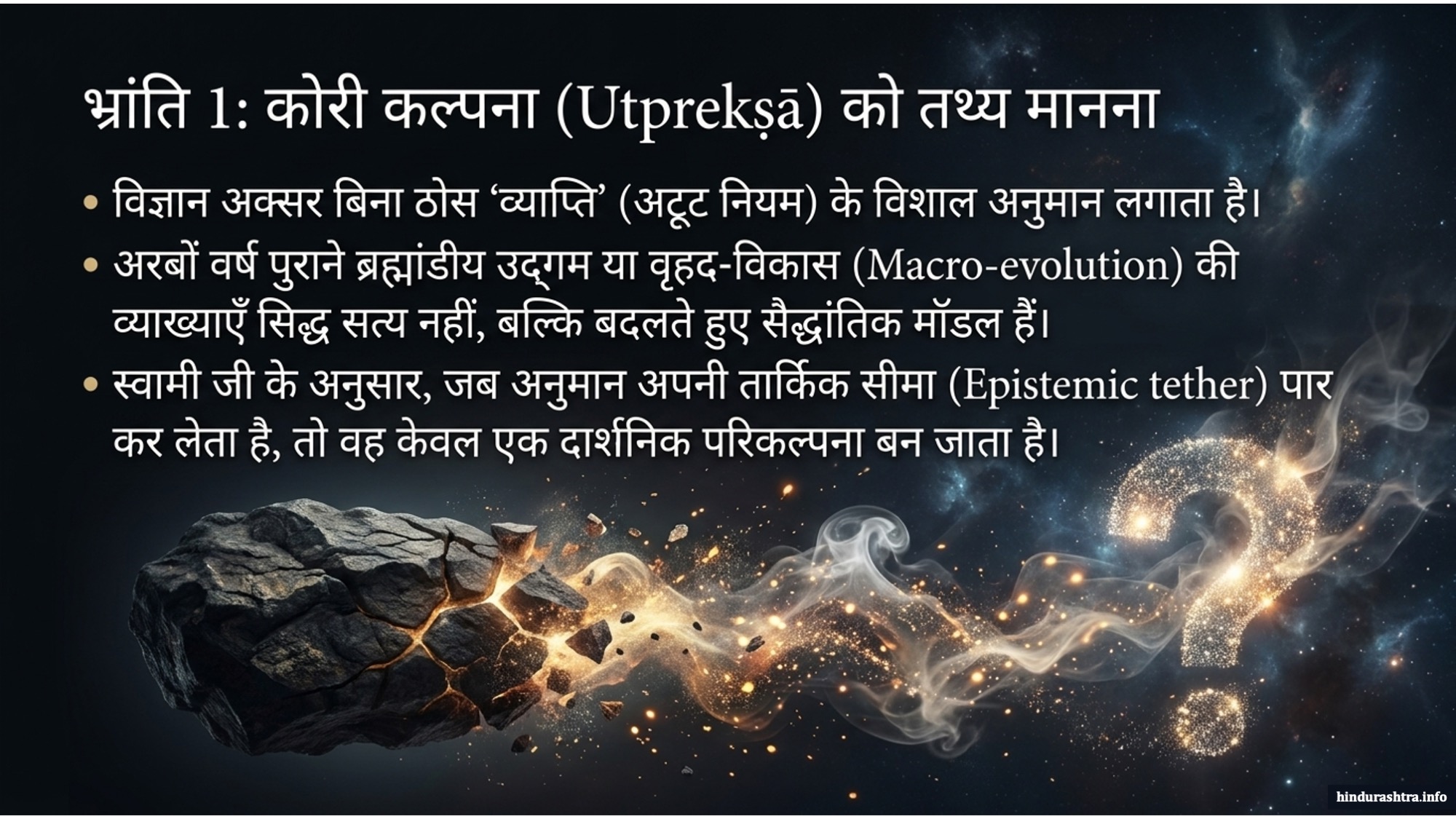
Furthermore, Karpatri Ji cited the historical instability of scientific theories as evidence of their provisional nature. The reality that physical models undergo ongoing paradigm shifts, such as the transition from classical Newtonian physics to relativistic and quantum mechanics, or shifting models in evolutionary theory demonstrates that scientific Anumāna yields provisional, functional knowledge applicable to the transactional world (Vyāvahārika Satya), rather than unshakeable, ultimate truth (Pāramārthika Satya). The error occurs when provisional transactional models are asserted as absolute ontological claims.
Critique of Sensory Chauvinism and Category Errors
Karpatri Ji challenged what he identified as “sensory chauvinism”, the reductionist claim that valid knowledge is strictly confined to gross physical sensory data and its instrumental extensions.
He argued that materialist scientism commits a fundamental category error when it deploys gross empirical instruments to evaluate, minimize, or deny transcendent metaphysical principles (alaukika [अलौकिक]). Physical instruments are engineered to register material variables; using them to judge transcendent metaphysical realities that lie outside physical sensory channels is logically invalid.
To illustrate this category error, Karpatri Ji utilized a classic metaphor: attempting to evaluate or deny transcendent metaphysical realities using physical instruments is epistemologically equivalent to a blind man attempting to evaluate or deny the existence of light using only tactile sensations. The instrument employed is categorically incapable of registering the domain under investigation.
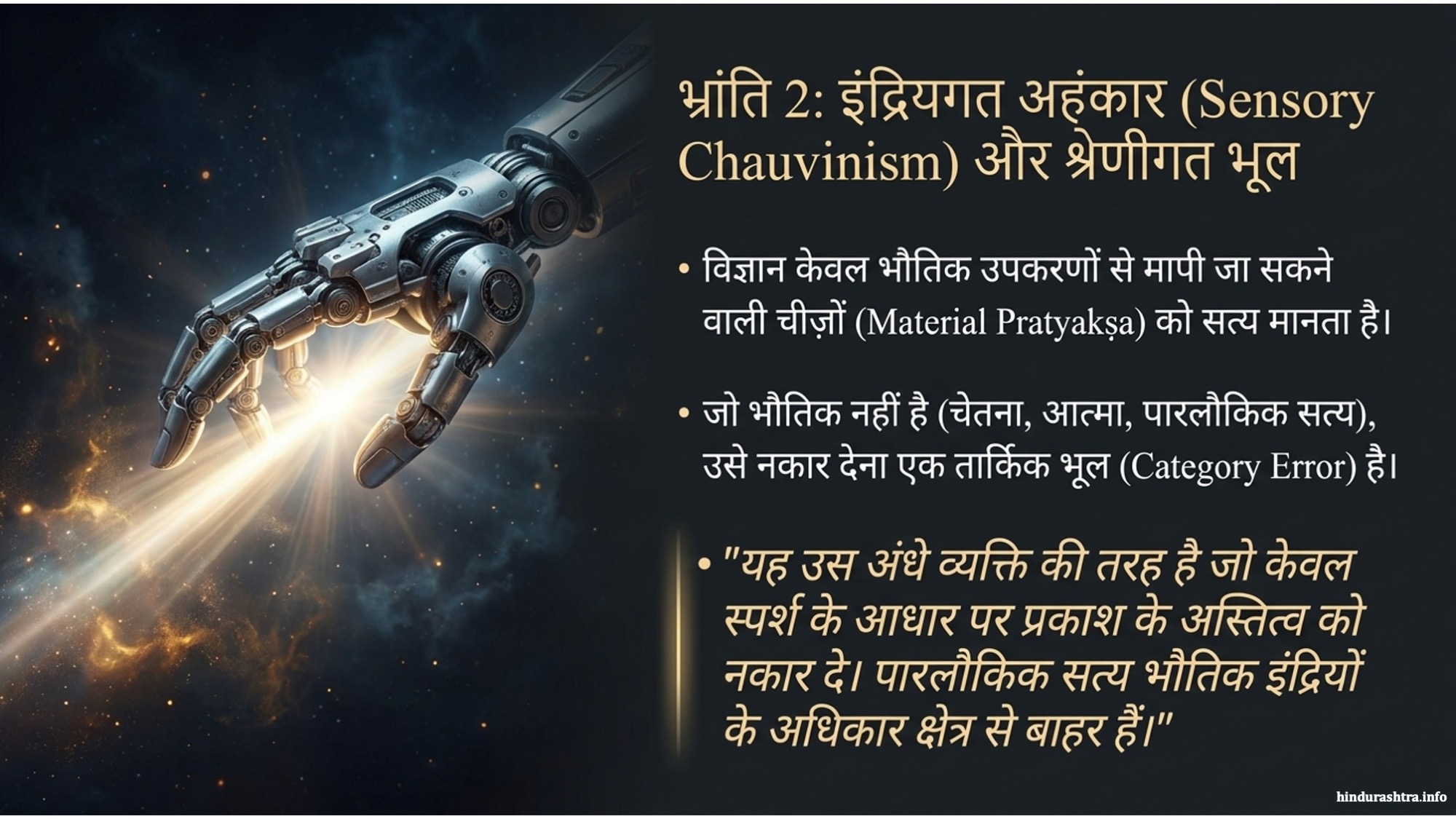
Epistemic Category Error in Materialist Scientism Gross Physical Senses & Instruments à Bounded strictly to measurable physical data (Laukika Pratyakṣa [लौकिक प्रत्यक्ष]). Evaluating Transcendent Realities (Ātman / Brahman / Dharma) à Lies outside gross material channels (Alaukika [अलौकिक]). Category Failure: Deploying physical tools to deny non-physical realities is logically equivalent to judging light purely through tactile feedback.
Critique of Materialist Reductionism and Vikāsavāda (विकासवाद Evolutionism)
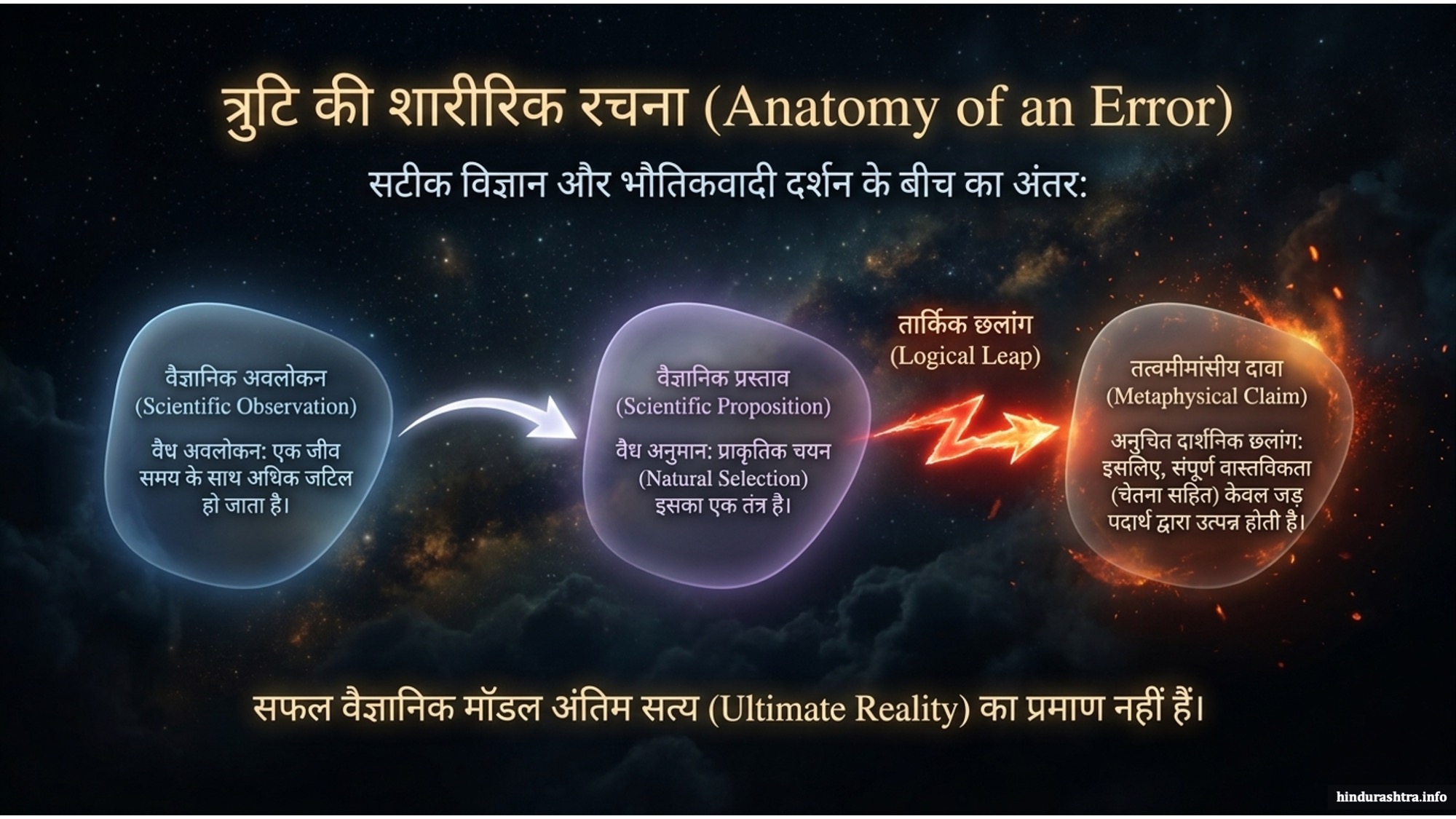
In Vikasvāda [विकासवाद] and the philosophical sections of Mārksavāda aur Rāmrājya, Karpatri Ji examined the logical mechanics of evolutionary materialism. He emphasized a critical distinction that modern commentators often obscure: empirical evolutionary biology as an observational science observing localized biological adaptations (micro-variations) operates legitimately within Pratyakṣa and bounded Anumāna. However, philosophical materialism commits an ungrounded logical leap when it uses localized biological variations to assert an exhaustive materialist cosmology; claiming that the entire universe and human consciousness developed through self-generating, unguided material processes (vikāsavāda).
Karpatri Ji demonstrated that extrapolating micro-level biological variations into a universal ontological claim of self-creating material evolution constitutes an ungrounded inference (utprekṣā) lacking universal concomitance (vyāpti). By rejecting the authoritative guidance of Śabda Pramāṇa, which reveals the purposeful, intelligent, and moral architecture of cosmic creation (sṛṣṭi [सृष्टि]); materialist philosophy traps itself in an unproven metaphysical dogma that reduces consciousness to a random byproduct of physical matter.
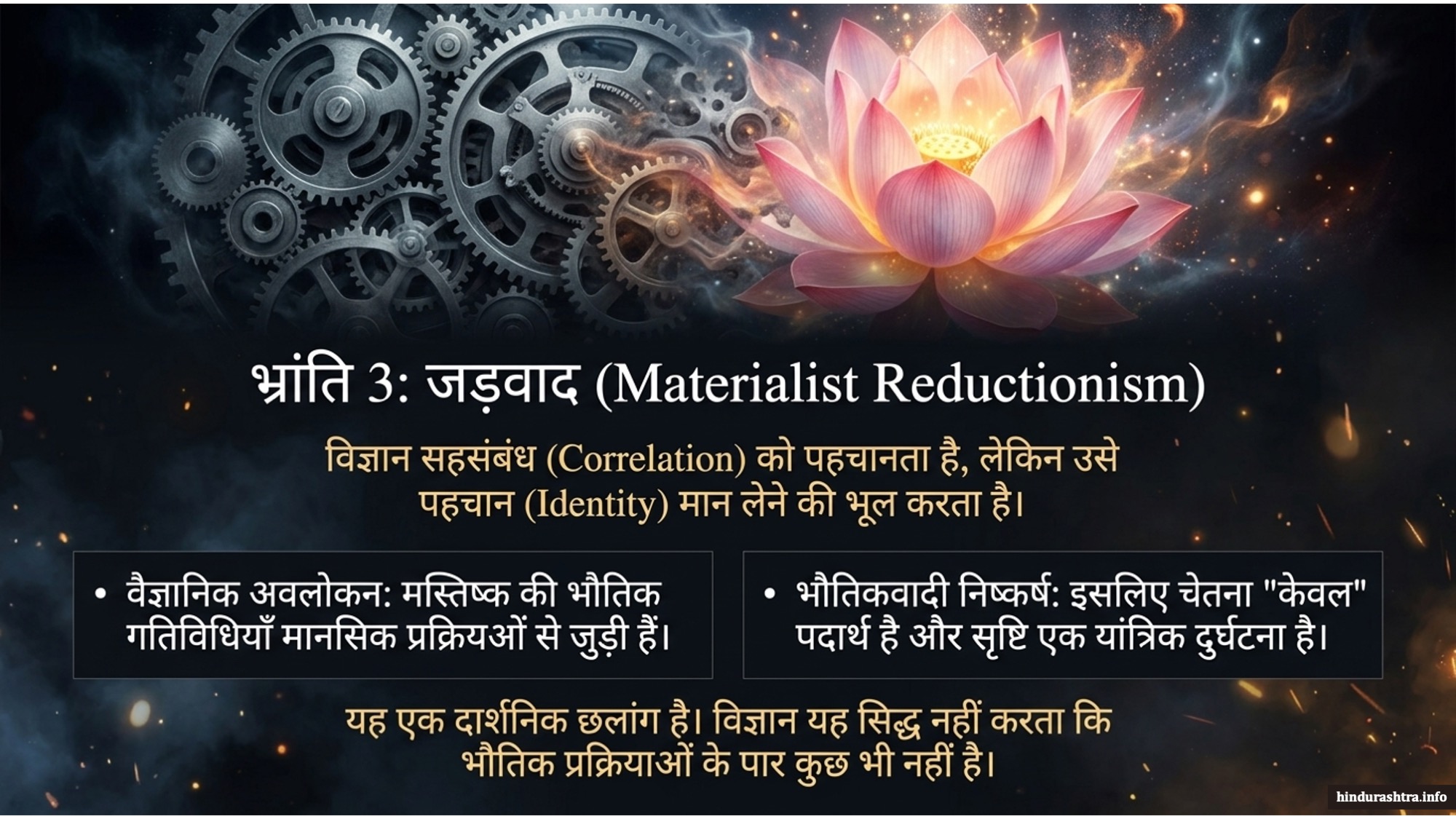
Translating these traditional critiques into formal comparative logic highlights specific inferential fallacies that arise when empirical methodology is overextended into materialist philosophy.
- Taxonomy of Logical Fallacies and Misuses of Anumāna in Scientism
To evaluate the philosophical overreach of materialist scientism through formal comparative logic, its core methodological errors can be organized into a five-part taxonomy of inferential fallacies. It is epistemologically vital to note that this taxonomy represents an analytical reconstructive framework; a comparative heuristic synthesis designed to categorize instances where empirical reasoning is overextended, rather than an enumerated list drawn verbatim from Karpatri Ji’s original Sanskrit and Hindi texts.
The Five Core Inferential Errors
- Treating Correlation as Proof of Identity
- Analytical Evaluation: Modern neurobiology observes that specific physical brain states systematically correlate with subjective conscious experiences. Scientism commits a fallacious leap by asserting that because consciousness is functionally correlated with neurochemical activity, subjective consciousness is identical to and fully explained by physical matter. While the empirical data proves correlation, the claim of ultimate causal identity requires an unproven metaphysical assumption.

- Generalizing Beyond Empirical Data
- Analytical Evaluation: Physical science successfully formulates laws governing observable material systems. The fallacy of over-generalization occurs when materialist ideology extrapolates these localized empirical successes to declare that the entire cosmos, in all its visible, subtle, and transcendent dimensions is exclusively material, dismissing non-material realities without direct observational warrant.
- Reifying Explanatory Models into Ultimate Reality
- Analytical Evaluation: Mathematical formulations and physical models are functional, predictive constructs developed to represent physical behaviors. Scientism commits the fallacy of reification when it treats a provisional predictive model or theoretical entity as the exhaustive ontological reality of existence itself, confusing an abstract interpretive tool with ultimate reality.
- Ignoring Alternative Epistemic Explanations
- Analytical Evaluation: An inferential model may successfully account for a set of physical observations. Scientism fallaciously presumes that because its materialist hypothesis accounts for observed physical data, it represents the only valid explanation, refusing to evaluate alternative non-materialist or Vedāntic frameworks that account for the same data while accommodating subjective awareness.
- Confusing the Limits of Sensory Perception with the Limits of Reality
- Analytical Evaluation: This error asserts that because transcendent entities (Ātman [आत्मा], moral order/dharma, subtle cosmological dimensions) cannot be registered by physical sense organs or empirical instruments, they do not exist. It fallaciously converts an observational limit of the instrument into an ontological negation of the unperceived reality.
Deconstructing Fallacious Reasoning Through the Nyāya Prism
In classical Nyāya logic, these five inferential fallacies represent structural instances of anumānābhāsa [अनुमानाभास]; a fallacious or ungrounded middle term (hetu) that fails to establish its thesis (sādhya).
Classical Anumānābhāsa Exemplar: Observed Sign (Hetu): Dust or mist mistaken for smoke. Flawed Relation (Vyāpti): Assuming mist invariably implies fire. Erroneous Conclusion (Nigamana [निगमन]): Inferring fire on a mountain where no fire exists.
Materialist Scientism Analogue: Observed Sign (Hetu): Neurochemical correlation with conscious states. Flaw: Mistaking functional correlation for causal identity. Erroneous Conclusion (Nigamana): Asserting that consciousness is merely a material byproduct.
Just as mistaking mist for smoke invalidates an inferential conclusion of fire, mistaking functional correlation for ontological identity or converting instrumental limits into ultimate negations creates an unsound inference. In both cases, the middle term (hetu) lacks true, invariable concomitance (vyāpti) with the major term (sādhya), rendering the resulting metaphysical assertion logically unanchored.
Sorting these epistemological distinctions requires establishing a clear typological framework to evaluate scientific and metaphysical claims according to their proper domains.
- Typological Framework for Evaluating Scientific and Metaphysical Claims
To prevent category errors and maintain epistemological clarity, claims regarding reality can be categorized into a three-tiered evaluative framework based on their domain, validation standards, and boundary conditions.
The Three-Tiered Evaluative Framework
Tier 1: Direct Empirical Claims (Observation & Measurement)
- Domain: Directly observable physical mechanisms, measurable properties, and reproducible natural phenomena (e.g., molecular bonds, planetary orbits, cellular structures).
- Validation Standard: Evaluated through direct observation, standardized measurement, controlled experimentation, and empirical reproducibility.
- Epistemic Boundary Rule: General metaphysical or theological objections cannot overturn valid Tier 1 empirical findings that satisfy observational and experimental verification within their material domain.
Tier 2: Inferred Causal Explanations (Scientific Anumāna)
- Domain: Theoretical models inferring unobservable physical mechanisms, subatomic structures, or past historical pathways from observed empirical signs (e.g., quantum state models, macro-evolutionary pathways, astrophysics models).
- Validation Standard: Evaluated through the logical strength of Vyāpti, internal mathematical consistency, predictive accuracy, and the systematic elimination of competing empirical hypotheses.
- Epistemic Boundary Rule: Valid within its empirical domain for functional prediction and theoretical modeling (Vyāvahārika Satya), but cannot be overextended to assert ultimate metaphysical conclusions (Pāramārthika Satya).
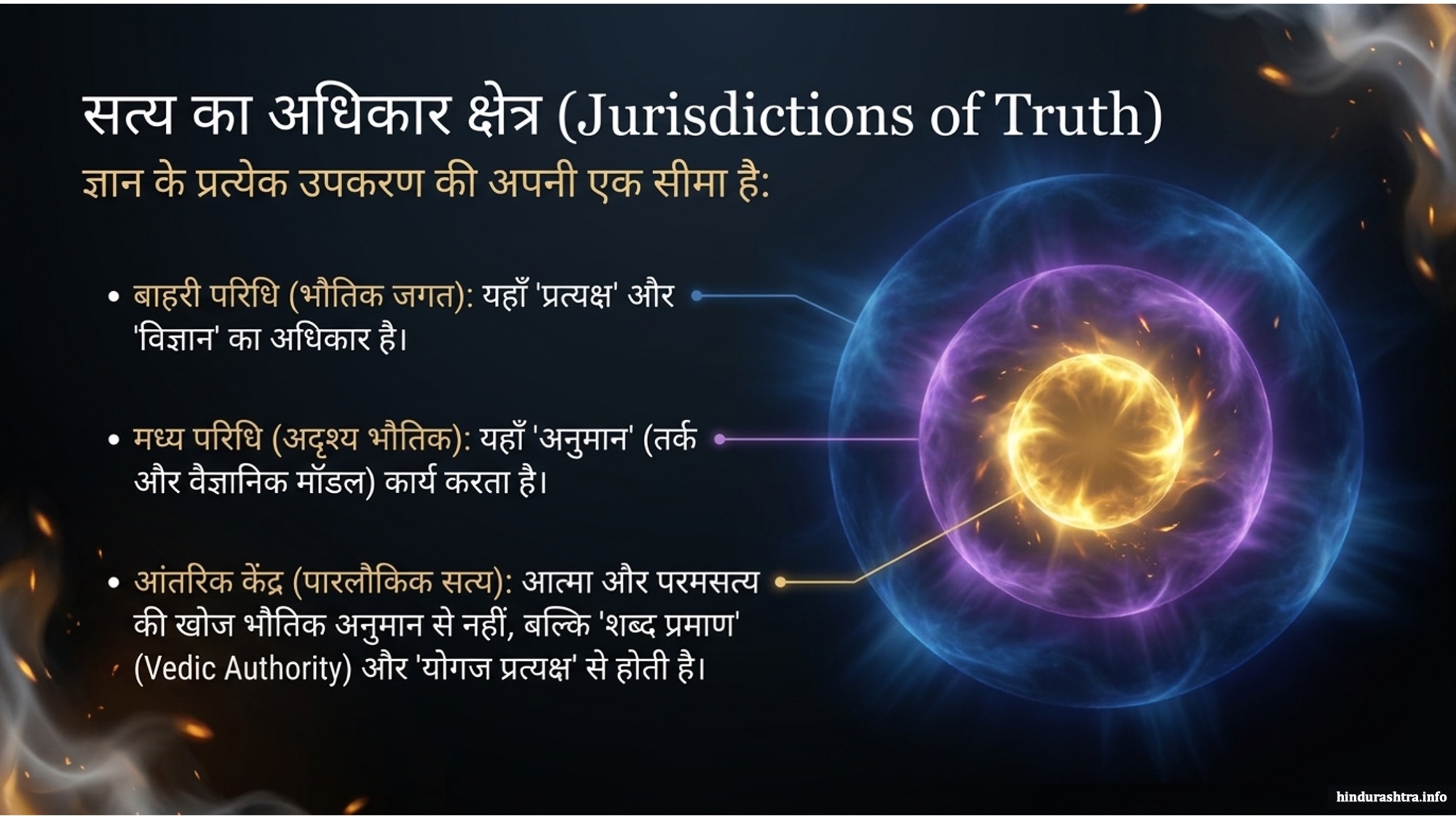
Tier 3: Metaphysical Assertions (Ontological Claims)
- Domain: Claims concerning ultimate existence, the fundamental nature of reality, or the essence of consciousness (e.g., “Physical matter is the sole baseline of reality,” or “Consciousness is the unconditioned foundation of existence”).
- Validation Standard: Evaluated through logical self-consistency, self-reflexive analysis of experience (vicāra [आत्म-विचार या आत्म-चिन्तन]), and revealed scriptural authority (Śabda / Āgama).
- Epistemic Boundary Rule: Empirical science cannot settle or refute Tier 3 metaphysical claims using Tier 1 or Tier 2 methods alone; attempting to do so constitutes a fundamental category error.
The Draṣṭā-Dṛśya [द्रष्टा-दृश्य] Distinction and the Boundaries of Establishing Ātman [आत्मा]
The necessity of this three-tiered framework is demonstrated by the classical Vedāntic distinction between Draṣṭā [द्रष्टा] (the Seer, Subject, or Knower) and Dṛśya [दृश्य] (the Seen, Object, or Known).
Advaita Vedānta demonstrates that every object of cognition (external physical structures, physiological sensations, mental thoughts, and neurochemical states) belongs categorically to the realm of Dṛśya (that which is observed). The true Subject (Draṣṭā) is the self-luminous, continuous awareness to which all physical and mental objects present themselves. Consequently, the knowing Subject (Draṣṭā) can never be reduced to an object of sensory perception (Dṛśya) or registered directly by material instruments.
Because empirical scientific methods are engineered to analyze, measure, and model objects (Dṛśya), empirical Anumānaalone is structurally insufficient to prove or disprove the eternal Subject (Ātman [आत्मा]). Discerning the nature of the Draṣṭā [द्रष्टा] requires self-reflexive Vedāntic inquiry (vicāra [आत्म-चिंतन या आत्म-विचार]) alongside the authoritative illumination of Śabda Pramāṇa [शब्द प्रमाण].
- Epistemic Reconciliation and Authoritative Baseline for Future Scholarship
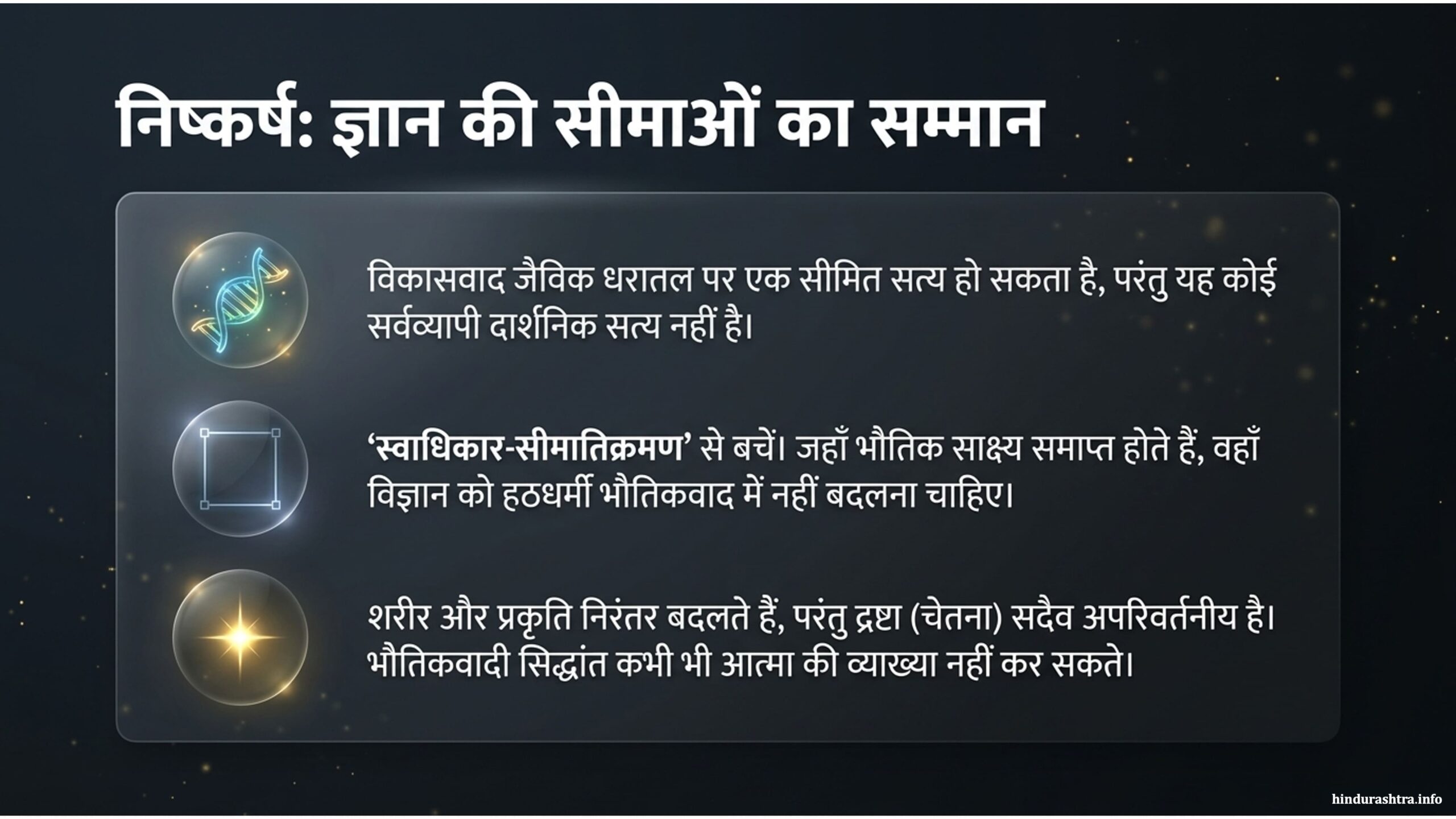
The ultimate purpose of comparative epistemology is not to invalidate empirical science or discount its technological achievements. Rather, it is to restore analytical rigor by ensuring that each pramāṇa [प्रमाण] operates within its valid jurisdiction.
Synthesis of Epistemic Jurisdictions
A rigorous comparative analysis establishes complementary jurisdictions for modern scientific inquiry and classical Pramāṇa Śāstra [प्रमाण शास्त्र]:
- Empirical Science (Vyāvahārika Satya [व्यवहारिक सत्य]): Modern scientific methodology provides authoritative, highly effective knowledge regarding the functional mechanisms, structural laws, and material operations of the physical cosmos. Its findings within Tier 1 and Tier 2 domains remain indispensable for practical, empirical, and technological applications.
- Classical Pramāṇa Śāstra [प्रमाण शास्त्र] & Śabda (Pāramārthika Satya [परमार्थिक सत्य]): Classical epistemology and revealed testimony (Śabda [शब्द]) provide authoritative guidance regarding ultimate ontological reality, the fundamental nature of consciousness (Ātman [आत्मा]), and transcendent moral order (dharma [धर्म]).
Swami Karpatri Ji’s critique serves as an important epistemological defense against scientism; the uncritical transformation of empirical methodology into an unproven materialist ideology. When empirical science operates within its valid boundary conditions, it yields vital physical insights; when materialist philosophy attempts to dismiss transcendent realities using physical sensory criteria, it commits an unjustifiable overreach.
Core Methodological Directives for Comparative Scholars
Scholars working at the intersection of Indian philosophy, Vedāntic hermeneutics, and the philosophy of science should observe four core directives:
- Maintain Epistemic Boundary Enforcement: Require every scientific and philosophical claim to explicitly define its underlying pramāṇa [प्रमाण], its claim tier (Tier 1, 2, or 3), and its precise domain of operation.
- Audit Inferential Chains for True Vyāpti: Rigorously analyze theoretical inferences to determine whether they rely on observed universal relations (vyāpti [व्याप्ति]) or unanchored speculative assumptions (utprekṣā [उत्प्रेक्षा]).
- Prevent Category Errors in Consciousness Studies: Preserve the Draṣṭā-Dṛśya [द्रष्टा-दृश्य] distinction when evaluating neurological data, recognizing that functional brain correlations (Dṛśya [दृश्य]) do not logically entail the material reduction of the subjective Knower (Draṣṭā [द्रष्टा]).
- Recognize Domain-Specific Authority: Respect empirical observation as authoritative within its physical domain (Vyāvahārika Satya [व्यवहारिक सत्य]), while recognizing Śabda Pramāṇa [शब्द प्रमाण] as authoritative regarding transcendent realities inaccessible to gross physical sense organs and scientific instruments.
True intellectual synthesis is achieved neither by dismissing empirical scientific findings nor by discarding ancient epistemological wisdom, but by upholding the structural boundary conditions of valid knowledge (Pramāṇa [प्रमाण]).