
The Seer Behind the Brain
A Comparative Analysis of Vedantic Draṣṭā–Dṛśya Metaphysics,
and Modern Physicalist Theories of Mind
- Introduction and Ontological Framing: The Core Conflict
The central dispute in contemporary philosophy of mind lies in a profound ontological disagreement: is human consciousness an emergent byproduct of physical matter, or is it the foundational reality in which all physical matter appears? Modern scientific inquiry largely operates under physicalist paradigm assumptions, treating the human being primarily as a complex biological organism whose internal life is generated by neural processes. Conversely, classical Advaita Vedānta (अद्वैत वेदान्त), as articulated by eminent traditional scholars such as Swami Karpatri Ji (स्वामी करपात्रीजी), presents a radical challenge to this materialist framework. Investigating whether consciousness is a late biological evolutionary product or the primary epistemic and ontological reality is not merely an abstract academic exercise. It dictates how we understand the nature of human identity, the validity of scientific observation, and the ultimate structure of reality itself.
1.1 The Fundamental Metaphysical Divide: Materialist Assumptions vs. First-Person Subjectivity
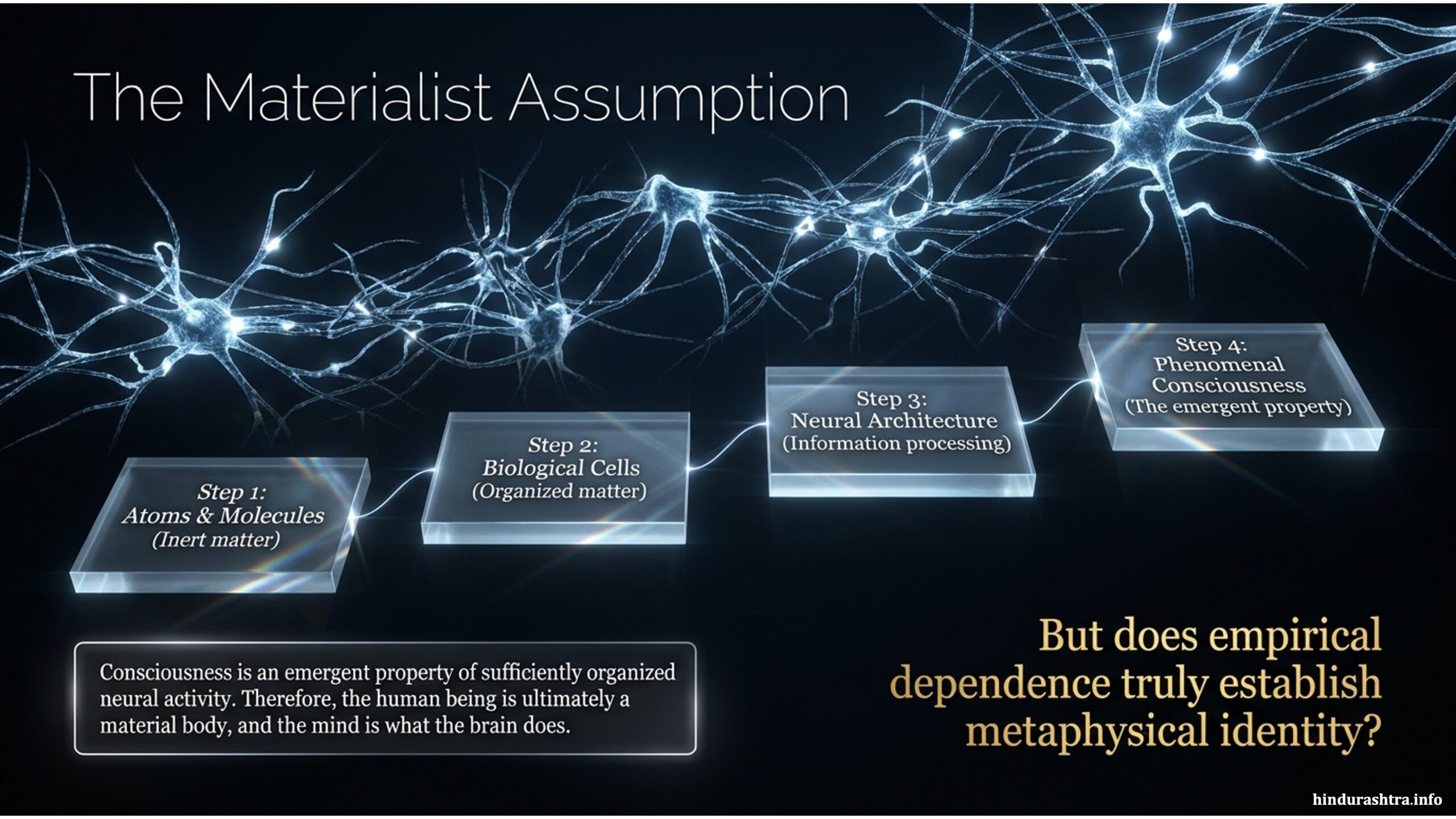
Modern natural science establishes a convincing chain of physical complexity: cells are constructed from molecules, molecules from atoms, and atomic structures organize into the central nervous system. Within this framework, neural architectures process information, culminating in thoughts, memories, emotions, and perceptions. The materialist perspective performs an effortless transition along this chain, inferring that because consciousness varies in tandem with neural manipulation, consciousness itself must be generated by (or identified with) brain activity.
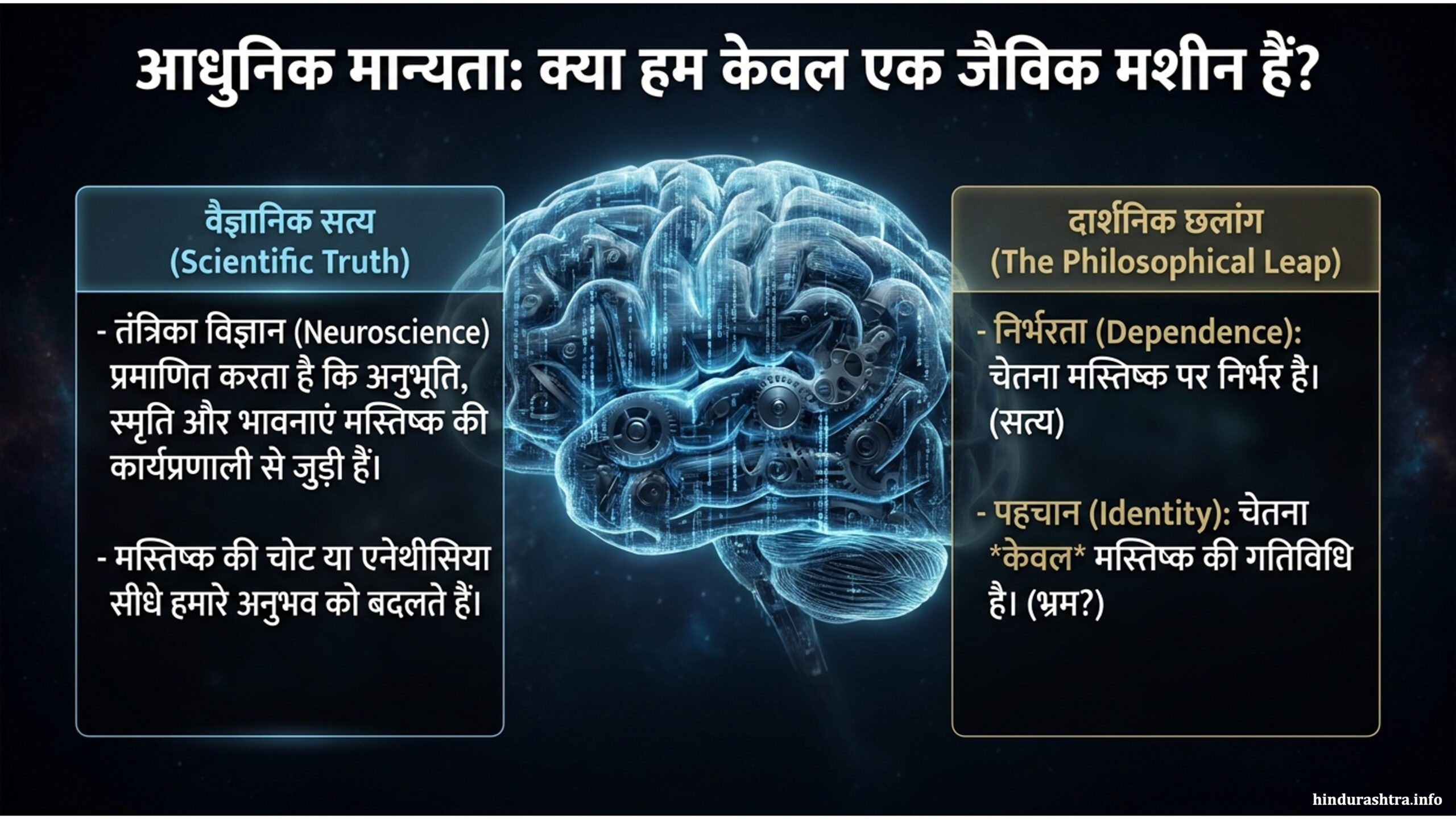
However, a critical philosophical critique reveals that physicalist models substitute correlation for causation. While empirical neuroscience excels at mapping functional correlations between brain states and reportable mental events, identifying empirical dependence is fundamentally distinct from establishing ontological identity. The assertion that neural firings are identical to subjective experience represents a metaphysical leap rather than an empirical discovery. The materialist model attempts to reduce first-person subjectivity (the felt, phenomenal character of awareness) to third-person physical descriptions, thereby confusing the inert, objective realm of jaḍa [जड] with the conscious, non-objective subject that knows it, mistaking the anātmā [अनात्मा] for the ātman [आत्मा].
1.2 Epistemic Grounding: The Vedantic Distinction of Draṣṭā (द्रष्टा) and Dṛśya (दृश्य)
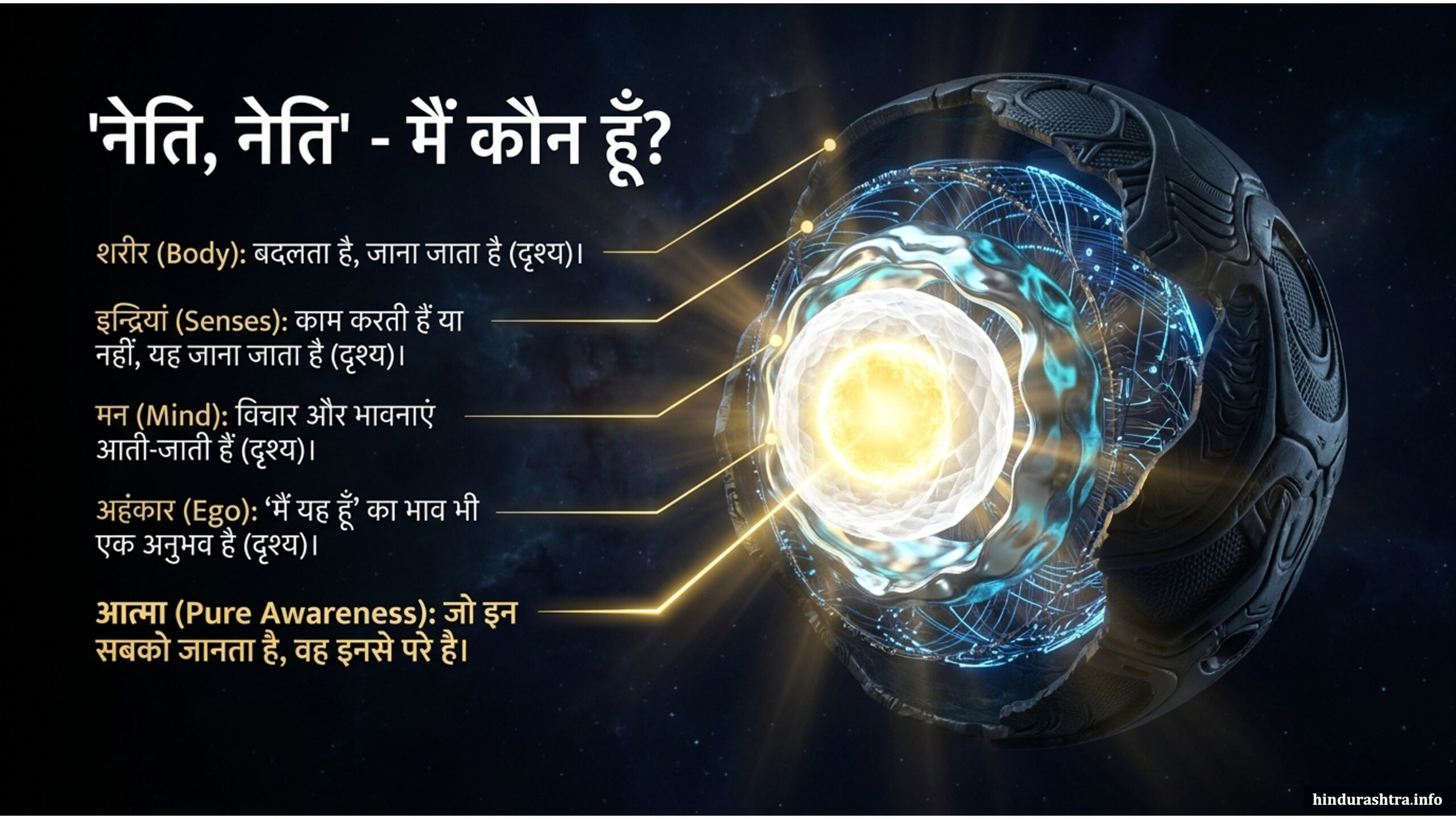
To address this metaphysical confusion, Swami Karpatri Ji frames the central inquiry not around the operational mechanics of the brain, but around the epistemic status of the observer: What is the true status of the knower of the brain, the body, the mind, and the entire field of experience? If the body and brain are entities of which an individual is aware, can the aware subject be identical to those observed physical objects?
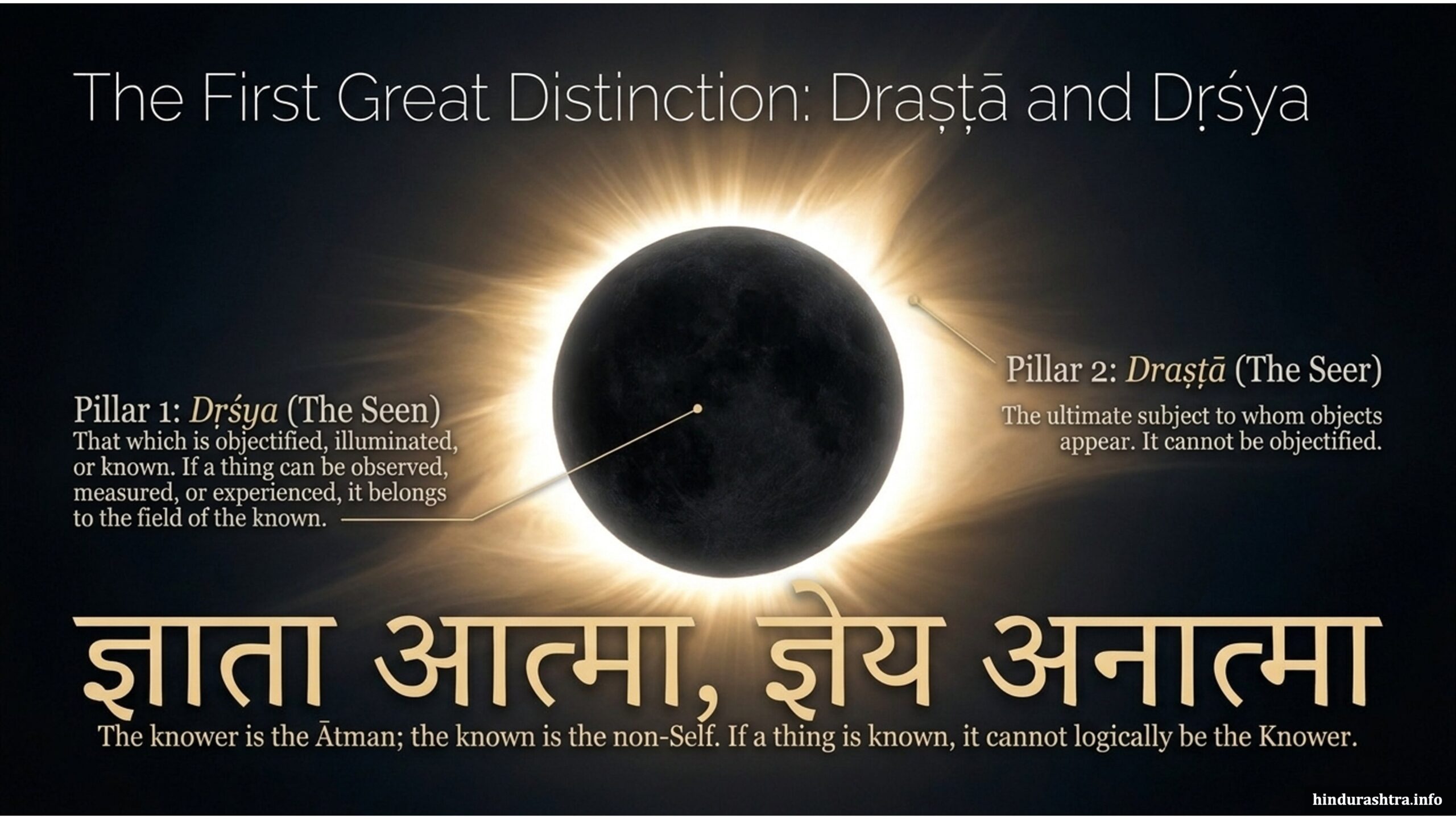
Advaita Vedānta answers through the rigorous epistemological distinction between the draṣṭā [द्रष्टा] (Seer) and the dṛśya[दृश्य] (Seen). The core thesis dictates that the ultimate subject of experience can never be reduced to an object within the field of experience. What is seen is inherently inert, objective, and dependent; the Seer is the unobjectifiable, self-luminous subject. As Karpatri Ji formulates this foundational principle regarding the dependence of the objective world:
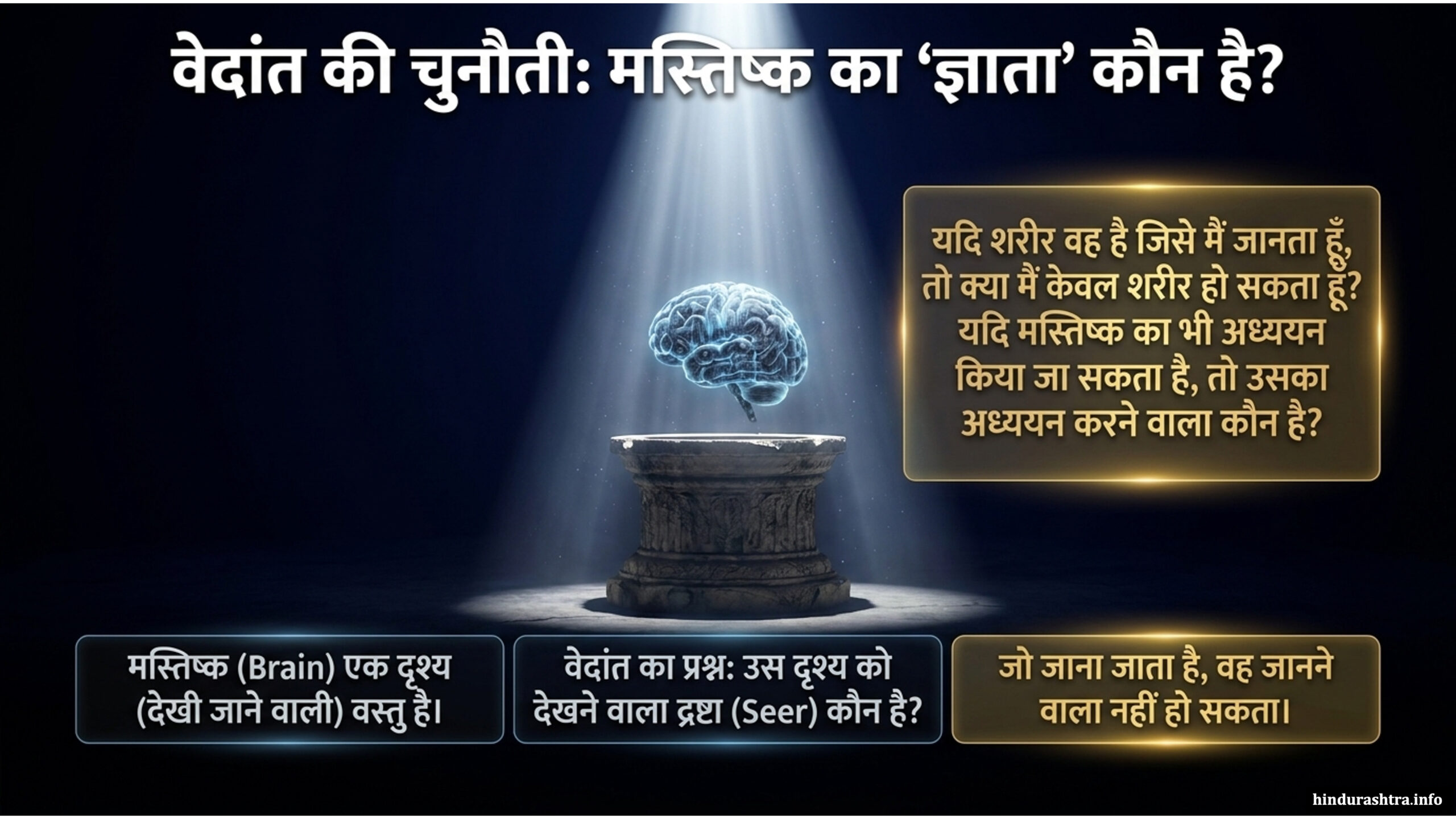
“जो वस्तु स्वतःसत्तास्फूर्तिवाली नहीं है वह जड है, उसे सत्तास्फूर्ति देनेवाला ही चेतन है।” [“That which does not possess existence and manifestation by itself is inert; that which gives it existence and manifestation is conscious.”]
Through this framework, ātman [आत्मा] (the foundational Self) is identified not as a physical entity or psychological ego residing inside the skull, but as the fundamental consciousness in whose presence all objects (including the brain) are known.
1.3 Scope and Methodology of the Comparative Synthesis
This comparative analysis establishes an academically rigorous framework to evaluate classical Vedantic non-dualism alongside modern physicalist models of mind, including functionalism, biological naturalism, and eliminativism. Rather than dismissing scientific empirical discoveries, this inquiry uses comparative epistemology to analyze the logical limits of both paradigms. The methodology relies on structured analytical text and comparative matrices to evaluate identity claims, phenomenological test cases, epistemological circularity, and the hard problem of consciousness. Reliance is placed strictly on structured, native Markdown formatting without non-renderable elements, flowcharts, or code blocks.
By systematically examining the arguments of Vedantic metaphysicians alongside contemporary physicalist theorists, this paper clarifies the logical boundary between empirical neural dependence and metaphysical identity. Having established these foundational ontological paradigms, Section 2 examines the physicalist architecture and its empirical arguments for neural identity in detail.
- The Physicalist Architecture: Empirical Correlations and Identity Claims
To conduct a rigorous comparative debate, physicalist theories of mind must be evaluated in their most robust and sophisticated forms. Rather than relying on simplistic reductions that dismiss mental phenomena, contemporary physicalism presents structured empirical and functional models to explain consciousness within a closed physical universe.
2.1 Neural Correlates of Consciousness (NCC) and Materialist Arguments for Dependence
The materialist framework draws its persuasive power from a substantial body of empirical neuroscientific evidence demonstrating that conscious experience is systematically tied to neural operations:
- Brain Damage and Lesions: Injury to specific cerebral structures alters or eradicates specific dimensions of conscious experience (e.g., damage to the visual cortex impairs visual awareness).
- Pharmacological and Neurochemical Interventions: Administering psychoactive substances or altering neurotransmitter levels drastically alters subjective mood, perception, and thought content.
- Anesthesia: Chemical suppression of neural network activity reliably causes the temporary disappearance of ordinary conscious experience.
- Developmental and Degenerative Trajectories: Cognitive capacities develop in parallel with biological brain maturation and deteriorate alongside neural degeneration.
From these clinical and experimental observations, physicalism establishes that conscious experience is deeply dependent upon brain function. Materialists leverage this dependence to argue via Occam’s razor that positing an unobservable ātman [आत्मा] is unnecessary: if every observable parameter of consciousness changes when the brain changes, the simplest and most parsimonious explanation is that consciousness is generated by, or identical to, neural processing.
2.2 Functionalism, Biological Naturalism, and Eliminativism
Modern physicalism comprises several distinct philosophical frameworks that attempt to accommodate or reduce phenomenal experience. John Searle, advocating biological naturalism, attempts to preserve first-person subjectivity as a real biological phenomenon while remaining committed to physicalism. Yet, even Searle acknowledges the deep explanatory difficulty inherent in physicalist reductions, noting: “Materialists have a problem: once you have described all the material facts in the world, you still seem to have a lot of mental phenomena left over.”
The theoretical landscape of physicalism and its Advaitic critiques can be systematically delineated across three major Western paradigms:
|
Philosophical Position |
Core Thesis on Consciousness |
Vedantic Critique |
|
Biological Naturalism (John Searle) |
Consciousness is a real, higher-level biological phenomenon caused by lower-level neurobiological brain processes, possessing first-person subjectivity. |
Reinterprets neural processes as physical instruments of manifestation; fails to explain how intrinsically unconscious physical processes yield phenomenal awareness without prior consciousness. |
|
Functionalism (Functional Computationalism) |
Mental states are functional and causal roles defined by information processing and input-output relations executed by neural hardware. |
Functions, computational states, and information processing belong strictly to the realm of observed objects (dṛśya [दृश्य]); information processing requires a conscious subject to be experienced. |
|
Eliminativism (Daniel Dennett) |
First-person phenomenal experience is an illusion generated by cognitive mechanisms; subjective qualities (qualia) do not exist in third-person science. |
The assertion of an illusion logically presupposes a conscious subject to whom the illusion appears; the act of denying phenomenal experience is itself a conscious act. |
|
Subjective Physicalism (Thomas Nagel) |
Consciousness is real and physical, possessing an irreducible first-person perspective (“what it is like to be” an organism) non-deducible from physics. |
Correctly identifies the irreducibility of the first-person point of view, but improperly assumes this perspective remains an intrinsic property of a physical biological organism. |
2.3 The Metaphysical Leap: Deconstructing the Transition from Empirical Dependence to Ontological Identity
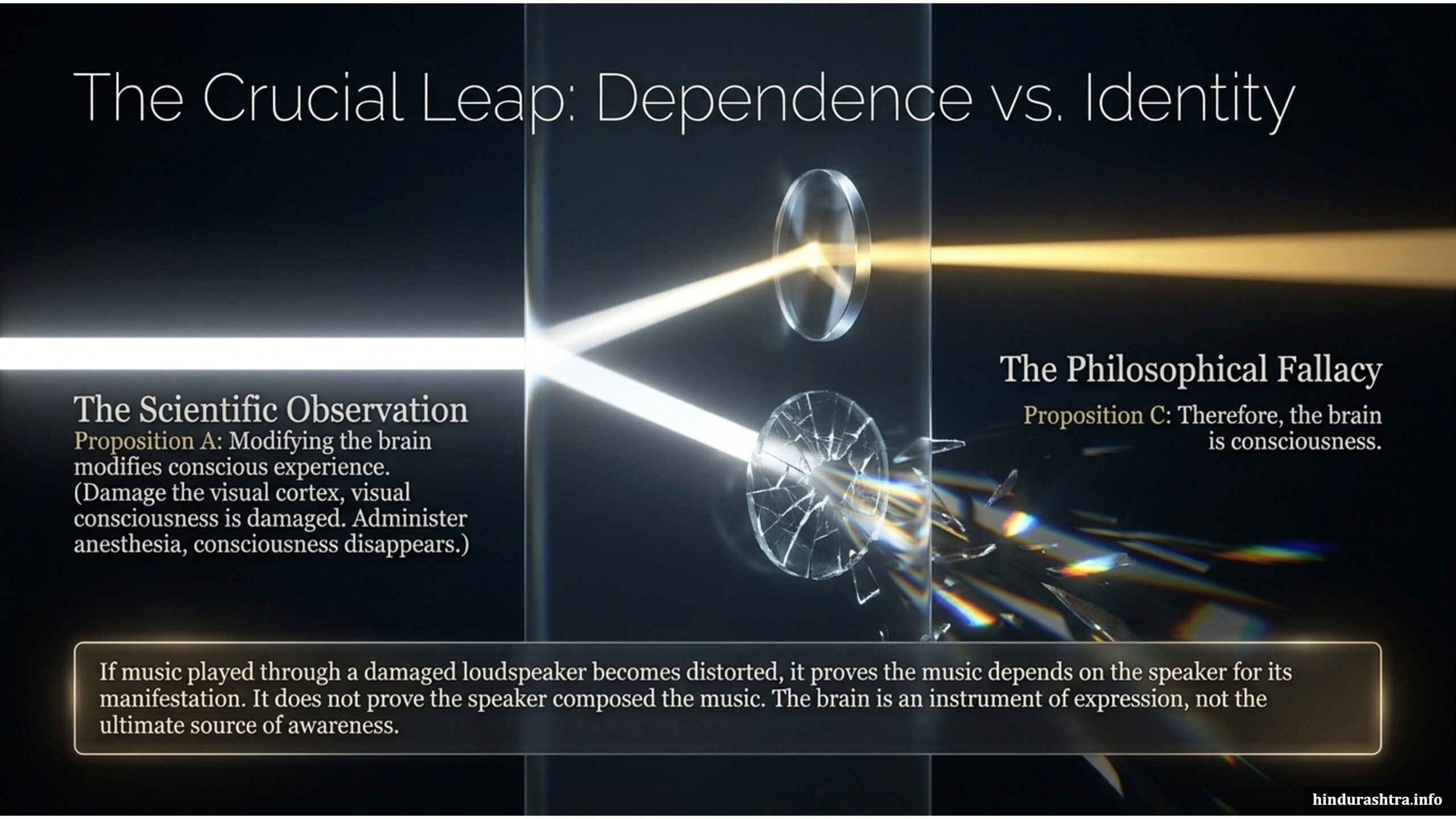
The logical core of the physicalist position rests on a subtle, unproven transition from correlation to identity. The empirical evidence gathered by neuroscience supports two primary premises:
- Proposition A: Whenever neural activity X is present, conscious experience Y is present.
- Proposition B: Whenever neural activity X is absent or disrupted, conscious experience Y is absent or altered.
Physicalism then asserts Proposition C: Neural activity X is identical to conscious experience Y.
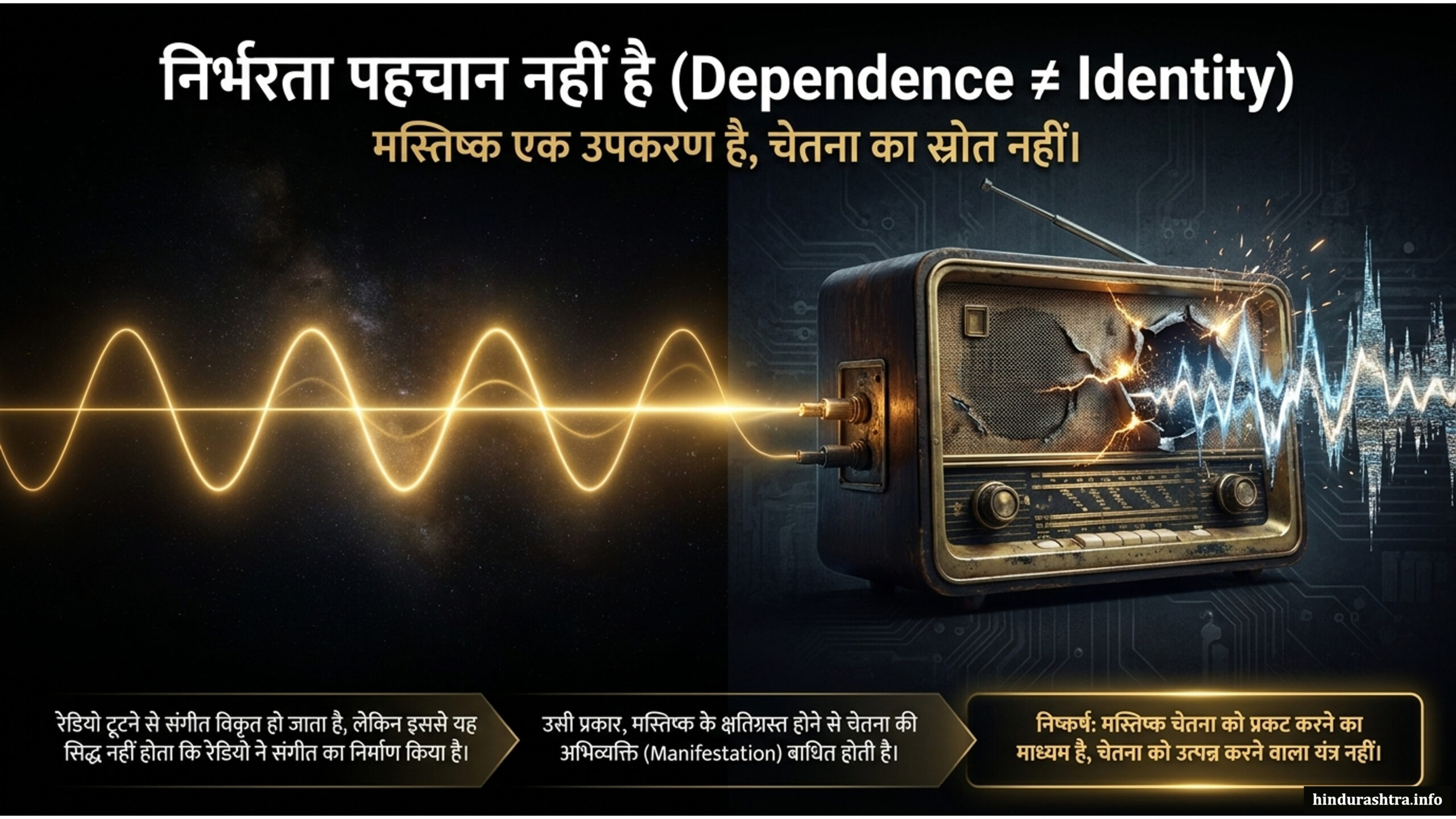
This transition from Propositions A and B to Proposition C represents an invalid deduction. Correlation and operational dependence do not logically constitute metaphysical identity. Demonstrating that altering a physical medium conditions the expression of a phenomenon does not prove that the medium created the phenomenon itself. Thus, physicalist identity claims remain metaphysical inferences drawn from empirical data, rather than direct empirical facts.
Having deconstructed the materialist architecture and its logical leaps, Section 3 introduces the epistemological mechanics of the draṣṭā–dṛśya [द्रष्टा-दृश्य] methodology formulated by Advaita Vedānta to refute physicalist identity claims.
- The Epistemological Mechanics of Draṣṭā–Dṛśya (द्रष्टा–दृश्य)
Advaita Vedānta responds to physicalist identity claims by introducing an epistemological framework that rigorously separates the physical instrument of perception from the illuminating consciousness behind it.
3.1 The Iron Ball Analogy: Mind as an Instrument of Manifestation
Swami Karpatri Ji addresses neural dependence by distinguishing between pure consciousness and the material medium through which it manifests during embodied existence. To illustrate this, he utilizes the classical analogy of a heated iron ball [lohapiṇḍa (लोहपिण्ड)] and fire [vahni (वह्नि)]:
“जैसे लोहपिण्डमें स्वतः दाहकत्व न होनेपर भी वह्निके साथ तादात्म्यसम्बन्ध होनेसे लोहपिण्डमें दाहकत्व होता है, उसी तरह भौतिक अन्तःकरण यद्यपि जड है, उसमें प्रकाशकत्व नहीं है, फिर भी स्वप्रकाश आत्मचैतन्यके तादात्म्याध्यास-सम्बन्धसे उसमें भी चैतन्यका उपलम्भ होने लगता है।” [“Just as an iron ball, although not inherently possessed of burning power, becomes endowed with the appearance of burning through its relation with fire, so the material inner organ, although inert and not itself luminous, comes to be apprehended as conscious through its superimpositional relation with the self-luminous consciousness of the Ātman.”]
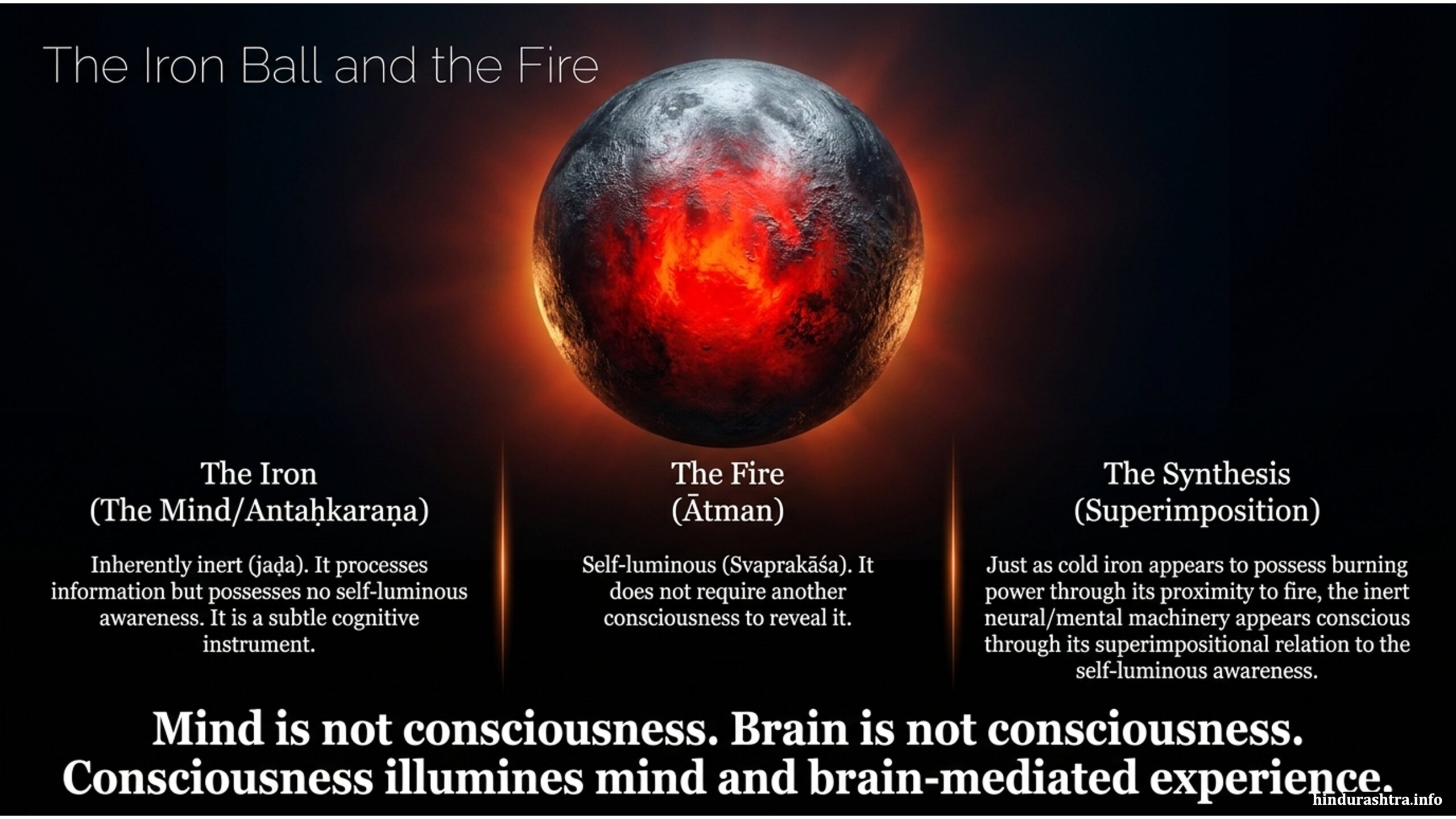
The mind and its neural substrate, termed the antaḥkaraṇa [अन्तःकरण] (inner instrument), are intrinsically jaḍa [जड] (inert/unconscious). However, through tādātmyādhyāsa [तादात्म्याध्यास] (superimpositional identification), the self-luminous Ātman-consciousness [swaprakāśa ātmachaitanya (स्वप्रकाश आत्मचैतन्य)] illumines the antaḥkaraṇa [अन्तःकरण]. As Karpatri Ji clarifies:
“स्वप्रकाश अखण्डबोध आत्मा ही मुख्य-ज्ञान है, उसीके प्रकाशसे मन अन्तःकरण आदिमें भी प्रकाश व्यक्त होता है।” [“The self-luminous, undivided consciousness of the Ātman alone is primary knowledge; by its illumination, consciousness becomes manifest in the mind and inner instrument.”]
Brain activity is not rendered irrelevant; rather, it is reinterpreted as the operational conditioning instrument of embodied cognition, not the ontological generator of awareness.
3.2 The Subject-Object Asymmetry: Why the Observed Mind Cannot Be the Observer
The Vedantic draṣṭā–dṛśya [द्रष्टा-दृश्य] method applies an exhaustive analysis to human experience. Every perceptual and cognitive event follows a strict hierarchy of illumination:
- An external object (such as a tree) is observed à It is dṛśya [दृश्य] (the seen).
- The visual sensory impression of the tree is observed à It is dṛśya.
- A thought evaluating the tree arises à It is observed, hence dṛśya.
- An emotional reaction or decision regarding the tree occurs à It is observed, hence dṛśya.
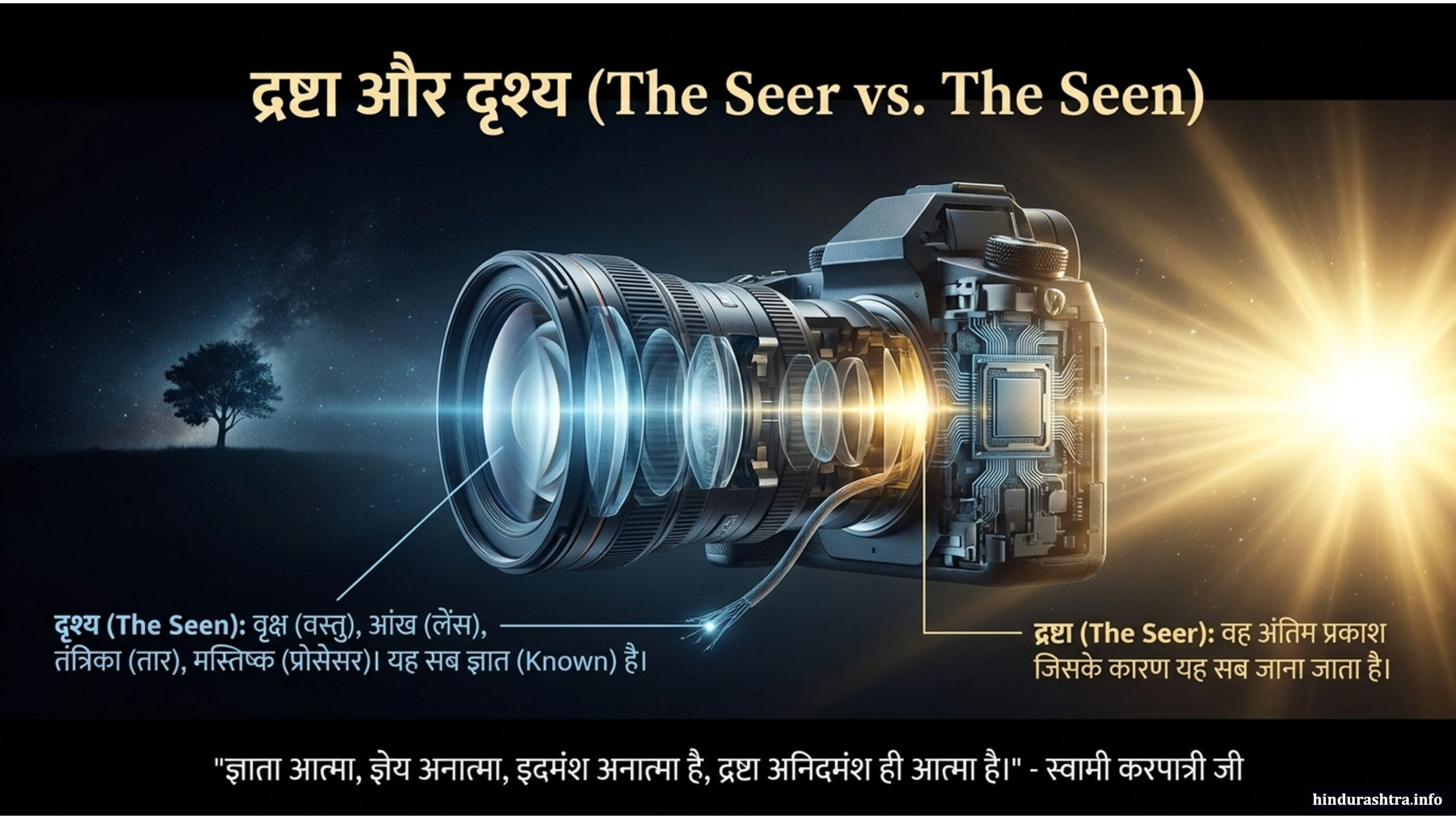
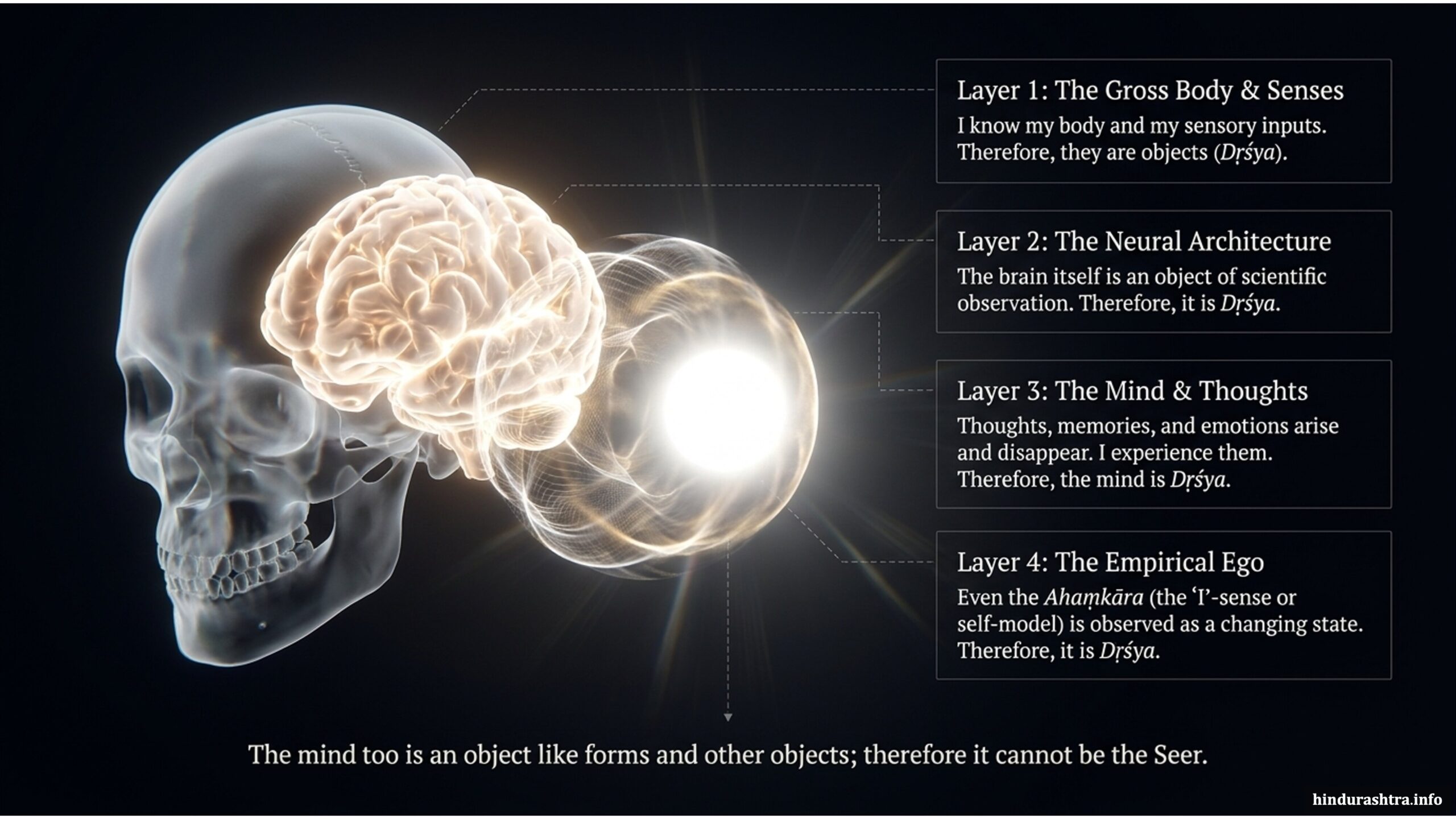
Every mental state (thoughts, feelings, sensory modifications, memories, and attention shifts) is an object of experience. They belong strictly to the realm of the ‘this’-aspect [idam-aṃśa (इदमंश)], representing objective phenomena. Because the mind itself is continuously observed and known, it cannot simultaneously be the ultimate, unobjectifiable observer [anidam-aṃśa (अनिदमंश)]. Swami Karpatri Ji formulates this core epistemic asymmetry precisely:
“ज्ञाता आत्मा, ज्ञेय अनात्मा, इदमंश अनात्मा है, द्रष्टा अनिदमंश ही आत्मा है।” [“The knower is the Ātman; the known is the non-Self. The ‘this’-aspect is non-Self; the Seer, which is not an objectified ‘this’, is the Ātman.”]
He reinforces this by explicitly ruling out the mind as the primary subject:
“मन भी रूपादिके तुल्य विषय ही है, फिर वह द्रष्टा नहीं हो सकता।” [“The mind too is an object like forms and other objects; therefore it cannot be the Seer.”]
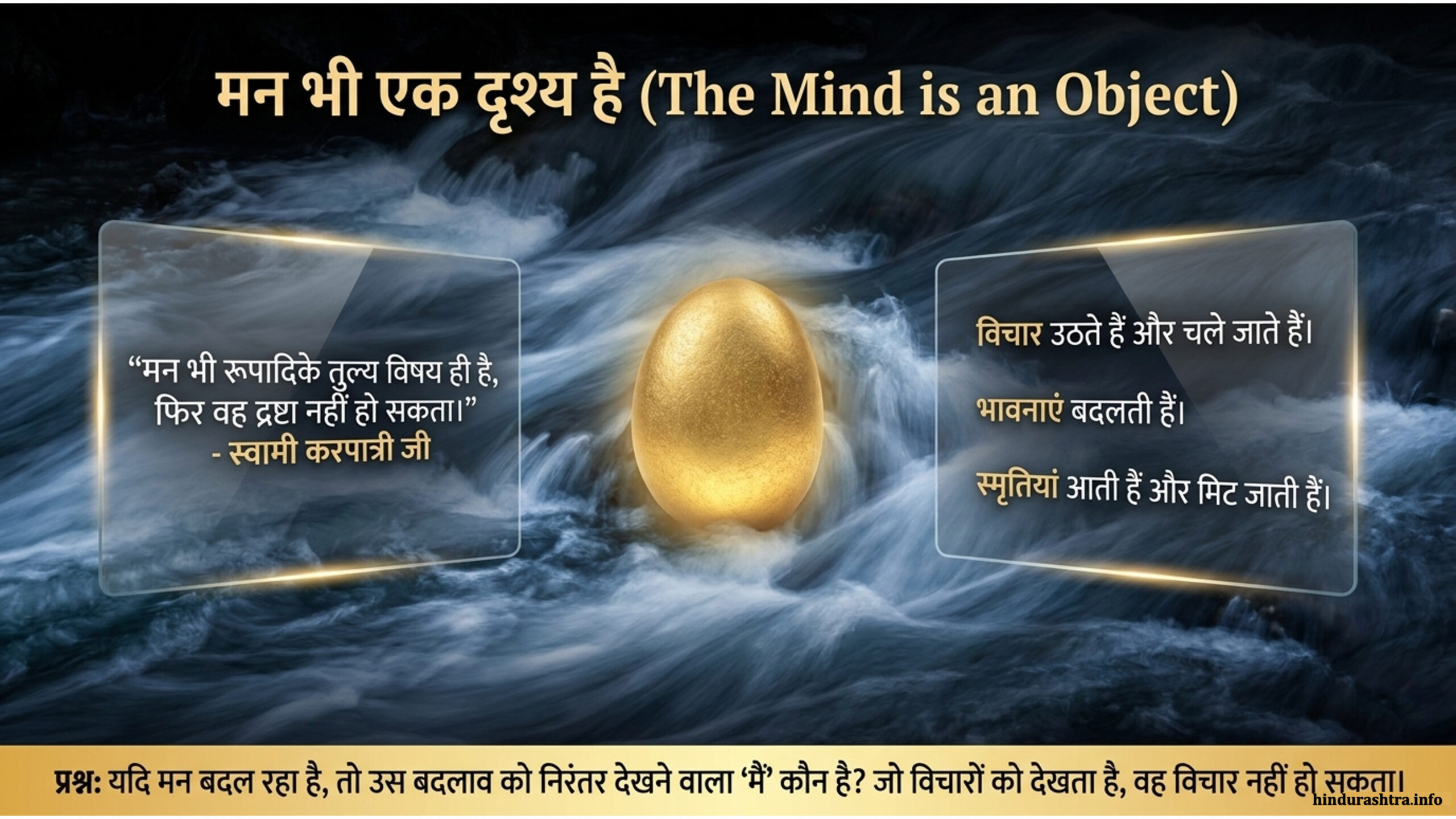
The experiential chain of observation demonstrates an unassailable epistemic break: external objects, sensory impressions, cognitive thoughts, and egoic self-models are all sequential links in the objective realm of dṛśya [दृश्य] (idam-aṃśa [इदमंश]). The ultimate subject, the draṣṭā [द्रष्टा] (anidam-aṃśa [अनिदमंश]), remains strictly asymmetric to all observed phenomena as their unbroken illuminator.
3.3 Deconstructing Metacognition: Representation vs. Pure Phenomenal Awareness
Modern cognitive science attempts to bypass the need for an unobjectifiable subject by positing higher-order representation and metacognition; the brain’s capacity to monitor and represent its own internal states.
Vedānta deconstructs this claim by establishing a fundamental distinction between vṛtti-jñāna [वृत्ति-ज्ञान] (cognitive representation or mental modification) and svarūpa-jñāna [स्वरूप-ज्ञान] (essential, self-luminous awareness). If brain state A represents brain state B, one must ask: Is the representation (state A) itself known? If it is known, it immediately falls into the category of dṛśya (vṛtti-jñāna [वृत्ति-ज्ञान]). Positing a third brain state C to represent state A merely extends the objective chain, threatening an infinite regress of objective representations. Higher-order cognitive monitoring simply expands the contents of the ‘seen’; it never arrives at the primary, unrepresented draṣṭā (svarūpa-jñāna [स्वरूप-ज्ञान]) in whose presence all representations are registered.
To test these theoretical distinctions against empirical reality, Section 4 examines the phenomenological test cases analyzed within Advaita Vedānta.
- Phenomenological and Empirical Test Cases in Vedantic Critique
Advaita Vedānta does not rely solely on abstract deduction; it utilizes ordinary phenomenological states like memory across time, physical death, dream imagery, cross-modal sensory integration, and deep sleep to empirically critique materialist reductions of consciousness.
4.1 Memory, Continuity, and the Rememberer: Refuting Momentary Cognition
Materialist models attribute psychological identity over time to continuous neural storage mechanisms. Swami Karpatri Ji counters this by examining the subject of memory, establishing the necessary rule of identity between the original experiencer and the subsequent rememberer (smartā aur draṣṭā ke ekatva kā niyama / स्मर्ता और द्रष्टाके भी एकत्वका नियम).
Karpatri Ji explicitly refutes theories of momentary cognition [kṣaṇika-jñāna (क्षणिक ज्ञान)], wherein consciousness is reduced to a series of discrete, fleeting computational states:
“अनुभविता भी यदि क्षणिक ज्ञान ही है तब स्मृति भी कैसे सम्पन्न होगी? अन्य अनुभूतका अन्य स्मरण कर नहीं सकता।” [“If the experiencer were merely momentary cognition, how could memory occur? One person cannot remember what another experienced.”]
Memory storage mechanisms in the brain account for the preservation of information traces, but they cannot account for the implicit first-person recognition: “I am the same entity who experienced that event in the past.” The continuity of personal experience requires an unchanging witnessing subject that spans across distinct moments of time.
To further separate biological physiology from the conscious observer, Karpatri Ji advances the empirical “Dead Body Argument” (mṛta deha [मृत देह]):
“मृत देहमें किसी प्रकारकी विकलता दृष्टिगोचर न होनेपर भी दर्शनादि क्रियाएँ नही होती। अतः मानना पड़ेगा कि जिसके न रहनेपर देहमें दर्शन आदि क्रियाएँ नही हो सकतीं, जिसके रहनेपर दर्शन आदि क्रियाएँ होती हैं, वही द्रष्टा है, देह नहीं।” [“Even though no particular defect may be visibly apparent in a dead body, acts such as seeing no longer occur. Therefore it must be accepted that that whose absence makes seeing and similar activities impossible in the body, and whose presence makes them possible, is the Seer; the body is not the Seer.”]
While a materialist attributes this to the breakdown of metabolic and neural functioning, the argument isolates the foundational principle: physiological intactness alone does not constitute awareness; the presence of the draṣṭā is required for embodied experience to occur.
4.2 The Dream State (Svapna / स्वप्न) and Sensory Transmutation
The phenomenological examination of dream states [svapna (स्वप्न)] serves to isolate the conscious subject from physical sense organs [indriya (इन्द्रिय)]. Karpatri Ji highlights the case of individuals who become blind in waking life yet continue to experience vivid visual imagery in dreams:
“जब कभी किसी प्राणीके नेत्र नष्ट हो जाते हैं तो वह अन्धावस्थामें भी पूर्वदृष्ट पदार्थोंको स्वप्नमें देखता है। स्पष्ट है कि स्वप्नके पदार्थोंका द्रष्टा देह नहीं है, क्योकि देहमें नेत्र हैं ही नहीं।” [“When the eyes of a person are destroyed, that person can nevertheless see previously seen objects in dreams even while blind. Clearly, therefore, the Seer of dream objects is not the body, because the body’s eyes are no longer functioning.”]
While neuroscientists correctly attribute dream images to internally generated neural firings, Vedānta asks the deeper question: Who is the observer of that internally generated imagery?
Furthermore, Vedānta points to cross-modal sensory integration. A person observes an object and subsequently touches it, formulating the judgment: “I am touching the very object that I saw.” Because the eye cannot touch and the skin cannot see, the integrating agent cannot be reduced to individual sense organs. The sense organs [indriya (इन्द्रिय)] are mere operational instruments utilized by a unified, underlying conscious subject.
4.3 The Three States of Consciousness (Avasthātraya / अवस्थात्रय)
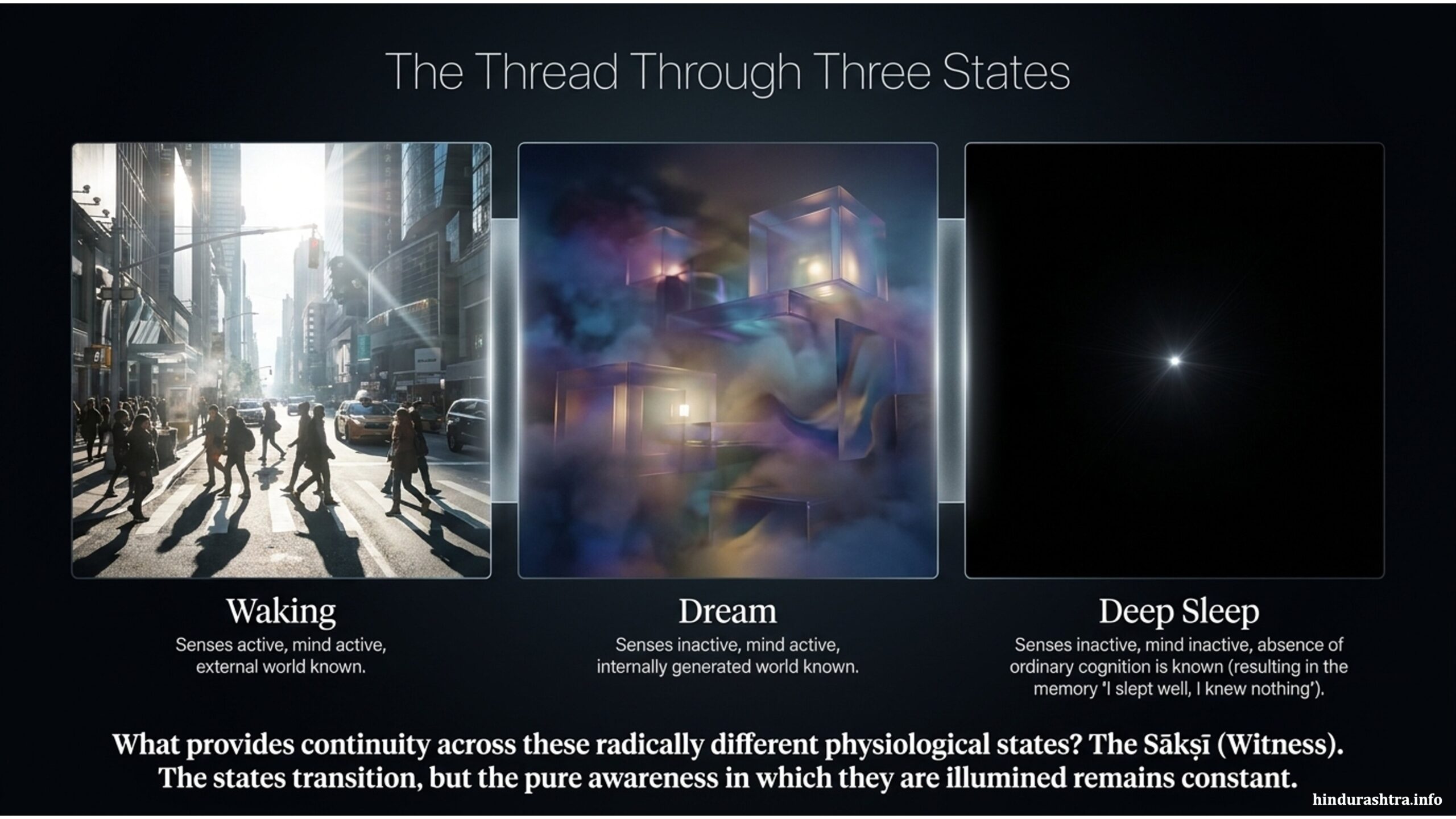
The Vedantic analysis of the three states of experience: waking [jāgrat (जाग्रत्)], dreaming [svapna (स्वप्न)], and deep sleep [suṣupti (सुषुप्ति)] provides a crucial empirical test case. Physicalism views deep sleep simply as a temporary physiological brain shutdown characterized by the absence of consciousness.
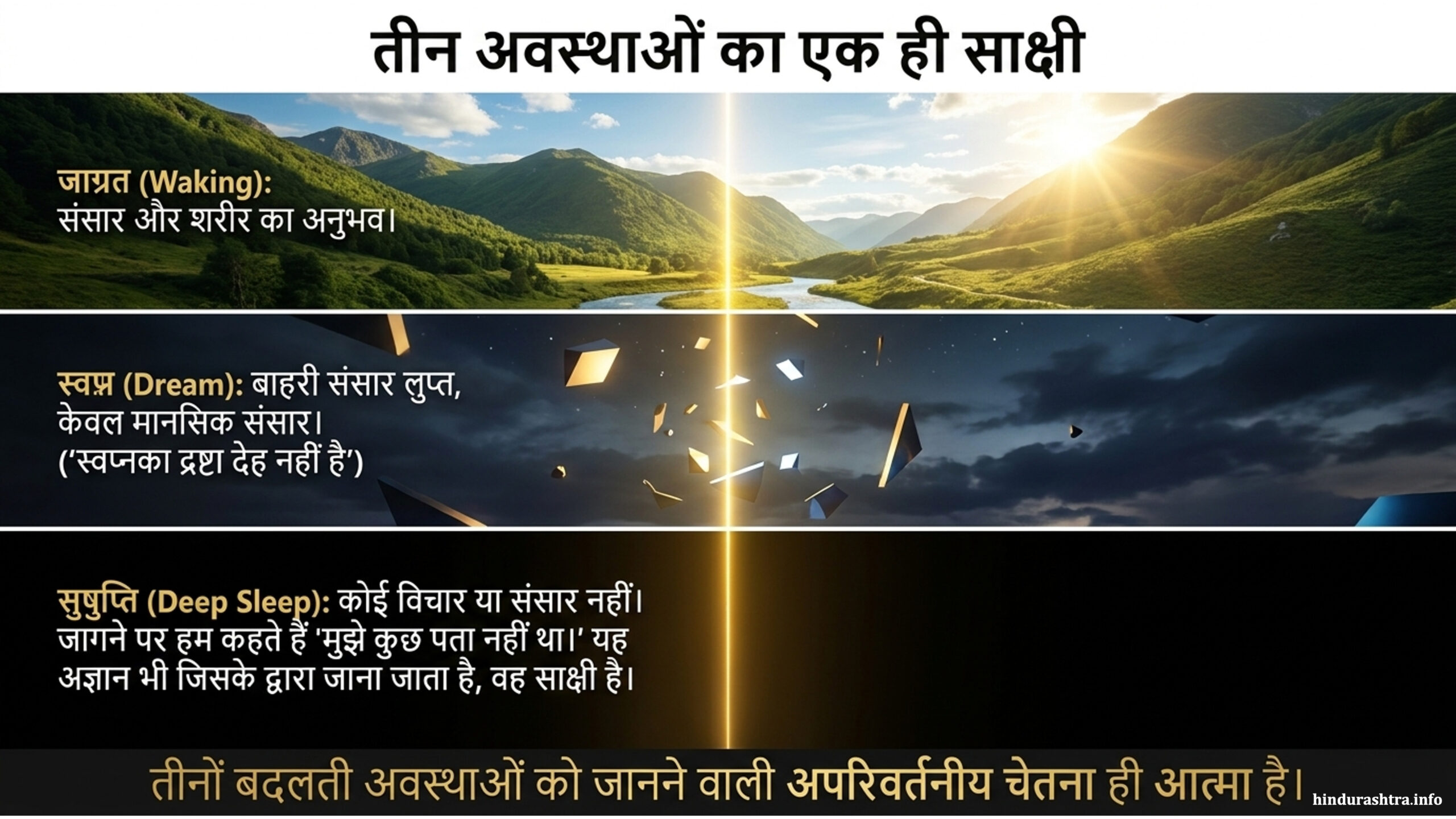
Advaita Vedānta reinterprets deep sleep as the witnessed absence of mental objects. Upon waking, an individual reports:“I slept peacefully; I knew nothing.” For such a retrospective judgment to occur, the absence of thought and sensory input during deep sleep must have been illumined by an enduring awareness. Karpatri Ji writes:
“जाग्रत्- स्वप्नके द्रष्टा, दर्शन, दृश्य, सुषुप्तिकी निद्रा या अज्ञान जिससे प्रकाशित होते हैं, वही शुद्ध भानरूप आत्मा है।” [“That by which the Seer, seeing and seen of waking and dream, and the sleep or ignorance of deep sleep are illumined, is the pure awareness that is the Ātman.”]
Consciousness is not turned off during deep sleep; rather, mind-mediated contents cease to appear. The pure awareness [śuddha bhānarūpa ātmā (शुद्ध भानरूप आत्मा)] remains as the continuous illuminator of both presence and absence across all three states.
Having demonstrated how ordinary phenomenology refutes materialist reductions, Section 5 explores the concept of self-luminosity (svaprakāśa [स्वप्रकाश]) and its resolution of David Chalmers’ Hard Problem.
- Svaprakāśa (स्वप्रकाश) and the Hard Problem of Consciousness
By reframing consciousness as the underlying illuminator of all states, Vedānta reverses the explanatory vector found in Western philosophy of mind.
5.1 Self-Luminosity (Svaprakāśa / स्वप्रकाश) as Primary Knowledge
In standard physicalist models, consciousness is treated as an enigmatic phenomenon that requires explanation through lower-level non-conscious physical processes. Advaita Vedānta asserts that consciousness is svaprakāśa [स्वप्रकाश] (self-luminous).
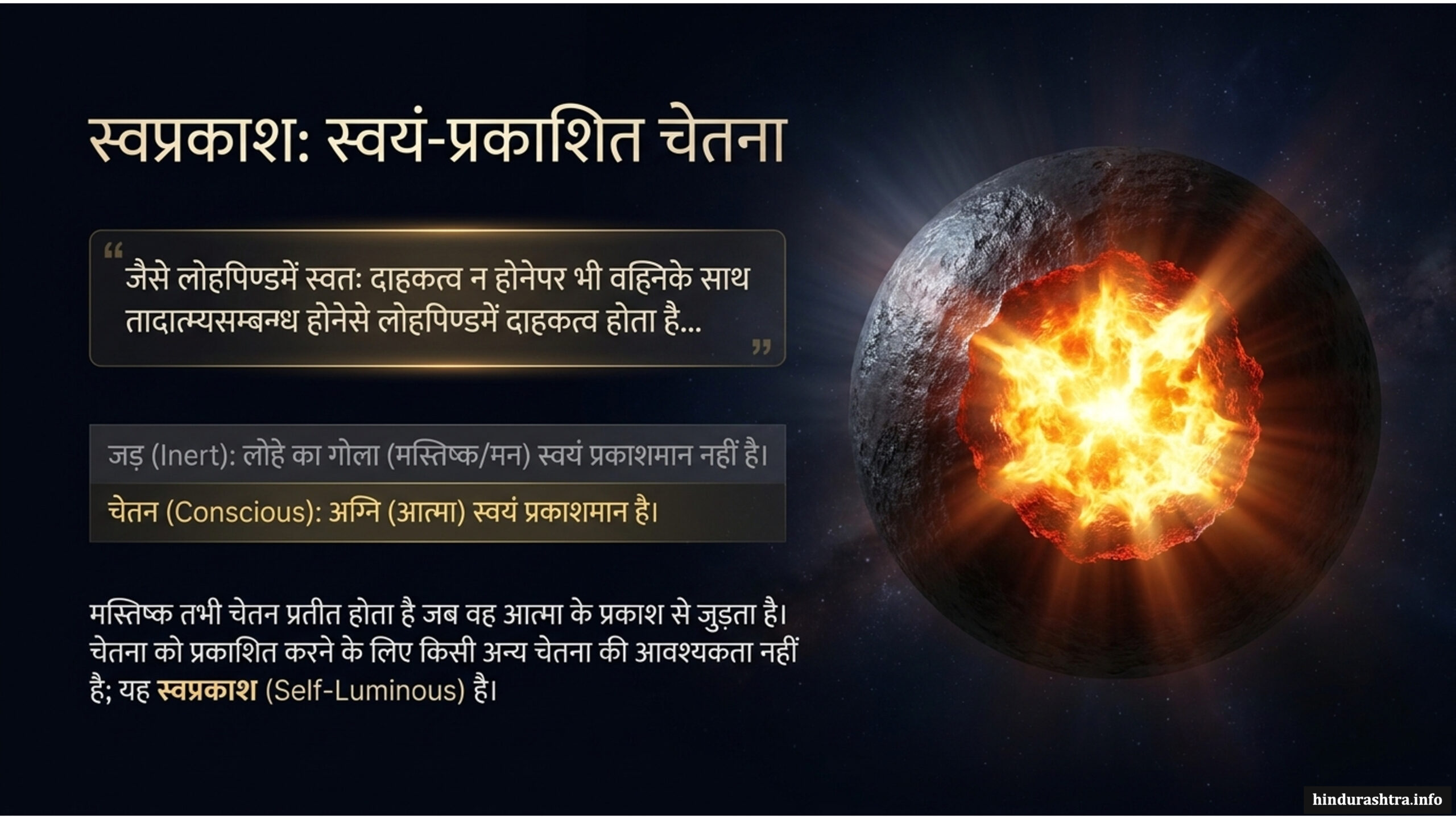
Inert physical objects (jaḍa) require an external agent to be illumined and known: a pot requires light to be seen, a brain state requires neuroimaging and conscious observation to be recorded. However, consciousness does not require another consciousness to reveal it. If awareness required a secondary awareness to render it conscious, philosophy would collapse into infinite regress [anavasthā (अनवस्था)]. Karpatri Ji defines self-luminosity as primary knowledge (mukhya-jñāna [मुख्य-ज्ञान]):
“नित्य ज्ञानस्वरूप आत्मा तो चित् नित्य स्वप्रकाश ही है। उसके विकासका प्रश्न ही नहीं उठता।” [“The Ātman, whose nature is eternal knowledge, is consciousness and eternally self-luminous; therefore the question of its development does not arise.”]
5.2 David Chalmers’ Hard Problem and the Failure of Strong Emergence
This self-luminous framework directly intersects with modern debates surrounding David Chalmers’ distinction between the “easy problems” and the “hard problem” of consciousness:
- Easy Problems: Explaining cognitive mechanics, such as information processing, behavioral focus, reportability, and sensory discrimination.
- Hard Problem: Explaining why and how physical processing should be accompanied by subjective, phenomenal experience (“what it is like” experience).
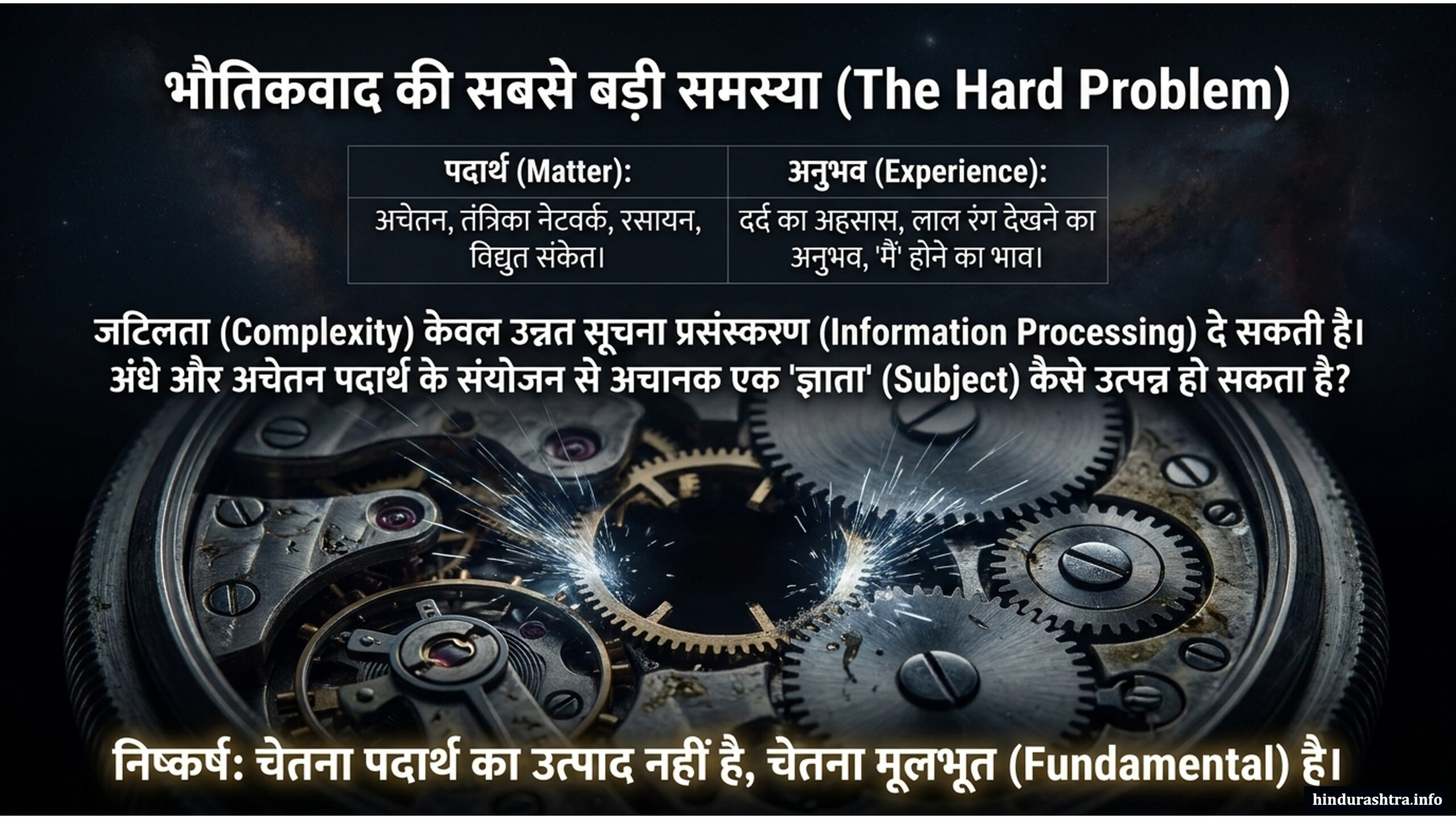
Physicalist claims rely on concepts of “emergence” to bridge this gap. However, Karpatri Ji’s metaphysics critiques both weak and strong emergence by posing a fundamental dilemma: What is the ontological status of consciousness before it emerges? If constituent matter (atoms, molecules, neurons) is intrinsically jaḍa [जड] (unconscious/inert), then asserting that complex arrangements of unconscious components suddenly produce subjective phenomenal experience either sneaks consciousness into the premises or relies on a magical category jump. Merely invoking the term “emergence” names the phenomenal gap rather than solving it.
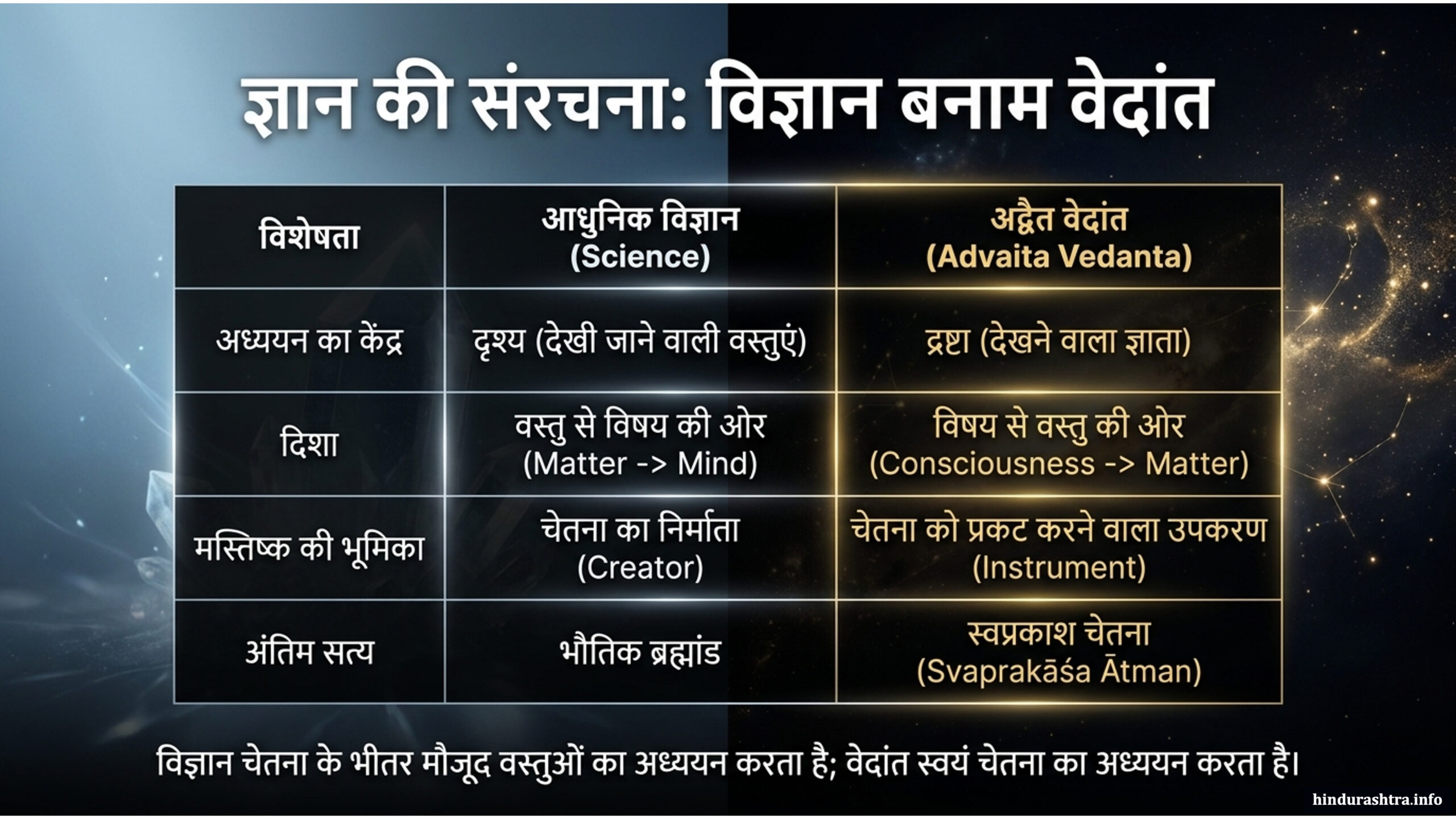
This fundamental disagreement can be summarized as an inversion of explanatory vectors:
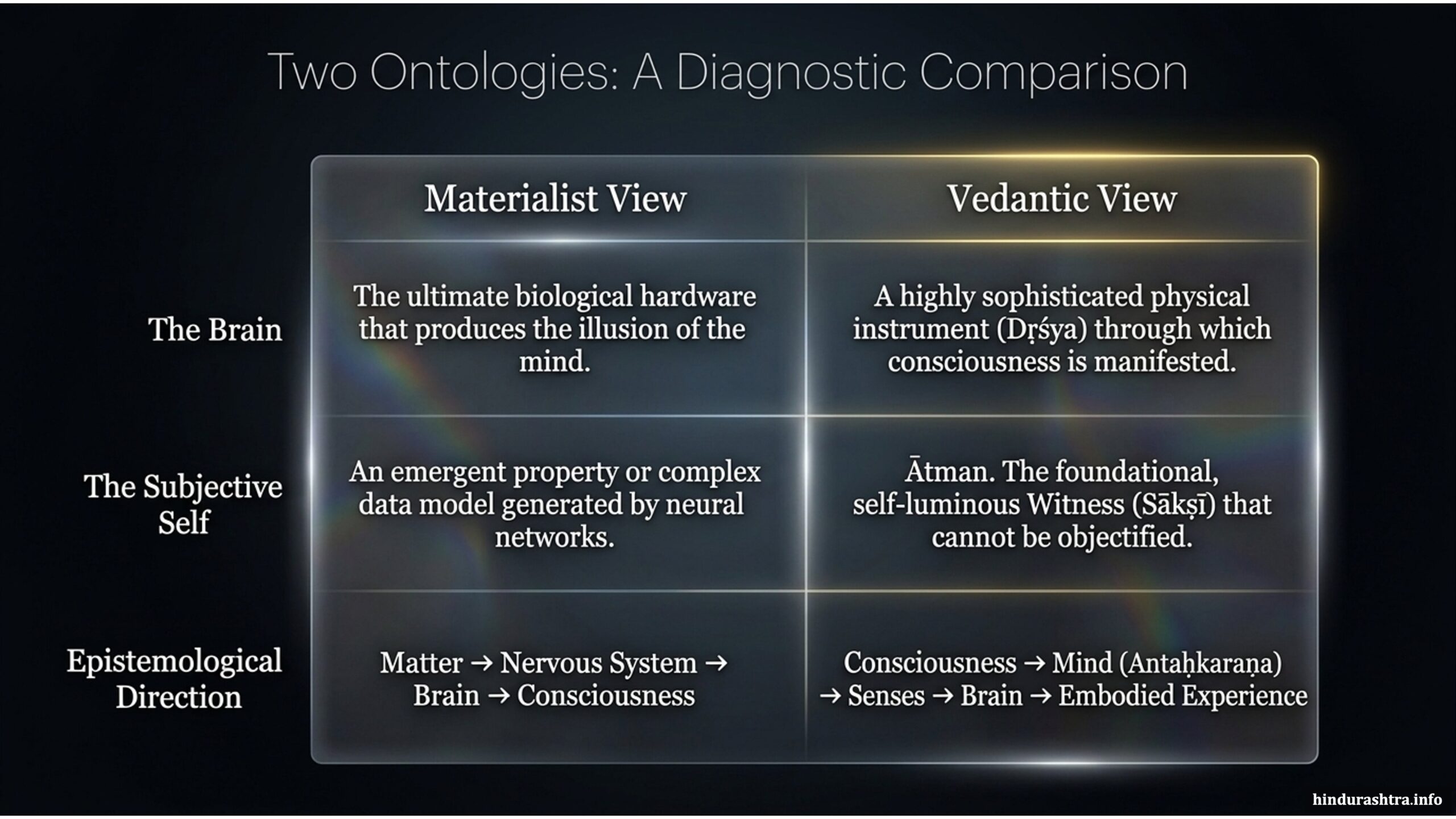
- Physicalist Explanatory Vector: Intrinsically unconscious matter (jaḍa [जड]) à Complex brain structures à[Explanatory Gap / Category Jump] à Emergent phenomenal consciousness.
- Vedantic Explanatory Vector: Primary self-luminous awareness (svaprakāśa [स्वप्रकाश]) à Illumines à Brain states, bodily sensations, and physical objects (dṛśya [दृश्य]).
5.3 The Epistemological Revolution: Scientific Investigation as an Object within Awareness
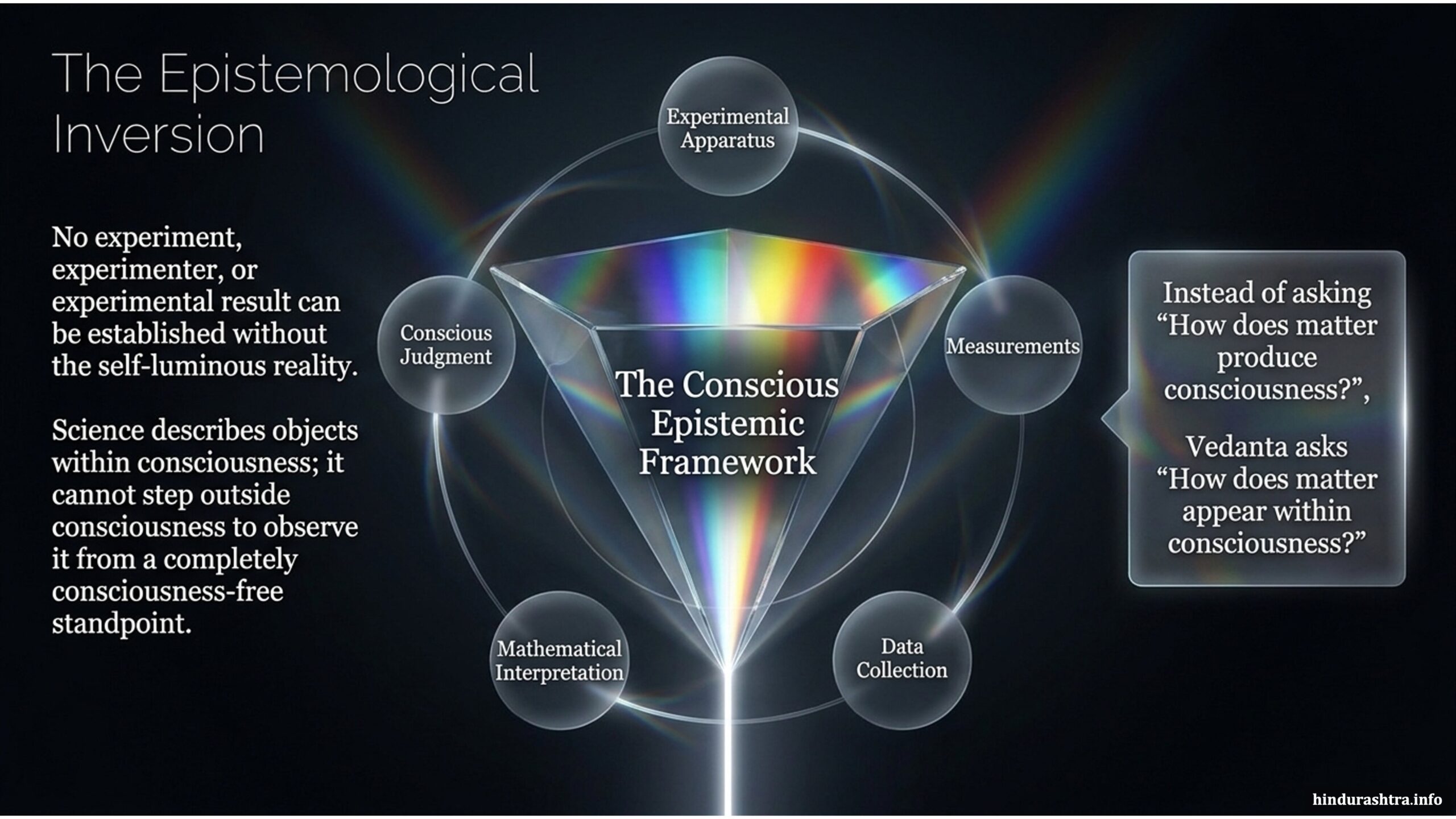
Advaita Vedānta highlights a fundamental circularity in third-person scientific physicalism: every scientific experiment, instrument, data point, and theoretical conclusion presupposes first-person conscious awareness. Karpatri Ji emphasizes that third-person physical science operates strictly within a pre-existing field of awareness:
“कोई प्रयोग, प्रयोक्ता एवं प्रयोगफल भी स्वप्रकाश सत्के बिना सिद्ध नहीं हो सकते।” [“No experiment, experimenter, or experimental result can be established without the self-luminous reality.”]
Attempting to disprove or reduce consciousness using third-person scientific instruments is epistemologically circular. The instrument, the laboratory, the experimenter, and the scientific theory are all objects appearing within the primary field of self-luminous awareness [svaprakāśa sat (स्वप्रकाश सत्)].
Building upon this epistemological self-luminosity, Section 6 traces the metaphysical transition from the individual witness to the non-dual absolute.
- From Individual Witness (Sākṣī / साक्षी) to Non-Dual Absolute (Brahman / ब्रह्म)
The Vedantic analysis does not end with isolating individual subjective awareness; it systematically expands from the localized witness to the ultimate ground of reality.
6.1 The Mechanics of Sākṣī (साक्षी) and Refuting the Homunculus Fallacy
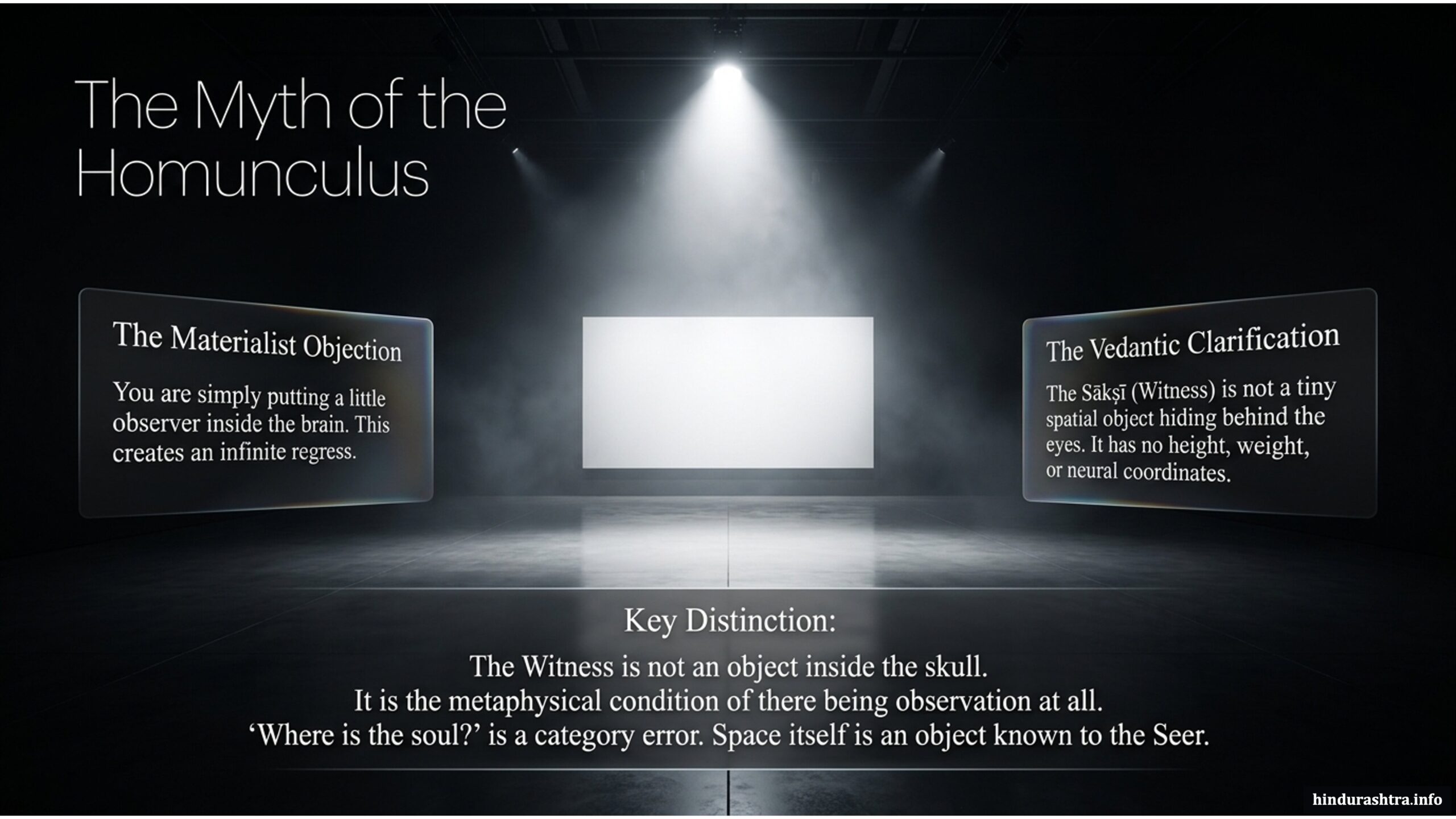
To avoid misunderstandings, Vedānta clarifies that the sākṣī [साक्षी] (witnessing consciousness) is not a psychological “little observer” sitting inside the brain. Physicalists frequently accuse dualists of committing the homunculus fallacy: positing an internal entity that itself would require a smaller observer, causing an infinite regress.
The sākṣī is explicitly non-spatial and non-objective. It is not an internal object located within the skull; rather, it is the non-spatial epistemic condition that makes spatial and temporal observation possible. Brain processes occupy space; the witnessing consciousness is the non-physical condition in which spatial concepts are known.
6.2 The Reflected Sun Analogy: Individualization (Jīva / जीव) through Mental Instruments
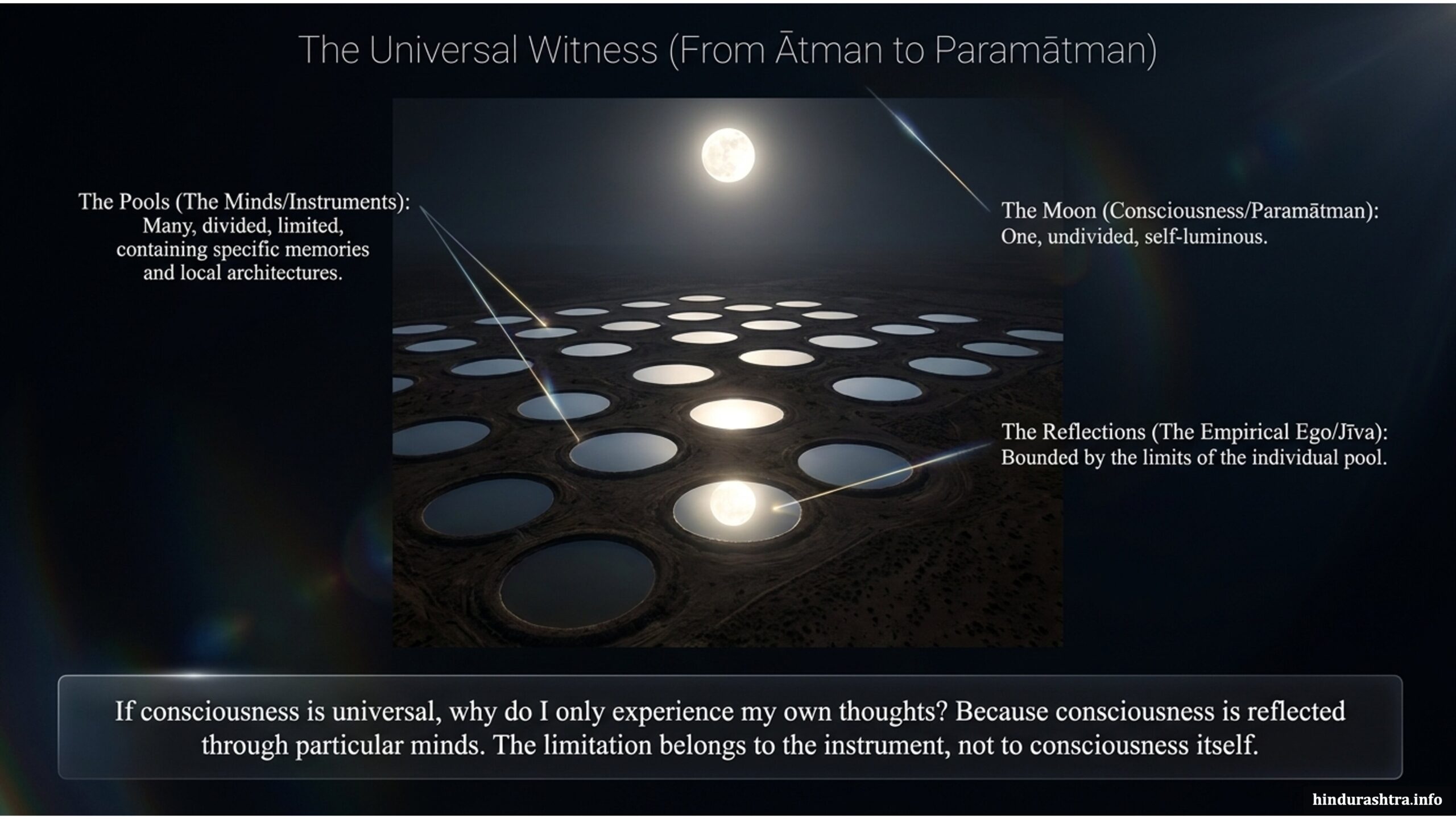
If consciousness is fundamental, why does experience appear individualized? Why does one person not directly experience the internal thoughts of another?
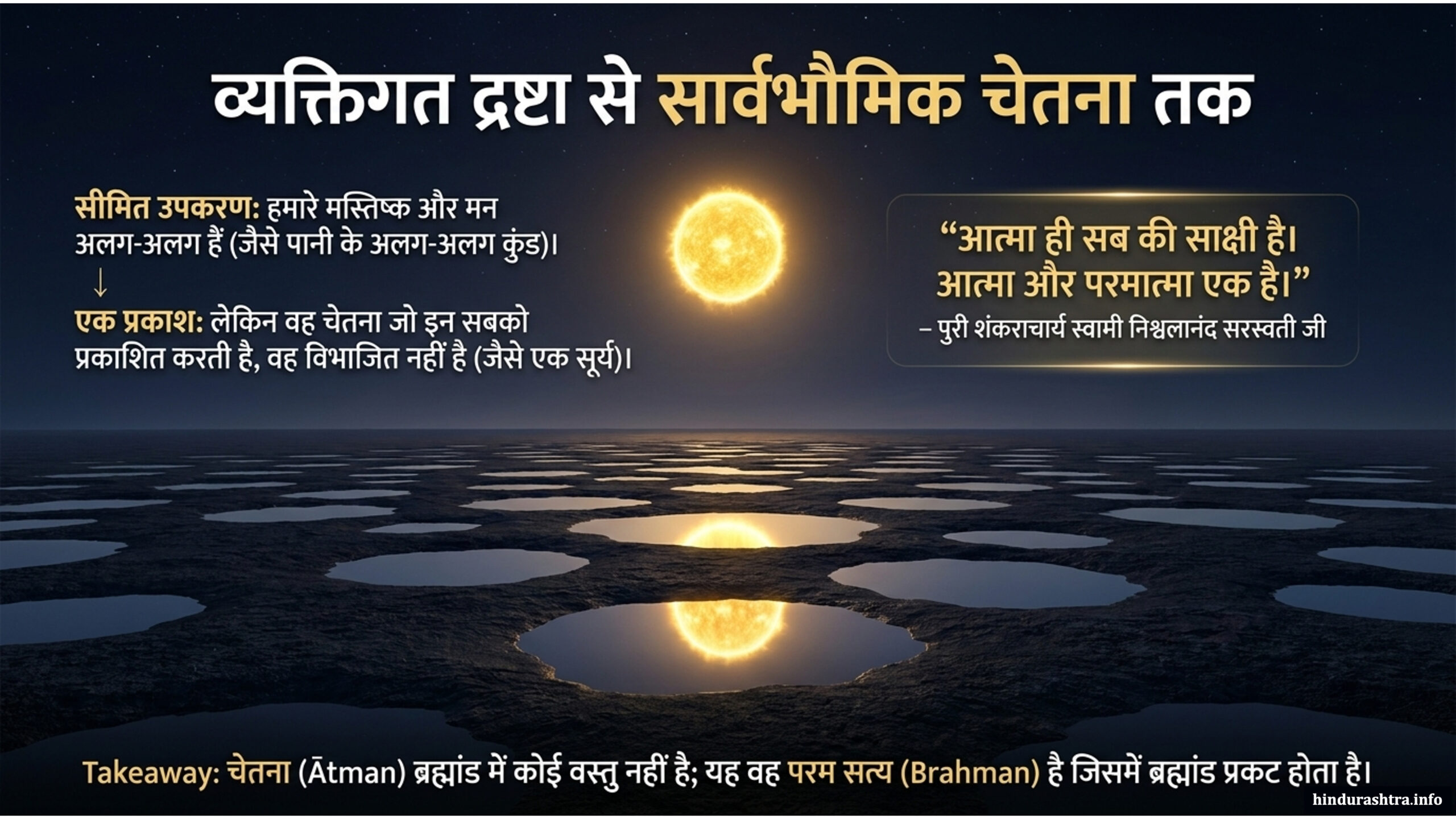
Advaita Vedānta explains individualization [jīva (जीव)] using the classical analogy of reflected light. Sunlight shining in the sky reflects across multiple distinct pools of water. The pools of water represent individual mental instruments [antaḥkaraṇa (अन्तःकरण)]; the distorted, localized reflections of the sun represent empirical egos [ahaṃkāra (अहंकार)]; while the single sun in the sky represents pure ātman [आत्मा].
To prevent the materialist from falsely equating the enduring ātman [आत्मा] with the psychological mind, Vedānta distinguishes between two distinct operational vehicles:
- Gross Physical Body (sthūla deha [स्थूल देह]): The biological organism composed of physical elements, subject to anatomical disintegration at death.
- Subtle Body (sūkṣma deha [सूक्ष्म देह]): The complex consisting of mind, intellect, memory, ego-sense, five sensory capacities, and vital energy forces.
As Swami Karpatri Ji explicitly formulates regarding the continuation of this subtle complex beyond biological demise:
“स्थूल देहके नष्ट होनेपर भी यह सूक्ष्म देह नष्ट नहीं होता।” [“Even after the destruction of the gross body, the subtle body does not perish.”]
While physical death destroys the gross medium (sthūla deha [स्थूल देह]), the subtle complex (sūkṣma deha [सूक्ष्म देह]) persists in Vedantic ontology as the reflective medium of the jīva [जीव]. The empirical ego [ahaṃkāra (अहंकार)] is conditioned by the limitations and fluctuations of this subtle instrument, whereas the underlying consciousness (ātman) illuminating the instrument remains undivided, uncreated, and unconditioned.
6.3 The Advaitic Culmination: Ātman (आत्मा) as Paramātman (परमात्मा) / Brahman (ब्रह्म)
In the non-dual realization articulated by Swami Karpatri Ji and supported by traditional teachings associated with Puri Shankaracharya Swami Nischalananda Saraswati Ji, the isolated witnessing self is recognized as non-different from the universal absolute:
“आत्मा ही सब की साक्षी है। आत्मा और परमात्मा एक है।” [“The Ātman alone is the witness of all. The Ātman and Paramātman are one.”] (Note: While drawn from traditional oral teachings reported in secondary sources rather than authenticated critical editions, this statement accurately captures the Advaitic culmination of the Puri lineage).
To provide complete textual authority from Swami Karpatri Ji himself, this insight is anchored in his master formulation regarding ultimate reality:
“ज्ञाता-ज्ञान-ज्ञेय, जाग्रत्- स्वप्न-सुषुप्ति, प्रकाश-प्रवृत्ति- मोह … इन सबका प्रकाशक, सबका अधिष्ठान, सबका कारण, सबसे अतीत सत् ही आत्मा है।” [“That which illumines knower, knowledge and known; waking, dream and deep sleep; illumination, activity and delusion; that which is the support of all, the cause of all and beyond all … that Reality is the Ātman.”]
This culmination synthesizes the foundational Upanishadic Mahāvākyas महावाक्य (अहं ब्रह्मास्मि / तत् त्वम् असि ahaṁ brahmāsmi / tat tvam asi) and aligns with Karpatri Ji’s definition of ultimate reality drawn from sacred texts: satyaṁ jñānam anantaṁ brahma [सत्यं ज्ञानमनन्तं ब्रह्म] (Brahman is truth, knowledge, and infinity). Consciousness is not a private, localized mental phenomenon generated by an individual brain; it is the ultimate, infinite ground (paramātman [परमात्मा] / brahman [ब्रह्म]) in which all empirical minds and physical universes manifest.
Having completed the metaphysical progression from witness to absolute, Section 7 provides a comprehensive comparative synthesis, addresses major materialist counter-arguments, and formulates the final philosophical resolution.
- Comparative Synthesis, Critical Objections, and Philosophical Resolution
A complete comparative analysis requires a direct confrontation between physicalist counter-arguments and the Vedantic draṣṭā–dṛśya [द्रष्टा-दृश्य] framework.
7.1 Cross-Theoretical Comparison: Vedantic Non-Dualism vs. Modern Theories of Consciousness
The four major paradigms analyzed in this inquiry diverge fundamentally across their starting premises, theoretical models of mind, phenomenal explanations, and epistemic boundaries:
|
Theoretical Paradigm |
Starting Point (Subject vs Object) |
Status of Mind/Brain |
Explanation of Experience |
Epistemic Limit |
|
Advaita Vedānta (Swami Karpatri Ji) |
Subject-first (svaprakāśa draṣṭā [स्वप्रकाशद्रष्टा]) |
Brain/Mind are inert instruments (dṛśya [दृश्य]) illumined by ātman [आत्मा]. |
Self-luminous awareness illumines mental modifications (vṛtti [वृत्ति]). |
Cannot objectify the ultimate Seer; known through self-evident presence. |
|
Biological Naturalism (John Searle) |
Object-first (Biological Organism) |
Mind is a real, high-level biological brain property. |
Emergent biological feature of neurobiological systems. |
Explanatory gap: cannot demonstrate how physical firings cause felt experience. |
|
Functionalism (Functional Computationalism) |
Object-first (Third-Person System) |
Mind is functional software/computational roles executed by neural hardware. |
Causal input-output information processing. |
Bypasses phenomenal experience; fails to explain why processing is felt. |
|
Eliminativism (Daniel Dennett) |
Object-first (Third-Person Description) |
Mental states and qualia are illusory constructs of folk psychology. |
Theoretical illusion generated by cognitive machinery. |
Epistemologically self-refuting; denies the very first-person data to be explained. |
7.2 Deconstructing Materialist Rebuttals: Circularity, Metaphysical Inflation, and Evolutionary Emergence
A physicalist can present three primary philosophical rebuttals to the Vedantic framework:
Objection 1: Epistemic vs. Ontic Circularity
- Materialist Counter: Saying matter is known through consciousness tells us about epistemology (how we acquire knowledge), not ontology (what exists). Knowing matter via consciousness does not prove matter depends ontologically on consciousness.
- Vedantic Resolution: Vedānta accepts this logical distinction. However, the draṣṭā–dṛśya [द्रष्टा-दृश्य] argument does not rely solely on epistemic priority. It establishes that all material properties assigned to matter belong to the realm of the object (dṛśya [दृश्य]). Because every objective physical property requires an illuminating subject, physical matter lacks self-manifesting existence (jaḍa [जड]). Epistemology and ontology merge because an unmanifest, unobserved object cannot be asserted as the ontological source of awareness.
Objection 2: Metaphysical Inflation
- Materialist Counter: Even if phenomenal experience is irreducible to neural circuits, jumping from individual subjective awareness to a universal, non-dual brahman [ब्रह्म] represents uncritical metaphysical inflation.
- Vedantic Resolution: Advaita acknowledges that isolating the sākṣī [साक्षी] does not automatically prove brahman in a single deductive step. The progression requires distinct analytical stages: isolating the witness from the body/mind, recognizing that pure awareness lacks objective physical boundaries, and utilizing Upanishadic textual reasoning (śruti [श्रुति]) to recognize the non-dual nature of foundational consciousness.
Objection 3: Evolutionary Emergence
- Materialist Counter: Evolution demonstrates that simple organisms lacked complex consciousness, and phenomenal awareness gradually emerged as nervous systems evolved computational complexity.
- Vedantic Resolution: Karpatri Ji clarifies that consciousness itself does not evolve from unconsciousness. What evolves are the physical instruments: the biological brains, nervous systems, and mental structures (antaḥkaraṇa[अन्तःकरण]) through which consciousness is expressed. Increasing biological complexity refines the medium of manifestation (the pool of water), not the underlying illuminating awareness (the sun).
7.3 Conclusion: The Unavoidable Primacy of the Seer
This comparative synthesis leads to an academically defensible conclusion that does not claim empirical neuroscience has been “defeated.” Contemporary neuroscience provides invaluable descriptions of the operational dependencies, information structures, and functional correlates of embodied cognition.
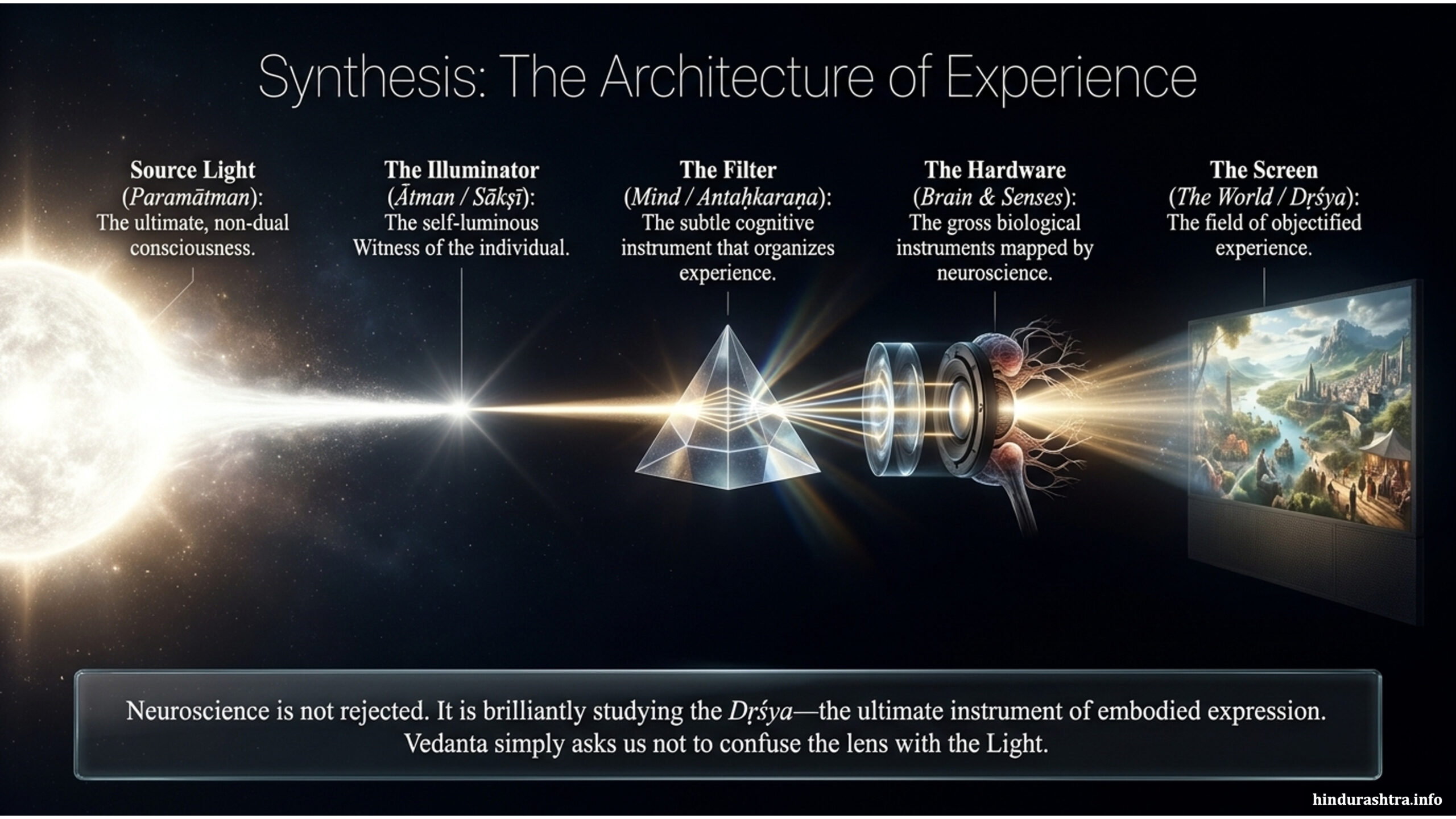
However, neuroscience fails to establish metaphysical identity or account for the ultimate subject of experience. Demonstrating that brain damage alters cognitive performance proves dependence, not identity. Higher-order representation extends the field of the seen (dṛśya [दृश्य]), but continuously fails to locate the unobjectifiable Seer (draṣṭā[द्रष्टा]). Third-person physicalism cannot eliminate first-person subjectivity without presupposing the very conscious subject required to formulate its scientific theories.
Ultimately, the entire physicalist paradigm, its neuroimaging data, its evolutionary models, and its claims of neural identity remain objects appearing within a conscious field. This leaves Swami Karpatri Ji’s foundational question standing at the intersection of philosophy and science: Who is the Seer to whom the brain itself appears?
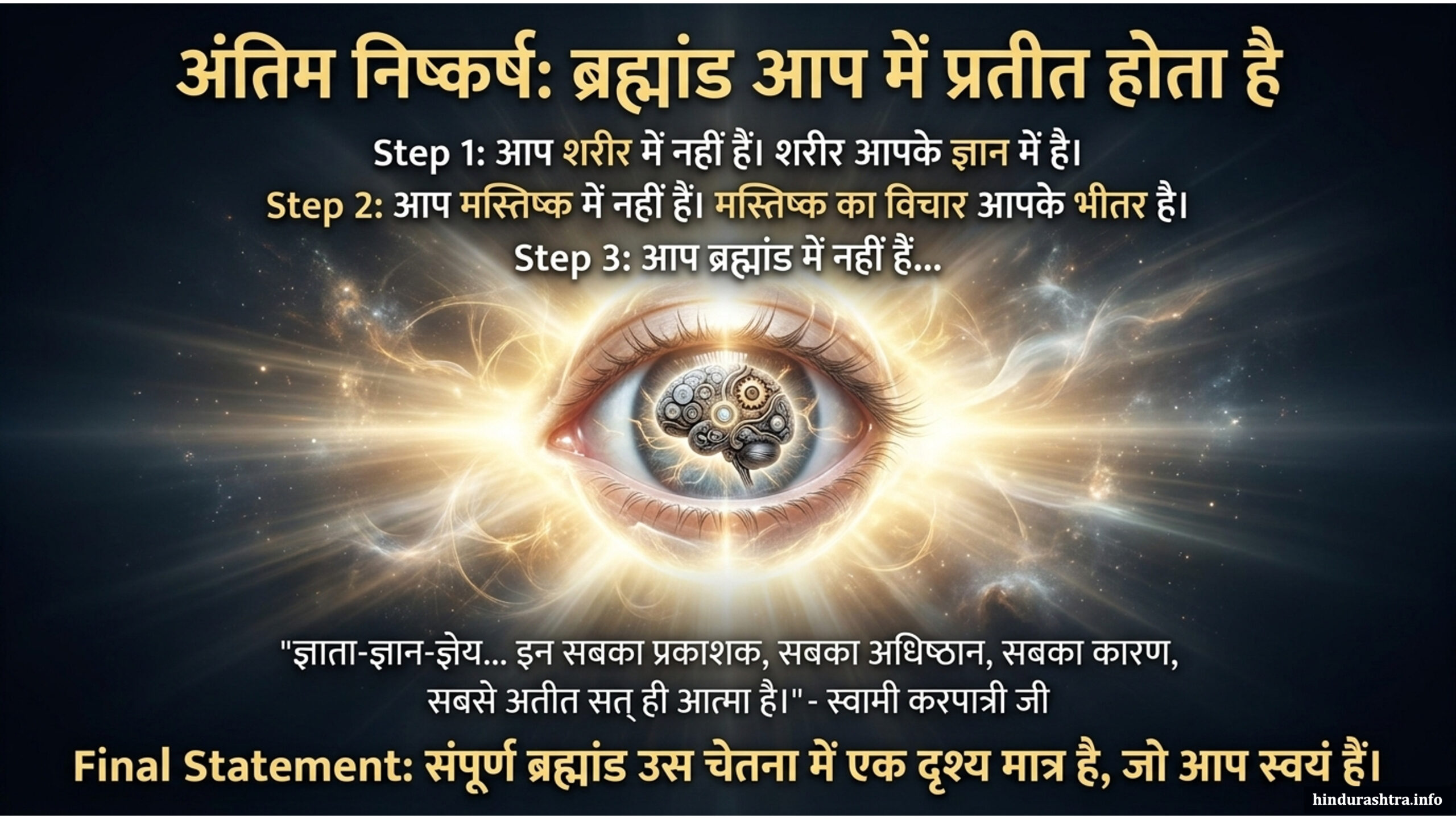
Neuroscience successfully maps the physical instrument, but the ultimate, self-luminous subject (the draṣṭā [द्रष्टा]) remains the unassailable foundation of all human experience and knowledge.