
Language Science – Origin, Development and Eternal Truth
Drawn from Dharma Samrat Swami Karpatri Ji Maharaj’s book
Marxism and Ramrajya [मार्क्सवाद और रामराज्य]
Human language is not a late invention that slowly grew out of animal noise. Traditional Indian thought, especially the writings of Swami Karpatri Ji Maharaj, places language at the very foundation of consciousness and knowledge. Modern Western theories treat speech as something that began with crude grunts and gestures and then improved over thousands of years. Classical Indian epistemology rejects this picture completely.
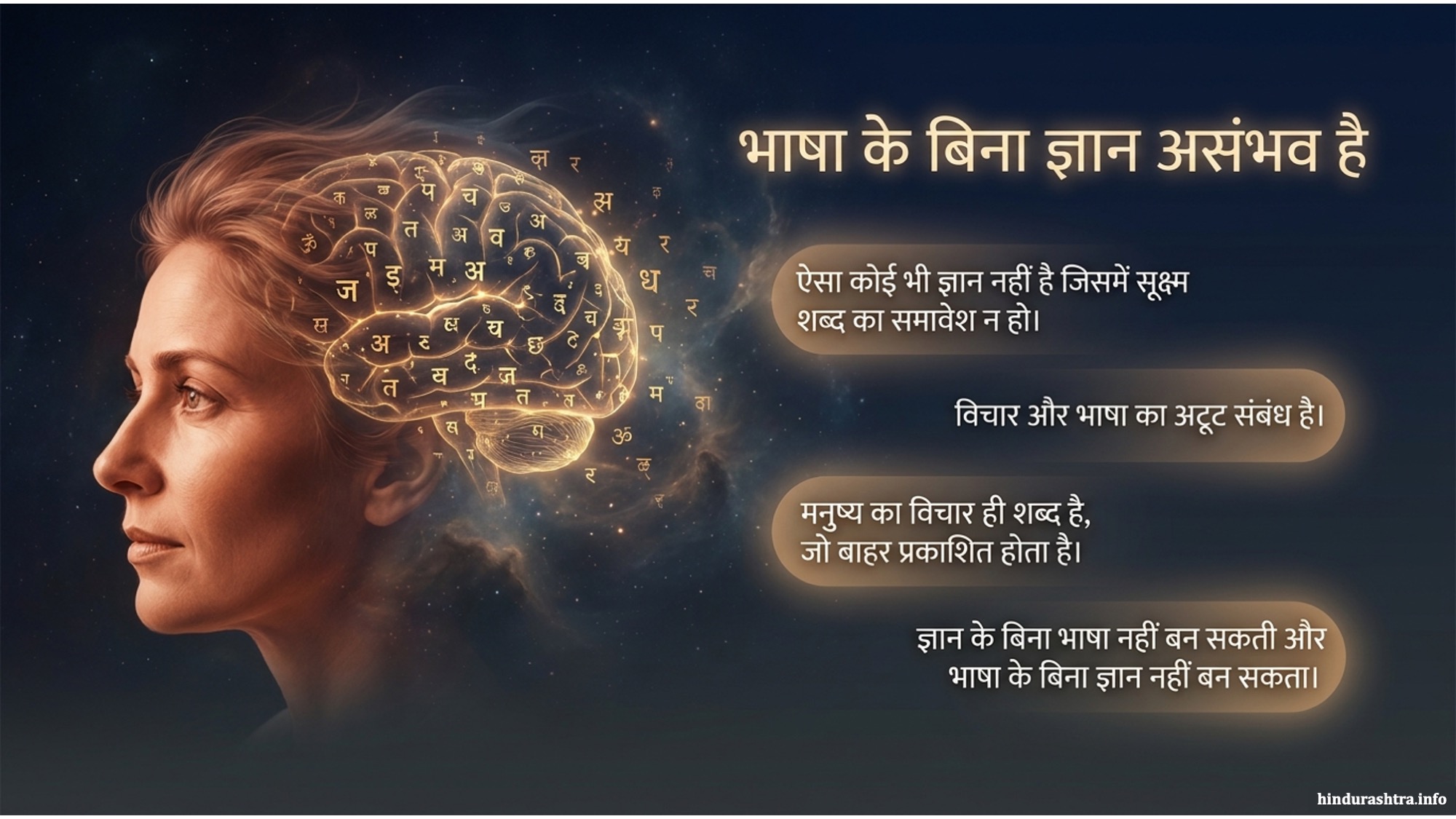
According to Mimamsa, Nyaya and Vedanta, articulate speech is either eternal or was fully present from the first moment of creation. It was never built piece by piece by mute ancestors. The relationship between a word and its meaning is not an arbitrary human agreement. It is either naturally inherent or established by divine will at the beginning of a cosmic cycle. Without language, structured thought itself cannot exist. Every clear idea is already interwoven with subtle speech.
This means the first human beings were not silent creatures who later invented words. They received both knowledge and the power of speech together. The Veda itself is described as beginningless and authorless. It is preserved through an unbroken line of teachers and students that stretches back without a starting point. Even when the universe dissolves and is recreated, the eternal sound patterns are recalled by the primordial sages.
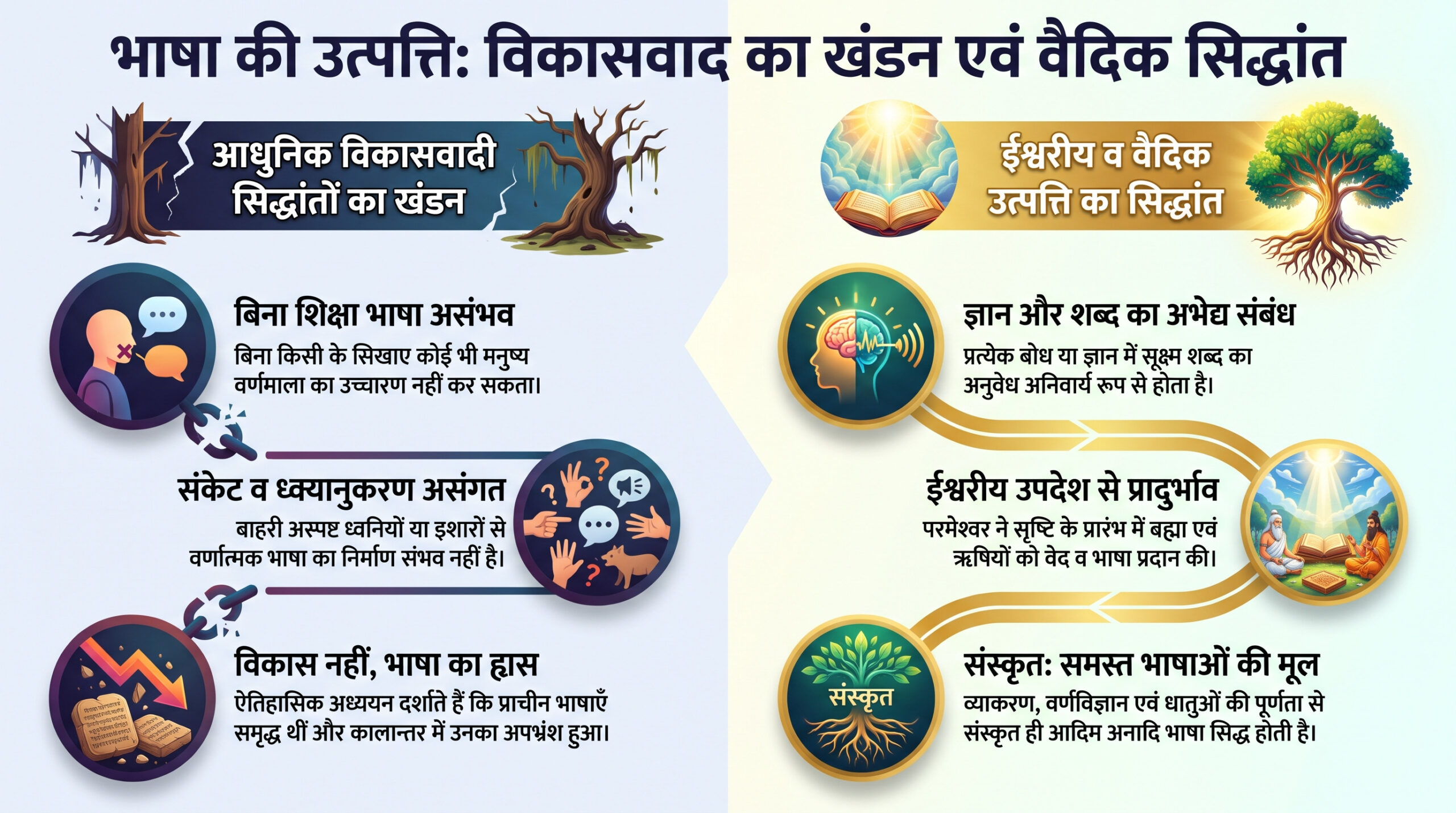
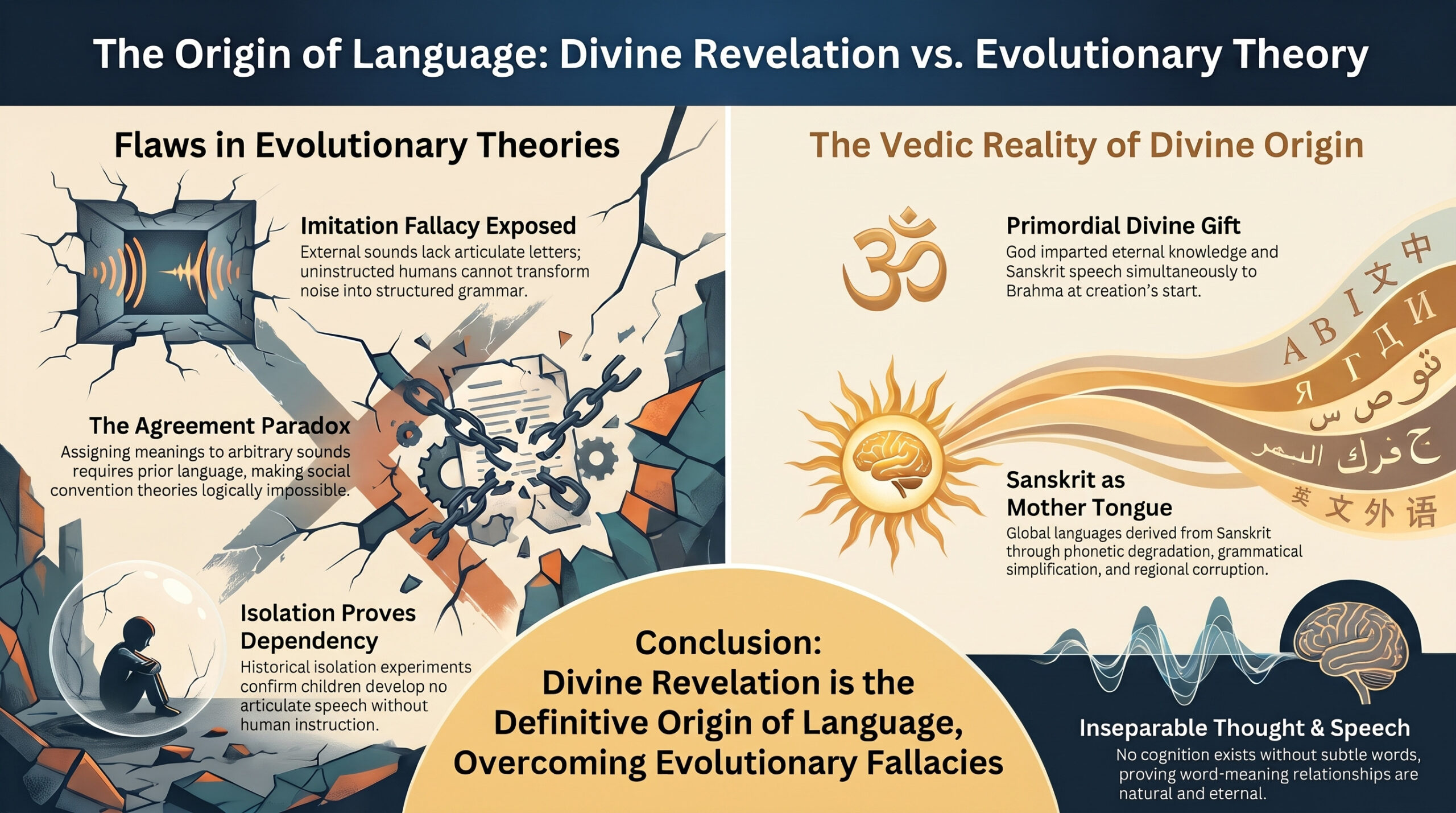
Swami Karpatri Ji repeatedly shows that evolutionary accounts of language rest on circular reasoning. They assume people already possessed complex ideas so they could invent words, yet complex ideas cannot form without language. Historical isolation experiments, the behaviour of deaf-mute persons, and the study of feral children all confirm the same fact: without hearing and instruction, human beings produce only unformed vowel sounds. They never invent a full system of consonants and grammar.
The entire discussion that follows rests on this single foundation. Language is not a biological accident. It is an eternal faculty of consciousness, preserved by tradition and revealed at the start of each cycle of creation. The pages that expand this point draw directly from the arguments Karpatri Ji presented in Marxism and Ramrajya and from the classical pramana systems that support those arguments.
What modern philology calls “progress” is, in the traditional view, a long process of decay and loss of precision. Sanskrit stands as the most complete surviving form of the original structure. All other languages show signs of phonetic erosion, loss of grammatical numbers, and simplification of case endings. The task of serious study is therefore not to invent new origin stories but to recover the original clarity that the classical tradition never abandoned.
This opening statement sets the method. Every claim will be tested against observed facts, logical consistency, and the explicit statements of Mimamsa, Nyaya and Vedanta. The goal is not to defend a religious dogma but to show that the evolutionary account of language fails under the same standards of evidence that any rigorous inquiry demands. The following posts examine each part of that failure in turn, always remaining within the material supplied by Swami Karpatri Ji’s analysis and the classical texts he cites.
The Blank Space of Assumption
Why the evolutionary story begins with an empty page
Many modern accounts of language simply assume that early humans once lived without speech and then slowly acquired it. That assumption is rarely examined. It is treated as the natural starting point. Traditional Indian thought refuses to begin there.
If speech is required for structured thought, then a long period of mute conceptual life is impossible. If speech is acquired only through instruction, then the first generation could not have invented it from nothing. The blank page of the evolutionary narrative is therefore not a neutral space. It is a contradiction waiting to be exposed.
Swami Karpatri Ji points out that every historical experiment designed to test spontaneous language creation produced the same result. Infants kept away from all human speech grew up able to make only simple vowel sounds. They never developed the full set of consonants or any grammatical system. The same pattern appears in children raised by animals and in persons born deaf. The organs of speech are present, yet without hearing a living model the organs remain unused for articulate language.
This is not a minor detail. It removes the supposed starting point of the evolutionary story. There never was a generation of mute humans who possessed clear ideas and then decided to attach sounds to those ideas. The decision itself would have required language. The circle cannot be broken by inventing a social contract or a gradual series of gestures. Both solutions still presuppose the very capacity they claim to explain.
The classical tradition therefore begins elsewhere. It begins with the recognition that knowledge and speech arrive together. Whether one follows the Mimamsa view that the word-meaning relation is eternal or the Nyaya view that it was established by divine instruction at the dawn of a cycle, the outcome is the same. There is no historical moment at which speech was invented by silent beings. The chain of transmission has no first link that stands outside language.
This blank-space problem is the reason the remaining discussion spends so much time on empirical cases and logical contradictions. The evolutionary account is not rejected because it is modern. It is rejected because it cannot survive the simplest tests of consistency and observation. Once the empty assumption is removed, the positive account of language as an eternal or primordially revealed faculty becomes the only coherent alternative left standing.
Language Is Not Inborn – It Must Be Learned
Wolf-children, deaf-mutes and the isolation experiments
The claim that language unfolds naturally from biological maturity alone is contradicted by every recorded case of complete linguistic isolation. Swami Karpatri Ji collects these cases and draws the clear conclusion: without hearing and instruction, articulate speech never appears.
Children discovered in wolf dens make only the sounds of the animals that raised them. They howl. They do not produce the structured consonants of human speech. When they are later brought into human society they must be taught, slowly and with great difficulty, the basic sounds of language. The vocal organs were present all along, yet without a living model the organs remained limited to animal-like cries.
Historical experiments reach the same result. The Egyptian king Psammetichus ordered two infants raised by a shepherd under the strict rule that no human speech should reach their ears. When the children grew older they produced only the simple vowels a, i and u. They never formed consonants or sentences. Similar isolation trials under Frederick II, James IV of Scotland and the Mughal emperor Akbar ended in the same way. The children remained without language.
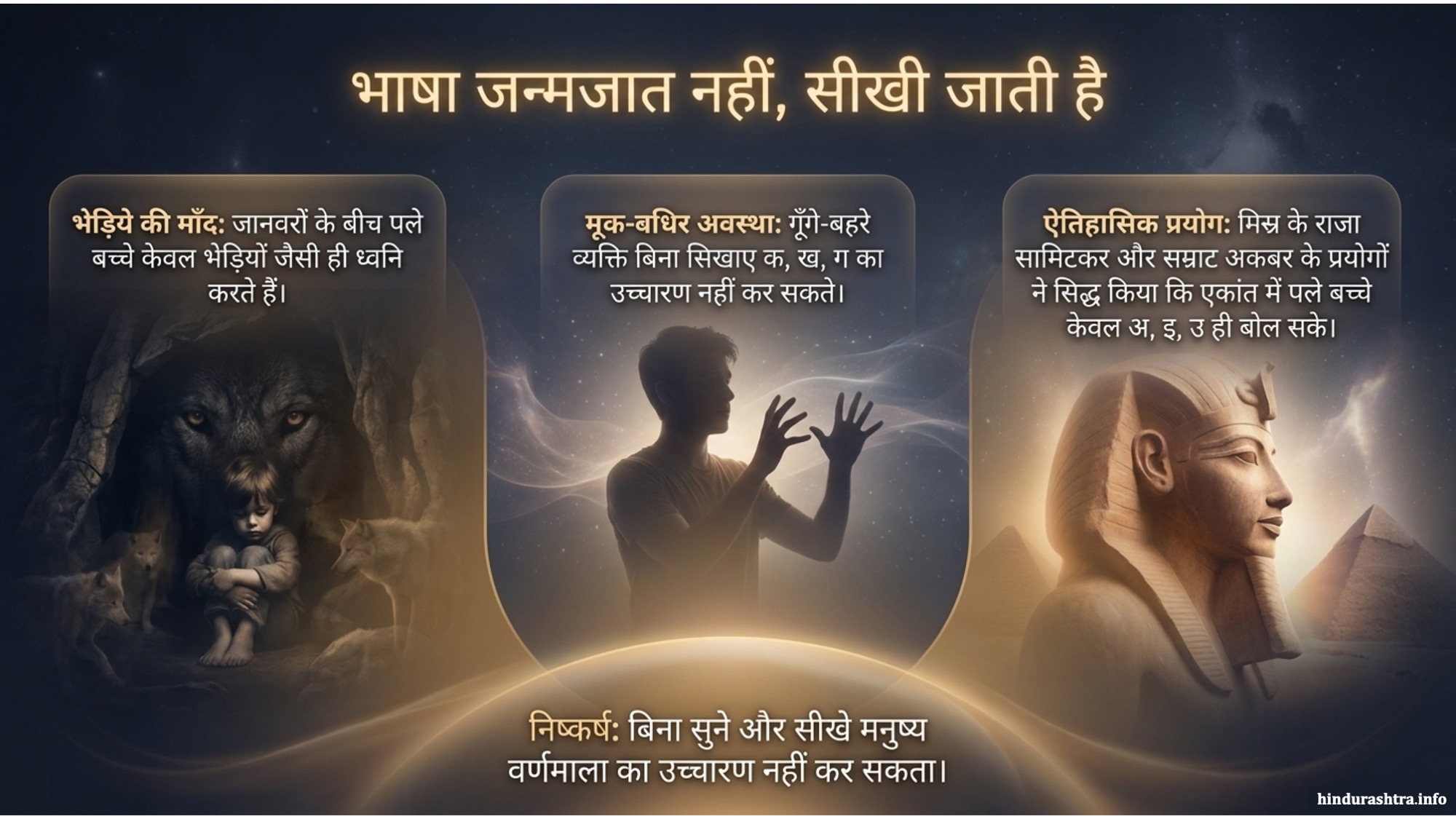
Deaf persons who have never heard speech provide further evidence. Their throats, tongues, teeth and lips are intact. Yet without auditory models they cannot produce the full range of phonemes. Only when they receive special visual or mechanical instruction do they begin to form sounds. If a person is both deaf and blind the difficulty becomes even greater, because even the visual cues are removed.
These facts destroy the idea that language is an automatic biological unfolding. The capacity for speech is present, but the actual system of sounds and meanings must be received from outside. The classical tradition therefore insists on the necessity of śikṣā – pedagogical transmission. Every speaker stands in a line of earlier speakers. There is no first speaker who invented the system from silence.
The same principle appears in the Mimamsa maxim that all study of the Veda is preceded by the teacher’s own prior study. The chain has no beginning. Language learning has always required a prior teacher. The isolation cases simply make this ancient insight visible in modern observation. Without the living chain of instruction, the human voice remains limited to unformed vowels. Structured language never arises on its own.
The Evolutionary Claim – Language Grew by Imitation
The bow-wow theory and its first difficulties
One popular evolutionary account says that language began when early humans imitated the sounds of nature. The bird’s call became the word “cuckoo.” The crow’s cry became the word for crow. Emotional outbursts such as cries of pain or joy slowly turned into fixed words. This is often called the imitation theory or the interjection theory.
Swami Karpatri Ji examines the claim carefully and finds it rests on a hidden assumption. Imitation of an external sound already requires the ability to produce distinct human phonemes. Natural noises themselves contain no human letters. A falling stick makes an unformed crash. A rat gnawing makes a continuous scraping. A snake moving makes a soft rustle. None of these sounds is divided into the separate consonants and vowels of human speech.
Only a person who already knows how to shape the throat, palate, tongue and lips into the positions for ka, kha, ga and the rest can project those letters onto the external noise. The Hindi speaker hears a rooster and says “kukroo-koo.” The English speaker hears the same sound and says “cock-a-doodle-do.” The difference shows that the human ear is already organised by a prior system of phonemes. The external noise is the same; the linguistic interpretation is different.
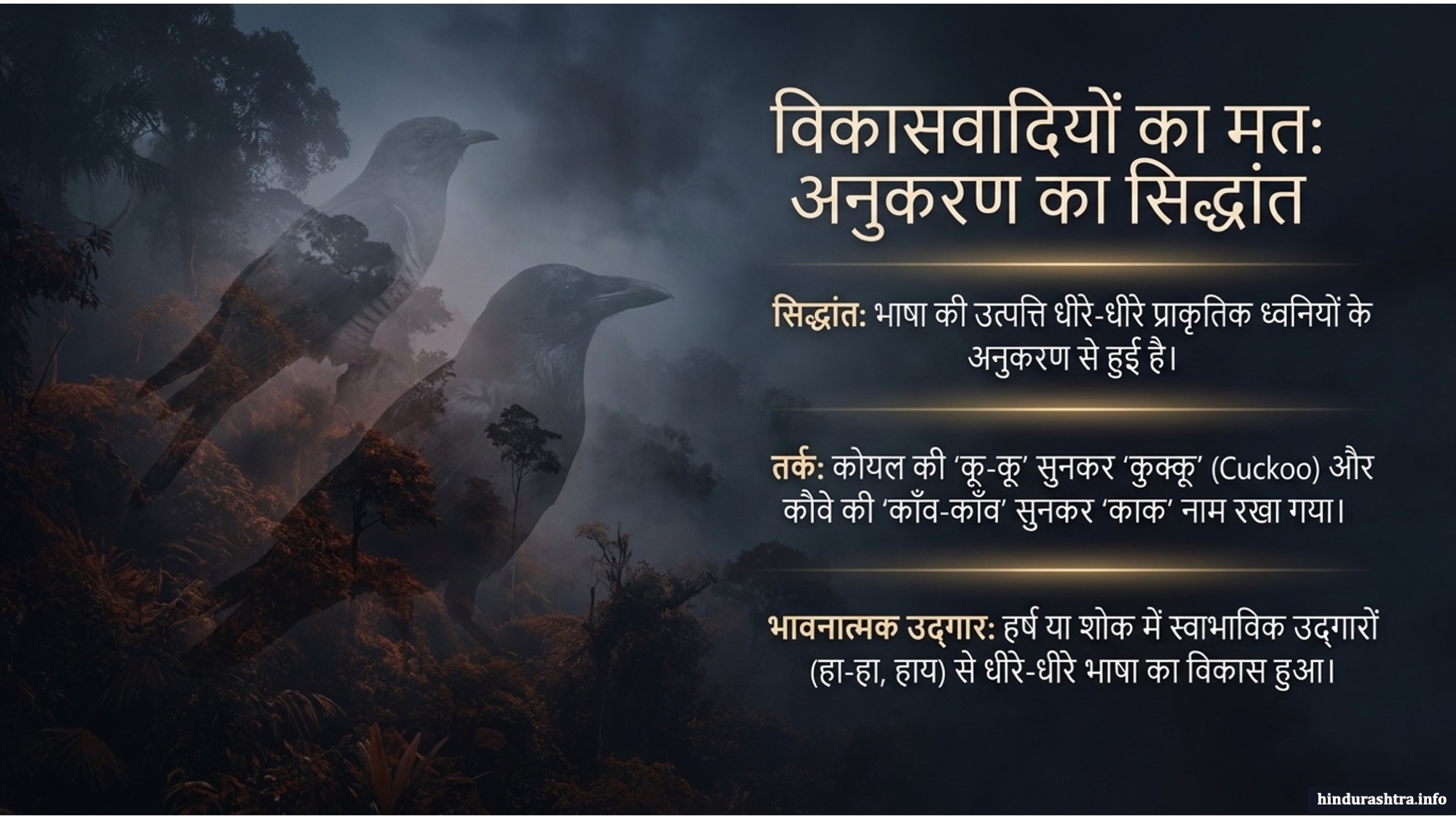
Emotional cries face the same problem. The sounds “ha-ha” or “hai-hai” are not raw animal noises. They are already formed from specific human phonemes. Infants and animals feel strong emotion yet produce only unshaped cries. The structured interjection appears only after the vocal organs have been trained.
Therefore the imitation theory does not explain the origin of language. It presupposes language. The capacity to analyse an unformed noise into discrete letters is itself a linguistic skill. Without that skill the external world remains a continuous field of sound, not a source of words. The evolutionary account begins in the middle of the process and then pretends to explain the beginning.
Classical Indian thought avoids this circularity by refusing to treat language as a late invention. Whether the word-meaning relation is eternal or was established at the start of a cosmic cycle, the full system of articulate speech is present from the outset. Imitation and emotional expression become possible only after that system is already in place.
The Illusion of Imitation – From the Unformed to the Formed
Why natural sounds contain no letters
Natural sounds are unarticulated. They do not contain the separate letters of human speech. The sound of a crow is a continuous caw. The sound of a falling object is a crash. The sound of a bell is a sustained tone. None of these noises is already divided into ka, kha, ga or any other phoneme.
Only a speaker who has already mastered the human vocal apparatus can hear those continuous noises as sequences of letters. The mastery includes precise control of the throat, the soft palate, the hard palate, the teeth, the lips and the tongue, together with the internal and external efforts that shape each sound. Without that prior training the external world remains a field of unformed noise.
This is why different languages hear the same natural sound in different ways. The same rooster call is rendered one way in Hindi and another way in English. The difference does not lie in the bird. It lies in the linguistic system already present in the listener. The system is projected onto the noise. The noise does not create the system.
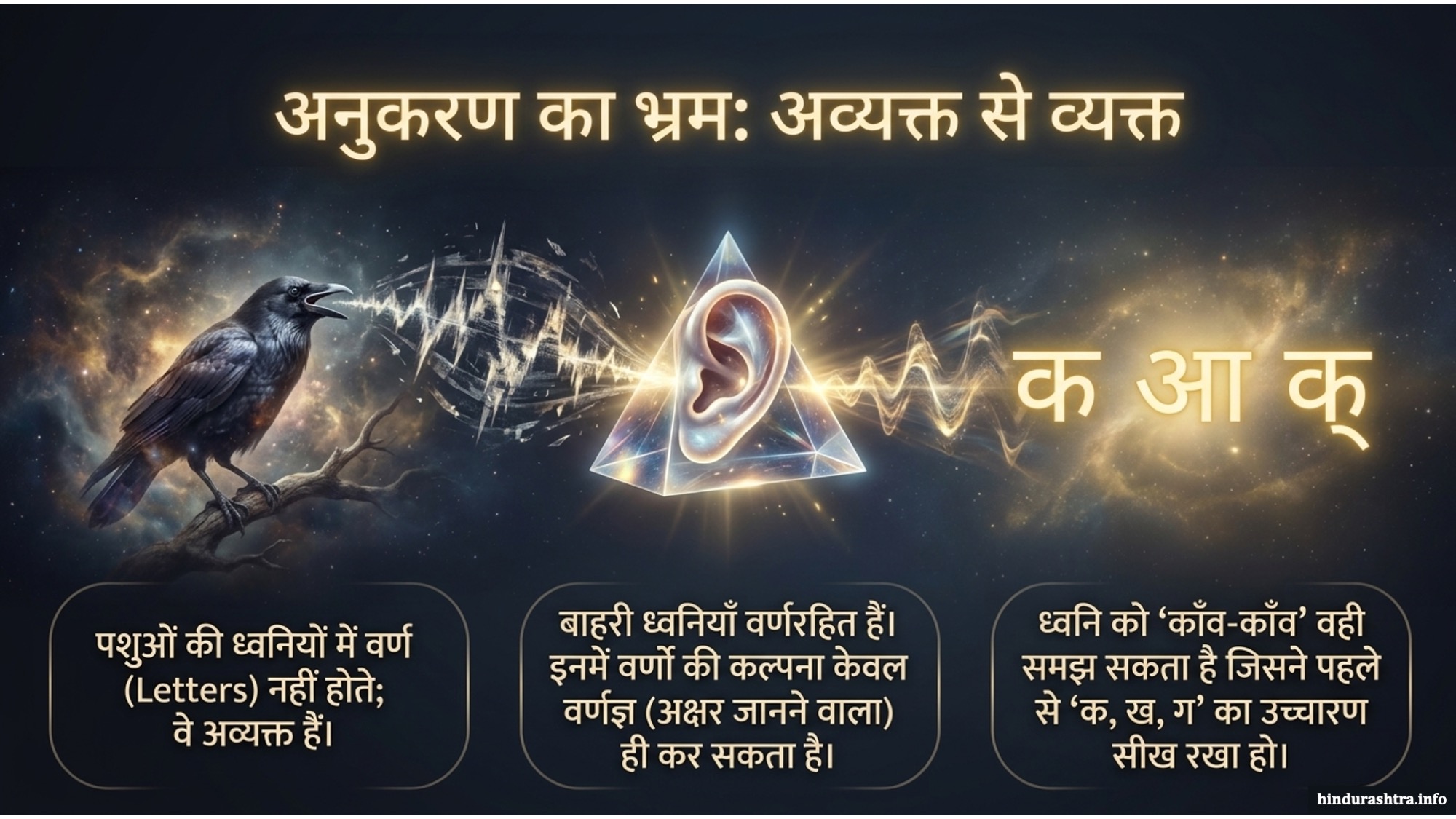
Swami Karpatri Ji uses this simple observation to dismantle the imitation theory. If the first humans had no phonemes, they could not have recognised phonemes in the environment. They would have heard only continuous sound. The step from continuous sound to discrete letters cannot be taken by imitation, because imitation already requires the letters.
The same difficulty appears with gestures. Complex gestural systems such as flag signalling, military spark codes or the hand language of classical dance are not primitive. They are advanced arts that demand prior training. An uninstructed mind cannot invent or interpret them. Gesture therefore cannot serve as a stepping-stone to speech. Both gesture and imitation presuppose a cognitive and vocal capacity that the evolutionary story claims to explain.
The traditional conclusion follows directly. Articulate speech cannot arise from the unformed. It must be received in already formed condition, either as an eternal relation or as a primordial instruction. The movement from the unarticulated to the articulated is not an evolutionary achievement. It is a transmission of what was already complete.
Knowledge and Language Come from the Divine Source
The testimony of the Śvetāśvatara Upaniṣad
The Śvetāśvatara Upaniṣad states that the Supreme Being first created Brahmā and then delivered the Vedas to him. The verse is clear: the same power that brings the first being into existence also transmits the eternal knowledge and the language in which that knowledge is expressed.
Swami Karpatri Ji takes this statement as the starting point for the positive account of language. At the beginning of a cosmic cycle the full system of speech is not invented. It is recalled and transmitted. The primordial sages awaken with the memory of the word-meaning relations that existed in previous cycles. They do not stand in silence and then decide to create words. They receive the already complete instrument of knowledge.
This view solves the circularity that destroys evolutionary theories. Knowledge cannot exist without subtle speech, and speech cannot be invented without knowledge. The only coherent solution is that both arrive together. The divine source supplies both at once.
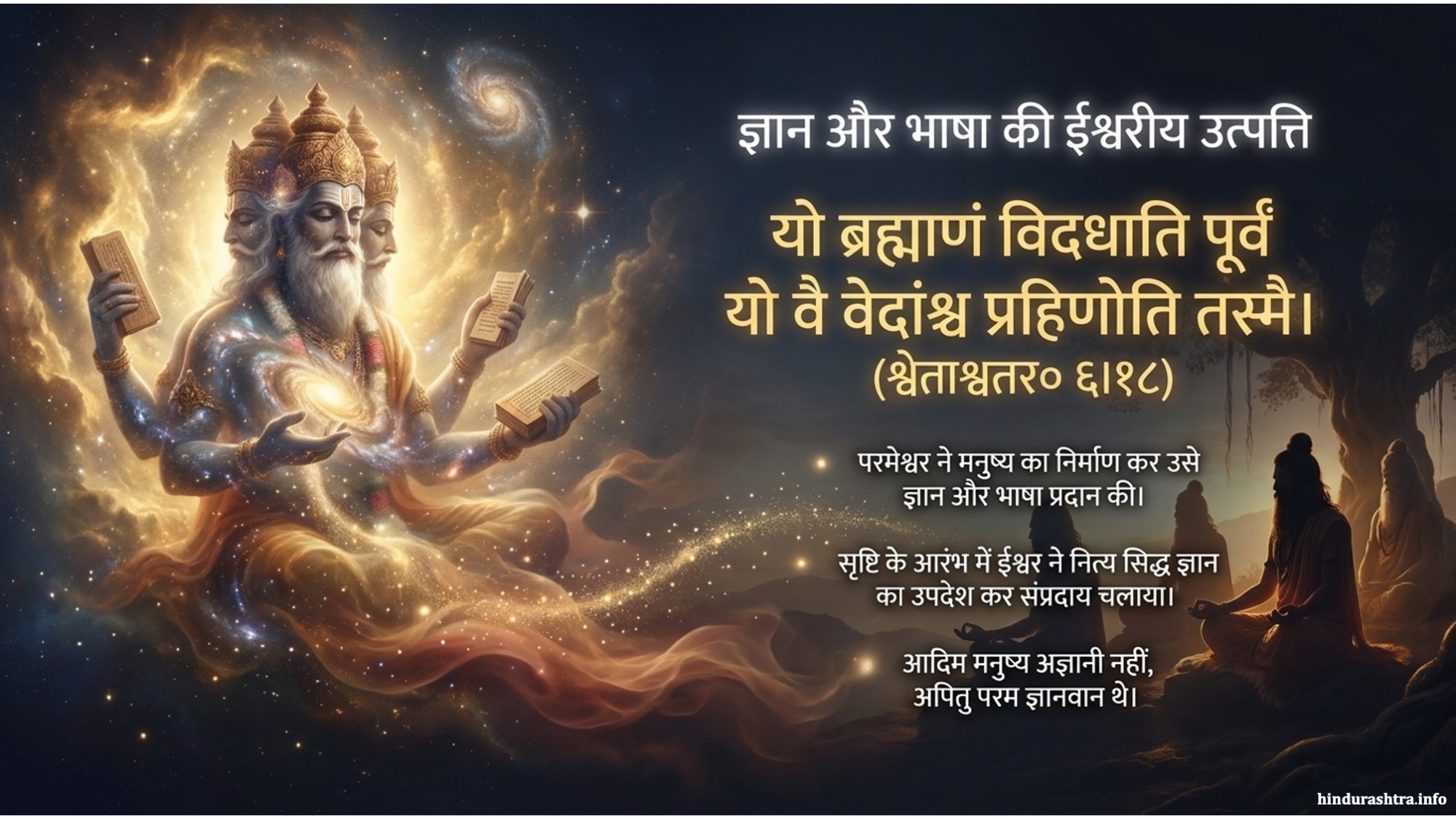
The same principle appears in the analogy of waking from sleep. A person who falls into deep sleep temporarily loses active use of language and identity. Upon waking he does not invent a new language. He simply recovers what was already his. In the same way, at the dawn of a new creation the sages recover the eternal linguistic forms. They are called seers of mantras, not authors of mantras.
Even the modern phenomenon of hypnotic induction illustrates the point. Under deep suggestion a person can speak or write in a language never studied in the present life. Latent impressions are activated. If a human hypnotist can do this, the Supreme Being can awaken the full linguistic capacity in the first beings of a cycle.
Thus language is not a human construction. It is a divine gift that accompanies the gift of knowledge. The first humans were not ignorant creatures slowly climbing toward speech. They were fully equipped with both from the outset. The later history of language is not a story of upward progress. It is a story of careful preservation in some lineages and gradual decay in others.
Śabda-Brahman – The Eternal Bond of Word and Meaning
Mimamsa and Nyaya on the nature of the relation
Classical Indian philosophy is united in rejecting the idea that the link between a word and its meaning is a late human invention. The schools differ on the precise status of that link, yet both place it beyond ordinary human creation.
Mimamsa declares that the relation is inherent, natural and eternal. The key sūtra states that the connection of the word with its meaning is autpattika – not made, not conventional, but belonging to the very nature of both. Words primarily denote universals, not fleeting individual objects. The universal “cowness” does not perish when a particular cow dies. Because the universal is eternal, the semantic relation remains unbroken across time.
Nyaya holds that the relation is established by the will of God at the beginning of a cycle. God instructs the first sages: from this word this meaning is to be understood. The instruction is then passed down through the teaching lineage. Language is therefore not humanly constructed, even though it is not strictly uncreated in the Mimamsa sense.
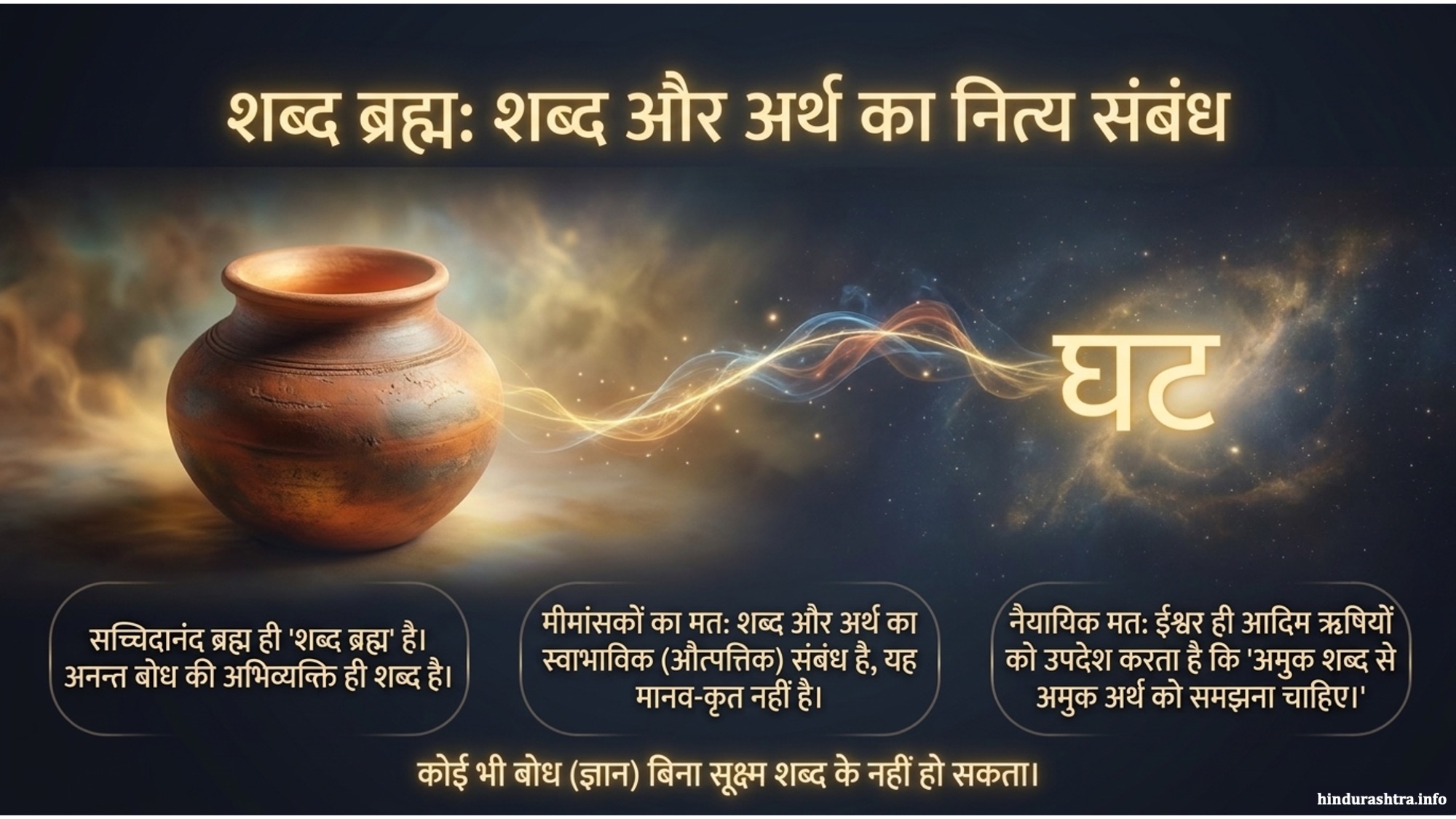
Both schools agree on the decisive point. The foundational vocabulary of human speech was never invented by mute ancestors. Later technical terms or regional slang may be conventional, but the core system is not. The mutual dependence of knowledge and language makes any other view impossible.
Swami Karpatri Ji emphasises that no cognition occurs without subtle speech. A completely silent thought is an epistemological fiction. Because thought and word are inseparable, they must have been present together from the first. The debate between Mimamsa and Nyaya is internal to a shared rejection of evolutionary accounts.
This eternal or primordially established bond is what the tradition calls Śabda-Brahman when the discussion rises to the level of Vedanta. Word and meaning are two aspects of the same non-dual consciousness. They are not glued together by human agreement. They express the same reality from different sides. The entire later history of language is the history of how carefully or carelessly that original bond is preserved.
Two Opposite Views of the Origin of Language
Evolutionary ascent versus Vedic completeness
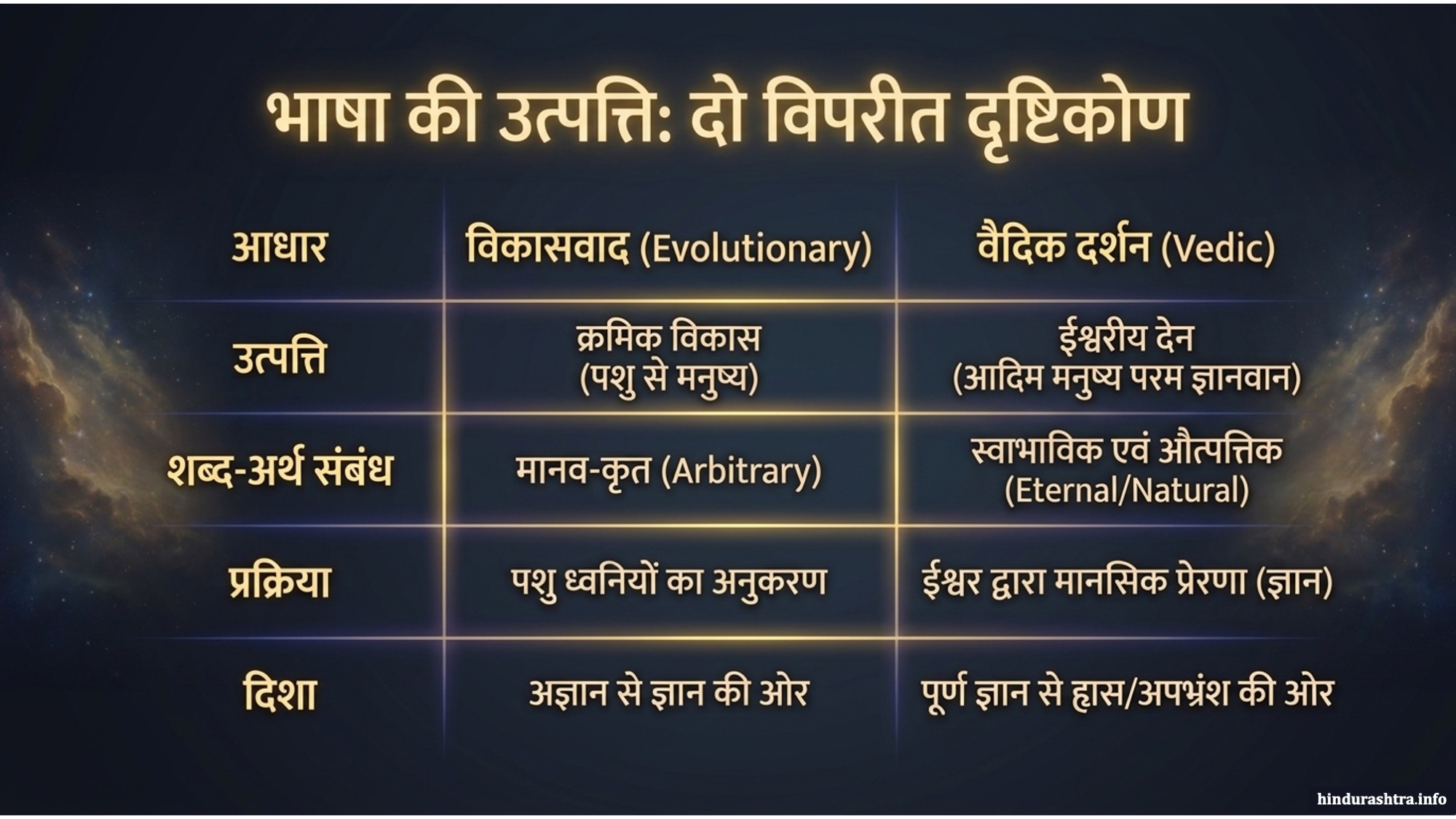
The contrast between the two frameworks can be set out simply.
The evolutionary view says language began in animal sounds and emotional cries. It moved upward through imitation and gradual convention. Word-meaning links are arbitrary human inventions. The direction of history is from ignorance toward knowledge and from simple noise toward complex grammar.
The Vedic view says language is a divine gift or an eternal reality. The first humans received both knowledge and speech together. Word-meaning links are either naturally inherent or established by divine instruction. The direction of history is from original completeness toward later loss and corruption in many lineages.
These are not minor differences of emphasis. They produce opposite pictures of human nature and of historical change. In one picture early humans were silent and incomplete. In the other they were fully equipped. In one picture modern languages represent the highest point so far reached. In the other they often represent simplification and loss of precision.
Swami Karpatri Ji insists that the evolutionary picture fails every empirical and logical test. Isolation experiments show that speech does not arise spontaneously. Imitation and gesture theories presuppose the very capacity they claim to explain. Social-contract theories fall into circularity because agreement itself requires language.
The Vedic picture avoids these failures. It begins with completeness and then accounts for later variation through careful transmission in some lines and phonetic decay in others. Sanskrit is treated as the most fully preserved form of the original structure, not as a late artificial refinement of crude dialects.
The table of contrasts is therefore not a neutral summary. It is a decision point. Once the evolutionary side is shown to be incoherent, the Vedic side remains as the only consistent account. The remaining posts examine the concrete evidence of decay and the special status of Sanskrit within that account.
Sanskrit – The Most Complete and Primordial Language
Inflection, roots and the unchanging core
Sanskrit is not merely one language among others. In the traditional analysis it preserves the fullest system of inflection, the richest set of verbal roots, and the most precise phonetic rules. Its grammar does not invent purity out of impurity. It functions like a sieve that separates the already pure forms from later corruptions.
The language is highly synthetic. A single word can carry information about number, gender, case, tense, mood and voice through its endings. The system of three numbers – singular, dual and plural – and eight cases is not a late luxury. It is part of the original design. The same complexity appears in other ancient languages that have remained relatively isolated, showing that rich inflection is not a product of recent civilisation.
The verbal roots form a closed and stable set. Comparative study shows that the major language families reduce to a few hundred primary roots. These roots are not emotional cries or animal imitations. They are structural moulds of sound that carry meaning. Sanskrit preserves them with greater clarity than most descendant languages.
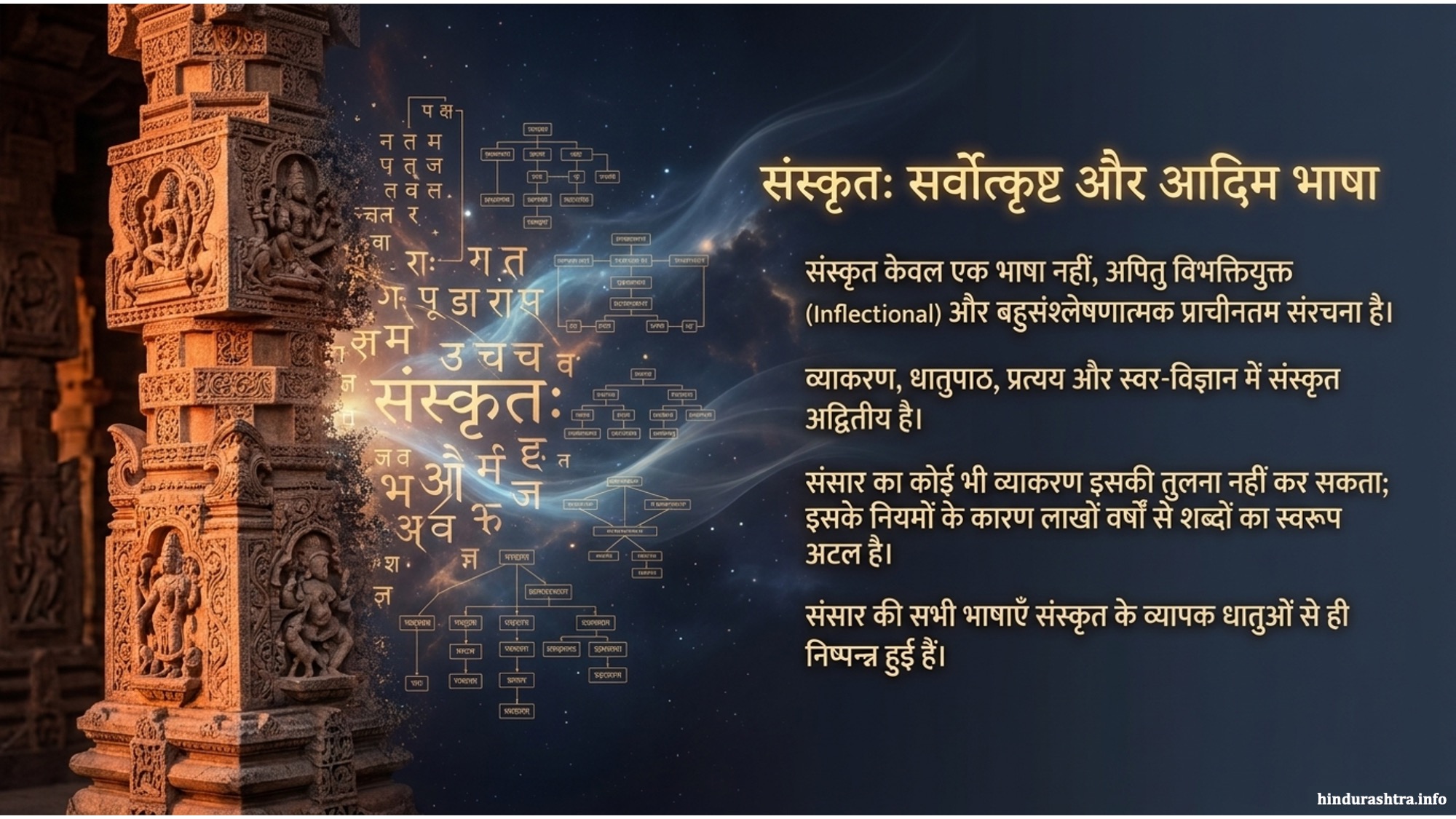
Because the rules of sandhi, accent and derivation are exact, the forms of words have remained stable across long periods. A change in a single accent can reverse the meaning of a compound, as the ancient story of the mispronounced mantra shows. This exactness is possible only because the system was complete from the beginning and was carefully protected.
Swami Karpatri Ji rejects the claim that Sanskrit was artificially constructed by polishing Prakrit dialects. Grammar does not create the pure grain. It only removes the chaff. The pure forms were already present. The work of the grammarians was to keep them distinct from the surrounding mixture of corrupted speech.
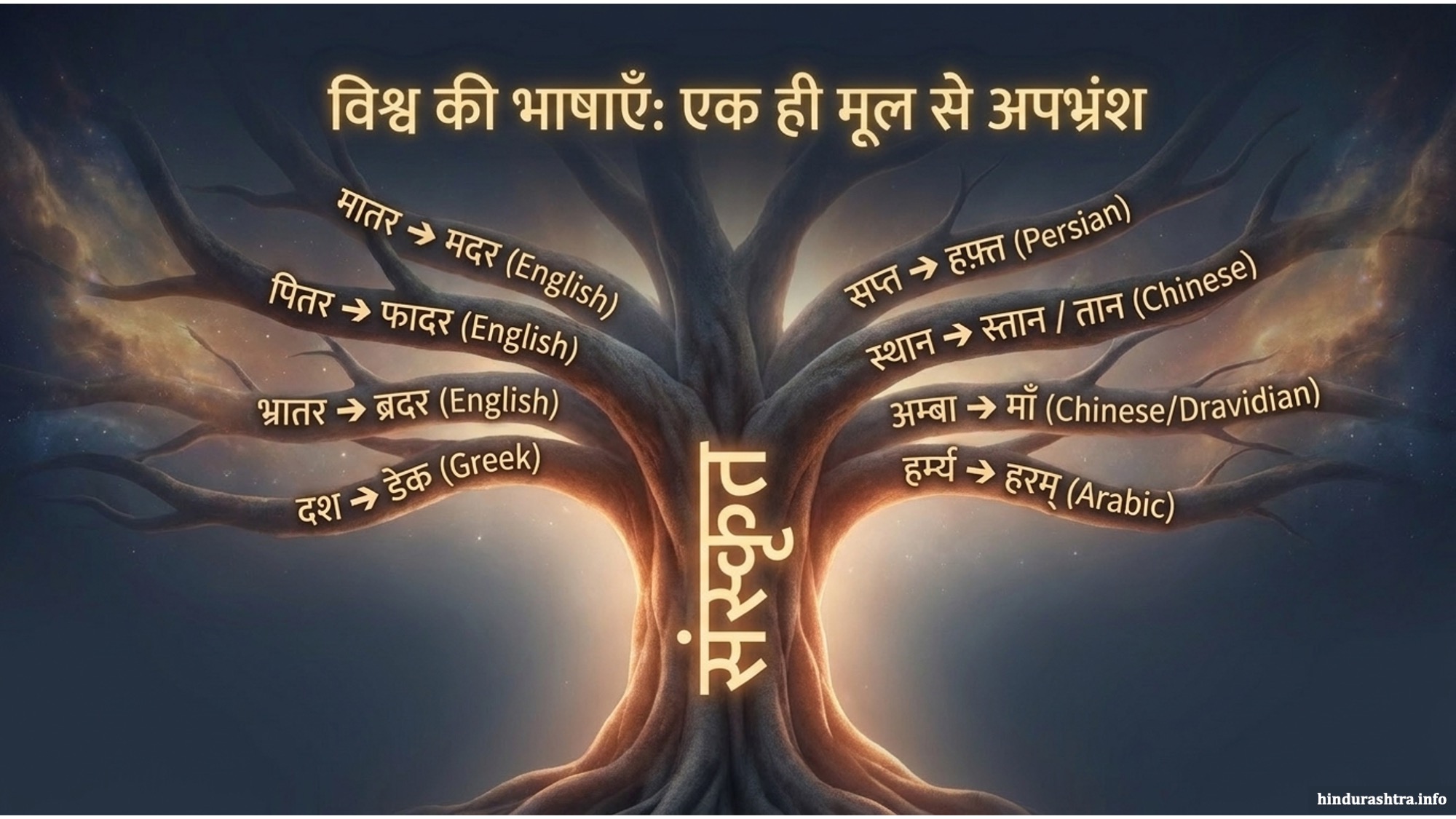
All other languages, in this view, are related to Sanskrit either as direct descendants that have lost structure or as parallel preservations of the same original stock that have undergone different degrees of erosion. The special status of Sanskrit is therefore not a matter of cultural pride. It is a conclusion drawn from the comparative evidence of morphological richness and phonetic stability.
Apabhraṃśa – Not Development but Degradation
The historical movement is from complexity toward loss
The evolutionary narrative claims that languages move from simple to complex. The traditional analysis of Swami Karpatri Ji claims the opposite. The historical movement is from original complexity toward simplification and loss. This process is called apabhraṃśa or degradation.
Ancient languages possessed three grammatical numbers. Many modern languages retain only two. Ancient languages possessed three genders. Many modern languages have collapsed the system to two or have lost grammatical gender altogether. Ancient languages possessed rich case systems. Modern analytic languages have reduced the endings to a handful of prepositions or word-order rules.
Phonetic change follows the same direction. Complex clusters are simplified. Final vowels are dropped. Aspirates are lost. Multi-syllable words shrink toward monosyllables. What modern typology sometimes calls “progress” toward analytic structure is, in the traditional view, the wearing away of an originally fuller system.
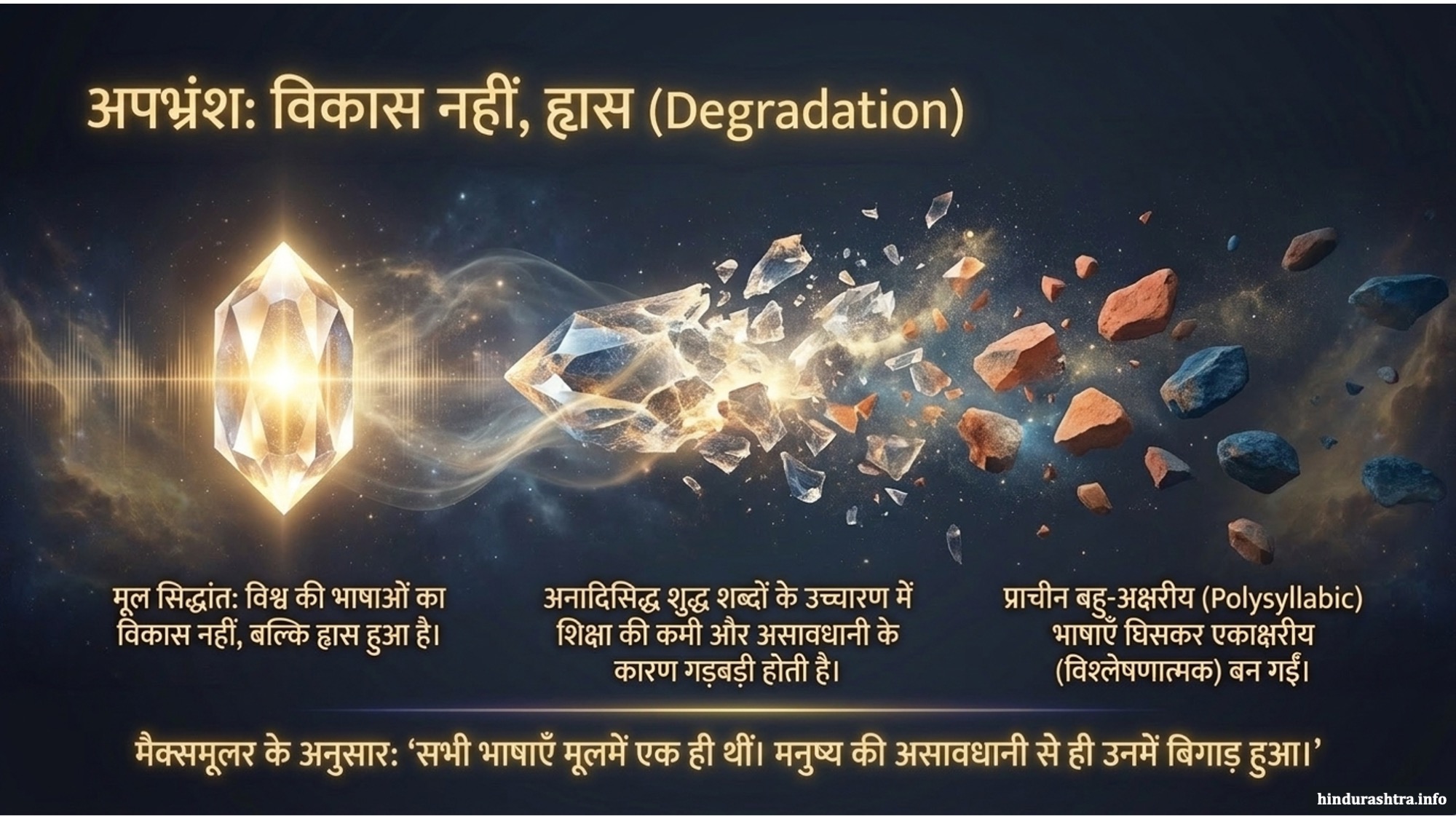
Max Müller himself noted that all languages were once one and that the differences arose through carelessness and loss of precision. Swami Karpatri Ji accepts the observation while rejecting the evolutionary framing. The original unity was not a primitive monosyllabic state. It was a fully articulated system whose later forms show varying degrees of erosion.
The same process appears across language families. Forms that remain close to the Sanskrit originals in one language appear in reduced shape in another. The reduction is not an advance. It is the result of less careful transmission, changes in script, or simple phonetic drift under conditions of reduced education in the classical norms.
Therefore the history of language is not a ladder of improvement. It is a record of how faithfully or unfaithfully the original structure has been kept. Sanskrit represents the high point of preservation. The vernaculars and the more distant cognate languages represent different stages of loss. The task of serious study is to recognise the direction of change and to recover what can still be recovered of the original clarity.
The Empty Interval of Transition
Why the supposed middle stages never appear
Between the claimed primitive stage of pure noise and the later stage of full grammar the evolutionary story must insert a long series of intermediate forms. Those intermediate forms are never actually found. The isolation experiments produce only unformed vowels. They do not produce half-formed consonants or partial grammars that then improve.
Feral children and deaf-mutes likewise show no spontaneous progress toward structured speech. When progress occurs it is the result of deliberate teaching, not of gradual internal evolution. The missing middle stages are therefore not an accidental gap in the evidence. They are evidence that the supposed process does not take place.
Swami Karpatri Ji notes that the same problem appears in the gesture theory and the social-contract theory. Both require a long period in which complex social coordination occurs without language. Yet the coordination of meaning itself demands the very linguistic capacity that is supposed to be under construction. The intermediate period remains empty because it is logically impossible.
The traditional account needs no such empty interval. The full system is present at the beginning. Later variation is explained by differential preservation and differential loss. There is no need to invent a series of half-languages that somehow improve themselves. The empirical record shows only full language transmitted by teaching or the absence of language when teaching is withheld.
This is why the blank space in the evolutionary narrative is decisive. It is not a place where future discoveries will fill in the details. It is a structural hole that cannot be filled without contradicting the premises of the theory. Once the hole is recognised, the theory collapses and the alternative account of primordial completeness stands unchallenged by the available facts.
Structural Collapse – From Fullness to Contraction
Loss of numbers, genders and case endings
The most visible sign of linguistic degradation is the progressive loss of grammatical categories. Sanskrit and several other ancient languages distinguish three numbers: singular, dual and plural. The dual is used whenever exactly two items are in view. Most modern languages descended from these sources have lost the dual entirely. Only singular and plural remain.
The same reduction appears in gender. The classical system recognises masculine, feminine and neuter. Many modern languages have eliminated the neuter or have abandoned grammatical gender altogether. The loss is not an improvement in efficiency. It is a reduction in the precision with which the language can track reference.
Case systems follow the same path. Sanskrit has eight cases that mark the exact relation of a noun to the verb and to other nouns. Modern analytic languages replace most of these endings with prepositions or fixed word order. The information is still expressed, but the morphological richness is gone. The language has become less synthetic and more dependent on external markers.
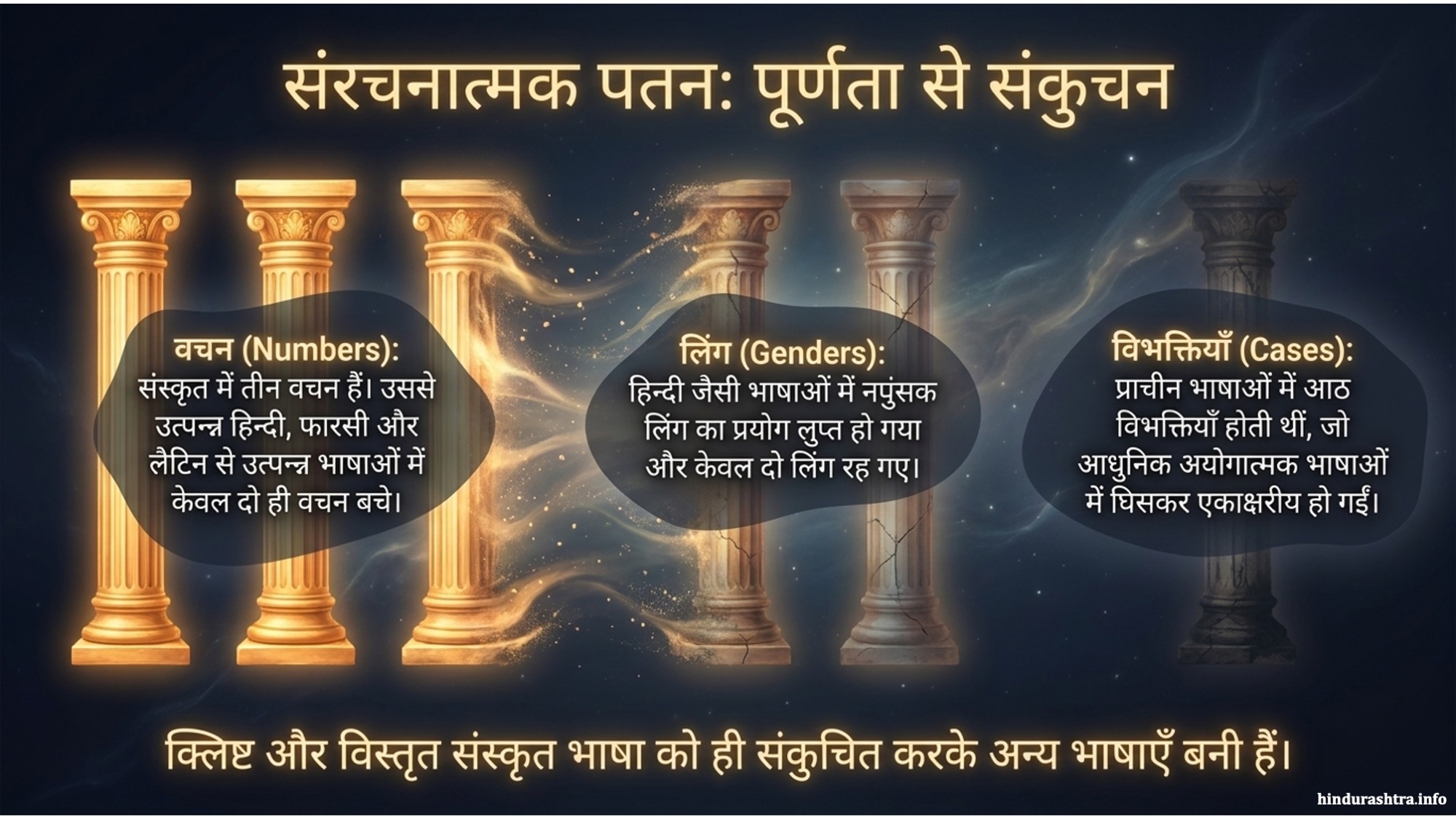
Swami Karpatri Ji treats these changes as evidence of contraction, not of progress. The original system was capable of packing more grammatical information into single words. The later systems require more words and more rigid order to express the same relations. The movement is from greater morphological density toward greater reliance on syntax and lexicon.
Parallel reductions appear outside the Indo-European family. Wherever a language can be shown to have moved from a richer inflectional system toward a simpler one, the direction matches the traditional account. The reverse movement – from true isolation toward rich inflection – is not observed in the historical record.
Thus the structural history of language is a history of loss of distinctions. The dual number, the neuter gender and the full set of cases were not late inventions that some languages have not yet acquired. They were original features that many languages have gradually abandoned. Recognition of this direction removes one of the central supports of the evolutionary narrative.
The Power of Correct Pronunciation and the Cost of Error
The story of the misplaced accent
In the Vedic tradition a single error of accent can reverse the meaning of a mantra and produce the opposite of the intended result. The classic illustration is the compound indraśatru.
When the acute accent falls on the final syllable the compound is understood as a tatpuruṣa: “the slayer of Indra.” When the acute accent falls on the first syllable the compound is understood as a bahuvrīhi: “he whose slayer is Indra.” The difference is only the placement of the accent, yet the ritual consequence is complete reversal. In the narrative the being for whom the mantra was recited was himself destroyed instead of becoming the destroyer.
Swami Karpatri Ji cites this episode to show the extreme precision required by the classical system. Sound is not a rough vehicle of approximate meaning. The exact phonetic form, including pitch, is part of the identity of the word. An alteration of form is an alteration of meaning.
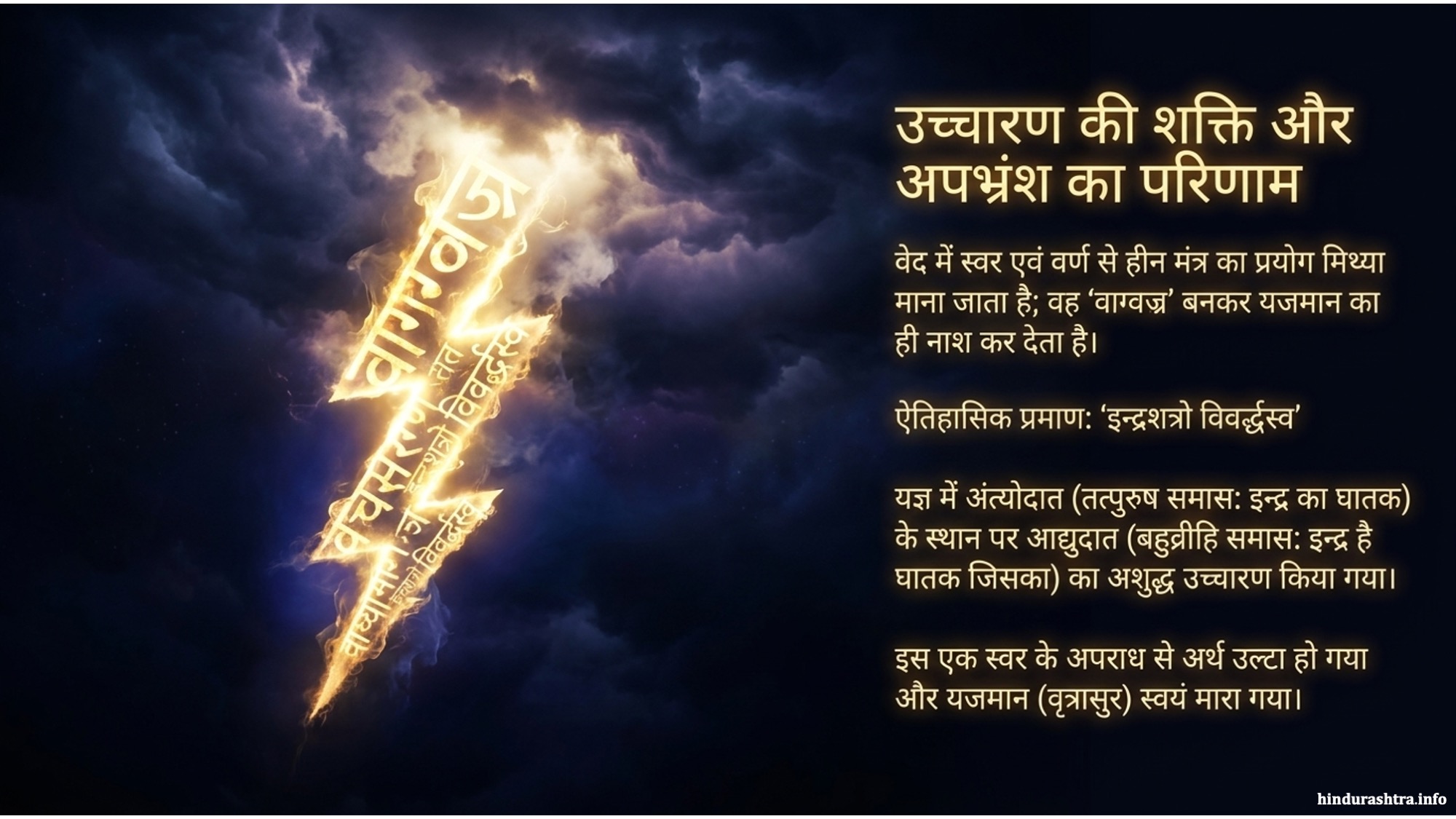
This insistence on precision explains why the grammatical tradition developed such detailed rules for accent, sandhi and derivation. The rules are not ornamental. They protect the integrity of the word-meaning relation across generations of oral transmission. When the rules are neglected, the language drifts into apabhraṃśa. Meanings become unstable and the original force is lost.
The same principle applies outside the strictly ritual context. Everyday speech that grows careless with endings, clusters and distinctions gradually loses the capacity to express fine differences. The process is slow, but the direction is consistent. Precision is original. Carelessness produces simplification and eventual ambiguity.
The story of the misplaced accent is therefore not a piece of mythology offered for belief. It is a concrete illustration of the traditional claim that form and meaning are inseparably bound. Any account of language that treats sound as a rough and changeable label fails to explain why the tradition treated a single accent as capable of reversing the entire effect of a sacred utterance.
The Limits of Physical Science and the Permanent Truth of the Word
Why material explanations stop short of speech and meaning
Physical science describes regularities in the behaviour of matter and energy. It does not explain why those regularities exist, nor does it reach the level of meaning and consciousness. Swami Karpatri Ji notes that even basic biological responses – tears under grief, sweating under fear – are not fully reduced to physical and chemical equations. If science cannot exhaustively explain these simple phenomena, it is still less equipped to explain the origin of structured thought and articulate speech.
The same limitation appears in the study of fundamental forces. Science can describe attraction and repulsion. It cannot say why particles behave in those ways. The descriptions change as new models are proposed. The underlying mystery remains.
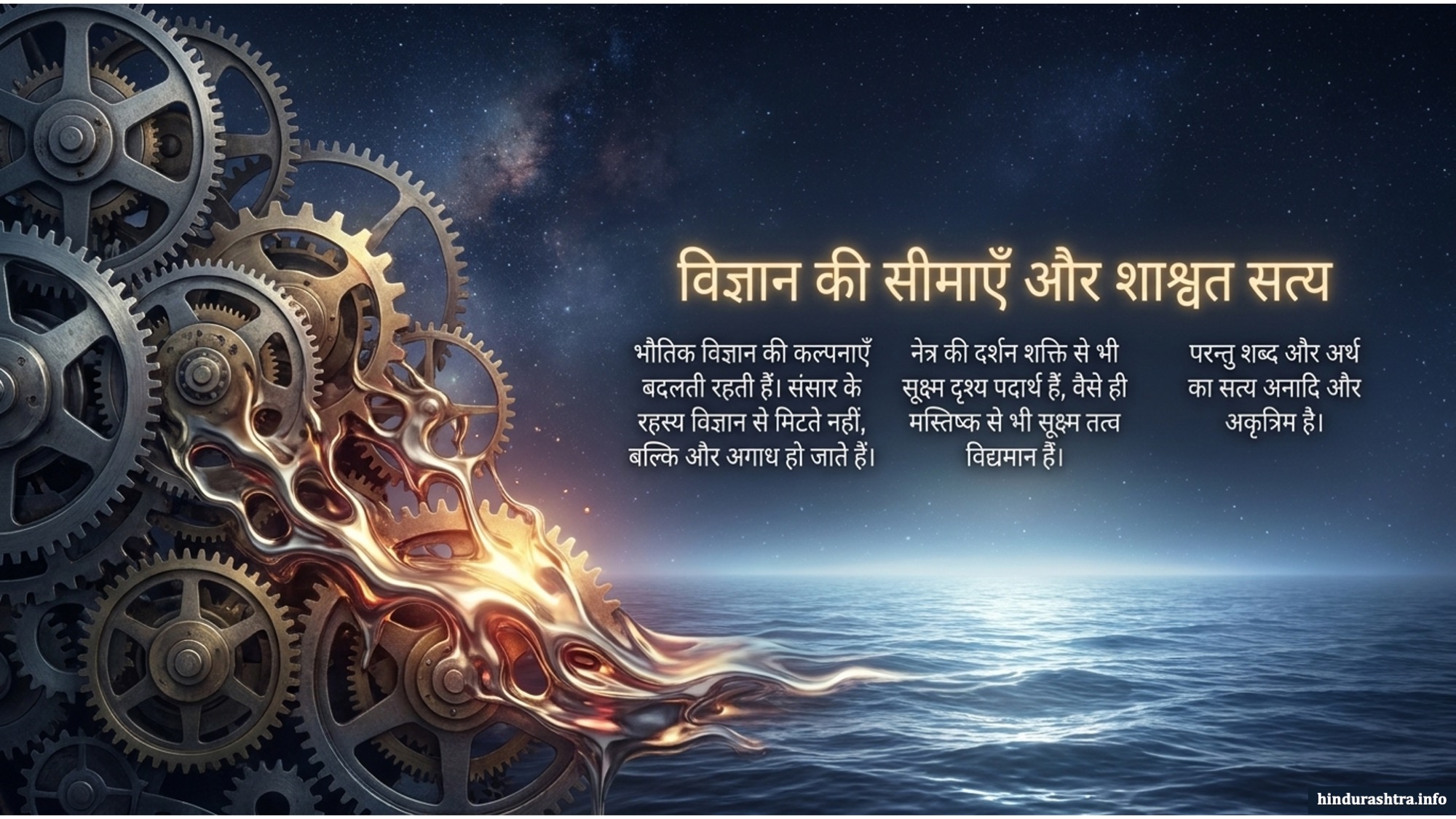
Language and meaning belong to a different order. The bond between a word and its object is not a physical event. It is a relation of knowledge. Because every act of knowledge is already permeated by subtle speech, the attempt to derive speech from purely physical processes begins from the wrong level. The physical description may track the movement of air through the vocal tract. It never reaches the semantic relation that makes the movement a word rather than a noise.
The traditional account therefore does not compete with science on the terrain of physical description. It simply notes that the physical description is incomplete. The permanent truth of the word-meaning relation stands outside the changing hypotheses of material science. That relation is either eternal or established at the origin of a cosmic cycle. In either case it is not a product of the physical processes that science studies.
Once this limit is recognised, the demand that language must have a purely material evolutionary history loses its force. The demand was never required by the evidence. It was an assumption imported from a wider materialist programme. When the assumption is dropped, the classical account of language as an inviolable faculty of consciousness remains coherent and consistent with every observed fact about acquisition, transmission and historical change.
Returning to the Eternal Sound – The Final Orientation
Language as the natural vibration of consciousness
The entire examination leads to a single orientation. Language is not a human invention that slowly improved. It is the natural expressive power of consciousness itself. In the highest formulation this power is called Śabda-Brahman – the Absolute as sound. Word and meaning are not two things later joined. They are two aspects of the same non-dual reality.
All particular languages, all historical changes, and all local conventions are secondary. They rest upon the primary fact that consciousness expresses itself as structured sound. When that expression is carefully preserved, the language remains rich, precise and stable. When it is neglected, the language undergoes phonetic erosion, loss of grammatical distinctions and eventual ambiguity.
The practical consequence is clear. The study of language should not begin with speculative stories about mute ancestors. It should begin with the recognition that speech and knowledge are co-extensive. The empirical record of isolation, the logical impossibility of inventing language from silence, and the historical evidence of morphological decay all confirm the same conclusion.

Swami Karpatri Ji’s analysis, drawn from the classical pramana systems and applied to the modern evolutionary claims, restores that conclusion to view. The Veda is not a late cultural product. It is the primordial expression of the eternal word. The teaching lineage is not a historical accident. It is the means by which the eternal word continues to be heard.
The final movement is therefore a return. Return from the assumption of progressive invention to the recognition of original completeness. Return from the search for material origins to the acknowledgement of the inviolable bond between sound and meaning. Return from the changing hypotheses of physical science to the permanent truth that consciousness and its expression as language have never been separate.
In that return the science of language recovers its proper foundation. It ceases to be a branch of speculative biology and becomes again what the classical tradition always held it to be: the study of the eternal word and of the conditions under which that word is preserved or allowed to decay.