
Vedic Metaphysics versus Western Evolutionary Theories
A Comprehensive Comparative Philosophical Analysis
Vedic Metaphysics versus Western Evolutionary Theories in
Ontology, Epistemology, and Language Origin
- Ontological Foundations: Prime Consciousness (Chetana [चेतन]) versus Material Inertia (Jada [जड])
1.1 Contextual Introduction & Strategic Importance
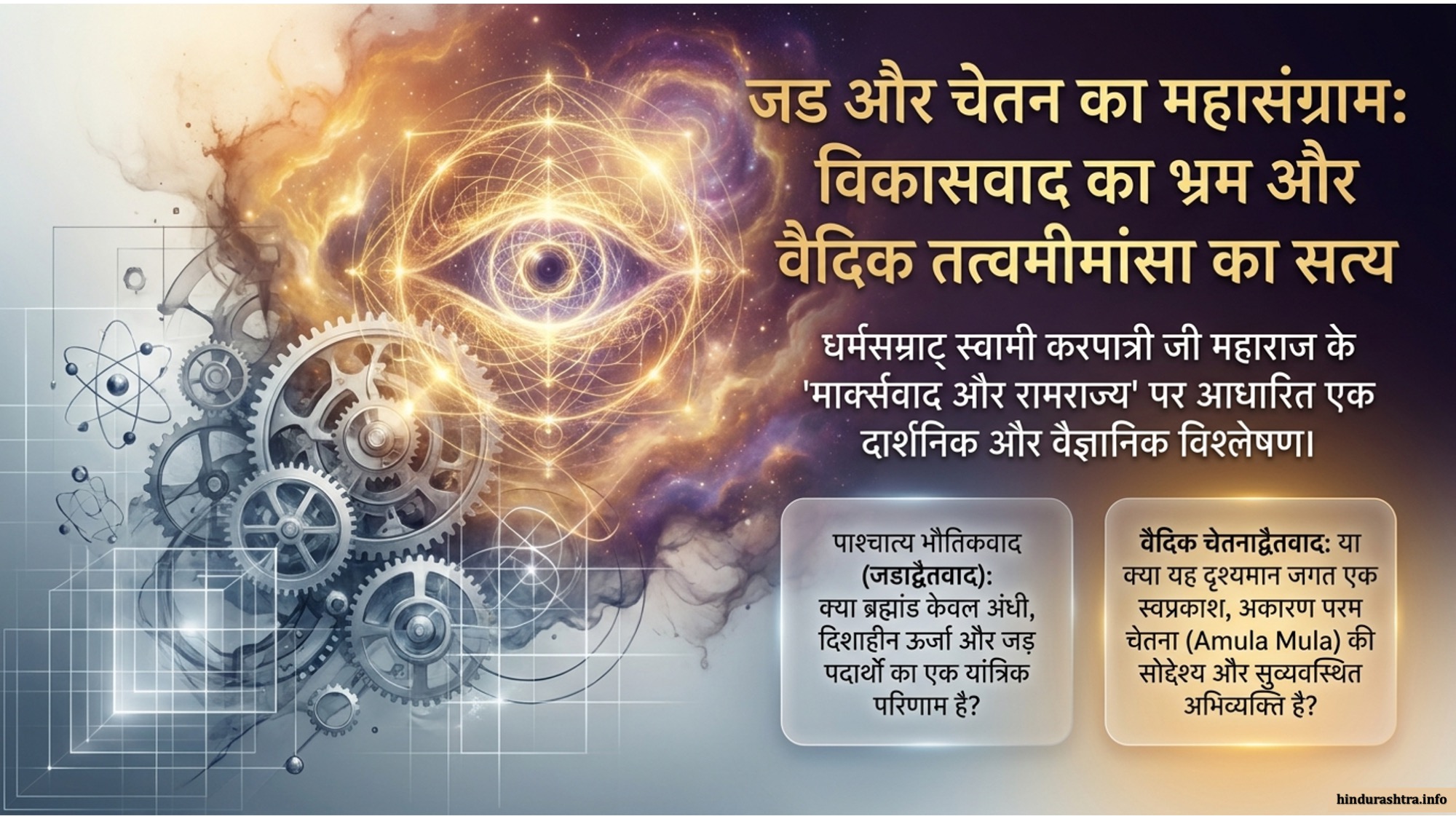
The foundational dichotomy dividing orthodox Vedic ontology from Western evolutionary positivism centers on the prime causal principle of reality: whether the cosmos originates from self-luminous, uncaused Pure Consciousness (Chetana [चेतन]) or from mindless, unguided Material Inertia (Jada [जड]). Establishing this ontological priority is not merely an abstract exercise in scholastic dialectics; it fundamentally determines the civilizational framework through which humanity comprehends existence, agency, ethical responsibility, and cosmic teleology. If primordial reality is reduced to mindless matter or physical force fields, then life, mind, and moral values are demoted to accidental, transient epiphenomena born of mechanical necessity, stripping human existence of intrinsic purpose. Conversely, if primordial reality is established as Pure Consciousness (Chetana [चेतन]), physical matter operates as a dependent, structured manifestation directed by divine teleology and moral order. Through his monumental treatise Marxvaad aur Ramrajya [मार्क्सवाद और रामराज्य], Dharma Samrat Swami Karpatri Ji Maharaj exposes the logical fallacies of materialist models, demonstrating that inert matter can never self-organize into purposeful, complex biological architecture without the eternal oversight of an All-Knowing Controller (Parameshvara [परमेश्वर]).
1.2 Teleological Order and the Impossibility of Unguided Materiality
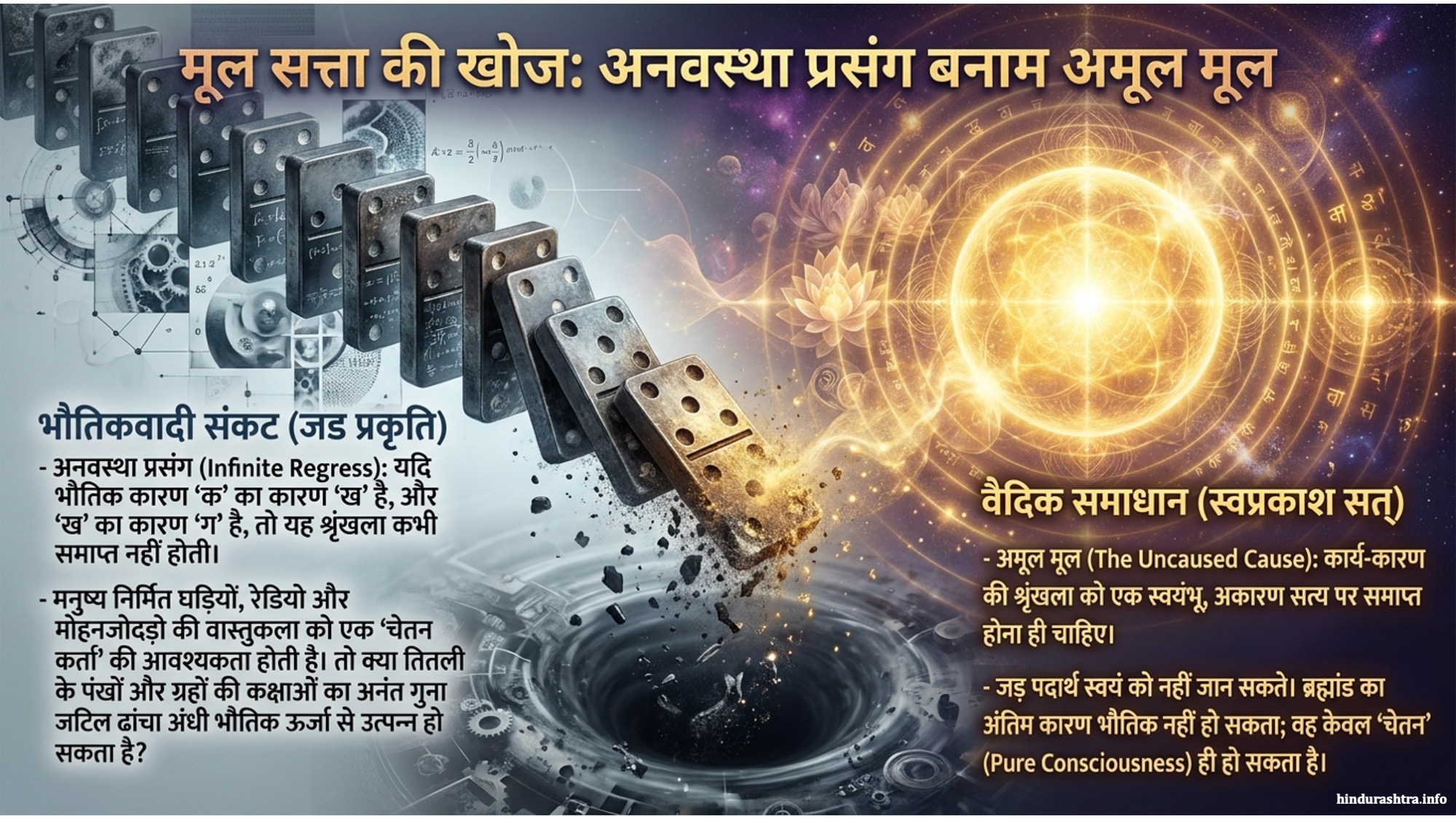
In Marxvaad aur Ramrajya [मार्क्सवाद और रामराज्य], Swami Karpatri Ji Maharaj refutes the materialist assertion that random physical interactions such as atomic collisions, electrical discharges, or unguided natural motion can generate the functional order observed throughout the universe. Karpatri Ji articulates an unshakeable teleological argument anchored in empirical logic: human technological artifacts, including mechanical clocks, railway trains, radios, airplanes, atomic devices, and hydrogen bombs, or the planned urban architecture uncovered at Mohenjodaro [मोहनजोदड़ो] and Harappa [हड़प्पा], undeniably require an intelligent, conscious creator (Chetana Karta [चेतन कर्ता]). Such complex systems can never assemble themselves spontaneously through blind material activity.
By logical necessity, the natural cosmos displays an incomparably higher order of functional complexity, structural balance, and aesthetic design; seen in the delicate chromatic patterns of butterfly wings, the symmetry of flowers, the self-sustaining orbits of planetary systems, and the neurological architecture of the human brain. To assert that simple human tools require a conscious designer while the infinitely more complex machinery of the living cosmos arises spontaneously from mindless physical energy (Jada Prakriti [जड प्रकृति]) constitutes a profound epistemological contradiction.
Karpatri Ji deconstructs materialist causality by establishing the Vedantic doctrine of Self-Luminous Pure Existence (Swaprakasha Sat [स्वप्रकाश सत्]) as the ultimate uncaused ground (Amula Mula [अमूल मूल]). Tracing causality back through material atoms or physical energy fields without accepting a primary conscious cause results in an infinite regress (Anavastha Prasanga [अनवस्था प्रसंग]). If material cause A requires material cause B, which requires cause C ad infinitum, cause and effect are never epistemologically grounded, rendering rational explanation impossible. To eliminate Anavastha Prasanga [अनवस्था प्रसंग], cause-and-effect chains must terminate in an uncaused, self-existent primary reality (Amula Mula [अमूल मूल]). Because physical matter is inherently insentient and requires observation to be known, this ultimate uncaused ground cannot be physical; it must be Self-Luminous Pure Consciousness (Chetana [चेतन]).
|
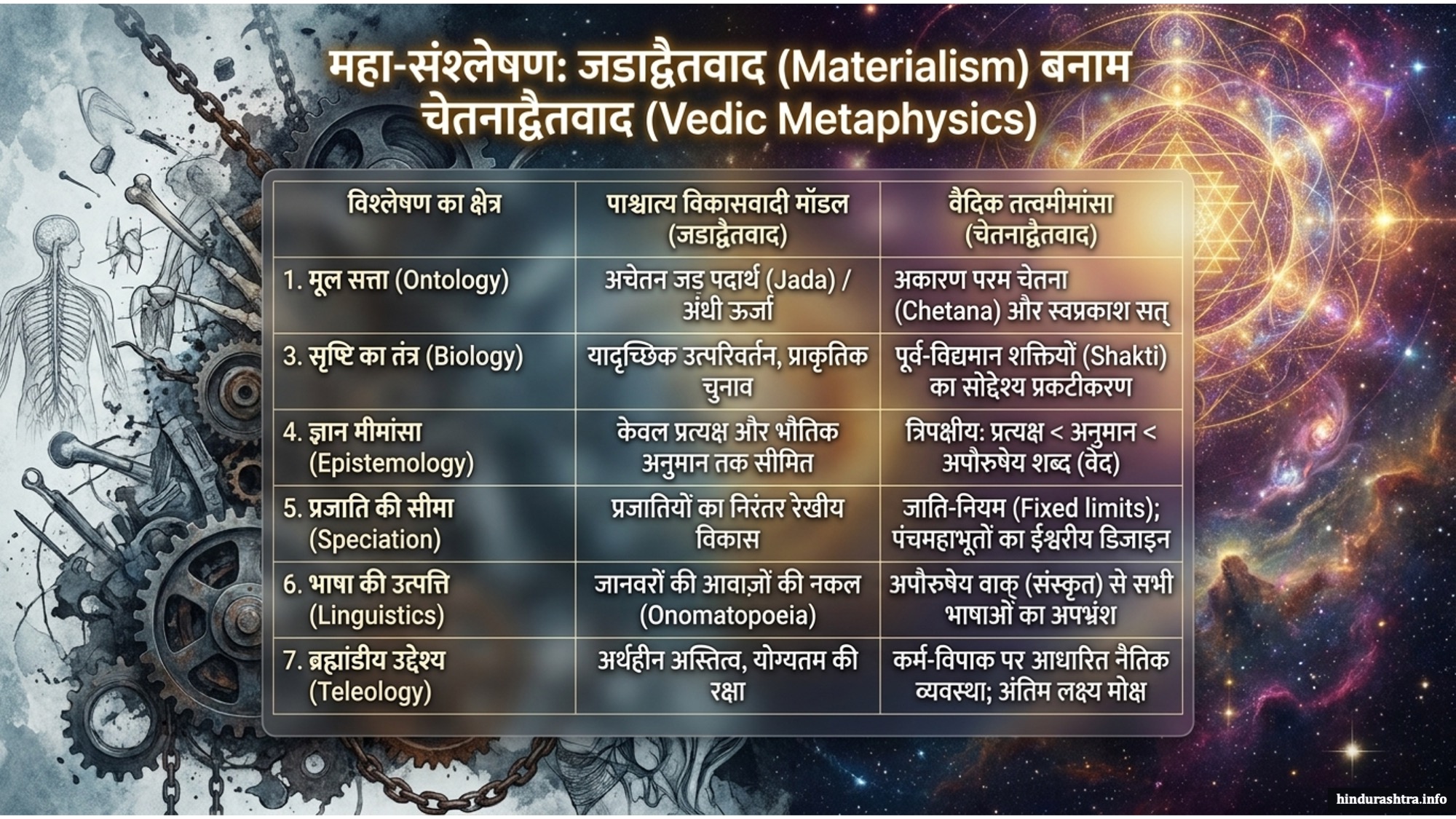
Analytical Category |
Western Materialist Model (Jadadvaitavada [जडाद्वैतवाद]) |
Vedic Vedantic Model (Chetanadvaitavada [चेतनाद्वैतवाद]) |
|
Ultimate Reality |
Mindless, inert Matter (Jada [जड]) or physical energy (Ether / Electron). |
Uncaused Pure Consciousness (Chetana [चेतन]) and Pure Being (Swaprakasha Sat [स्वप्रकाश सत्]). |
|
Cause of Complexity |
Random atomic collisions, natural selection, unguided physical mechanics. |
Intentionally governed manifestation (Ikshana [ईक्षण]) driven by Divine Will (Parameshvara [परमेश्वर]). |
|
Nature of Mind |
Epiphenomenon or emergent byproduct of physical brain activity (Mastishka [मस्तिष्क]). |
Independent inner instrument (Antahkarana [अन्त:-करण]) illuminated by the Soul (Atma [आत्मा]). |
|
Mechanism of Creation |
Linear material transformation (Utkrantivada [उत्क्रान्तिवाद]) from simple to complex forms. |
Cyclical projection (Srishti-Samhara [सष्टि-संहार]) of latent subtle potencies (Shakti [शक्ति]). |
|
Status of Moral Values |
Subjective human constructs; social conventions born of survival instincts. |
Eternal objective laws (Dharma [धर्म]) embedded in the moral structure of the cosmos. |
|
Scope of Human Agency |
Deterministic physical output governed by neurochemical interactions. |
Free will operating within karmic parameters (Karma-Yoni [कर्मयोनि]) seeking liberation (Moksha [मोक्ष]). |
|
Ultimate Cosmic Trajectory |
Entropy, random dissolution, and the annihilation of conscious experience. |
Continuous cyclical harmony (Yuga-Chakra [युग-चक्र]) returning to Supreme Unity. |
1.3 The Tripartite Nature of Primordial Nature (Triguna [त्रिगुण]) and Self-Luminous Being
To explain physical manifestation without succumbing to reductive materialism, Karpatri Ji unpacks the Samkhya-Vedanta (Samkhya-Vedanta [सांख्य-वेदान्त]) cosmological model. Primordial Nature (Prakriti [प्रकृति]) is constituted by three structural attributes (Triguna [त्रिगुण]):
- Luminosity / Purity (Sattva [सत्त्व]): The principle of light, knowledge, clarity, and manifestation.
- Motion / Activity (Rajas [रजस्]): The principle of impulse, dynamic force, transformation, and movement.
- Inertia / Obstruction (Tamas [तमस्]): The principle of mass, resistance, stability, and structural boundary (Avashtambha [अवष्टम्भ]).
Karpatri Ji demonstrates that no entity can manifest in either the unmanifest state (Avyakta [अव्यक्त]) or manifest state (Vyakta [व्यक्त]) without the simultaneous operation of all three attributes. Sattva [सत्त्व] provides illumination and conceptual clarity, Rajas [रजस्] supplies dynamic movement, and Tamas [तमस्] provides necessary physical resistance (Avashtambha [अवष्टम्भ]) to hold the form together. Karpatri Ji illustrates this with the carpenter analogy: a carpenter possesses knowledge (Sattva [सत्त्व]) and applies physical movement (Rajas [रजस्]) with his tools to shape wood into a cabinet. However, if there were no physical resistance or stopping boundary (Tamas [तमस्]), the chisel would move continuously through the material, reducing the wood to fine dust and destroying the product. Continuous motion without structural inertia annihilates functional form.

Crucially, Karpatri Ji emphasizes that while Prakriti [प्रकृति] contains these dynamic attributes, material nature remains completely insentient (Jada [जड]) and unmanifest without the illuminating proximity of Consciousness (Chetana [चेतन]). Matter cannot experience or direct its own operations. Consciousness is not an emergent property born of physical combinations, just as heat is not an inherent property of an iron ball. When an iron ball is placed in fire, it glows and radiates heat; yet the heat and light belong strictly to the fire (Agni [अग्नि]), not to the iron. Similarly, the physical body and brain display intelligence and activity only because they are pervaded by the proximate illumination of the self-luminous Soul (Atma [आत्मा]).
1.4 The Irreducibility of the Witnessing Soul (Sakshi Atma [साक्षी आत्मा])
Karpatri Ji presents a rigorous refutation of materialist monism (Jadadvaitavada [जडाद्वैतवाद]), particularly as advanced by Ernst Haeckel and 19th-century European positivists who claimed that mental operations are merely physiological secretions of the physical brain. Karpatri Ji deconstructs this error by establishing the absolute epistemological distinction between the Observer (Pramata [प्रमाता]) and the Observed Object (Prameya [प्रमेय] / Drishya [दृश्य]).
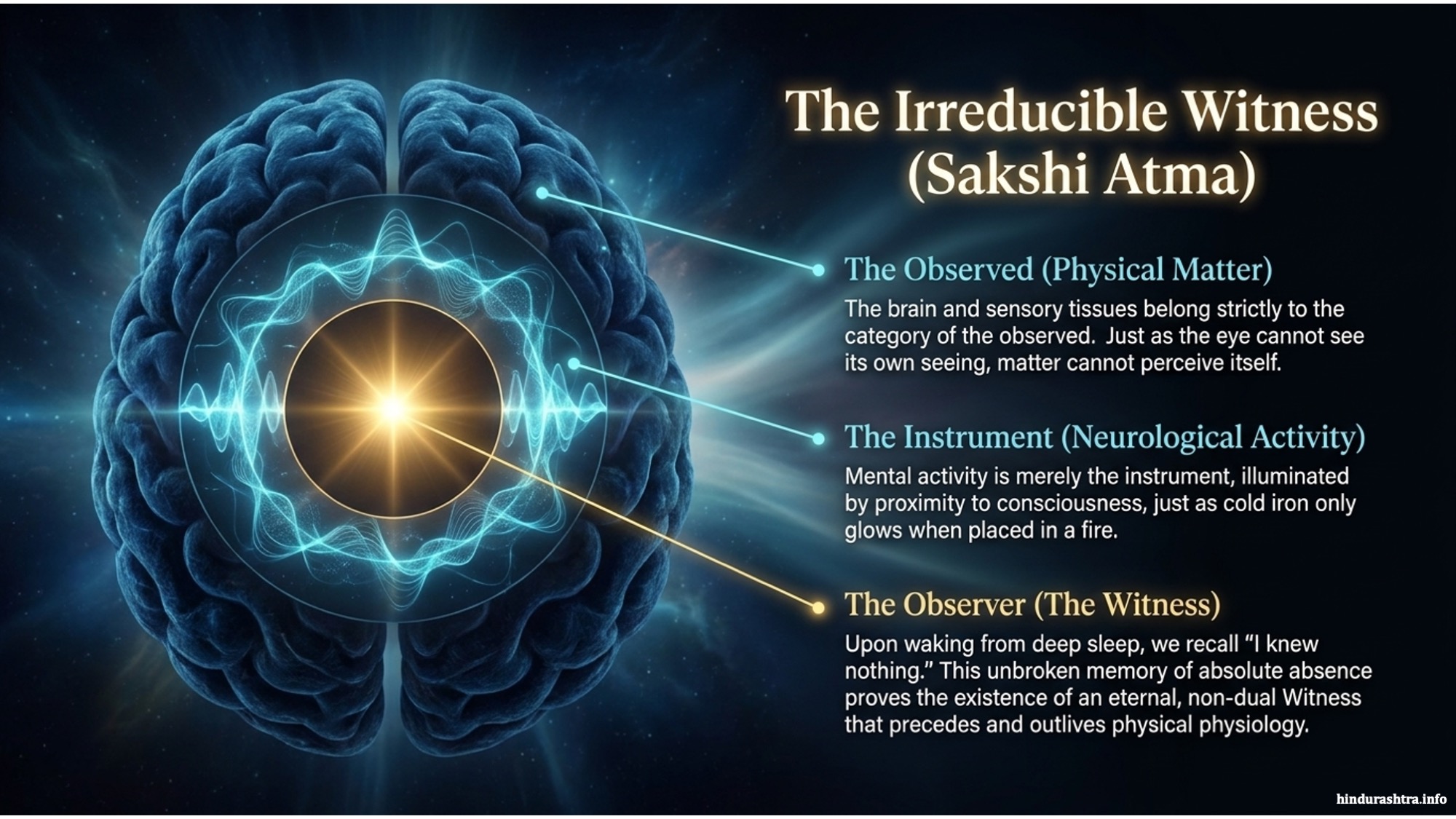
Physical matter, the brain, bodily tissues, and sensory organs fall strictly under the category of the Observed (Prameya [प्रमेय]). An object of observation can never transform into the subject that observes it. The eye perceives external objects, but the eye cannot perceive its own seeing; the intellect perceives thoughts, but the witnessing awareness (Sakshi [साक्षी]) perceives the presence or absence of thoughts. Therefore, the conscious Knower (Pramata [प्रमाता]) is irreducible to the observed material object (Prameya [प्रमेय]).
Furthermore, Karpatri Ji highlights the unchanging nature of the Witnessing Soul (Sakshi Atma [साक्षी आत्मा]) across the three mutually exclusive states of human experience:
- Waking State (Jagrat [जाग्रत्]): Awareness experiences external physical objects through physical sensory organs.
- Dreaming State (Swapna [स्वप्न]): Sensory organs are inactive; awareness witnesses internally projected subtle images and mental impressions.
- Deep Sleep State (Sushupti [सुषुप्ति]): Physical senses and mental projections vanish entirely into unmanifest stillness. Upon waking, an individual recalls, “I slept peacefully; I knew nothing.”
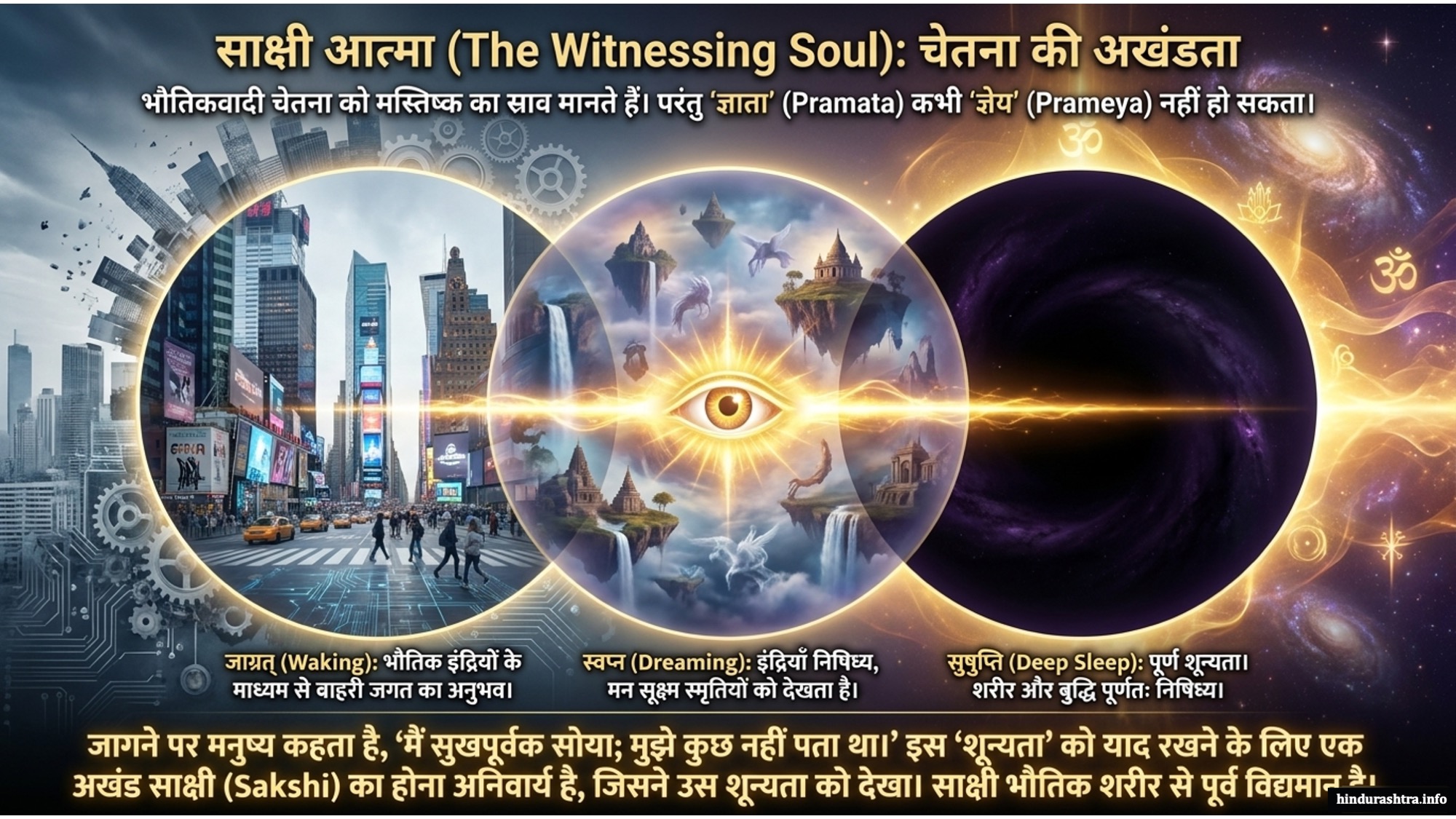
Karpatri Ji analyzes this memory of deep sleep as profound epistemological proof. For an individual to remember that “nothing was known” in deep sleep, there must exist an unbroken Witness (Sakshi [साक्षी]) that observed the total absence of mental activity and sensory input. The physical body was dormant; the intellect was inactive; yet Consciousness remained continuously present as a non-dual observer. This irreducible Witness (Sakshi Atma [साक्षी आत्मा]) precedes physical physiology, proving that Consciousness is the ultimate primary reality upon which all material phenomena depend.
Having established the absolute ontological priority of Pure Consciousness over material inertia, the analysis logically proceeds to evaluate the epistemological instruments (Pramana [प्रमाण]) required to acquire uncontradicted knowledge of this transcendent reality.
- Epistemological Frameworks: Direct Perception (Pratyaksha [प्रत्यक्ष]), Inference (Anumana [अनुमान]), and Divine Word (Shabda Pramana [शब्दप्रमाण])
2.1 Contextual Introduction & Strategic Importance
An ontological claim is only as valid as the epistemological instrument (Pramana [प्रमाण]) used to establish it. The fundamental crisis of Western empiricism and materialist evolutionism lies in their self-imposed cognitive restriction: limiting valid knowledge exclusively to physical sense perception (Pratyaksha [प्रत्यक्ष]) and materialist inference (Anumana [अनुमान]). Vedic philosophy, as articulated by Swami Karpatri Ji Maharaj, structures epistemological inquiry through a rigorous hierarchy of Pramanas [प्रमाण], demonstrating that physical sense organs are structurally equipped to perceive only gross, external surfaces. To evaluate transcendent causality, moral laws (Dharma [धर्म]), and absolute consciousness, human intellect must rely upon unauthored, divine revelation (Apaurusheya Shabda Pramana [अपौरुषेयशब्द प्रमाण]). Exposing the internal contradictions of pure empiricism is therefore essential to restore a valid methodology for knowing truth.
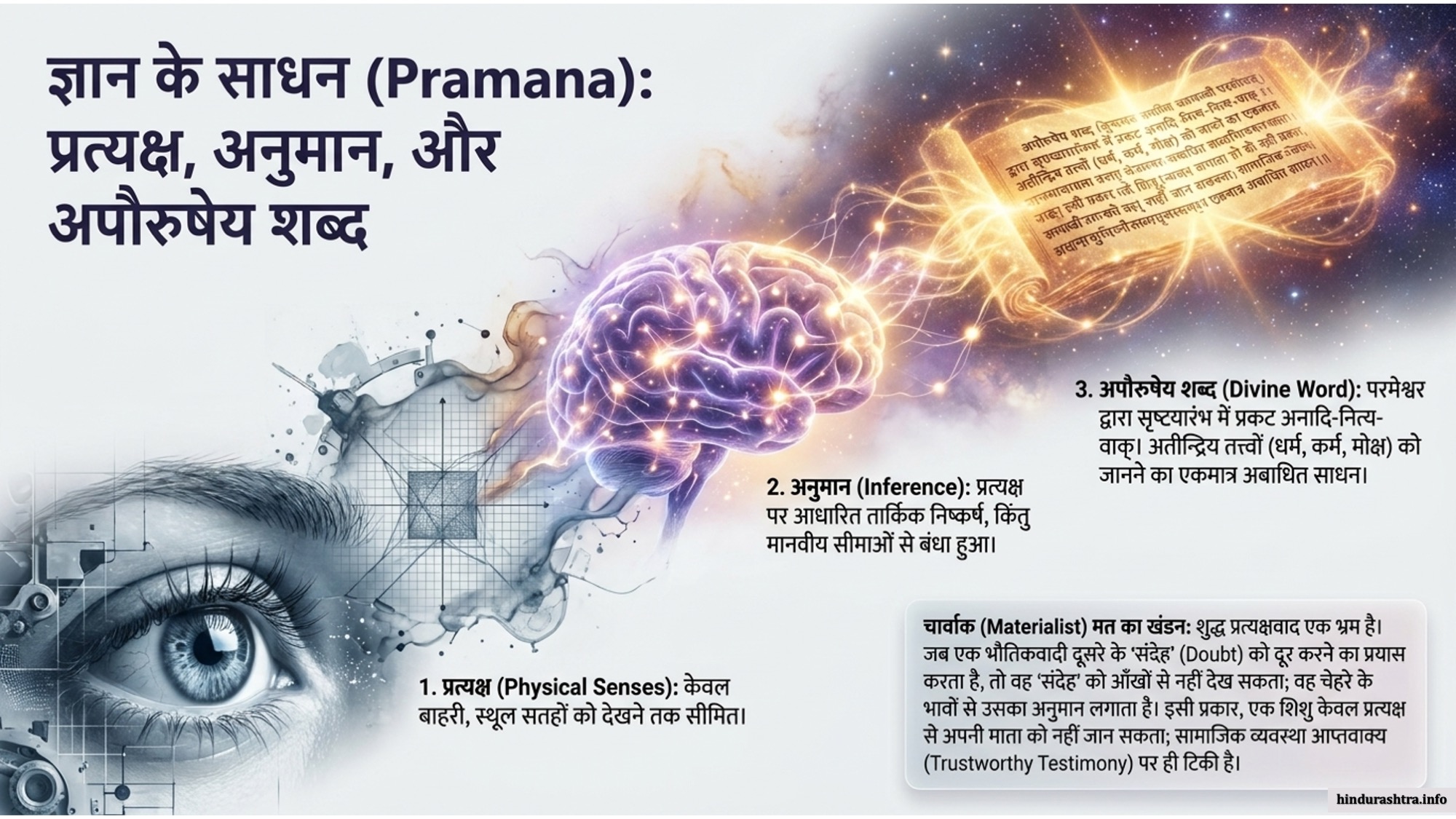
2.2 Critique of Pure Empiricism (Charvaka [चारवाक] / Materialist Positivism)
Swami Karpatri Ji Maharaj systematically deconstructs the logical fallacies inherent in pure empirical positivism (Pratyaksha-matra-vada [प्रत्यक्षमात्रवाद]), historically championed in India by the Charvaka [चारवाक] school and in the West by radical empiricists. Pure empiricism asserts that physical perception (Pratyaksha [प्रत्यक्ष]) is the sole valid source of knowledge, rejecting non-sensory inference and verbal testimony as unscientific.
Karpatri Ji exposes the immediate self-refutation of this stance: even a strict Charvaka [चारवाक] or materialist positivist is forced to rely continuously upon Inference (Anumana [अनुमान]) in daily life and academic discourse. When a materialist philosopher speaks to an audience or refutes an opponent, he does so to resolve the opponent’s internal mental state of ignorance (Ajnana [अज्ञान]), doubt (Samshaya [संशय]), error (Bhramanti [भ्रान्ति]), or curiosity (Jijnasa [जिज्ञासा]). However, another person’s internal mental state is completely imperceptible (Apratyaksha [अप्रत्यक्ष]) to external physical senses. An empiricist cannot see or touch another person’s doubt. To acknowledge that the listener possesses doubt, the empiricist must infer it through facial expressions, vocal tones, and physical gestures (Mukhakriti / Vagvyavahara [मुखाकृति / वाग्व्यवहार]). Thus, the moment an empiricist opens his mouth to instruct another, he abandons pure empiricism and relies on Inference (Anumana [अनुमान]).
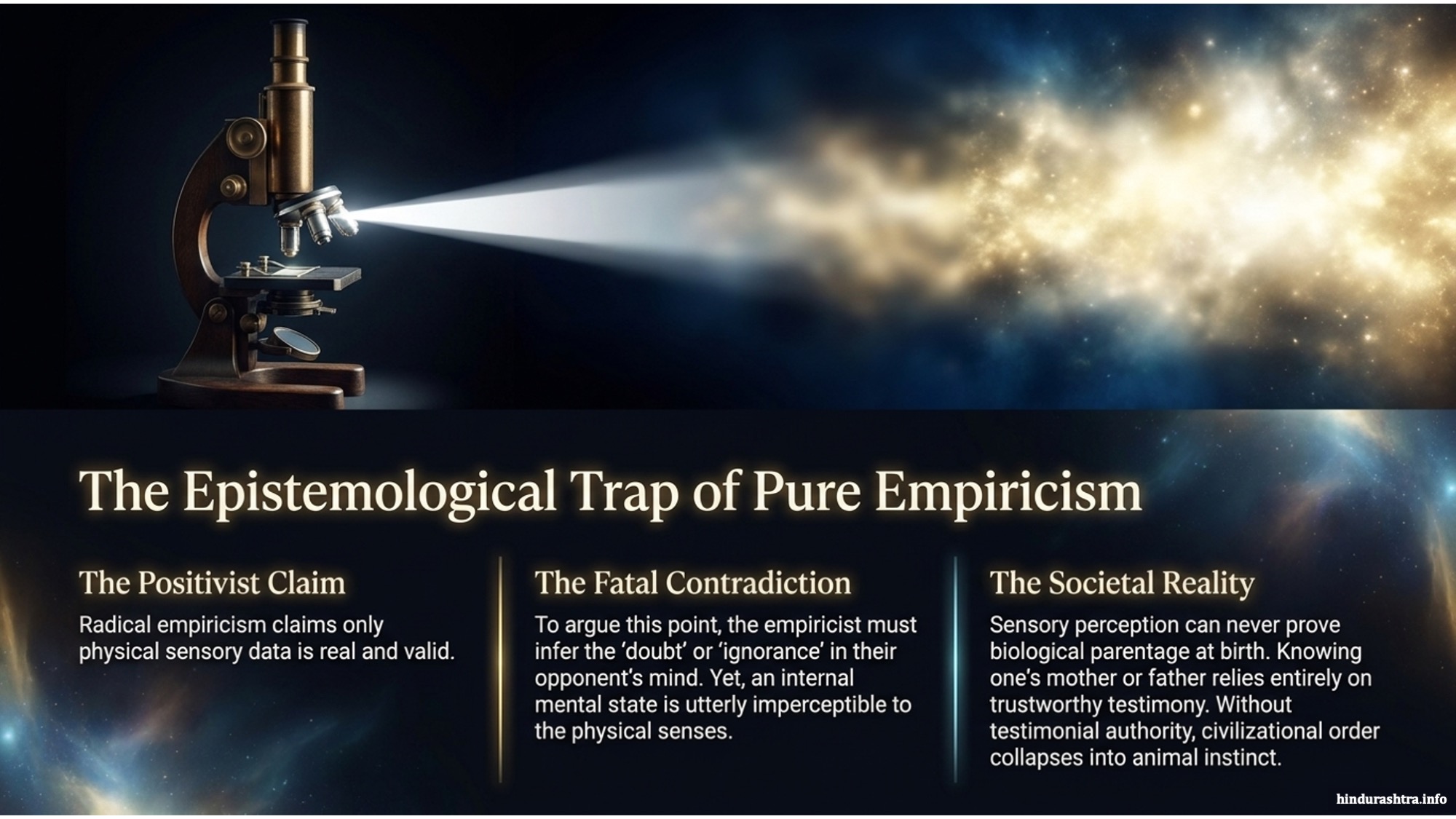
To further demonstrate the absolute necessity of testimonial authority (Shabda Pramana [शब्द प्रमाण]), Karpatri Ji presents a socio-legal argument regarding biological lineage and heritage. Direct sensory perception (Pratyaksha [प्रत्यक्ष]) can never establish an individual’s mother or father. An infant’s physical senses cannot verify its own birth or biological parentage at the moment of delivery. To know one’s mother, an individual relies entirely upon trustworthy testimony (Apta-vakya [आप्तवाक्य] / Shabda [शब्द]). To know one’s father, one must rely upon the mother’s word. If human beings rejected all testimony and insisted strictly on direct empirical verification, social order, civil governance, and legal inheritance would collapse. Karpatri Ji contrasts human civilizational conduct, guided by trustworthy testimony (Apta-vakyas [आप्तवाक्य]) with animal instinct. Animals lack access to verbal testimonial frameworks (Shabda-pramana-rahita [शब्द-प्रमाण-रहित]); consequently, they lack awareness of lineage, engaging in indiscriminate reproduction. Humans are distinguished precisely because their knowledge transcends immediate empirical sensation through verbal testimony (Shabda Pramana [शब्द प्रमाण]).
2.3 Epistemology of the Witness (Sakshi [साक्षी]) and Uncontradicted Awareness
Karpatri Ji clarifies that every valid act of knowledge (Pramiti [प्रमिति]) requires three irreducible components:
- The Subject / Knower (Pramata [प्रमाता]): The conscious self, the one seeking knowledge.
- The Instrument / Means of Knowledge (Pramana [प्रमाण]): The sensory or intellectual mechanism deployed.
- The Object of Knowledge (Prameya [प्रमेय]): The physical or subtle entity being known.
Karpatri Ji points out a fatal epistemological error in materialist thought: demanding empirical proof (Pramana [प्रमाण]) for the Knower (Pramata [प्रमाता]) itself. The conscious Knower self-evidently precedes the search for proof. Before any empirical instrument (Pramana [प्रमाण]) can be deployed, the conscious subject (Pramata [प्रमाता]) must already exist to deploy it. If one demands a separate proof to validate the Knower, a second Knower is required to validate that proof, and a third to validate the second, resulting in an infinite regress (Anavastha [अनवस्था]). The Knower is self-luminous (Swaprakasha [स्वप्रकाश]) and self-proven.
Furthermore, Karpatri Ji synthesizes the Vedantic principle of absolute non-negation (Abadhita Samvit [अबाधित संवित्]). Materialists argue that consciousness can be reduced to zero or proven non-existent. Karpatri Ji demonstrates that the total absence of consciousness can never be established. To prove the absence (Abhava [अभाव]) of anything, a conscious witness (Sakshi [साक्षी]) must be present to perceive that absence. If awareness were truly absent, who would perceive or report its absence? The act of asserting “there is no consciousness” requires active awareness to make the assertion. Therefore, Consciousness (Samvit [संवित्]) is non-negatable (Abadhita [अबाधित]), infinite, and uncaused (Anadi-Ananta [अनादि-अनन्त]).
2.4 The Authority of Unauthored Divine Revelation (Apaurusheya Shabda [अपौरुषेय शब्द])
Vedic metaphysics structures valid knowledge through an explicit hierarchy of cognitive sources:
Indriya [इन्द्रिय] (Physical Senses) à Anumana [अनुमान] (Inference) à Apaurusheya Shabda [अपौरुषेय शब्द] (Unauthored Divine Revelation).
Direct sensory perception (Indriya [इन्द्रिय]) is limited to visible, gross physical surfaces. Inference (Anumana [अनुमान]) extends sensory data through logical deduction, but remains bounded by human intellectual limitations and fallible premises. Consequently, empirical physical science (relying solely on sensory observation and human inference) undergoes continuous paradigm shifts, internal contradictions, and self-refutations. To illustrate the inherent instability of empirical science, Karpatri Ji quotes prominent 20th-century Western physicists such as J.J. Thomson and Frederick Soddy, who openly acknowledged that whenever physical science unlocks a small natural mystery, vastly deeper and more baffling mysteries immediately emerge, proving that physical nature (Prakriti [प्रकृति]) is unbounded and inscrutable to human physical intellect alone.
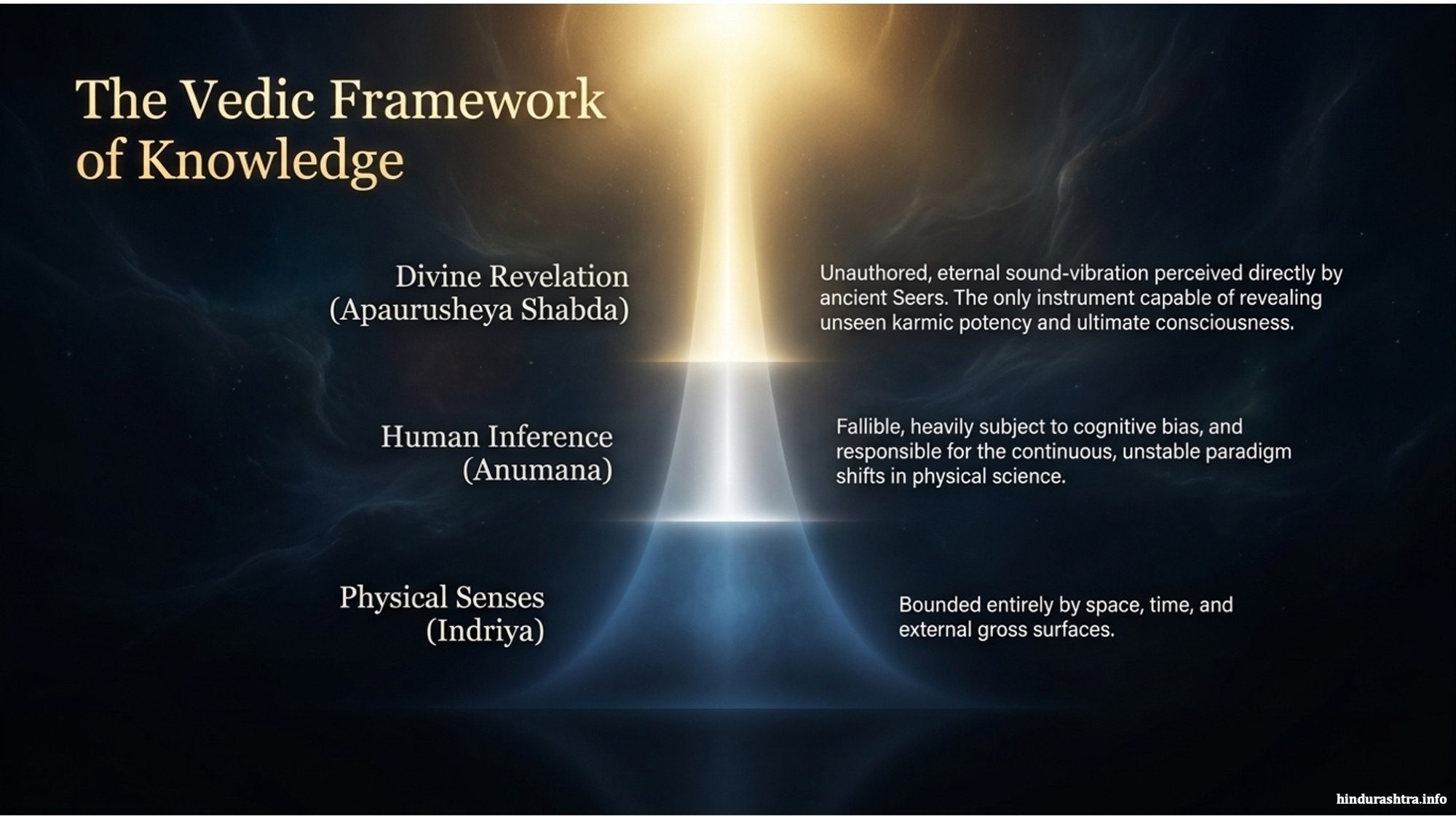
To access uncontradicted, transcendent truths regarding cosmic causality, the mechanics of Karma [कर्म], post-mortem states, and absolute reality (Brahman [ब्रह्म]), human intellect requires Unauthored Divine Revelation (Apaurusheya Shabda [अपौरुषेय शब्द]). Karpatri Ji defines the Vedic scriptures as unauthored (Apaurusheya [अपौरुषेय]) because they are not the intellectual compositions of fallible human authors (Purushas [पुरुष]). Rather, they represent eternal, subtle sound-vibrations (Anadi-Nitya-Vak [अनादि-नित्य-वाक्]) projected by the Supreme Being (Parameshvara [परमेश्वर]) at the dawn of cosmic creation, perceived directly by ancient Seers (Rishis [ऋषि]).
These Seers did not invent the Veda through mental imagination; instead, through the refined intuitive faculty of Truth-Bearing Wisdom (Ritambhara Pragya [ऋतम्भरा प्रज्ञा]) developed during non-dual meditative absorption (Nirvikalpa Samadhi [निर्विकल्प समाधि]), they directly perceived the eternal structure of cosmic reality (Rta [ऋत]).
- Empirical Scientific Inference (Anumana [अनुमान]):
- Originates from fallible, human sensory observation (Indriya-Jnana [इन्द्रिय-ज्ञान]).
- Subject to continuous historical refutation, cognitive bias, and changing hypotheses.
- Restricted entirely to gross, physical matter (Prameya [प्रमेय]) within space-time.
- Incapable of knowing moral law (Dharma [धर्म]), unseen karmic potency (Adrishta [अदृष्ट]), or ultimate consciousness.
- Vedic Divine Testimony (Shabda Pramana [शब्द प्रमाण]):
- Originates from unauthored, eternal vibration (Apaurusheya Vak [अपौरुषेय वाक्]) projected by Parameshvara [परमेश्वर].
- Immutable, eternally uncontradicted (Abadhita [अबाधित]), and free from human cognitive error (Paurushya-Dosha [पौरुषेय-दोष]).
- Directly reveals transcendent, supra-sensory realities (Atindriya Tattva [अतीन्द्रिय तत्त्व]).
- Provides the definitive normative framework for human action, spiritual practice, and cosmic liberation (Moksha [मोक्ष]).
By establishing that empirical observation is structurally incapable of assessing primordial causality or transcendent design, Karpatri Ji lays the epistemological foundation for a direct critique of Charles Darwin’s evolutionary biology.
- Biological Evolution under Scrutiny: Refuting Darwinism through Vedic Causality
3.1 Contextual Introduction & Strategic Importance
The publication of Charles Darwin’s Origin of Species marked a pivotal shift in Western science, attempting to replace divine creation with unguided material mechanics. Darwinism posits that all biological diversity arose from primitive single-celled organisms through random variations, natural selection, and a brutal competition for survival. In Marxvaad aur Ramrajya [मार्क्सवाद और रामराज्य], Swami Karpatri Ji Maharaj subjects Darwinian evolutionary theory to a comprehensive logical, empirical, and philosophical critique. Karpatri Ji demonstrates that Darwinian mechanics are epistemologically flawed, logically self-contradictory, and empirically refuted by biological realities. By upholding the Vedic doctrine of eternal causal potency (Shakti [शक्ति]) and fixed species categories (Jati-Niyama [जाति-नियम]), Karpatri Ji dismantles the materialist attempt to reduce life to a mindless struggle for existence.
3.2 Deconstructing Darwin’s Core Mechanics: Malthusian Competition and Natural Selection
Swami Karpatri Ji Maharaj outlines Darwin’s observational model as presented in the source text:
- Geometric Population Growth vs. Arithmetic Food Supply: Darwin adopted Thomas Malthus’s demographic theory, observing that living organisms reproduce geometrically (1, 2, 4, 8, 16…), whereas food resources increase only arithmetically (1, 2, 3, 4…).
- Universal Struggle for Existence (Jivana-sangharsha [जीवन-संघर्ष]): This demographic imbalance forces all living organisms into a relentless conflict for limited physical resources.
- Survival of the Fittest (Yogyatama ki Raksha [योग्यतम की रक्षा]): In this conflict, organisms possessing favorable physical variations survive and reproduce, while weaker organisms are eliminated by Natural Selection (Prakritik Chunav [प्राकृतिक चुनाव]). Over vast epochs, these accumulated variations generate entirely new species.
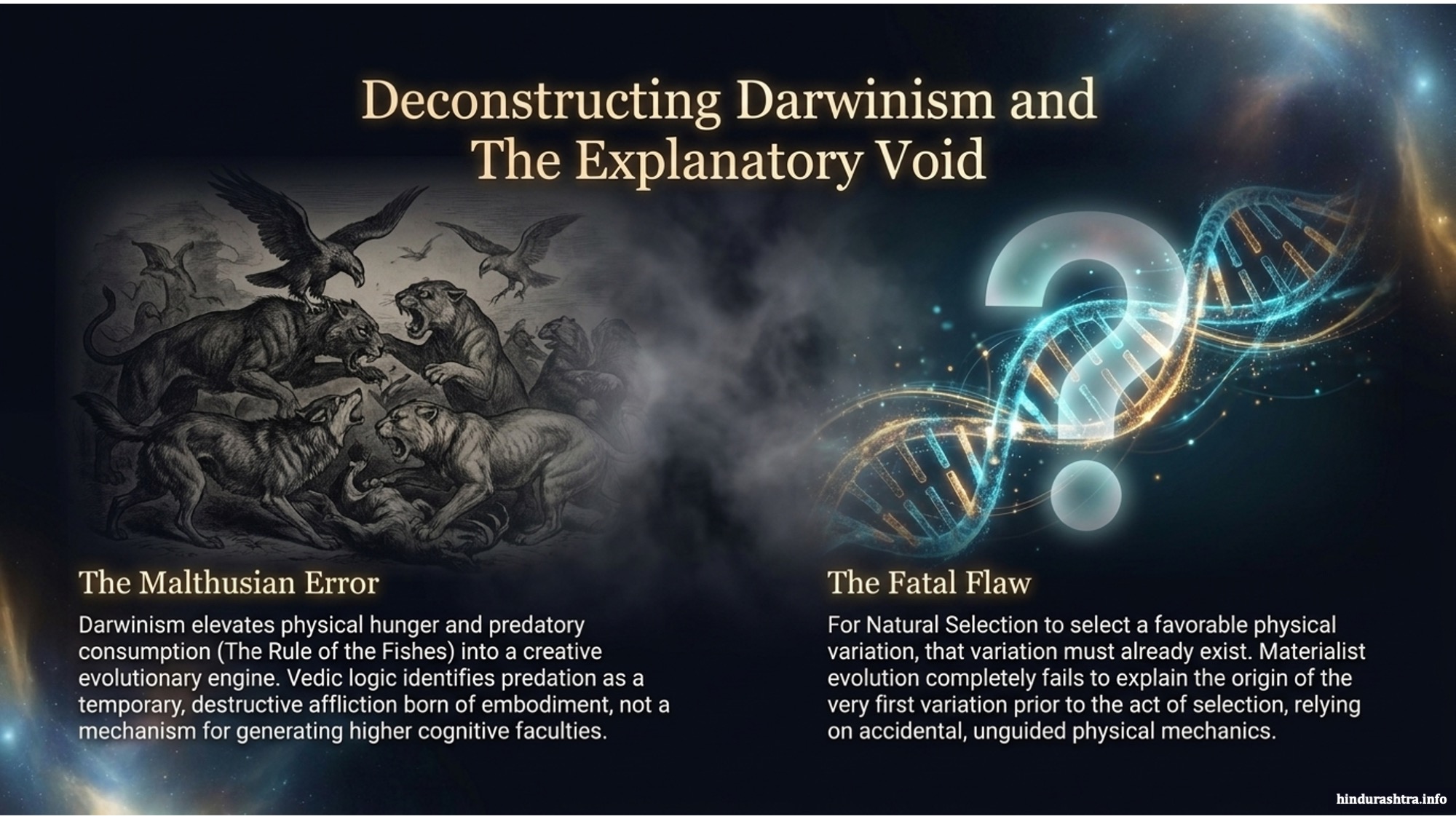
Karpatri Ji delivers a profound philosophical counter-argument to this materialist premise. He asserts that the struggle for existence driven by physical hunger (Kshudha [क्षुधा]) is an incidental, temporary affliction (Upadrava [उपद्रव]) born of Ignorance (Avidya [अविद्या]), Egoic Desire (Kama [काम]), and Past Moral Actions (Karma [कर्म]). It is not the eternal, intrinsic nature of living beings. Essential spiritual nature is divine, immortal, and unified (as declared by the Upanishadic revelation): “Children of Immortality” (Amritasya Putrah [अमृतस्य पुत्रा:]). Innate spiritual reality is characterized by essential oneness, harmony, and mutual compassion, whereas conflict and predatory survival are temporary distortions resulting from physical embodiment (Dehadhyasa [देहाध्यास]).
To evaluate predatory behavior in nature, Karpatri Ji references the classic “Mincemeat/Raisin Experiment” (Munakka Insect Container Example [मुनक्का उदाहरण]): if a quantity of dried raisins or sweet mincemeat is sealed inside a jar, tiny insects spontaneously manifest within it over time. As their population expands rapidly within the closed container, they begin consuming one another due to food exhaustion; the strong devour the weak until only a single large insect remains. Karpatri Ji identifies this predatory dynamic as the ancient aquatic principle; the Rule of the Fishes (Matsyanyaya [मत्स्यन्याय]), explicitly documented in the Srimad Bhagavatam [श्रीमद्भागवतम्]:
अहस्तानि सहस्तानामपदानि चतुष्पदाम्। फल्गूनि तत्र महतां जीवो जीवस्य जीवनम्॥ (Ahastani sahastanam apadani chatuspadam | Phalguni tatra mahatam jivo jivasya jivanam ||) – Srimad Bhagavatam [श्रीमद्भागवतम्] (1.13.47) “Limbless entities are food for hand-bearing entities; legless entities are devoured by four-legged beasts; the weak are consumed by the powerful. Indeed, one living entity serves as the sustenance of another.”
Crucially, Karpatri Ji points out that while predatory consumption occurs in the physical world when organisms are driven by physical hunger; which the Veda identifies as death itself (Ashanaya vai Mrityuh [अशनाया वै मृत्यु:]), this predatory consumption is purely destructive. Hunger-driven conflict does not possess creative force. Devouring another organism does not generate new physiological organs, higher cognitive faculties, or distinct species forms. Predation is a symptom of physical limitation, not the creative engine of biological transformation.
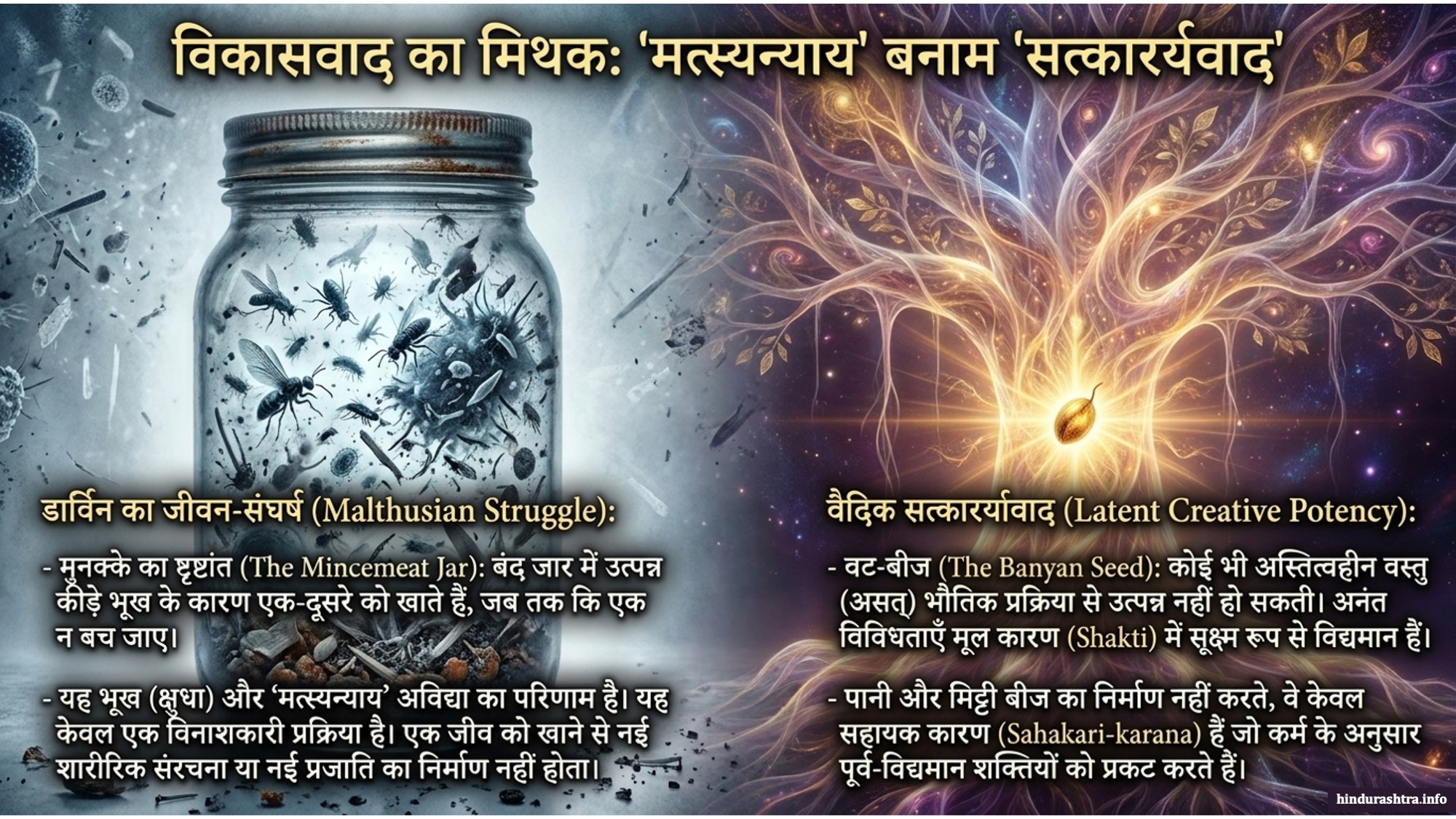
3.3 The Problem of Initial Variation and Unseen Causal Potency (Shakti [शक्ति])
Karpatri Ji exposes a fatal logical flaw in the foundational structure of Darwinian evolution: its total inability to explain the origin of the first variation among individual organisms.
For Natural Selection (Prakritik Chunav [प्राकृतिक चुनाव]) to select a favorable trait, that trait must already exist within the individual. When Darwinism is pressed to explain where the very first variation originated before selection could act upon it, the theory falters, attributing initial variations to blind environmental conditions, climate variations, or organ use and disuse. Karpatri Ji highlights that when evolutionary theory reaches the ultimate origin of individual variations, its explanatory framework breaks down completely.
In contrast, Vedic philosophy resolves the problem of variation through the foundational doctrine of Pre-existent Effect (Satkaryavada [सत्कार्यवाद]) and Causal Potency (Shakti [शक्ति]). Nothing can manifest in an effect that does not already exist in a subtle, latent state within its cause. An entity that is absolute non-existence (Asat [असत्]) can never be brought into physical existence by any material process, as affirmed in the Bhagavad Gita [भगवद्गीता]: “The non-existent can never come to be” (Nasato Vidyate Bhavah [नासतो विद्यते भाव:]).
All infinite variations of form, color, taste, and structure reside latently as unmanifest potencies (Shakti [शक्ति]) within the primordial Cause (Karana [कारण]). These latent potencies are brought into physical manifestation when activated by specific auxiliary conditions (Sahakari-karana [सहकारी कारण]), such as time, climate, water, soil, and (most importantly) the moral actions (Karma [कर्म]) of individual souls.
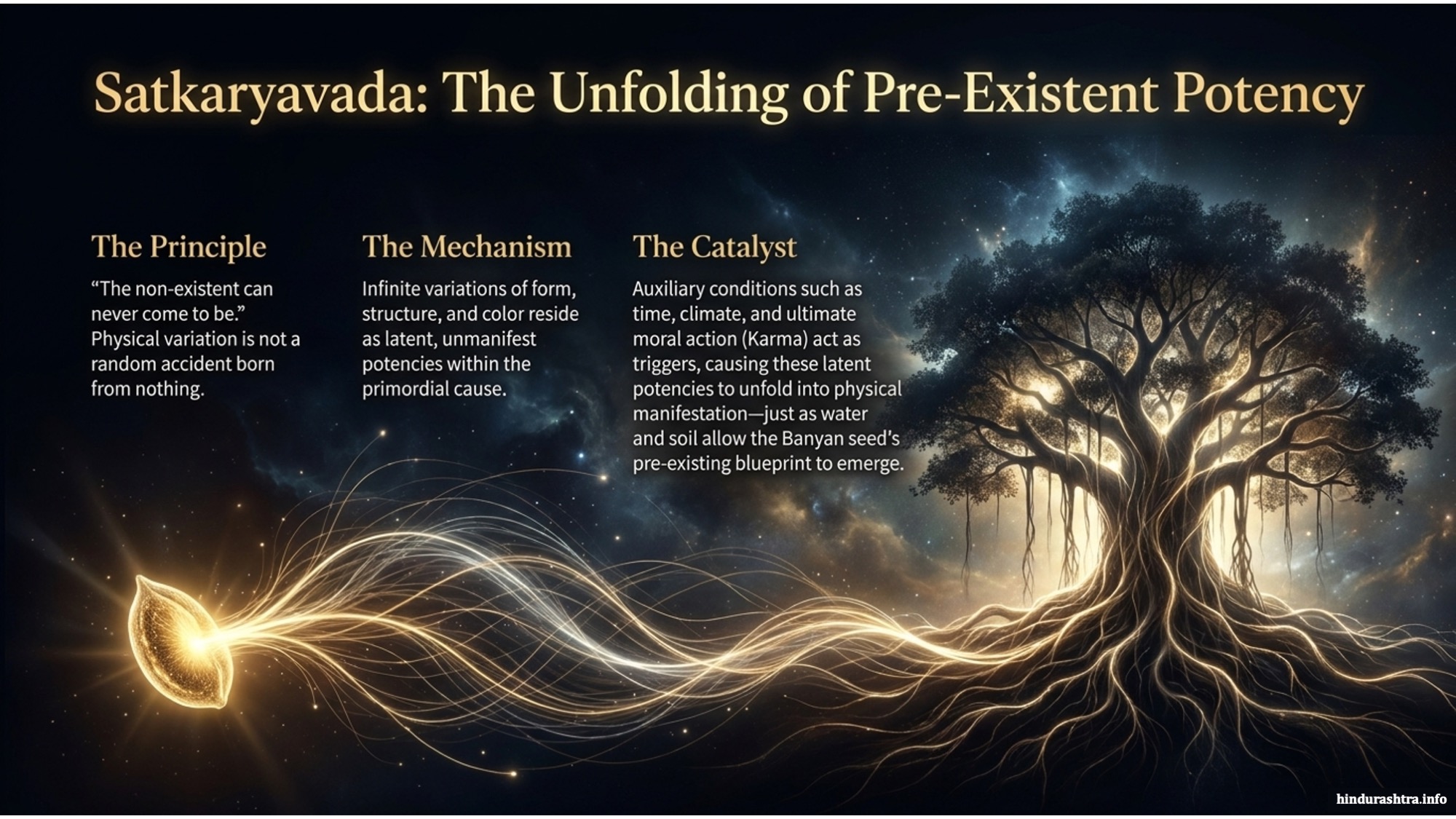
Karpatri Ji illustrates this using the seed analogy: a microscopic Banyan seed (Vata-bija [वट-बीज]) invisibly contains the potential trunk, branches, leaves, flowers, shade, and fruit of the full tree. Water and soil do not create the Banyan tree out of nothing; they serve as auxiliary conditions (Sahakari-karana [सहकारी कारण]) that allow the pre-existing latent potency (Shakti [शक्ति]) to unfold. Similarly, a goldsmith shapes gold into various ornaments (crowns, armlets, rings), or a potter shapes clay into different vessels; the gold and clay are the material causes containing the potency of these forms. Variation is the manifestation of pre-existing latent potencies brought forth by auxiliary causes, not random mutations creating non-existent traits.
3.4 The Fixity of Species (Jati-Niyama [जाति–नियम]) and Biological Counter-Evidence
Karpatri Ji presents a direct empirical challenge to macro-evolutionary speciation (the claim that one biological species transforms into an entirely different species line, such as fish becoming reptiles, or monkeys becoming humans).
If species continuously evolve into higher taxonomic forms, why do ancient parent forms continue to reproduce strictly within their own species boundaries today? Why do fish produce only fish, frogs produce only frogs, and monkeys produce only monkeys? If monkeys evolved into humans over millions of years, why has no human been observed emerging from a monkey throughout recorded history? The persistent, simultaneous reproduction of ancient parent species alongside allegedly evolved descendant species refutes macro-evolution. In nature, biological reproduction follows strict species fixity (Jati-Niyama [जाति-नियम]): seeds produce their own kind, just as Banyan seeds produce Banyan trees today exactly as they did in antiquity.
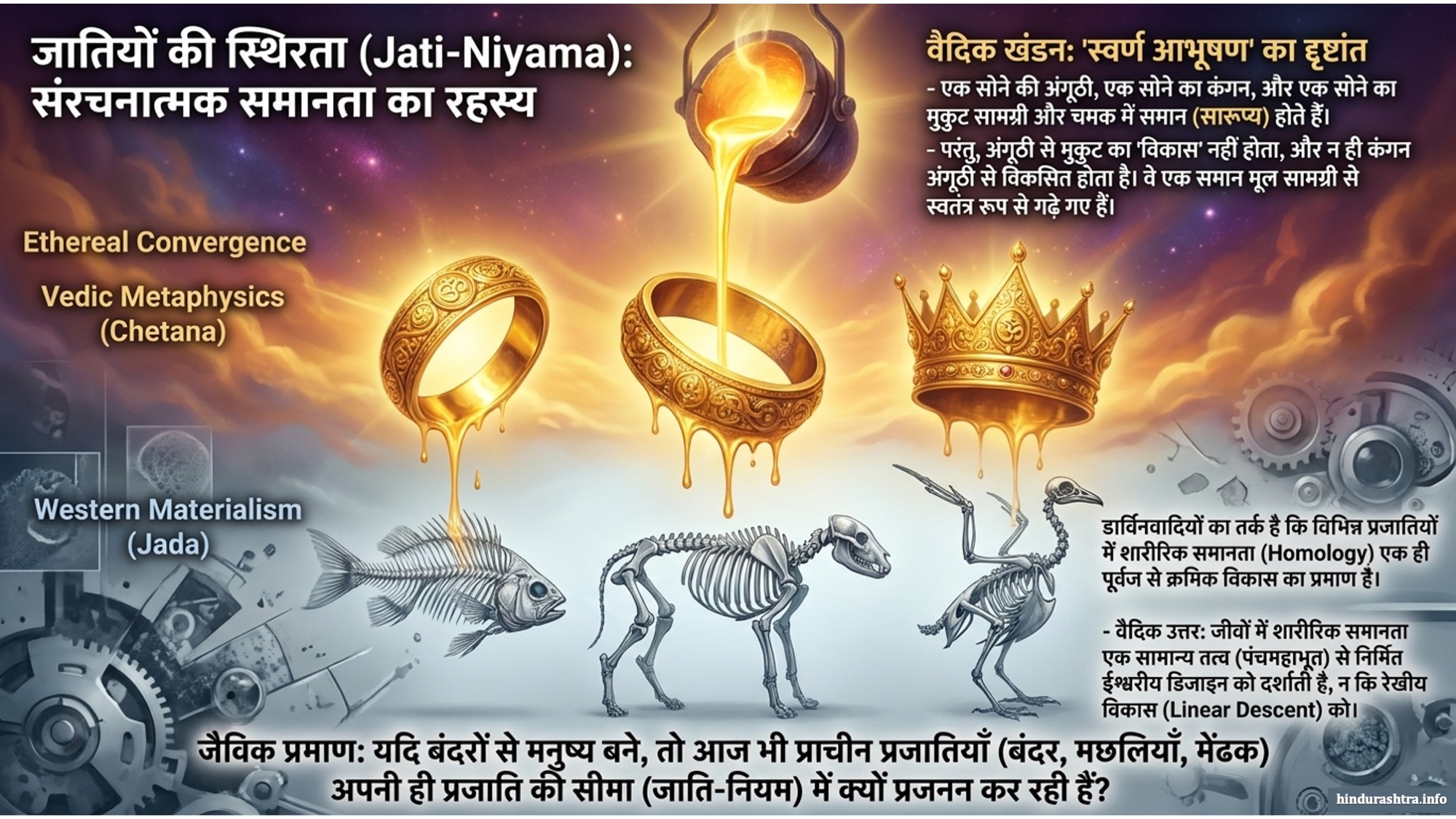
Karpatri Ji also deconstructs the arguments Darwinists draw from comparative anatomy, vestigial organs, and embryonic similarities:
- Morphological Similarity (Sarupya [सारूप्य]): Structural similarity between species does not prove lineal evolutionary descent. Karpatri Ji illustrates this with a precise analogy: a gold ring, a gold tiara, and a gold bracelet exhibit morphological similarities in material and luster, yet a tiara does not evolve from a ring, nor a bracelet from a tiara. They are independent designs forged from a common underlying material. Similarly, structural similarities among vertebrates reflect a unified divine design using common elemental building blocks (Panchamahabhuta [पञ्चमहाभूत]), not linear descent.
- Artificial Selection: Darwin cited domestic breeding practices (e.g., horse and sheep breeders selecting specific traits) to argue for natural evolution. Karpatri Ji points out that human-guided artificial breeding yields only minor variations within strict species boundaries. A breeder can produce a faster horse or a woollier sheep, but centuries of breeding have never transformed a horse into a non-equine species or a sheep into a different biological genus. The moment human intervention ceases, bred animals revert toward their wild, natural species form, demonstrating the absolute boundaries of Jati-Niyama [जाति-नियम].
|
Category of Comparison |
Darwinian Evolutionary Model |
Vedantic Causality Model (Karpatri Ji) |
Epistemological / Empirical Failure of Darwinism |
|
Initial Variation Origin |
Accidental, unguided variations driven by physical environment and organ disuse. |
Unfolding of pre-existing latent causal potencies (Shakti [शक्ति]) triggered by Karma. |
Fails to explain the origin of the firstvariation before Natural Selection can act (Asatkaryavada [असत्कार्यवाद] flaw). |
|
Speciation Mechanics |
Fluid Macro-Evolution: Species continuously transform across genus lines over epochs. |
Fixed Species Categories (Jati-niyama [जाति-नियम]): Micro-adaptations within fixed limits. |
Unobserved in real time; fails to explain why ancestral forms stop evolving into higher forms. |
|
Predatory Struggle |
Intrinsic, universal law of nature driving biological progress (Jivana-sangharsha [जीवन-संघर्ष]). |
Incidental affliction (Upadrava [उपद्रव]) caused by hunger (Kshudha [क्षुधा]), Avidya [अविद्या], and Karma [कर्म]. |
Mistakes destructive hunger (Matsyanyaya [मत्स्यन्याय]) for a creative evolutionary force. |
|
Parent Species Persistence |
Unresolved anomaly: Ancient parent species persist alongside “evolved” descendant species. |
Parallel, fixed manifestations originating from primordial divine potency (Shakti-Vaichitrya [शक्ति-वैचित्र्य]). |
Cannot explain why monkeys continue producing monkeys rather than transitioning into humans. |
|
Anatomical Homology |
Proof of common physical ancestor and lineal descent across geological time. |
Unified structural design (Sarupya [सारूप्य]) utilizing common elemental matter (Panchamahabhuta [पञ्चमहाभूत]). |
Confuses shared material composition (like gold ornaments) with lineal evolutionary descent. |
Having dismantled the biological mechanics of Darwinism, Karpatri Ji extends his critique to Western geological timelines and linear models of human history.
- Geological Ages, Human Origins, and the Myth of Primitive Man
4.1 Contextual Introduction & Strategic Importance
To sustain the narrative of materialist evolution, Western secular scholarship constructed a short, linear historical timeline that envisions human origins progressing from primitive cave-dwelling savages through sequential technological ages: the Stone Age, Bronze Age, and Iron Age. This linear paradigm conflicts directly with the Vedic vision of human origins, which posits immediate, highly civilized divine ancestral origins, cyclical cosmic epochs (Yugas [युग] and Manvantaras [मन्वन्तर]), and expansive temporal scales spanning billions of years. In Marxvaad aur Ramrajya [मार्क्सवाद और रामराज्य], Swami Karpatri Ji Maharaj dismantles the assumptions of geological stratigraphy, exposes the missing Copper Age anomaly, refutes Western geographic origin hypotheses, and reinstates the Vedantic cosmic chronology rooted in unauthored revelation and empirical archaeological anomalies.
4.2 Deconstruction of Geological Stratigraphy and the “Stone/Metal Age” Paradigm
Swami Karpatri Ji Maharaj directly refutes the linear “Stone Age, Bronze Age, Iron Age” paradigm propagated by Western archaeologists and uncritically accepted by modern scholars (including Lokmanya Bal Gangadhar Tilak in his historical works).
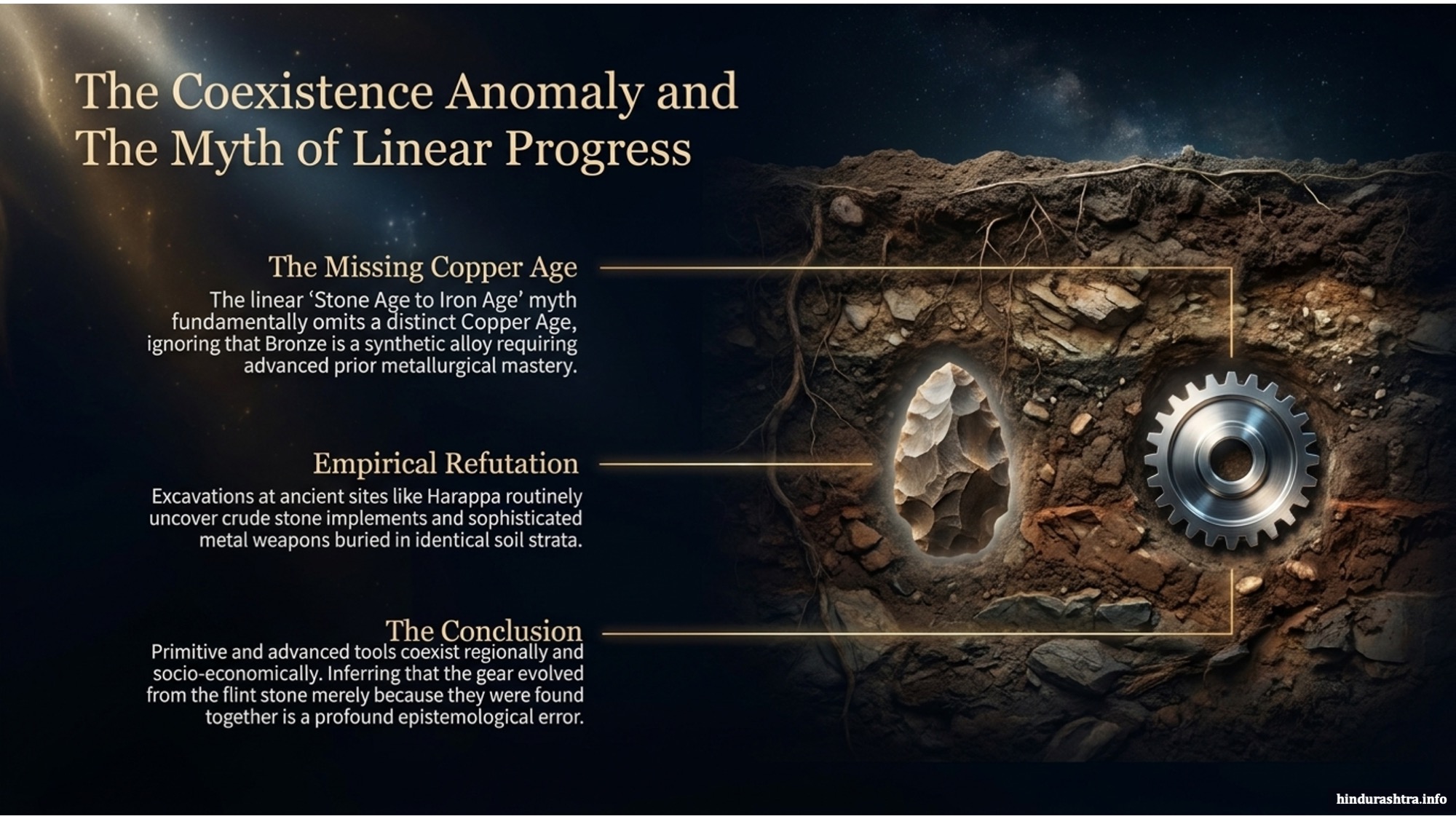
Karpatri Ji exposes a glaring logical vulnerability in this classification: the complete omission of a distinct “Copper Age” (Tamra-Yuga [ताम्र-युग]). Bronze is a synthetic alloy produced by smelting copper and tin together. For bronze tools to exist, metallurgy must have already mastered the extraction and refining of copper. The total absence of an independent, chronologically distinct Copper Age layer in archaeological stratigraphy exposes the artificial, speculative nature of the Western technological age sequence.
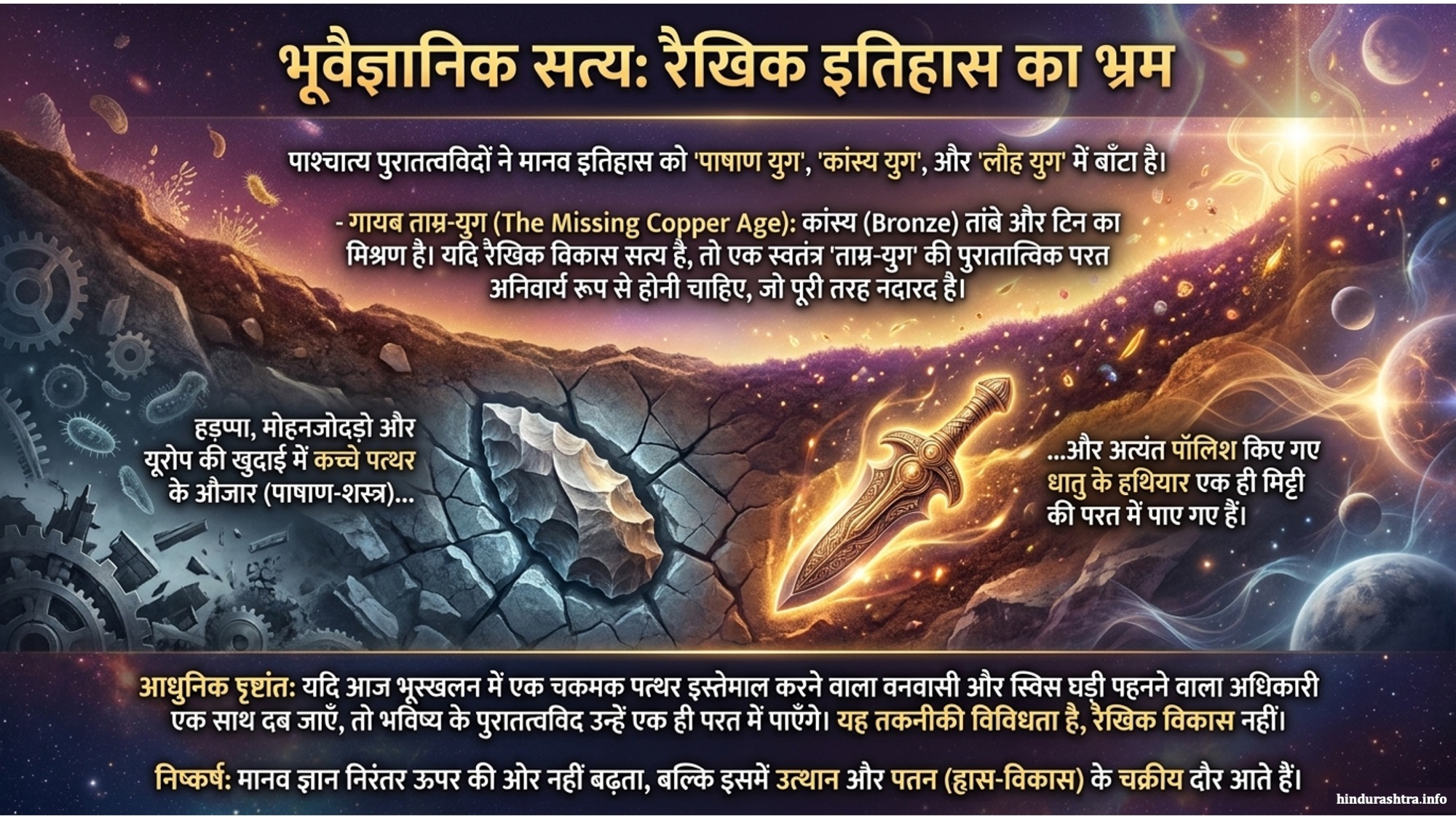
Furthermore, Karpatri Ji presents empirical counter-evidence from archaeological excavations across the globe, including the ancient sites of Harappa [हड़प्पा] and Mohenjodaro [मोहनजोदड़ो], as well as European ruins. In these excavations, crude stone implements (Pashana-shastra [पाषाण-शस्त्र]) and highly polished, sophisticated metal weapons (Lauha/Kansya-shastra [लौह/कांस्य-शस्त्र]) are routinely uncovered buried within the exact same soil layers and depths. If a Stone Age had cleanly preceded a Metal Age by thousands of years, stone and metal implements would occupy distinct, sequentially ordered geological strata. Their simultaneous presence in identical soil strata proves that primitive and advanced tools coexisted within the same temporal period.
To illustrate this reality, Karpatri Ji offers a contemporary analogy: if a modern forest dweller using primitive flint stones (Chakmak Pathari [चकमक पथरी]) and a modern government officer wearing a sophisticated Swiss wristwatch were walking together through a jungle and buried under a sudden landslide, future archaeologists excavating the site centuries later would find the flint stone and the electronic wristwatch side by side. Inferring that the wristwatch evolved from the flint stone would be an epistemological error. Socio-economic diversity and regional technological variances exist simultaneously in every age.
Furthermore, Karpatri Ji cites John Boson’s 1923 article in New Age to document historical instances of technical regression (Hrasa [ह्रास]) that refute the myth of continuous linear progress:
- Egyptian Geometry: During the era of Pyramid construction, ancient Egyptians possessed advanced geometrical knowledge that was subsequently lost to later generations.
- Pyrotechnics in China: Ancient China possessed advanced gunpowder formulas prior to the Christian era, knowledge that later faded from practice.
- Metallurgy of Delhi’s Iron Pillar: The rust-resistant Iron Pillar of Delhi (Lauha Latta [लौह लाट]) represents metallurgic capabilities that modern European metallurgy could not replicate for centuries.
Karpatri Ji compares human knowledge to a moth drawn to a lamp flame: the moth approaches, gets scorched, retreats, and returns again. Human knowledge does not follow linear upward progress. Instead, human civilization exhibits alternating cycles of advancement and decay (Hrasa-Vikasa [ह्रास-विकास]). When systematic educational traditions (Shiksha-Parampara [शिक्षा-परम्परा]) are maintained, knowledge flourishes; when these traditions are broken by catastrophes, knowledge decays, and populations temporarily regress into primitive conditions.
4.3 Geodynamics of Creation and the True Origin of Humanity (Bharatvarsha [भारतवर्ष])
Karpatri Ji systematically evaluates Western scientific and orientalist theories regarding the geographic origin of humanity, which variously claimed human origins in Africa, Australia, Madagascar, Lemuria, Tibet (Swami Dayananda Saraswati), Central Asia (Max Müller), Mongolia (Umesh Chandra Dutt), or the North Pole / Arctic Region (Bal Gangadhar Tilak, influenced by Dr. Warren).
Karpatri Ji provides a multi-pointed empirical refutation of the Arctic/North Pole origin hypothesis:
- Recurring Severe Ice Ages (Himapata [हिमपात]): Geological data confirm that catastrophic ice ages occur at the North Pole every 10,500 years, burying the region under impenetrable ice sheets and making continuous human civilization impossible.
- Anatomical Physiology: As noted by medical experts like Dr. Allen, human physiology lacks the dense, long fur/body hair characteristic of native Arctic fauna (e.g., polar bears). Instead, human skin is covered with minute sweat pores (Roma-chidra [रोम-छिद्र]) designed for thermal regulation in temperate climates, proving humans are not native to extreme polar regions.
- Absence of Essential Vegetation: Human survival requires rich plant life, grains, and medicinal flora. The North Pole lacks the vegetation necessary to sustain human life.
Karpatri Ji establishes that the Himalayan region, Kashmir, and greater India (Bharatvarsha [भारतवर्ष] / Aryavarta [आर्यावर्त]) represent the true cradle of human origin. He cites medical authorities (e.g., Dr. E.R. Elens) and textual sources confirming that the Himalayan region possesses abundant flora, rich grasslands, diverse animal species, and ideal climate conditions capable of supporting early human life. Furthermore, Kashmir and the Himalayan valleys contain the oldest fossil remains of life.
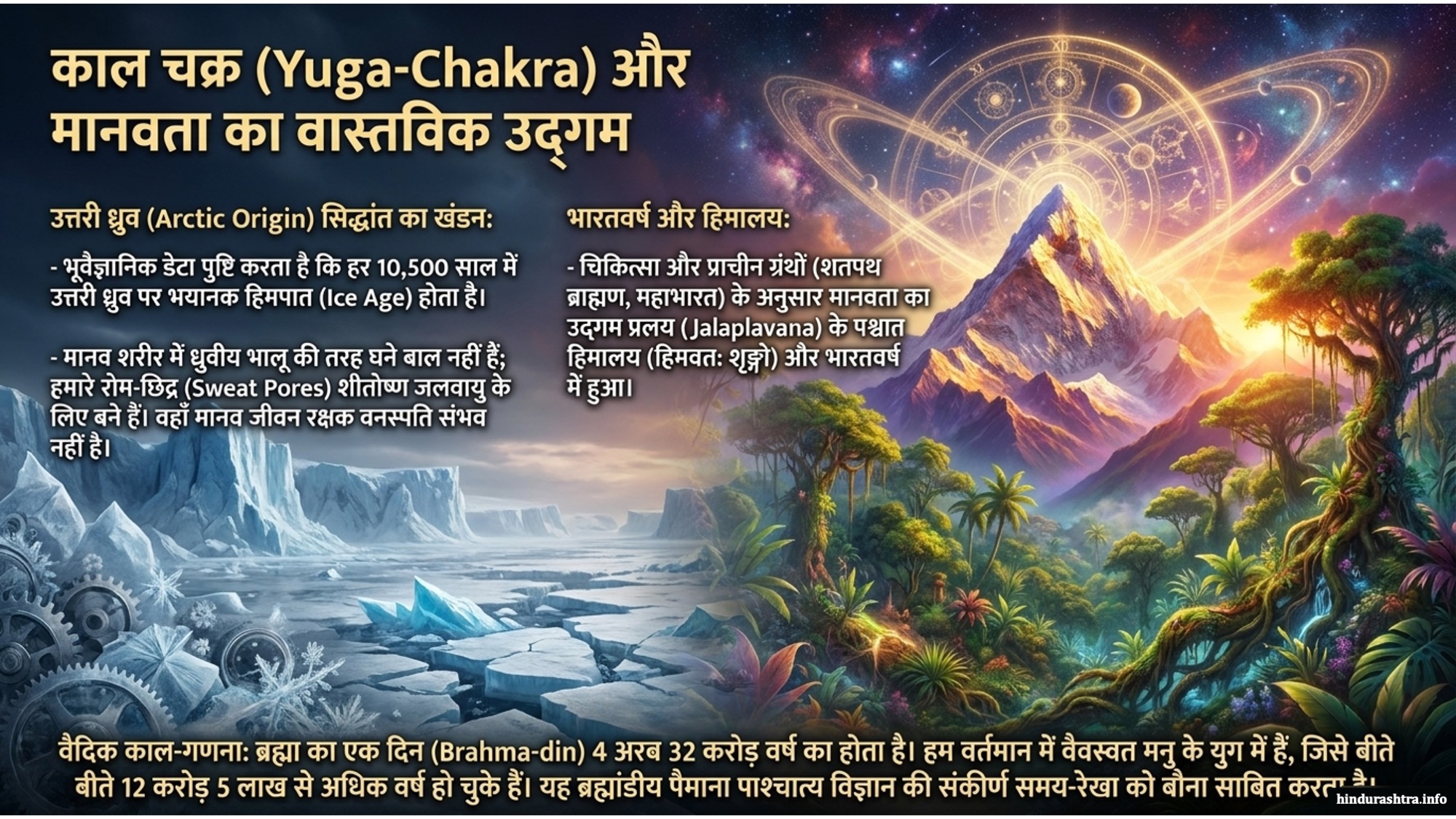
Textually, Karpatri Ji supports the primordial primacy of Bharatvarsha [भारतवर्ष] by citing the Shatapatha Brahmana [शतपथ ब्राह्मण], Ramottaratapaniya Upanishad [रामोत्तरतापनीय उपनिषद्], and Mahabharata [महाभारत]:
तेषां कुरुक्षेत्रं देवयजनमास। तस्मादाहु: कुरुक्षेत्रं वै देवानां देवयजनम्। (Tesam kurukshetram devayanamasa | Tasmaduhur kurukshetram vai devanam devayanam ||) – Shatapatha Brahmana [शतपथ ब्राह्मण] “Kurukshetra is the sacred altar of the Divine; hence it is declared by the wise to be the divine place of creation.”
The Mahabharata [महाभारत] (Vana Parva) explicitly documents the Himalayan origin of humanity following the global flood (Jalaplavana [जलप्लवन]), where Manu tied his sacred vessel to the Himalayan peaks (Himavata Shringa [हिमवत: शृङ्गे]):
अस्मिन् हिमवत: शृङ्गे नावं बध्नीत मा चिरम्। (Asmin himavata sringhe navam badhnita ma me chiram ||) – Mahabharata [महाभारत] (Vana Parva 187.49) “Upon this highest peak of the Himalayas, bind your vessel without delay.”
हिमालयाभिधानोऽयं ख्यातो लोकेषु पावन:। अर्धयोजनविस्तार: पञ्चयोजनमायत:॥ परिमण्डलयोर्मध्ये मेरुरुत्तमपर्वत:। तत: सर्वास्समुत्पन्नावृत्तयो द्विजसत्तम॥ (Himalayabhidrano’yam khyato lokeshu pavanah | Ardhayojanavistarah panchayojanamayatah || Parimandalayormadhye meruruttamaparvatah | Tatah sarvah samutpanna vrittayo dvijasattama ||) – Mahabharata [महाभारत] (Vana Parva) “This sacred mountain known across the worlds as the Himalayas is the holy cradle of existence. From this central realm around Meru, all human vocations and life forms originated.”
Karpatri Ji clarifies that the term Arya [आर्य] does not designate a racial or geographic subgroup (as claimed by Western philologists who restricted the term to fair-skinned European lineages). In Vedic tradition, Arya [आर्य] is a normative, ethical, and spiritual designation denoting individuals of noble character, righteous conduct, and scriptural wisdom. He cites the Vasishtha Smriti [वसिष्ठ-स्मृति] and Mahabharata [महाभारत]:
कर्तव्यमाचरन् काममकर्तव्यमनाचरन्। तिष्ठति प्रकृताचारे: य: स आर्य इति स्मृत:॥ (Kartavyam acharan kamam akartavyam anacharan | Tishthati prakritachare yah sa arya iti smritah ||) – Vasishtha Smriti [वसिष्ठ-स्मृति] “He who performs his prescribed duties with rectitude, shuns unrighteous actions, and remains established in noble conduct is known as an Arya.”
न वैरमुद्दीपयति प्रशान्तं न दर्पमारोहति नास्तमेति। न दुर्गतोऽस्मीति करोत्यकार्यं तमार्यशीलं परमाहुरार्या:॥ न स्वे सुखे वै कुरुते प्रहर्षं नान्यस्य दु:खेभवति प्रहृष्ट:। दत्त्वा न पश्चात् कुरुतेऽनुतापं स कथ्यते सत्पुरुषार्यशील:॥ (Na vairam uddipayati prashantam na darpam arohati nastam eti | Na durgato’smiti karotyakaryam tam aryashilam param ahur aryah || Na sve sukhe vai kurute praharsam nanyasya dukhe bhavati prahristah | Datva na pashchat kurute’nutapam sa kathyate satpurusaryashilah ||) – Mahabharata [महाभारत] (Udyoga Parva 33.112-113) “He who does not reignite settled animosities, who is neither blinded by pride nor cast down by defeat, who refuses to commit evil even when in dire distress: he alone possesses the noble character of an Arya. He who does not exult excessively in his own good fortune, nor rejoice in the suffering of others, nor regret his acts of charity; he is acclaimed as a true Arya.”
4.4 Vedic Time Cycles (Yuga-Manvantara [युग–मन्वन्तर]) versus Western Linear Chronology
Karpatri Ji contrasts the abbreviated historical timelines of Western scholarship (which date human history to a few hundred thousand years) with the vast, mathematically precise cosmic temporal cycles of the Vedic tradition.
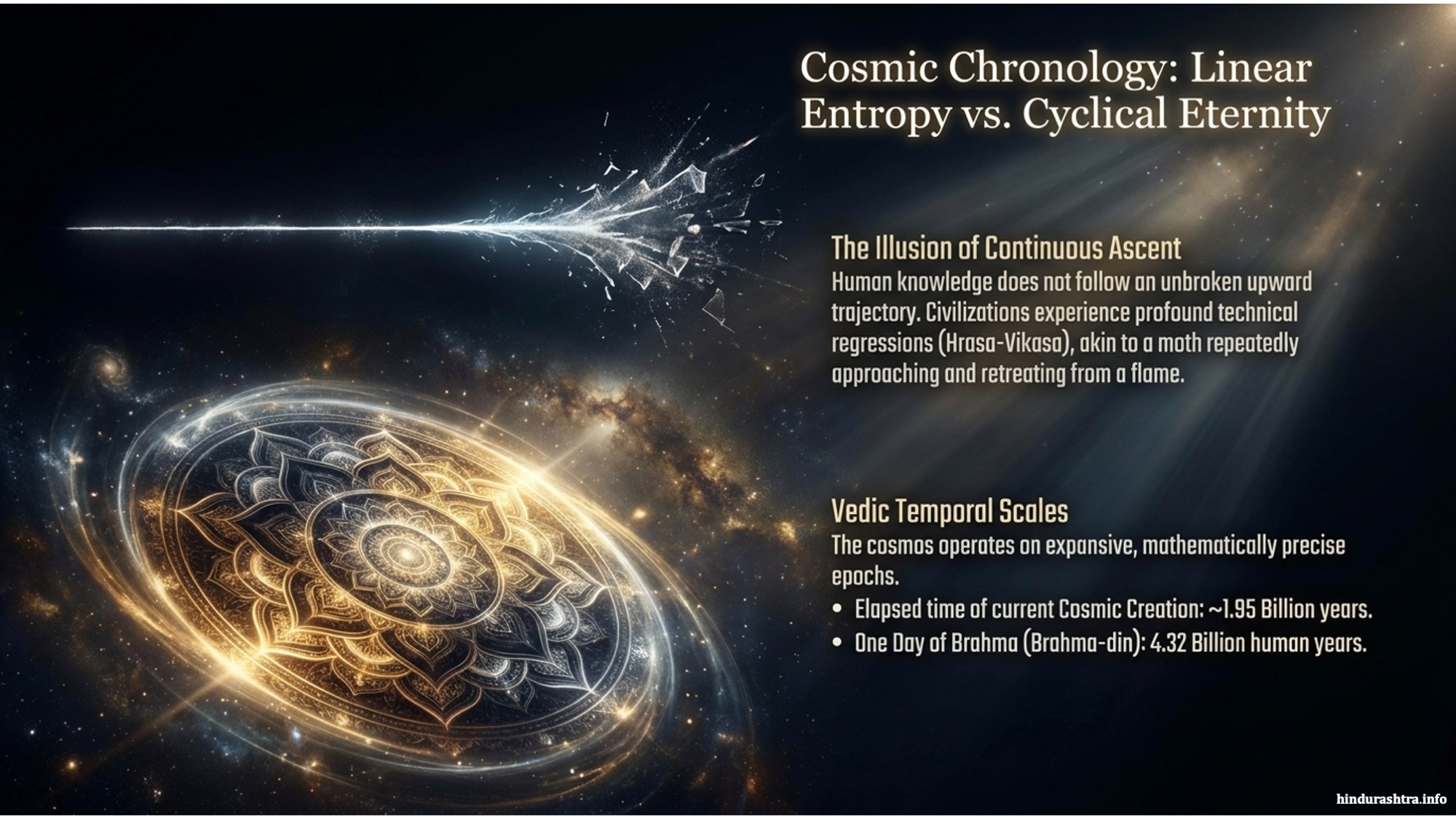
Drawing directly from the unauthored Veda, Manu Smriti [मनुस्मृति], and Puranic astronomy, Karpatri Ji provides the exact Vedantic temporal calculations (as evaluated in Samvat 2013):
- Elapsed time since current progenitor, Vaivasvata Manu [वैवस्वत मनु]: 120,533,030 years (12 Crore 5 Lakh 33 Thousand 30 years [१२ करोड़ ५ लाख ३३ हजार तीस वर्ष]).
- Elapsed time since current Cosmic Creation (Srishti-Kala [सृष्टि-काल]): 1,955,885,057 years (1 Arab 95 Crore 58 Lakh 85 Thousand 57 years [१ अरब ९५ करोड़ ५८ लाख ८५ हजार ५७ वर्ष]).
- Structure of a Day of Brahma (Brahma-din [ब्रह्मा-दिन]): Consists of 14 Manus [मनु] (Epochs), spanning 4,320,000,000 human years (4 Arab 32 Crore years [४ अरब ३२ करोड़ वर्ष]).
- One Year of Brahma (Brahma-Varsha [ब्रह्मा-वर्ष]): Spans 1,555,200,000,000 human years (15 Kharab 55 Arab 20 Crore years [१५ खरब ५५ अरब २० करोड़ वर्ष]).
- Lifetime of Brahma (Brahma-ayu [ब्रह्मा-आयु]): Spans 100 Brahma years (311.04 trillion human years). Currently, 50 Brahma years have elapsed, equaling 777,600,000,000,000 human years (7 Neel 77 Kharab 60 Arab years [७नील ७७ खरब ६० अरब वर्ष]).
These calculations demonstrate that Vedic metaphysics operates on expansive cosmic timelines that accommodate vast epochs of creation, manifestation, dissolution, and spiritual cycling; dwarfing the narrow temporal models of 19th-century European positivism.
From these vast geological and historical temporal structures, the investigation turns to the origin of human thought and language.
- Linguistic Philosophy: Eternal Word (Apaurusheya Vak [अपौरुषेय वाक्]) versus Evolutionary Onomatopoeia
5.1 Contextual Introduction & Strategic Importance
Language is the essential vehicle of human thought, self-consciousness, and civilizational memory. Evolutionary linguistics asserts that human language evolved gradually from primitive animal grunts, emotional interjections, and environmental sound imitations. In Marxvaad aur Ramrajya [मार्क्सवाद और रामराज्य], Swami Karpatri Ji Maharaj refutes these evolutionary theories, demonstrating that articulate, rule-governed language cannot generate itself spontaneously from unarticulated noise. Karpatri Ji establishes the Vedic doctrine of Primordial Sanskrit as the eternal, uncreated language (Anadi Nitya Vak [अनादि नित्या वाक्]), revealed directly to humanity by the Supreme Controller (Parameshvara [परमेश्वर]) at the dawn of creation.
5.2 Refutation of Evolutionary Language Theories (Bow-Wow, Interjection, Gesture Theories)
Swami Karpatri Ji Maharaj systematically deconstructs the prevailing evolutionary theories of language origin:
- The Onomatopoeic / Bow-Wow Theory: Claims language arose from imitating natural environmental sounds (e.g., naming a bird “Cuckoo” after its call, or a crow Kaka [काक] after its croak).
- The Interjection / Pooh-Pooh Theory: Claims language evolved from involuntary emotional outbursts (Ha-ha, Hay-hay [हा-हा, हाय-हाय]).
- The Gesture / Convention Theory (Locke, Adam Smith, Dugald Stewart): Claims humans were originally mute, communicating through hand gestures (Hasta-sanketa [हस्त-संकेत]) until they convened to assign arbitrary vocal sounds to objects.
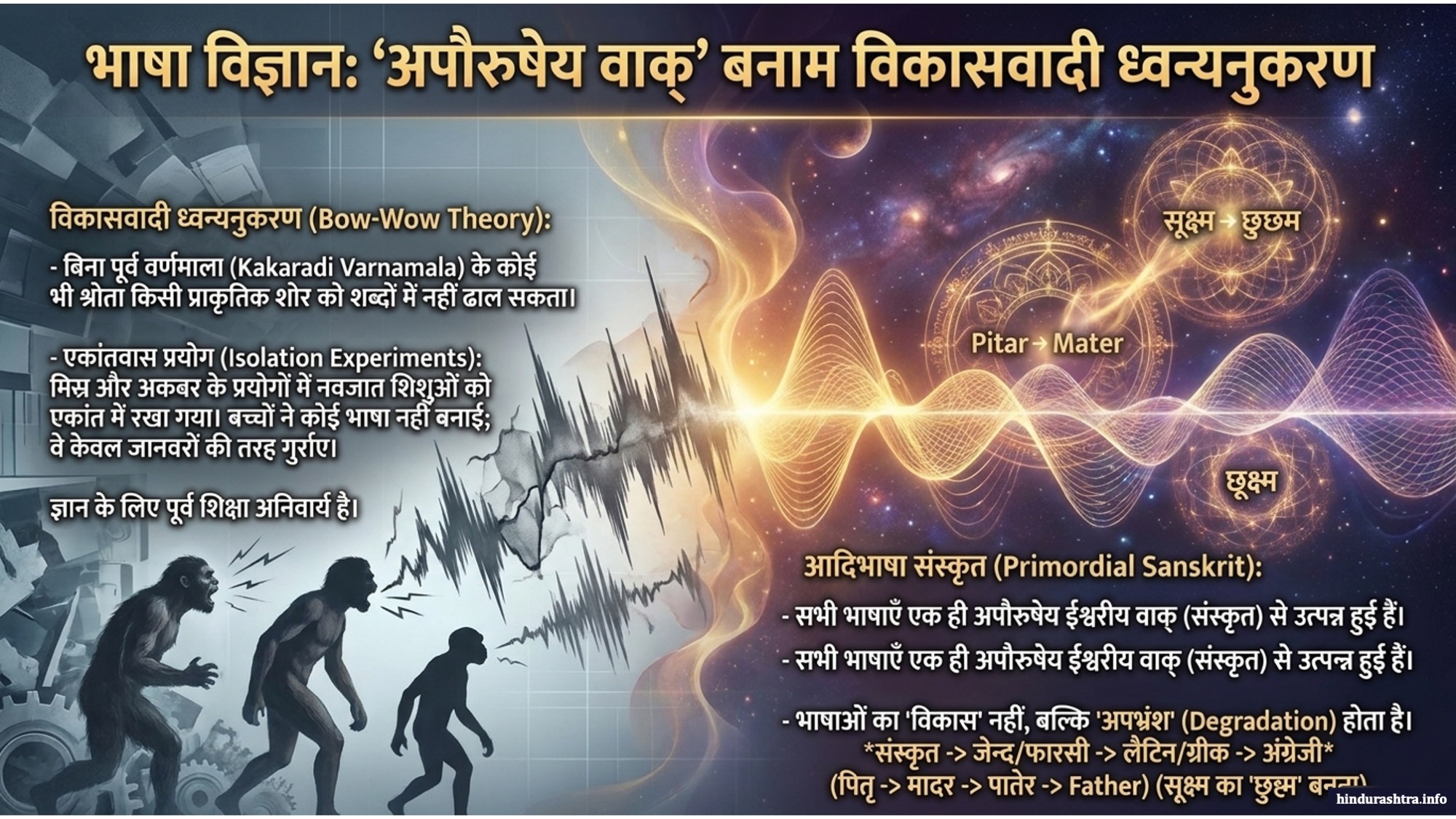
Karpatri Ji refutes the Onomatopoeic theory through rigorous phonetic logic:
- Animals, birds, and insects have been exposed to natural environmental sounds for millions of years, yet they have never developed articulate, rule-governed linguistic systems.
- Imitating an external natural noise (such as mapping a rooster’s crow to Kukurukoon [कुकड़ूकूँ] in Hindi or “Cock-a-doodle-doo” in English) requires prior mastery of an articulate phonetic alphabet (Kakaradi Varnamala [ककारादिवर्णमाला]). Karpatri Ji establishes the vital distinction between Unmanifest/Unarticulated Sound (Avyakta Shabda [अव्यक्त शब्द]) and Manifest/Articulated Phonetic Letters (Vyakta/Varnatmaka Shabda [व्यक्त/वर्णात्मक शब्द]). External natural noise is unarticulated sound (Avyakta Shabda [अव्यक्त शब्द]), devoid of innate Vowels (Svara [स्वर]) and Consonants (Vyanjana [व्यंजन]). An unarticulated physical noise cannot magically produce phonetic letters in a listener’s throat. Only a speaker who already possesses a fully developed phonetic alphabet (Kakaradi Varnamala [ककारादि वर्णमाला]) can mentally map an unarticulated noise into articulate letters.
Karpatri Ji refutes the Gesture and Convention theory by citing the logical refutation articulated by philologist Max Müller: establishing arbitrary meanings for vocal sounds through gestures requires complex mutual understanding among the participants. How could mute, primitive humans communicate to one another that a specific vocal sound would henceforth represent “bread” or “water” without already possessing an articulate language to establish that agreement? Attempting to establish language through non-verbal convention presupposes the prior existence of the very linguistic understanding it seeks to explain, resulting in an infinite logical regress (Gahanataram Anavastham [गहनतरम् अनवस्थाम्]).
5.3 The Necessity of Prior Instruction and Isolation Experiments
Karpatri Ji asserts a fundamental principle of linguistic philosophy: human beings cannot generate articulate language without prior instruction (Shiksha [शिक्षा]).
To prove this empirically, Karpatri Ji details historical isolation experiments conducted across different eras:
- Pharaoh Psammetichus of Egypt: Raised two newborn infants in total isolation under the care of mute shepherds, ensuring they heard no human speech.
- Emperor Akbar of India, King James IV of Scotland, and Emperor Frederick II of Europe: Conducted identical isolation experiments with newborn children.
The results across all historical isolation experiments were unanimous: infants raised without hearing human language produced no articulate speech. They uttered only basic guttural vowel sounds (a, i, u [अ, इ, उ]) or imitated the grunts and cries of animals in their immediate environment (such as wolf-children). They never spontaneously invented a structured grammar or vocabulary.
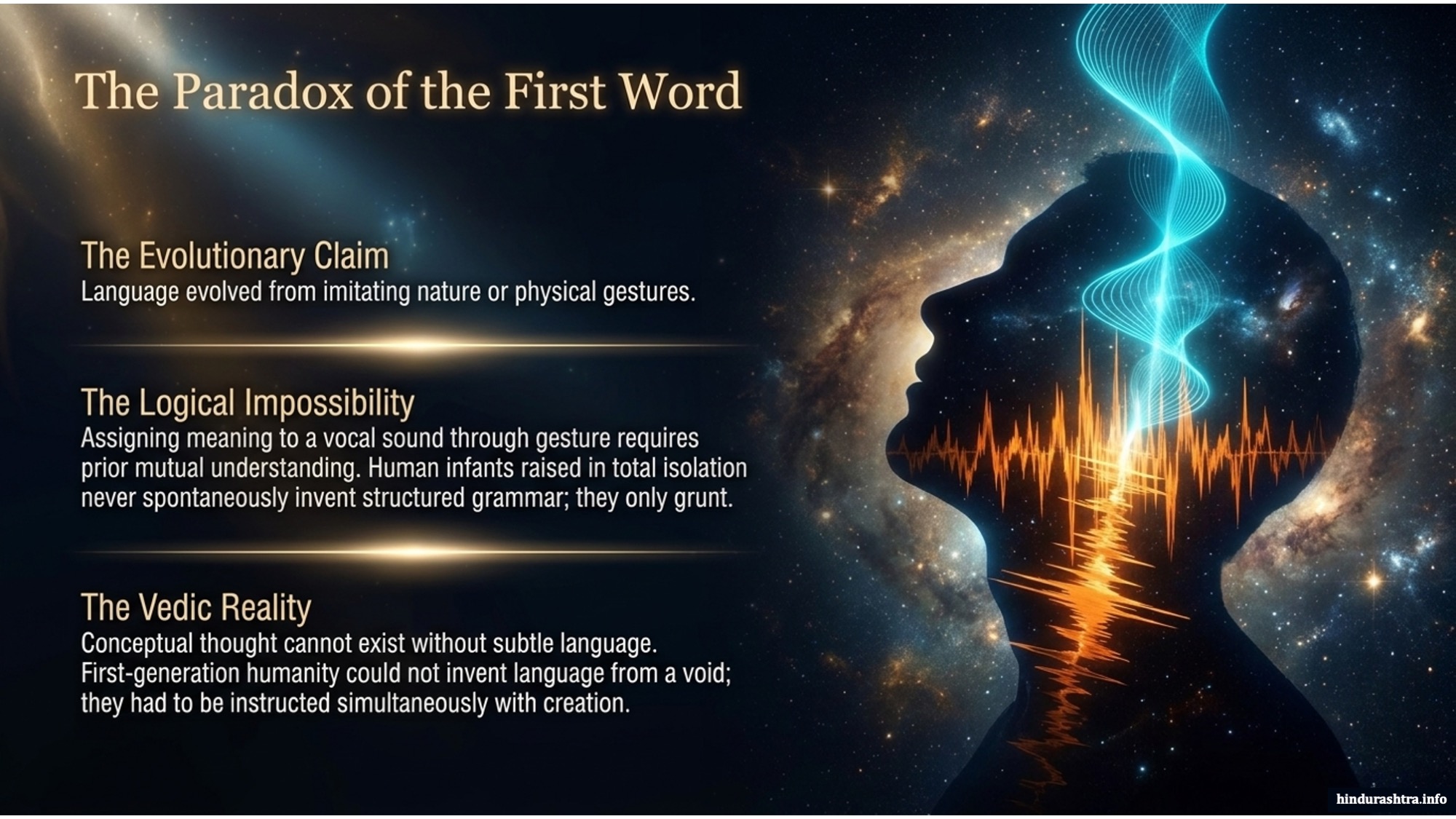
Karpatri Ji emphasizes the inescapable interdependence of conceptual thought (Jñana [ज्ञान]) and articulate language (Shabda [शब्द]). Cognitive awareness cannot form distinct concepts without inner verbal representation (Sukshma Shabda [सूक्ष्म शब्द]), as declared by Grammarian-Philosopher Bhartrihari in the Vakyapadiya [वाक्यपदीय]:
न सोऽस्ति प्रत्ययो लोके य: शब्दानुगमादृते। अनुविद्धमिव ज्ञानं सर्वं शब्देन भासते॥ (Na so’sti pratyayo loke yah sabdanugamad rite | Anuviddham iva jnanam sarvam sabdena bhasate ||) – Vakyapadiya [वाक्यपदीय] (1.123) “There is no comprehension in the world that exists without subtle verbal association. All knowledge shines forth as if penetrated and structured by language.”
Karpatri Ji also engages the classical debate between Mimamsa (Mimamsa [मीमांसा]) and Nyaya (Nyaya [न्याय]) regarding the relationship between word (Shabda [शब्द]) and meaning (Artha [अर्थ]). The Mimamsa school establishes that the relationship between word and meaning is eternal and uncreated (Akrtrim-Sambandha [अकृत्रिम-सम्बन्ध]), whereas Nyaya asserts that meaning is fixed through Divine Will (Ishvariya-Sanketa [ईश्वरीय-संकेत]). Both orthodox schools agree that human beings cannot arbitrarily invent linguistic meaning out of zero prior instruction.
Because thought requires language, and language requires prior instruction (Shiksha [शिक्षा]), first-generation humanity could not have been uninstructed primitive cavemen. First-generation humanity must have received language and knowledge simultaneously from a transcendent, primeval Instructor: the All-Knowing God (Parameshvara [परमेश्वर]).
5.4 Primordial Sanskrit, Language Degradation (Apabhransha [अपभ्रंश]), and Philological Proofs
Swami Karpatri Ji Maharaj establishes that Sanskrit (Samskrita [संस्कृत]), the refined, grammatically perfect language of the unauthored Veda (Vacha Virupanityaya [वाचा विरूपनित्यया]) is the primordial mother of all human languages.
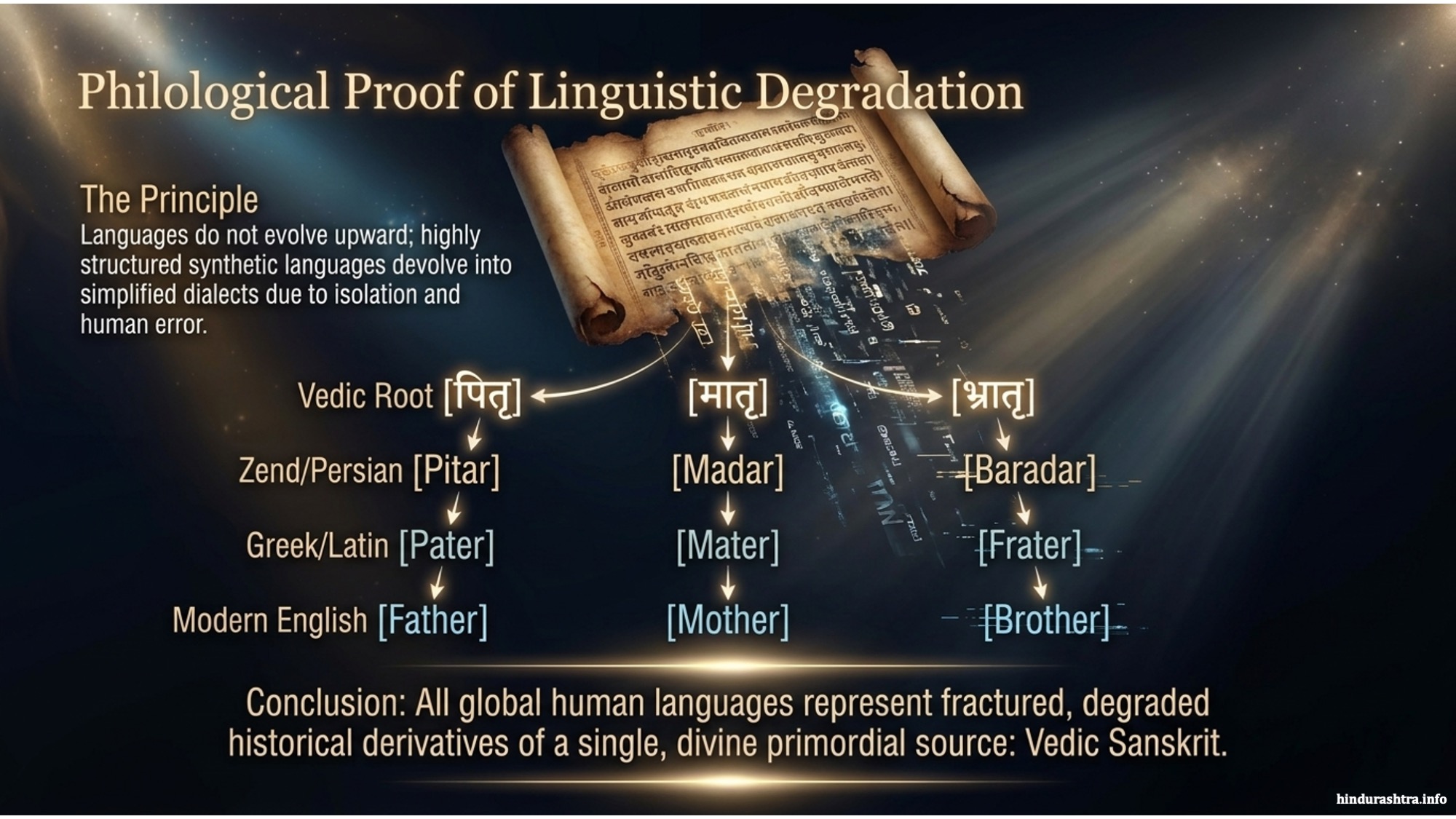
Modern evolutionary philology assumes that languages evolve from simple, unstructured dialects into complex synthetic languages. Karpatri Ji demonstrates that historical linguistic trajectory displays degradation (Apabhransha [अपभ्रंश]), not evolutionary expansion. Complex, highly structured synthetic languages featuring precise case inflections, three grammatical numbers (singular, dual, plural), and rich root verb systems (Dhatu [धातु]) devolve over time into simplified, analytical languages due to human carelessness, regional isolation, and phonetic mispronunciation.
Karpatri Ji cites specific historical examples of linguistic degradation (Apabhransha [अपभ्रंश]):
- Ancient Asuric tribes mispronounced the sacred greeting He Arayah! [हे आर्य:] as Hela-yeti [हेलय].
- The refined word Sukshma [सूक्ष्म] degraded in vernacular speech into Chuchham [छुछ्म].
- The English word Ticket degraded in local Indian vernacular into Tikas [टिकस].
- The name of the ancient physician Charaka [चरक] became Saraka [सरक] in Arabic translations.
- The Sanskrit administrative term Kotapala [कोटपाल] degraded into Kotwal [कोतवाल].
Karpatri Ji presents philological proof by demonstrating that Vedic Sanskrit root words form the structural foundation of major world language families, as documented in the comparative linguistic analysis of Marxvaad aur Ramrajya [मार्क्सवाद और रामराज्य]:
|
Sanskrit Original [संस्कृत] |
Zend / Persian [जेन्द / फारसी] |
Greek / Latin [ग्रीक / लैटिन] |
Modern English / European |
Direct Semantic Meaning |
|
Pitar [पितृ] |
Pitar [पितर] |
Pater [पातेर] |
Father |
Biological Father |
|
Matar [मातृ] |
Madar [मादर] |
Mater [मातेर] |
Mother |
Biological Mother |
|
Bhratar [भ्रातृ] |
Baradar [बरादर] |
Frater [फ्रातेर] |
Brother |
Male Sibling |
|
Saptah [सप्त] |
Haft [हफ्त] |
Septem [सेप्तम्] |
Seven |
Numerical 7 |
|
Shatam [शतम्] |
Sad [सद] |
Keton [केटन] |
Hundred |
Numerical 100 |
|
Asura [असुर] |
Ahura [अहुर] |
— |
— |
Divine Being / Opposing Entity |
|
Ustra [उष्ट्र] |
Ushtar [उश्तर] |
— |
— |
Camel |
|
Rta [ऋत] |
— |
— |
Right / Correct |
Cosmic Order / Truth |
This global linguistic evidence confirms that human speech did not originate independently from animal grunts in scattered geographic pockets. Instead, all human languages represent degraded historical derivatives (Apabhransha [अपभ्रंश]) of a single, divine primordial source: Vedic Sanskrit (Apaurusheya Vak [अपौरुषेय वाक्]).
Having established the transcendent origin of language and cognitive knowledge, the inquiry turns to the metaphysical laws governing biological diversity, physical suffering, and species assignment.
- Metaphysical Mechanics: Karma (Karma [कर्म]), Cosmic Governance, and Teleological Creationism
6.1 Contextual Introduction & Strategic Importance
The ultimate test of any metaphysical system is its capacity to explain biological diversity, individual inequality, physical suffering, and cosmic governance without falling into moral arbitrariness or divine cruelty. Darwinian materialism accounts for biological variation through random, amoral genetic mutations and predatory competition. Vedic metaphysics, as articulated by Swami Karpatri Ji Maharaj, grounds biological diversity in the absolute moral law of Karma (Karma-vipaka [कर्मविपाक]) operating under the supervision of an All-Knowing, Just Sovereign (Parameshvara [परमेश्वर]). Understanding the precise mechanics of Karma is essential to realize that the universe is governed by absolute justice, moral purpose, and spiritual evolution toward liberation (Moksha [मोक्ष]).
6.2 The Law of Karma (Karma-Vipaka [कर्मविपाक]) versus Natural Selection
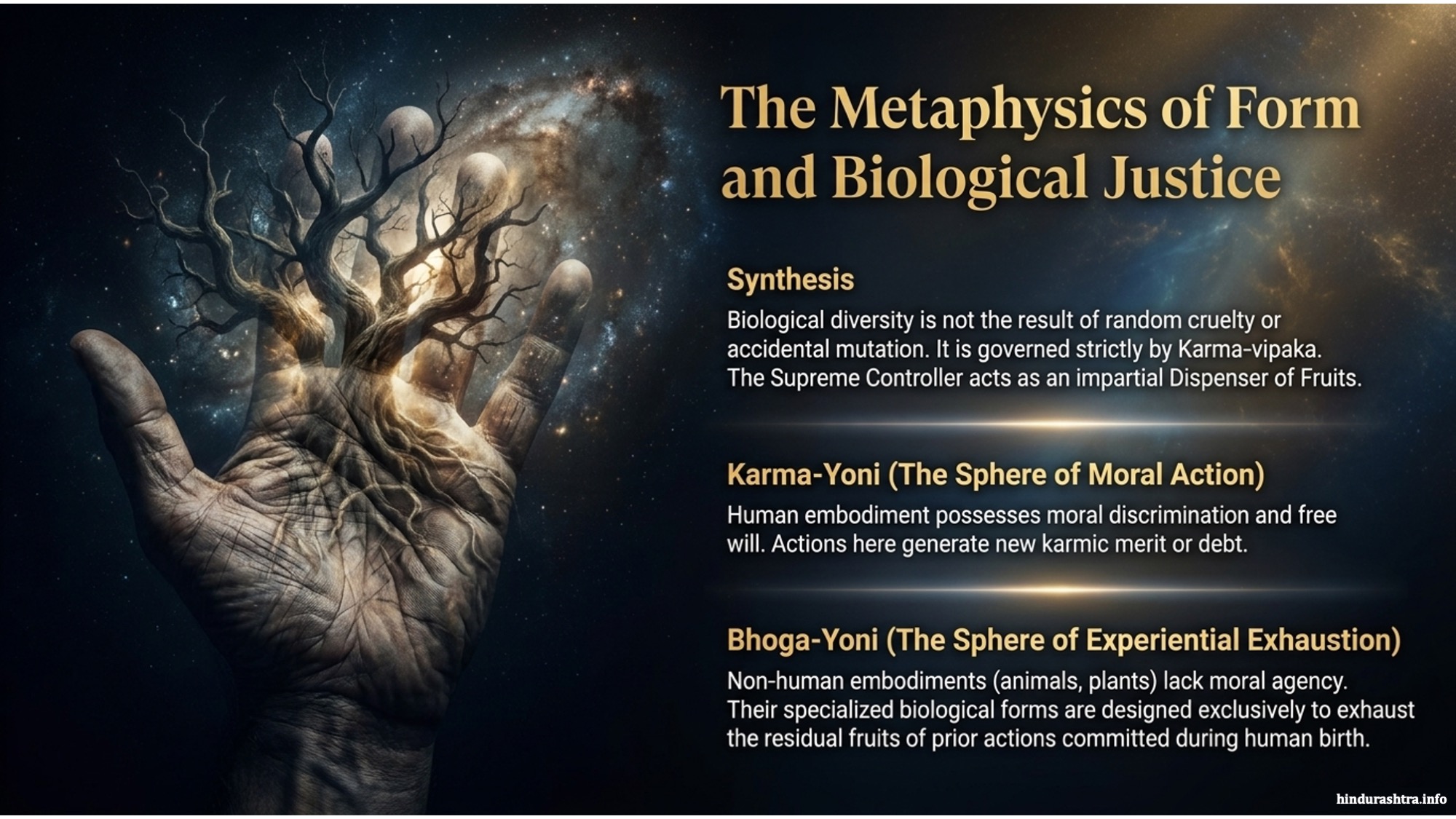
Swami Karpatri Ji Maharaj asserts that an individual soul’s biological embodiment, species category (Jati [जाति]), lifespan (Ayu [आयु]), and experiential enjoyment or suffering (Bhoga [भोग]) are strictly determined by past moral and immoral actions (Dharma-Adharma [धर्म-अधर्म]).
Karpatri Ji addresses a classic materialist objection regarding non-human life: If biological form is determined by moral Karma, how can animals, insects, and plants (which lack intellectual discrimination and moral agency) be part of a Karma system? How can an unreasoning beast perform righteous or unrighteous deeds to determine its next birth?
To resolve this objection, Karpatri Ji establishes a foundational Vedantic distinction between two spheres of existence:
- Sphere of Moral Action (Karma-Yoni [कर्मयोनि]): Refers specifically to human embodiment (particularly within Bharatvarsha [भारतवर्ष]). Humans possess moral discrimination (Viveka [विवेक]), free will, and scriptural eligibility (Adhikara [अधिकार]). Human actions generate new moral consequences (Agami Karma [आगामी कर्म]) that bind the soul to future births.
- Sphere of Experiential Exhaustion (Bhoga-Yoni [भोगयोनि]): Refers to non-human embodiments including animals, plants, insects, heavenly beings (Devas [देव]), and hellish entities. Entities in Bhoga-Yoni [भोगयोनि] do not possess moral agency or scriptural eligibility; consequently, their actions do not generate new binding moral Karma. Instead, their non-human bodies serve as specialized physical instruments designed exclusively to exhaust (Bhoga [भोग]) the residual fruits of prior unrighteous or righteous actions accumulated during previous human births.
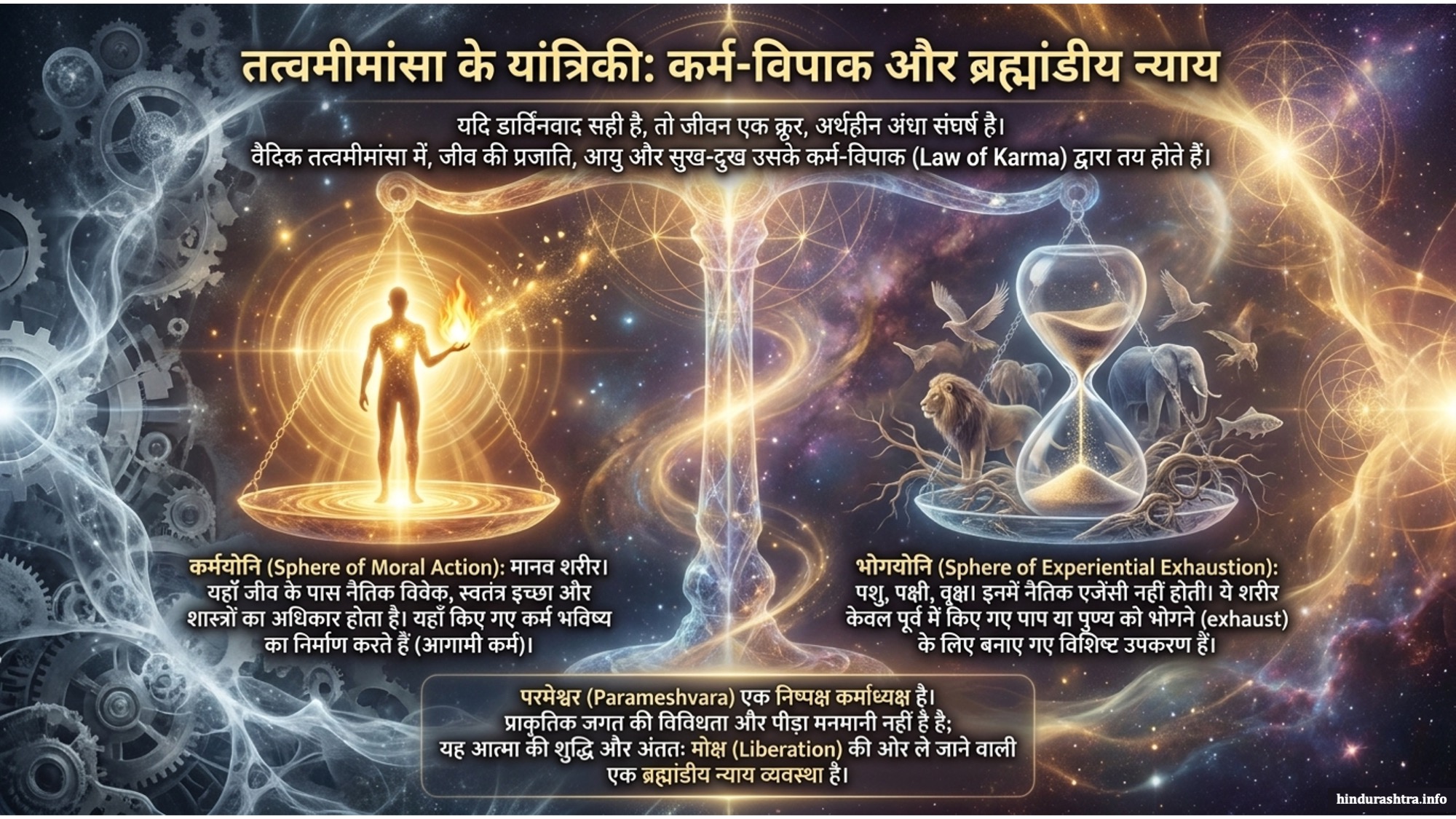
When an individual in human form (Karma-Yoni [कर्मयोनि]) engages in severe transgressions, those actions create heavy negative karmic merit (Papa [पाप]). Upon death, to exhaust that specific karmic debt, the soul is assigned appropriate non-human bodies (Bhoga-Yoni [भोगयोनि]) such as a tiger to exhaust aggressive predatory tendencies, or a tree to exhaust dull, ignorant inertia. Once the specific karmic debt is exhausted through animal embodiment, the soul re-ascends into human embodiment to resume its spiritual journey.
6.3 Resolution of Cosmic Anomalies: Infinite Souls, Corporate Bodies, and Divine Grace
Karpatri Ji resolves several complex metaphysical paradoxes regarding cosmic population dynamics and species transformations:
The Population Paradox
Materialists ask: If lower animal species are mere temporary embodiments for human souls exhausting past sins, how can millions of animal and insect species exist when the human population is comparatively small? Karpatri Ji provides a multi-layered Vedantic resolution:
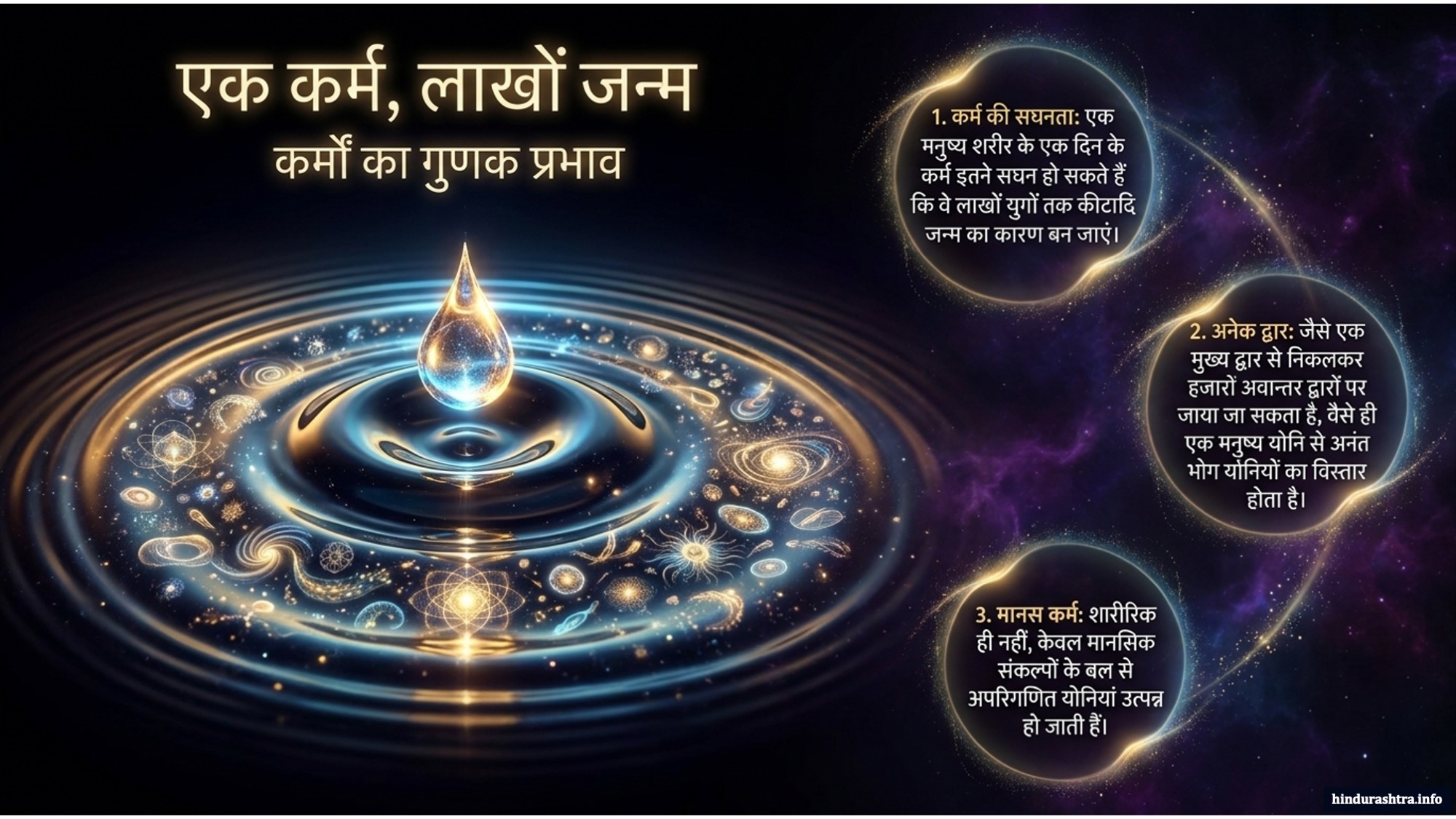
- A single severe karmic transgression in human form can yield thousands of successive lower births in animal or insect forms before that specific karmic debt is fully exhausted.
- Infinite individual souls (Ananta Jiva [अनन्त जीव]) exist across infinite cosmic systems (Ananta Brahmanda [अनन्तब्रह्माण्ड]), moving between subtle and gross dimensions.
- Advanced spiritual beings (such as Hiranyagarbha [हिरण्यगर्भ]) or accomplished yogis possess the capacity for Multi-Body Projection (Kayavyuha [कायव्यूह]), projecting thousands of physical forms simultaneously to exhaust complex karmic matrixes under unified conscious awareness.
Spontaneous Species Transformations
Karpatri Ji accounts for historical instances of immediate species transformation recorded in sacred texts such as King Nahusha transforming instantly into a python due to the curse (Shapa [शाप]) of Agastya Rishi, Rambha transforming into a rock, or Nandi attaining divine status through intense devotion (Vara [वर]). These rapid transformations are driven by extreme karmic momentum, divine blessings, or powerful ascetic resolves (Sankalpa [संकल्प]), which instantly reconfigure the elemental subtle particles (Bhutani [भूतानि]) constituting the physical body. This demonstrates that biological forms are fluid under spiritual and moral laws, rather than being restricted to slow physical evolution.
6.4 Divine Governance, Moral Order, and the Purpose of Cosmic Suffering
Charles Darwin expressed agnostic skepticism regarding divine benevolence, arguing that a merciful God would not create a world characterized by predation, disease, and suffering.
Swami Karpatri Ji Maharaj provides a rigorous Vedantic justification for cosmic suffering:
- God acts as an impartial Dispenser of Fruits (Karmadhyaksha [कर्माध्यक्ष]), administering experience strictly according to the eternal, uncreated moral Karma (Karma-Vipaka [कर्मविपाक]) of individual souls (Jivas [जीव]). God does not arbitrarily inflict suffering or bestow joy; He functions like a just sovereign enforcing impartial law.
- Suffering serves an essential pedagogical purpose in spiritual evolution. Continuous physical pleasure leads to spiritual lethargy, sensory attachment, and deeper ignorance. Suffering acts as a transformative catalyst, fostering detachment (Vairagya [वैराग्य]), intellectual discrimination (Viveka [विवेक]), and spiritual purification. Just as a compassionate sovereign imposes imprisonment upon a criminal for self-reformation and public order, Divine Providence permits suffering to guide the soul back to its divine nature (Amritasya Putrah [अमृतस्य पुत्रा:]).
Having established the moral mechanics governing biological embodiment, Karpatri Ji evaluates prominent Western philosophers and 20th-century scientific reversals.
- Evaluation of Western Philosophers and Modern Scientific Reversals
7.1 Contextual Introduction & Strategic Importance
A complete philosophical critique must engage directly with opposing intellectual traditions and evaluate their historical evolution. In Marxvaad aur Ramrajya [मार्क्सवाद और रामराज्य], Swami Karpatri Ji Maharaj engages deeply with Western thinkers (including Herbert Spencer, Immanuel Kant, Ernst Haeckel, and Thomas Huxley) while highlighting major 20th-century scientific reversals that undermined classical 19th-century materialist evolutionism. Karpatri Ji demonstrates that as physical science advances, its empirical discoveries increasingly dismantle crude materialist assumptions, aligning with the timeless principles of Vedic metaphysics.
7.2 Critique of Herbert Spencer’s Agnosticism and Evolutionary Metaphysics
Swami Karpatri Ji Maharaj deconstructs the evolutionary metaphysics of Herbert Spencer, who formulated three formal stages of universal evolution:
- Centralization / Concentration: Aggregation of unorganized physical matter.
- Differentiation: Inner structural diversification from homogeneous to heterogeneous forms.
- Explicit Organization: Systematic integration of differentiated organs into a functional whole.
Spencer concluded that behind all physical phenomena lies an Unknowable Power (Ajneya Shakti [अज्ञेय शक्ति]), asserting that human reason can know only relative phenomenal relationships, while ultimate reality remains perpetually inaccessible.
Karpatri Ji exposes Spencer’s “Unknowable Power” as an epistemological surrender resulting from reliance on sensory empiricism. What is unknowable to physical laboratory instruments is fully knowable through Vedic seership (Rishi-Drishti [ऋषि-दृष्टि]) and self-luminous self-awareness (Swaprakasha Atma-chaitanya [स्वप्रकाश आत्म-चैतन्य]). Ultimate reality is not an unknowable blank; it is Pure Consciousness (Sat-Chit-Ananda Brahman [सच्चिदानन्द ब्रह्म]), accessible through scriptural means (Shabda Pramana [शब्द प्रमाण]) and direct realization (Aparoksha Anubhuti [अपरोक्ष अनुभूति]).
Furthermore, Karpatri Ji refutes Spencerian Social Darwinism which argued that state governance should not provide charity, healthcare, or assistance to the poor or sick, so that natural selection could eliminate the weak. Karpatri Ji contrasts this cruel materialist stance with Vedic Dharma [धर्म], which mandates duty-based governance (Ramrajya [रामराज्य]), universal compassion (Daya [दया]), and protection for all living beings.
7.3 Refutation of Ernst Haeckel’s Materialist Monism (Jadadvaitavada [जडाद्वैतवाद])
Ernst Haeckel championed materialist monism (Jadadvaitavada [जडाद्वैतवाद]), claiming that mind, intellect, and consciousness are physical secretions of the brain. Haeckel argued that brain damage or neurological injury destroys mental faculties, proving that no independent soul (Atma [आत्मा]) exists outside physical physiology.
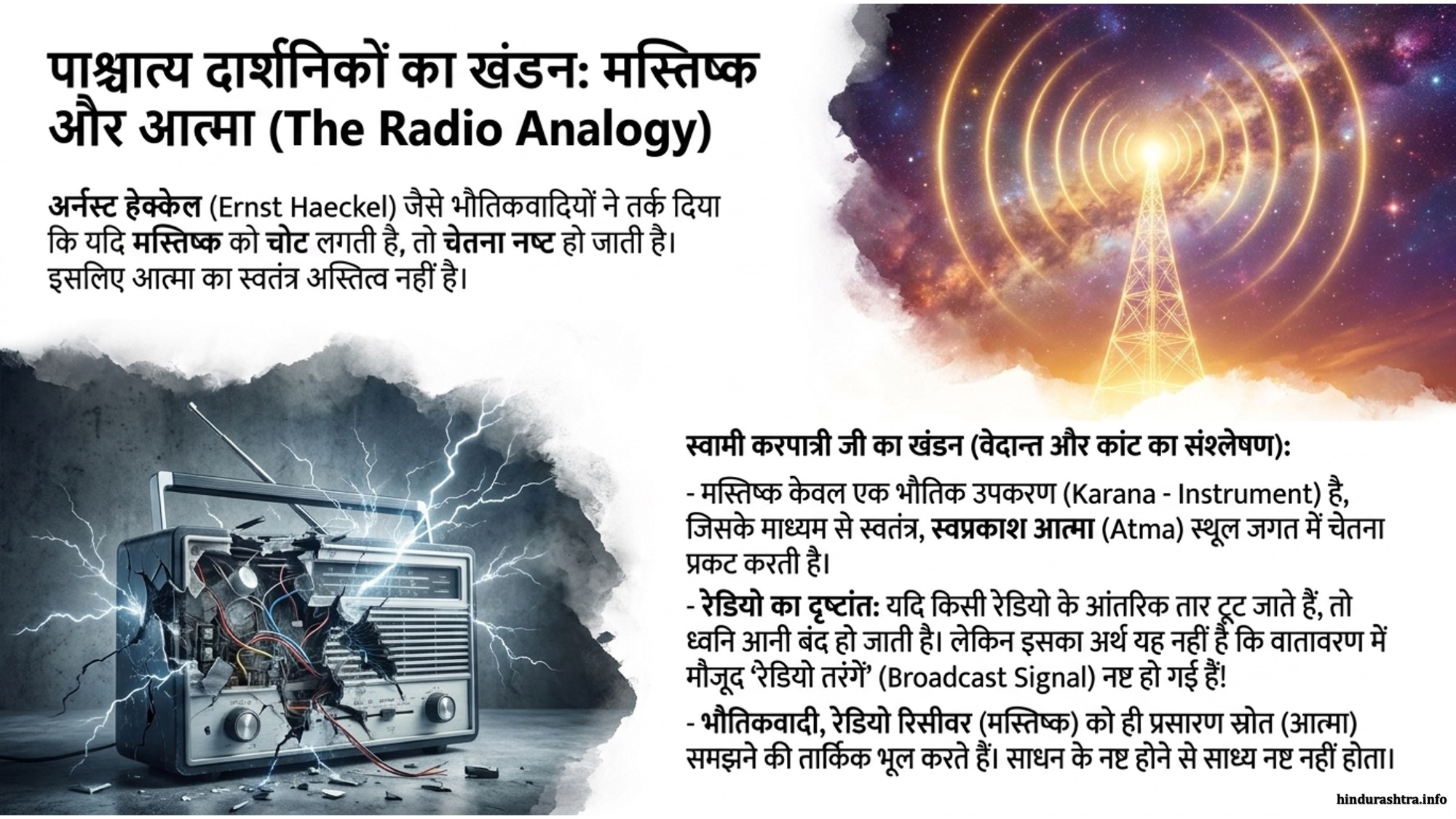
Karpatri Ji refutes Haeckel’s neurological reductionism by drawing upon Immanuel Kant’s distinction between physical phenomena and intrinsic reality, integrated with Advaita Vedanta:
- The physical brain and nervous system are merely the physical instrument (Karana [करण]) through which the independent, self-luminous Soul (Atma [आत्मा]) manifests conscious awareness in the gross physical world.
- Impairment of the physical instrument (the brain) disrupts the manifestation of consciousness in the physical world, but does not destroy the transcendent Soul (Atma [आत्मा]). Karpatri Ji illustrates this with a clear physical analogy: if a radio receiver’s internal wiring is damaged, the sound output becomes distorted or silent. However, the radio station’s broadcast signal remains completely intact in the atmosphere. The radio receiver is the physical instrument (Karana [करण]); the radio signal is the independent broadcast. Haeckel committed the logical fallacy of confusing the physical receiving instrument with the independent, animating source.
7.4 Biological, Hematological, and Anatomical Counter-Proofs
Karpatri Ji synthesizes compelling anatomical, hematological, and biological evidence to dismantle macro-evolutionary claims:
Hematological Proofs (Rudhira Pariksha [रुधिर परीक्षा])
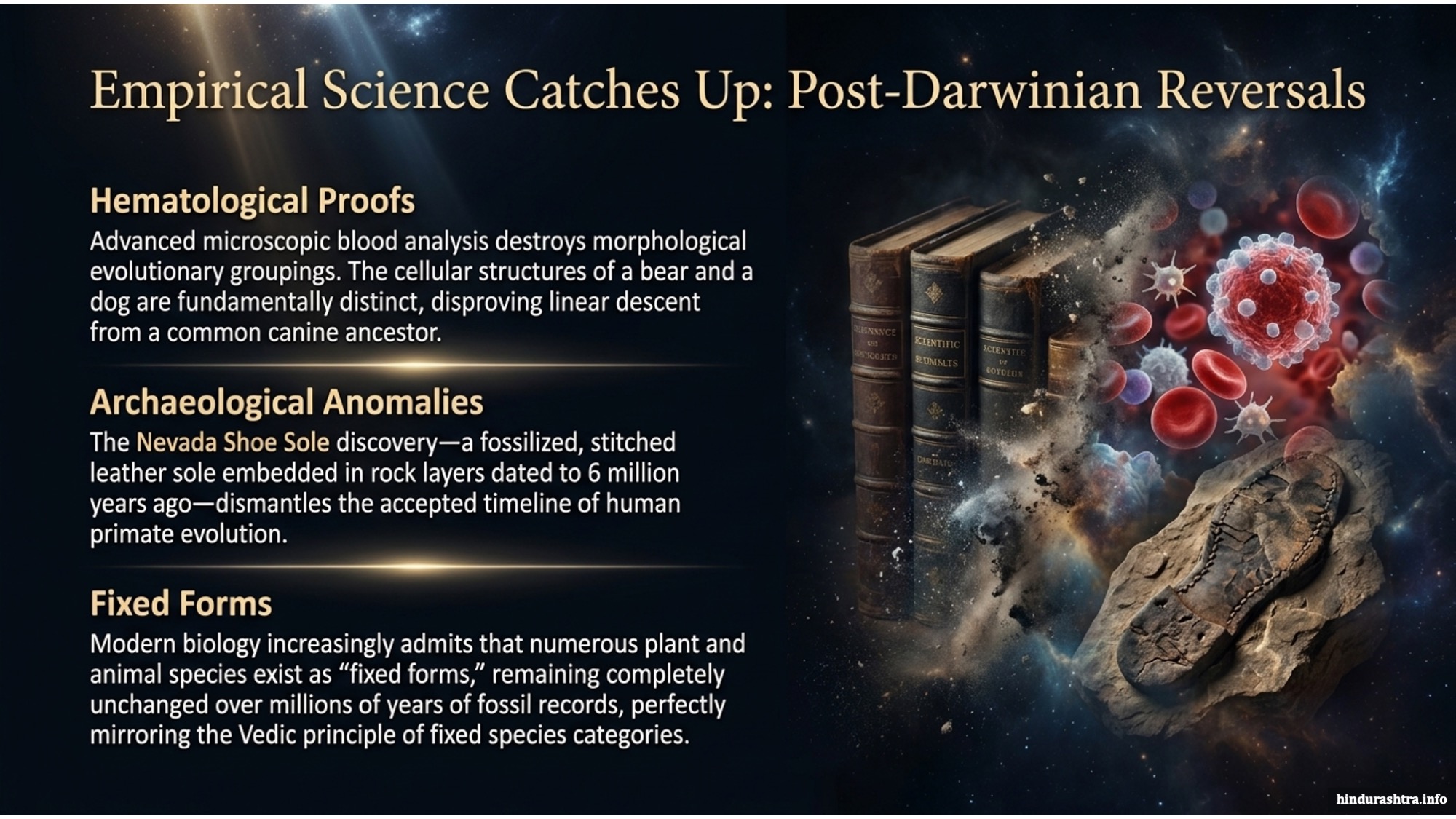
19th-century evolutionists categorized animals based on superficial external similarities (e.g., placing guinea fowls alongside chickens, or bears alongside dogs). Karpatri Ji highlights that advanced microscopic blood analysis (Rudhira Pariksha [रुधिर परीक्षा]) demolished these evolutionary groupings:
- Microscopic examination reveals that blood cell structures, shapes, and chemical properties are distinct for each species.
- The blood cells of a bear are structurally distinct from those of a dog, proving bears belong to a distinct lineage (closer to marine mammals like seals) rather than evolving from canine stock.
- Guinea fowl blood cells differ fundamentally from chicken blood cells, showing structural alignment with ostriches. These blood-cell distinctions refute the hypothesis of a single ancestral origin.
Systematic Demolition of Four Bone Origin Hypotheses
Karpatri Ji demolishes four materialist hypotheses proposed to explain how bone-bearing vertebrates evolved from boneless organisms:
- Mental Inspiration: Claimed boneless organisms “wished” for internal bones. Karpatri Ji refutes this by showing that boneless organisms have no conscious connection to skeletal formation; an insect cannot generate an internal skeleton by thought.
- Friction and Callus Formation: Claimed physical labor created internal bone calluses. Karpatri Ji refutes this by demonstrating that external physical friction creates external skin calluses, not an internal structural skeleton.
- Lime-Rich Diet: Claimed eating calcium-rich food created bones. Karpatri Ji refutes this empirically: bloodsucking parasites (leeches, bedbugs, fleas, lice) consume calcium-rich blood for generations without developing a single internal bone.
- Nerve-Hardening: Claimed internal nerves hardened into bones. Karpatri Ji refutes this anatomically: dental extractions and orthopedic surgery demonstrate that nerves and bones remain entirely distinct anatomical structures.
Respiration vs. Lifespan Paradox
Darwinism claims that macro-evolution produces biologically fitter, more durable organisms. Karpatri Ji presents an empirical comparison showing an inverse relationship between evolutionary complexity and longevity, contradicting the claim that evolved species are more durable:
|
Species / Organism |
Respiration Rate (Breaths per Minute) |
Average Lifespan (Years) |
Structural Complexity Category |
|
Turtle (Kachhupa [कच्छप]) |
5 breaths/min |
150 years |
Reptilian / Primitive |
|
Snake (Sarpa [सर्प]) |
8 breaths/min |
120 years |
Reptilian / Primitive |
|
Elephant (Gaja [गज]) |
12 breaths/min |
100 years |
Advanced Mammalian |
|
Human (Manushya [मनुष्य]) |
13 breaths/min |
100 years |
Evolved Primate / Human |
|
Horse (Ashwa [अश्व]) |
19 breaths/min |
32 years |
Advanced Mammalian |
|
Dog (Kukura [कुक्कुर]) |
29 breaths/min |
14 years |
Mammalian |
|
Monkey (Vanara [वानर]) |
32 breaths/min |
21 years |
Primate |
|
Pigeon (Kapot [कपोत]) |
36 breaths/min |
8 years |
Avian |
|
Rabbit (Shashaka [शशक]) |
38 breaths/min |
8 years |
Mammalian |
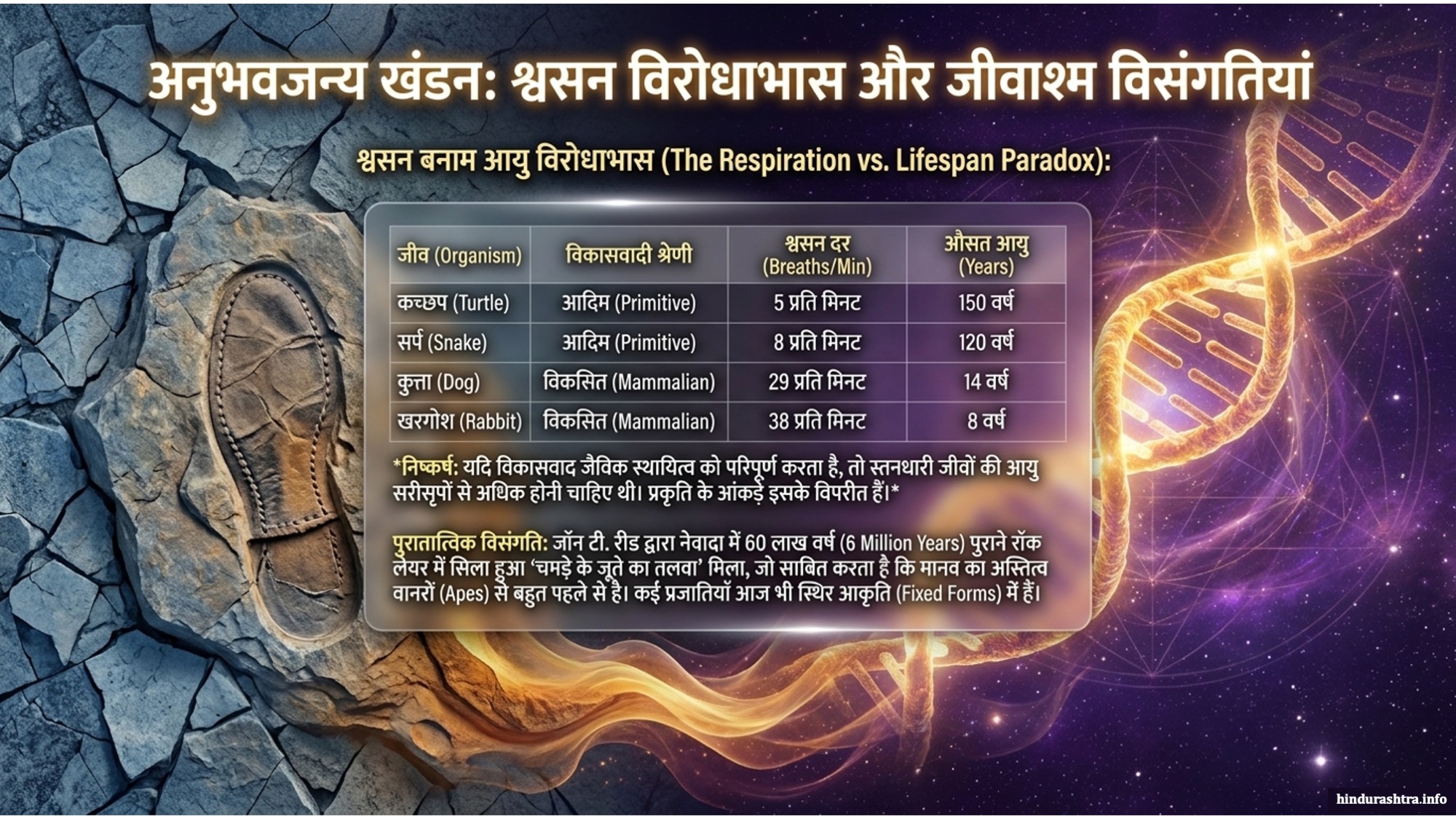
This empirical data demonstrates that “primitive” reptilian organisms (turtles, snakes) possess far greater longevity (120–150 years) than “highly evolved” primates and mammals (monkeys: 21 years; dogs: 14 years; rabbits: 8 years). If macro-evolution continuously perfected biological durability, evolved mammals would outlive primitive reptiles.
7.5 Modern Scientific Reversals: Post-Darwinian Findings and Scientific Support
Karpatri Ji cites prominent 20th-century scientists who challenged classical Darwinism, including Sir Oliver Lodge, Prof. J.A. Fleming, George Darwin, John T. Reid, Dr. Gadow, and T.L. Stage:
- The Nevada Shoe Sole Discovery: Karpatri Ji cites the archaeological discovery documented by John T. Reid in Nevada; a fossilized, stitched leather shoe sole embedded in rock layers dated to 6 million years old (6,000,000 Years / 60 Lakh Years [६० लाख वर्ष]). This artifact demolished the evolutionary timeline, which claimed humans evolved from apes only hundreds of thousands of years ago.
- Devolution Theory (“Monkeys from Humans”): Karpatri Ji documents post-Darwinian scientific findings arguing that ancient humans possessing advanced intellectual capacities suffered cultural and neurological regression, degenerating into primitive forest dwellers, ape-men, and monkeys.
- Fixed Forms (Sthira Akriti [स्थिर आकृति]): Karpatri Ji highlights admissions by 20th-century biologists (such as T.H. Huxley in his later work) that numerous plant and animal species exhibit “fixed forms” (Sthira Akriti [स्थिरआकृति]), remaining unchanged in fossil records over millions of years without undergoing evolutionary mutation. This empirical finding matches the Vedic principle of fixed species categories (Jati-Niyama [जाति-नियम]).
With modern physical science confirming the presence of fixed species forms and transcendent physical limits, the entire comparative treatise can be integrated into a master synthesis.
- Comprehensive Synthesis: Vedic Metaphysics versus Western Evolutionism
8.1 Contextual Introduction & Strategic Importance
The rigorous evaluation conducted across ontological, epistemological, biological, historical, linguistic, and metaphysical domains reveals an uncompromising opposition between Western materialist evolutionism and orthodox Vedic metaphysics. Swami Karpatri Ji Maharaj’s systematic refutations in Marxvaad aur Ramrajya [मार्क्सवाद और रामराज्य] do not merely highlight minor scientific oversights; they dismantle the foundational assumptions of materialist positivism. The grand synthesis demonstrates that materialist evolutionism is a limited, localized hypothesis elevated beyond its valid domain, whereas Vedic metaphysics offers a complete, uncontradicted account of reality, integrating physical nature, human consciousness, moral law, and cosmic divine governance.
8.2 Master Comparative Matrix
|
Domain of Analysis |
Darwinian / Western Evolutionary Model |
Vedic Metaphysical Model (Karpatri Ji) |
Epistemological / Metaphysical Consequence |
|
Primary Ontology |
Unconscious Matter (Jada [जड]) or physical energy; Mind is an emergent byproduct. |
Uncaused Prime Consciousness (Chetana [चेतन] / Brahman [ब्रह्म]); Matter is animated by Maya [माया]. |
Materialism reduces consciousness to physical mechanics; Vedantism establishes Consciousness as fundamental reality. |
|
Epistemology |
Empirical Observation (Pratyaksha [प्रत्यक्ष]) and Materialist Inference (Anumana [अनुमान]). |
Tripartite Epistemology: Senses < Inference < Unauthored Divine Revelation (Apaurusheya Shabda [अपौरुषेय शब्द]). |
Empiricism yields constantly changing hypotheses; Vedic revelation provides immutable metaphysical truth. |
|
Mechanism of Species Creation |
Random Mutation, Environmental Adaptation, Malthusian Struggle, Natural Selection. |
Divine Manifestation of Pre-Existing Potencies (Shakti [शक्ति]) governed by Karma-vipaka [कर्मविपाक]. |
Evolutionary model lacks initial causal explanation; Vedic model grounds biological form in moral order. |
|
Species Permanence |
Fluid Macro-Evolution: Species continuously transform across genus lines. |
Fixed Species Categories (Jati-niyama [जाति-नियम]): Micro-adaptation within fixed elemental potencies. |
Science fails to observe inter-species transition today; Vedic model matches observed species fixity. |
|
Human & Language Origin |
Apes/Pragmatic grunts evolving via physical gestures, onomatopoeia, and survival pressures. |
Eternal Divine Revelation (Vedic Sanskrit [वेद-संस्कृत]) given directly to Primordial Ancestors (Brahma/Manu). |
Evolutionary model cannot explain language without prior instruction; Vedic model establishes uncreated Word. |
|
Historical Trajectory |
Linear Progress: Primitive Caveman / Stone Age -> Industrial / Technological Man. |
Cyclical Epochs (Yugas [युग] / Hrasa-Vikasa [ह्रास-विकास]): Periods of peak wisdom cycling into decay. |
Western model assumes technological growth equals human elevation; Vedic model recognizes spiritual regression. |
|
Cosmic Purpose & Ethics |
Amoral Survival of the Fittest (Yogyatama ki Raksha [योग्यतम की रक्षा]); Ethical relativism. |
Moral Universe governed by Dharma [धर्म], Compassion (Daya [दया]), and Ultimate Liberation (Moksha [मोक्ष]). |
Evolutionary struggle leads to conflict/nihilism; Vedic Karma model grounds morality in universal law. |
8.3 Philosophical Conclusion and Final Imperative
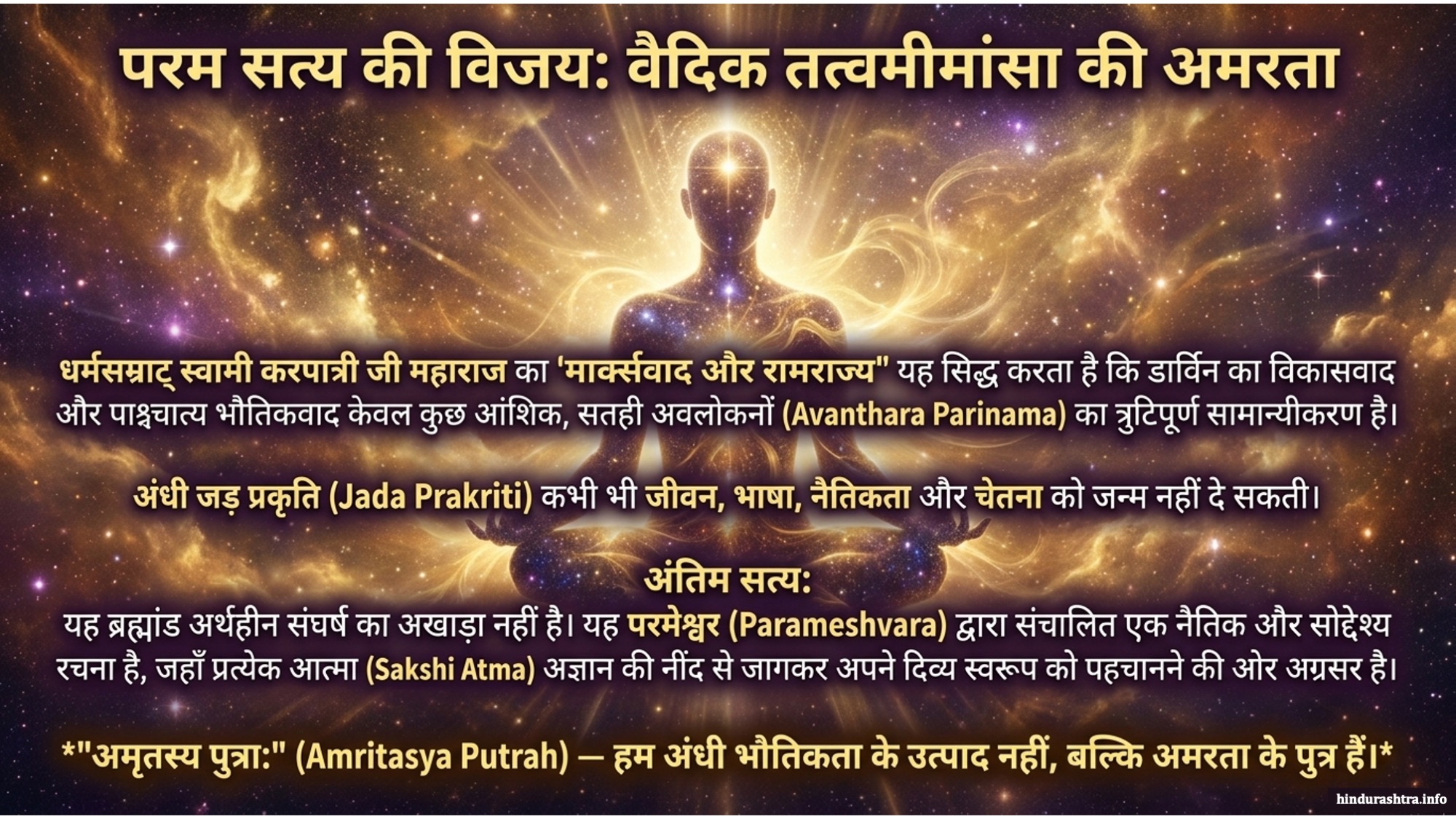
The ultimate philosophical verdict established by Dharma Samrat Swami Karpatri Ji Maharaj in Marxvaad aur Ramrajya [मार्क्सवाद और रामराज्य] is both definitive and transformative. Darwinian evolutionary biology and Western materialist theories represent localized, superficial observations of minor micro-adaptations (Avanthara Parinama [अवान्तर परिणाम]), errantly projected as a universal metaphysical paradigm. Materialism fails to account for the origin of first variations, the irreducibility of the witnessing self, the non-verbal convention paradox of language, and the presence of fixed species forms throughout geological history.
The logical path forward requires returning to the Vedantic worldview: recognizing an Eternal, All-Knowing Supreme Controller (Parameshvara [परमेश्वर]), an immortal Witnessing Soul (Sakshi Atma [साक्षी आत्मा]), the eternal validity of Divine Revelation (Apaurusheya Veda [अपौरुषेय वेद]), and the moral mechanism of Cosmic Action (Karma-Vipaka [कर्मविपाक]). Only within this comprehensive framework can humanity account for the exquisite order, profound diversity, linguistic majesty, and ultimate spiritual purpose of the cosmos. Vedic metaphysics stands not as a relic of ancient faith, but as an immutable, uncontradicted science of reality; shining triumphantly above the transient hypotheses of materialist evolutionism.