Ramrajya as a Socio-Economic Alternative
A Critical Synthesis of Capitalism, Socialism,
and Dharma-Regulated Governance
Section 1: Executive Orientation & Theoretical Framework
1.1 Ideological Paralysis of the Modern Binary: Capitalism vs. Socialism
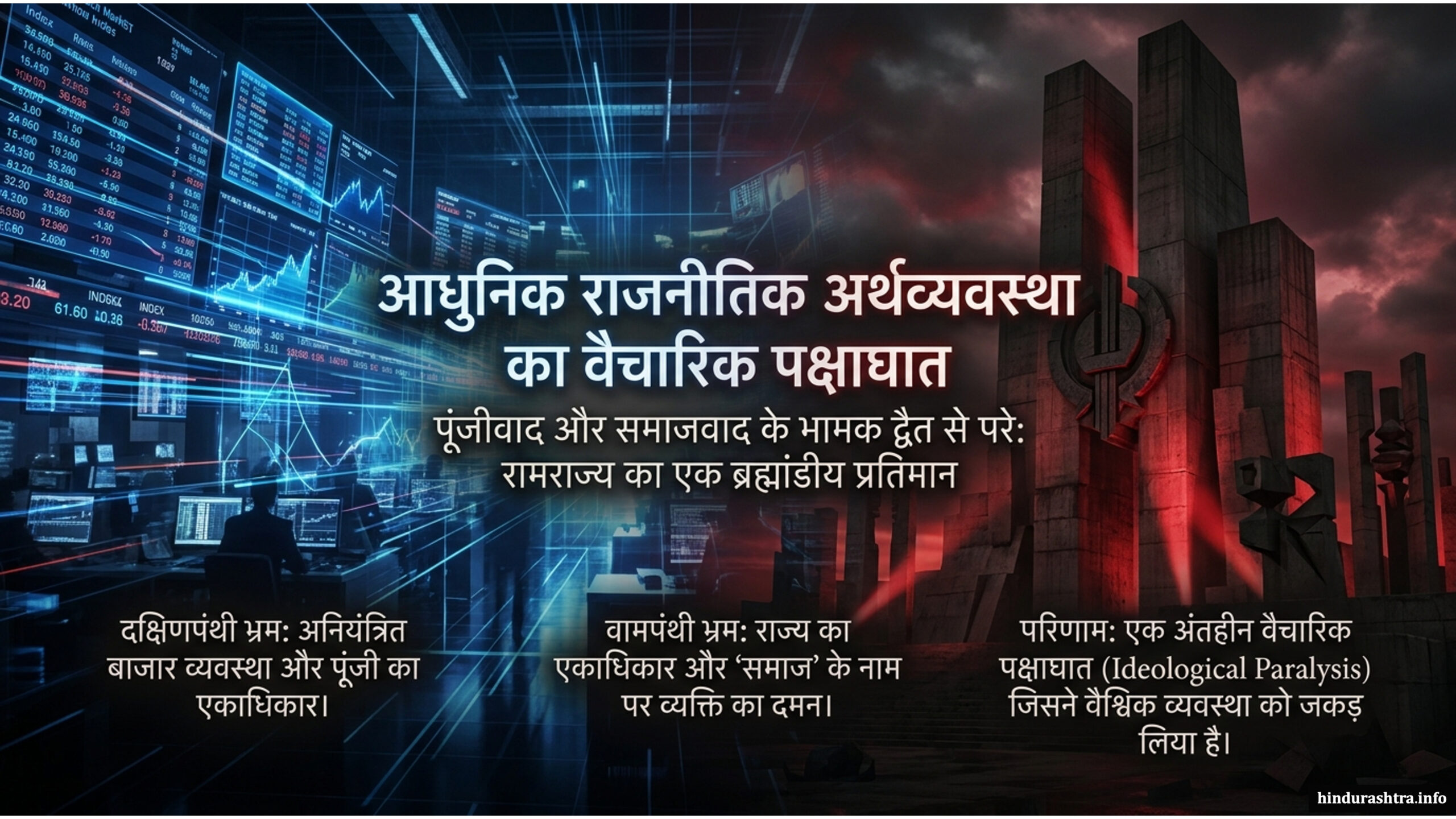
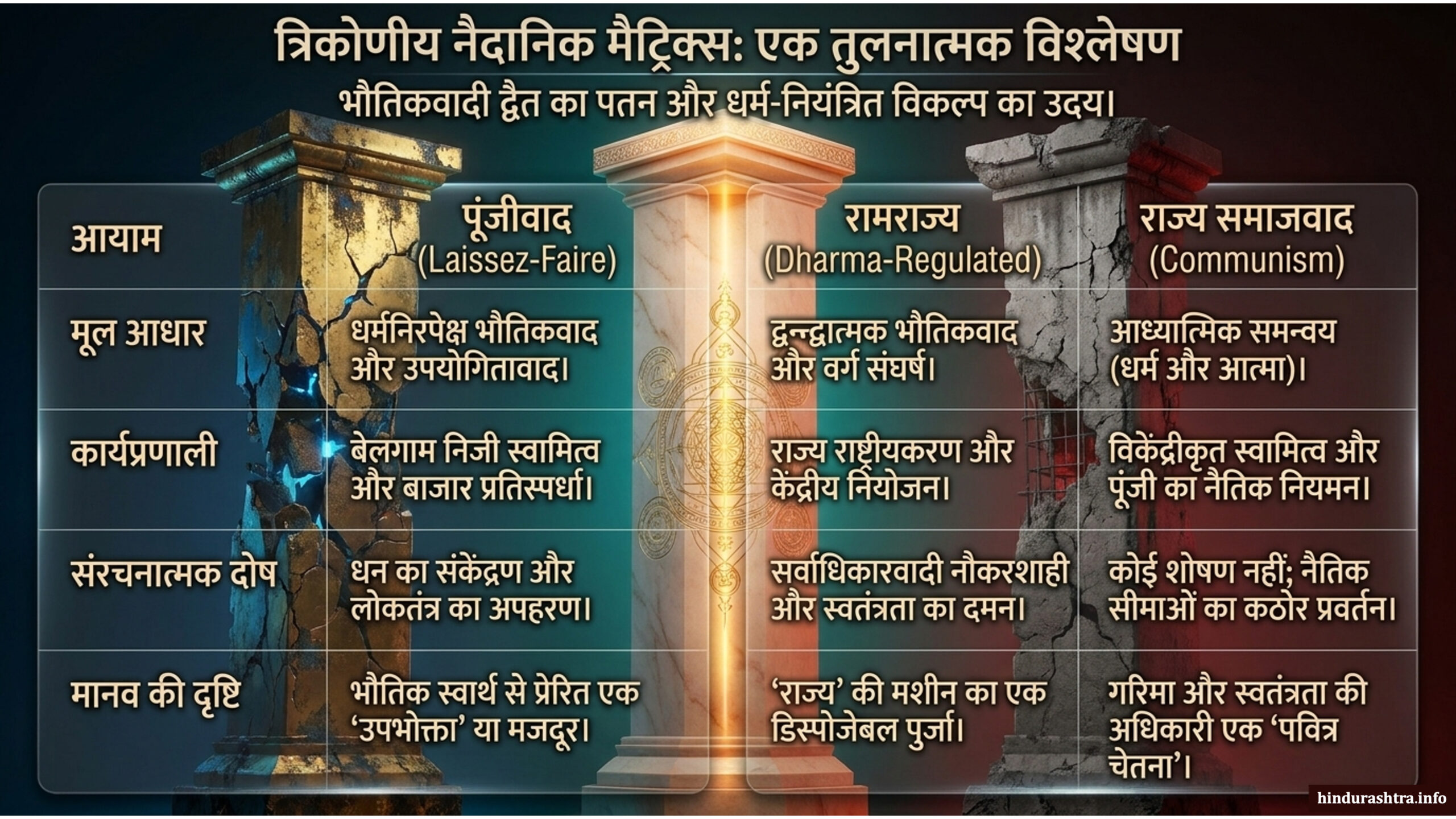
The contemporary global political economy is trapped in an exhausting ideological paralysis. For centuries, theoretical discourse and institutional policy have been restricted to a rigid Western binary: the market-driven chaos of laissez-faire capitalism on one hand, and the state-monopolized coercion of socialism and communism on the other. Diagnosing the systemic failures inherent in both paradigms is an urgent necessity for modern policymakers. Both capital-centric market systems and state-centric socialist regimes suffer from fundamental structural contradictions that generate severe socio-economic instability, systemic inequality, and the spiritual alienation of the individual. To transcend this perpetual cycle of economic crisis, wealth concentration, and political tyranny, humanity urgently requires a holistic governance model grounded in transcendent ethical regulation (Dharma-Niyantrit धर्म-नियन्त्रित).
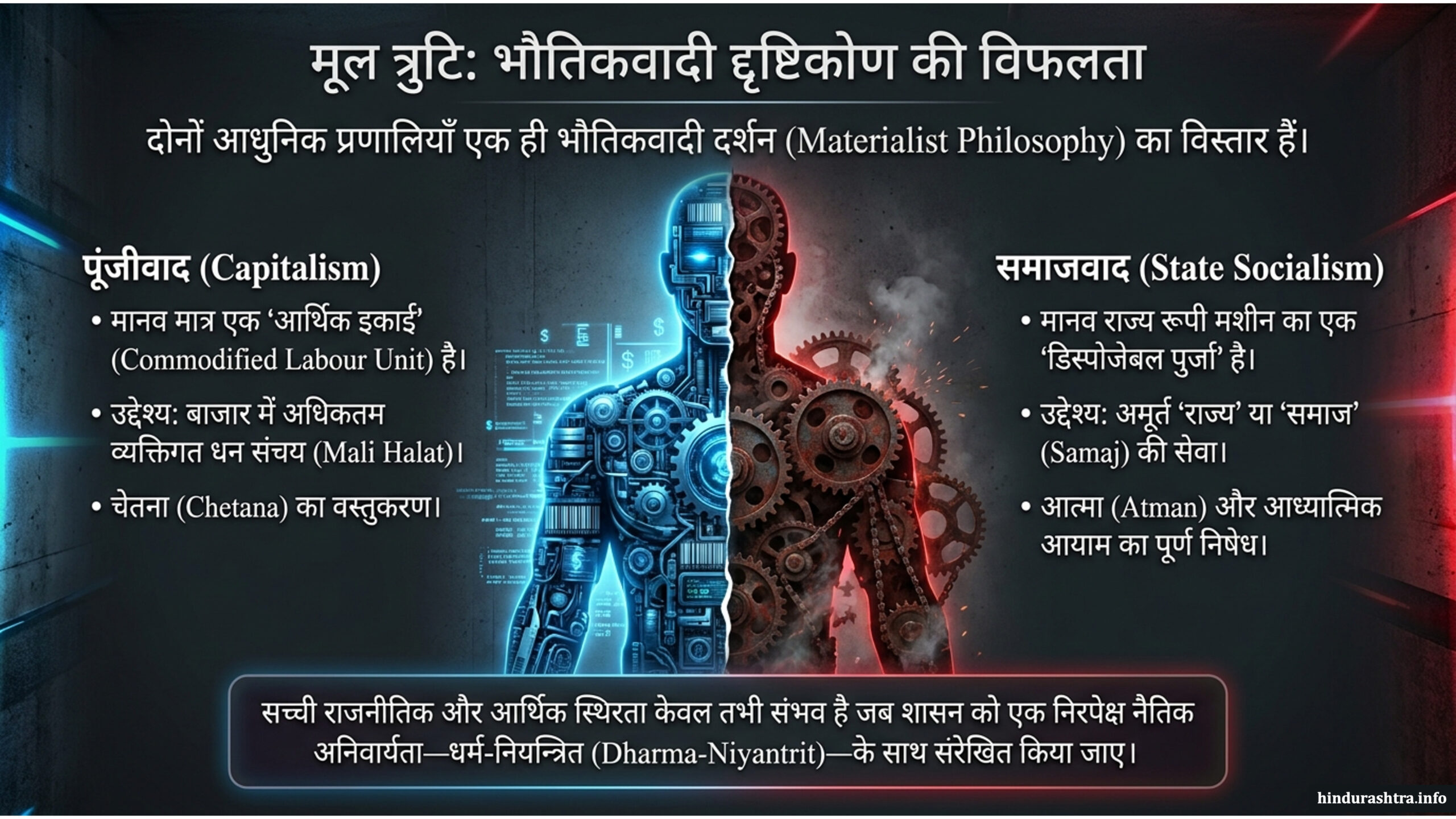
This dual failure stems from a shared foundational error: both modern capitalism and state socialism are rooted in an exclusively materialist philosophy. Both paradigms reduce human existence to economic drivers (Mali Halat माली हालात), physical consumption, and material wealth accumulation. In this reductionist view, human beings are treated either as commodified labour units within a market or as disposable cogs within a state apparatus, ignoring the transcendent, moral, and spiritual dimensions of human existence (Atman and Dharma आत्मा और धर्म). As Swami Karpatri Ji Maharaj rigorously demonstrated through his comprehensive engagement with Western political economy by critiquing the philosophical lineages of Adam Smith, Jeremy Bentham, John Stuart Mill, Herbert Spencer, Charles Darwin, George Darwin, Thomas Huxley, David Ricardo, and Karl Marx; socio-economic equilibrium cannot be achieved through purely materialist adjustments, wage reallocations, or utilitarian administrative restructurings. Utilitarianism and social Darwinism reduce justice to numerical calculation or the survival of the financially fittest, ignoring the absolute moral substrate required for social cohesion. True political and economic stability requires aligning governance with an absolute ethical imperative (Dharma-Niyantrit धर्मनियन्त्रित), ensuring that material growth serves human fulfillment without degrading social harmony or moral integrity.
|
Dimension |
Laissez-Faire Capitalism (पूँजीवाद) |
State Socialism / Communism (राज्य समाजवाद / साम्यवाद) |
Ramrajya (Dharma-Regulated State) रामराज्य (धर्म-नियन्त्रित शासन) |
|
Foundational Premise |
Secular Materialism & Utilitarianism; individual wealth maximization. |
Dialectical Materialism; class struggle (Varga Sangharsha वर्ग संघर्ष) and state monopoly. |
Transcendent Spiritualism (Dharma धर्म, Atman आत्मा); balanced integration of Purusharthas. |
|
Primary Mechanism |
Unfettered private ownership; market competition; capital accumulation. |
State nationalization (Rashtriyakarana राष्ट्रीयकरण); central planning; Dictatorship of Proletariat. |
Decentralized ownership; moral regulation of capital; public duty (Kartavya कर्तव्य). |
|
Structural Flaws |
Capital concentration; unchecked automation; democratic capture by capital. |
Totalitarian bureaucracy; erasure of liberty; State Capitalism (Rajya Poonjivad राज्य पूँजीवाद). |
Non-exploitative equilibrium via rigorous moral-legal enforcement of ethical bounds. |
|
View of the Human Being |
Commodified labour unit or consumer driven by material self-interest. |
Disposable instrument for the abstract “State” or “Society” (Samaj समाज). |
Sacred conscious entity (Chetana चेतना) entitled to dignity, liberty, and self-realization. |
The intellectual defenses constructed to justify these materialist paradigms, particularly contemporary neo-capitalist apologetics, must be rigorously dissected to expose their underlying logical inconsistencies.
1.2 The Refutation of Neo-Capitalist Apologetics: The Karpatri-Rajneesh Debate
A prominent example of contemporary neo-capitalist rhetoric is found in the writings of thinkers such as Rajneesh (Beware of Socialism / समाजवाद से सावधान). Rajneesh mounted an impassioned defense of unchecked capitalist development while attempting to dismiss socialism as a complete illusion. To make his case, Rajneesh deployed the classic allegory of the “Emperor’s New Clothes,” wherein a trickster fabricates non-existent divine garments that adults pretend to see out of fear of appearing illegitimate or foolish, until an innocent child exposes the monarch as walking completely naked. Through this allegory, Rajneesh argued that socialism is a collective mass delusion, a non-existent entity (Khapushpaखपुष्प or Vandhya-Putra वन्ध्या-पुत्र, akin to a flower blooming in the sky or the son of a barren woman) promoted by foolish masses and opportunistic ideologues.
In his critique, Swami Karpatri Ji systematically dismantled this neo-capitalist apologetic by exposing its deep epistemological and logical errors. Karpatri Ji demonstrated that dismissing socialism as a mere hallucination is logically absurd and economically blind. Socialism is not a non-existent illusion; it is a concrete, operational socio-economic force that arose directly in response to the severe material realities of industrial production, wealth concentration, and labour exploitation under capitalism. Dismissing a global geopolitical movement that restructured entire nations, nationalized complex industries, and challenged global superpowers as a “non-existent dress” represents an evasion of reality.
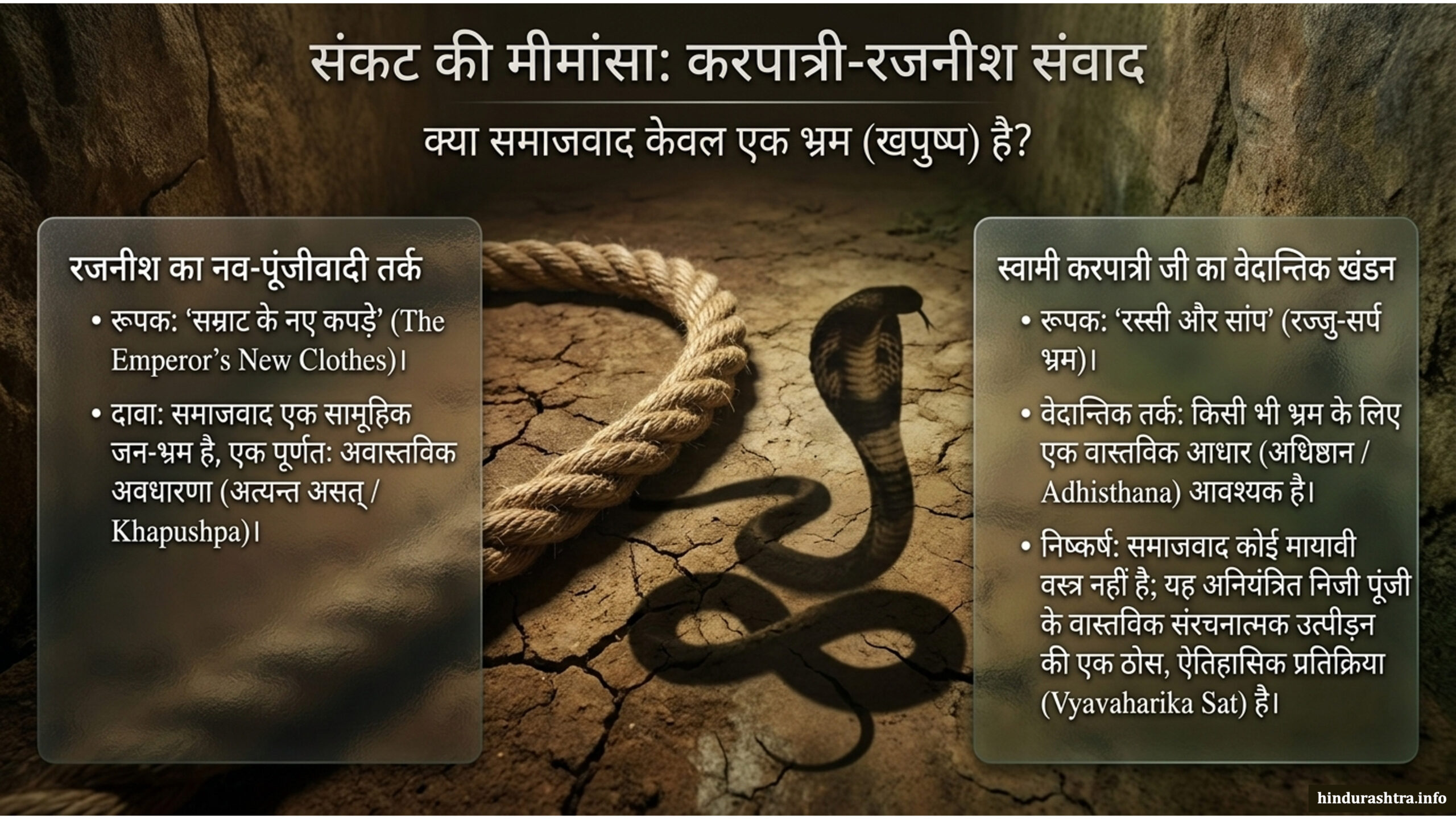
Furthermore, Swami Karpatri Ji Maharaj highlighted a glaring internal contradiction in Rajneesh’s narrative. Within the same theoretical framework, Rajneesh simultaneously claimed that socialism is an absolute, non-existent illusion (Khapushpa खपुष्प) while asserting that socialism is the natural, inevitable evolutionary child (Santan सन्तान) born from the womb of fully developed historical capitalism. Logically, both premises cannot be true. An entity cannot be a non-existent hallucination (Atyanta Asat अत्यन्त असत्) and, at the same time, a tangible evolutionary byproduct generated by the material mechanics of capital concentration.
Swami Karpatri Ji’s Epistemological Refutation: “To declare a global socio-economic force that nationalizes capital, organizes millions of industrial workers, and restructures world geopolitics as a non-existent illusion (Khapushpa) is pure self-deception. In Vedantic epistemology, an illusory perception requires a concrete underlying substrate (Adhisthanaअधिष्ठान). Socialism is not a hallucinatory garment; it is the tangible, historical reaction to the real structural oppressions of unrestrained private capital.”
This refutation of neo-capitalist apologetics opens the door to a deeper investigation into how capitalist accumulation operates mechanically and why its internal flaws inevitably trigger systemic breakdown.
1.3 Defining Dharma-Niyantrit Governance (Dharma-Regulated State)
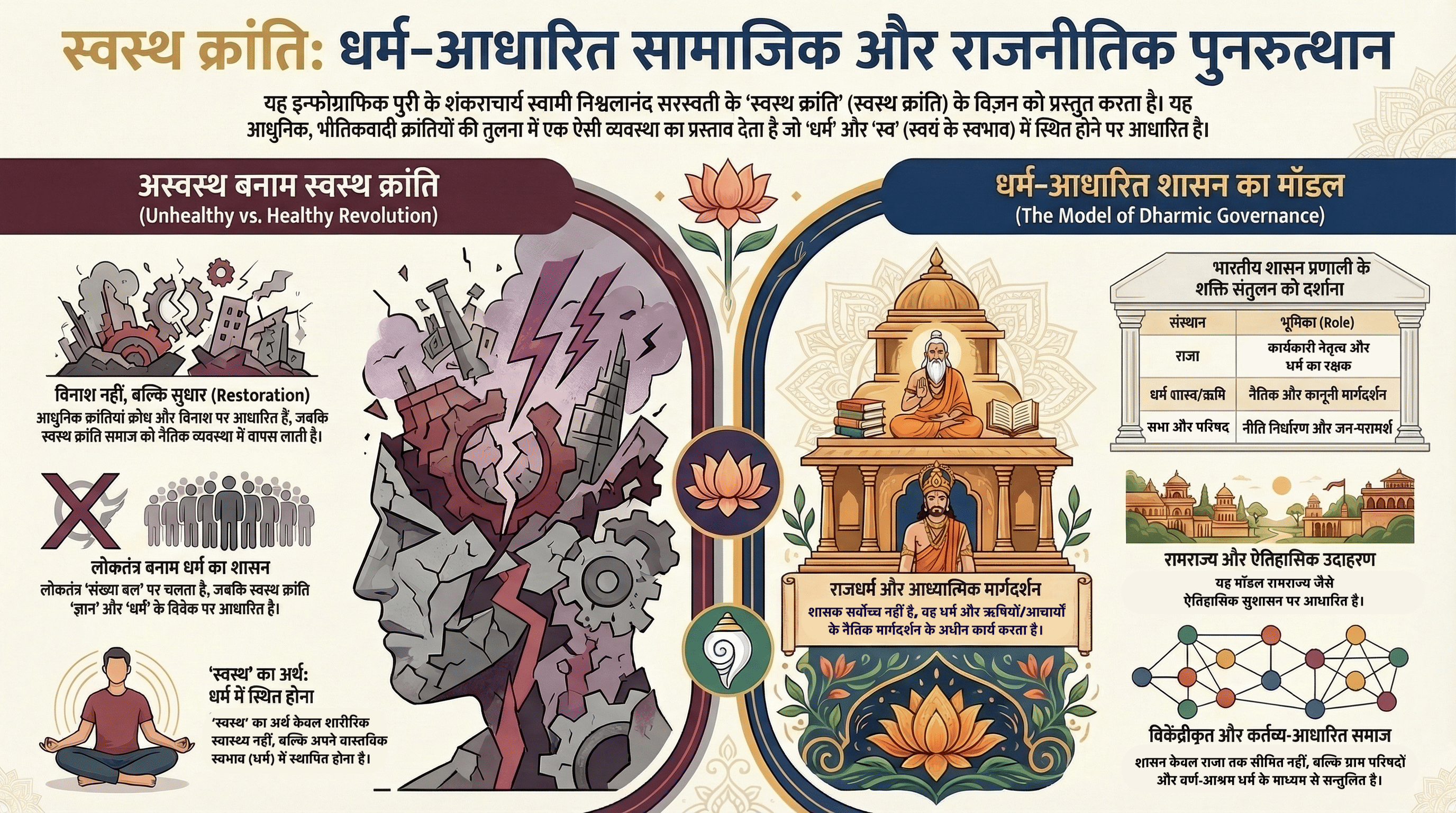
To move beyond the materialist binary, we must clearly define the conceptual scope of Ramrajya (रामराज्य), or Dharma-Niyantrit Rajtantra/Loktantra (धर्मनियन्त्रित राजतन्त्र/लोकतन्त्र Dharma-regulated monarchy or democracy). Far from being a primitive, regressive, or sectarian political structure, Ramrajya represents a sophisticated, timeless governance architecture where political authority and economic mechanisms are strictly subordinated to moral and cosmic law (Dharma धर्म).
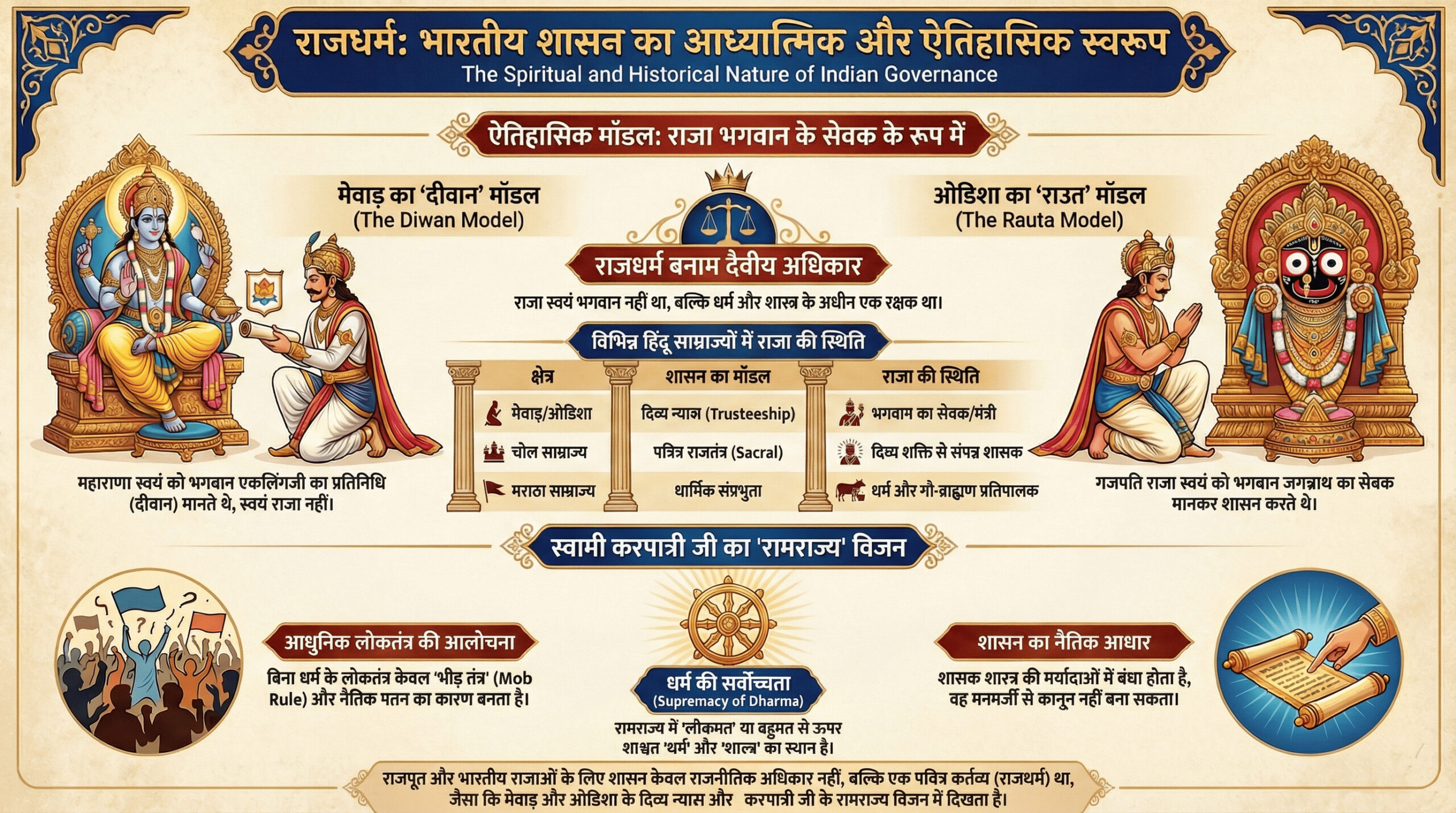
In this framework, Dharma must never be confused with sectarian religion, dogma, or institutionalized doctrine (Mazhabor Sampradaya मज़हब या सम्प्रदाय). Rather, Dharma signifies absolute moral duty, universal justice, cosmic order, and the essential rules of righteousness that sustain physical, psychological, and social life (“Dharanaat Dharma Mityahu” धारणात् धर्ममित्याहुः). Under Dharma-Niyantrit governance, Dharma functions as a supreme, meta-legal regulating force that sits firmly above both the sovereign political authority of the state and the financial power of private capital. Neither a monarch nor an elected parliamentary majority possesses the legislative jurisdiction to enact laws that violate universal ethical principles, exploit the vulnerable, or disrupt societal equilibrium (Matshya-Nyaya मत्स्यन्याय).
Within a Dharma-regulated framework, human freedom (Swatantrata स्वतन्त्रता) is understood not as an unregulated license for self-indulgence or predatory accumulation, but as the structural alignment of individual liberty with social equilibrium and spiritual self-realization. True liberty requires providing every citizen with the material necessities of life alongside a framework of moral accountability. By placing ethical boundaries on both political coercion (Danda दण्ड) and economic greed (Trishna तृष्णा), Dharma-Niyantrit governance guarantees genuine civil, economic, and spiritual freedom.
With these foundational definitions established, we turn directly to an explicit critique of the economic mechanics of modern capital accumulation.
Section 2: The Structural Mechanics and Internal Contradictions of Capitalism
2.1 The Myth of Capitalist Wealth Creation and the Reality of Exploitative Accumulation
Modern industrial capitalism is celebrated by its proponents as an engine of wealth creation. However, a rigorous economic analysis reveals that while capitalist production generates vast material output, its internal mechanics systematically destabilize labour equity, erode purchasing power, and undermine social cohesion. Capitalism does not create wealth out of nothing; rather, it organizes and extracts value from natural resources and human effort through asymmetric power structures.
Capitalist apologetics rest on the assertion that private capital single-handedly creates wealth. In reality, all economic value is derived from natural resources provided by nature (Bhoomi, Khani/Khanij भूमि, खनि/खनिज) combined with human labour power (Shrama श्रम). Classical economists like David Ricardo attempted to explain market value strictly through supply and demand price determination. Karl Marx advanced economic analysis by formulating the labour theory of surplus value, identifying human labour as the primary source of economic expansion. Synthesizing these perspectives within a Dharmic framework, Swami Karpatri Ji observed that capital in itself is inert and dead (Jada जड़). Raw materials, factory buildings, and land remain unproductive without the animating energy, intelligence, and conscious effort (Chetanaचेतना) of the worker.
Crucially, Karpatri Ji emphasized that human labour must be bifurcated into physical labour (Kaya-Shrama काया-श्रम) and intellectual/scientific labour (Buddhijivi Shramik बुद्धिजीवी/श्रमिक). Capital owners frequently claim that technological advancements and organizational efficiencies stem from “capital,” whereas in reality, managers, engineers, scientists, and technicians are themselves intellectual workers whose conscious innovation (Chetana चेतना) is commodified and extracted by non-productive capital owners.
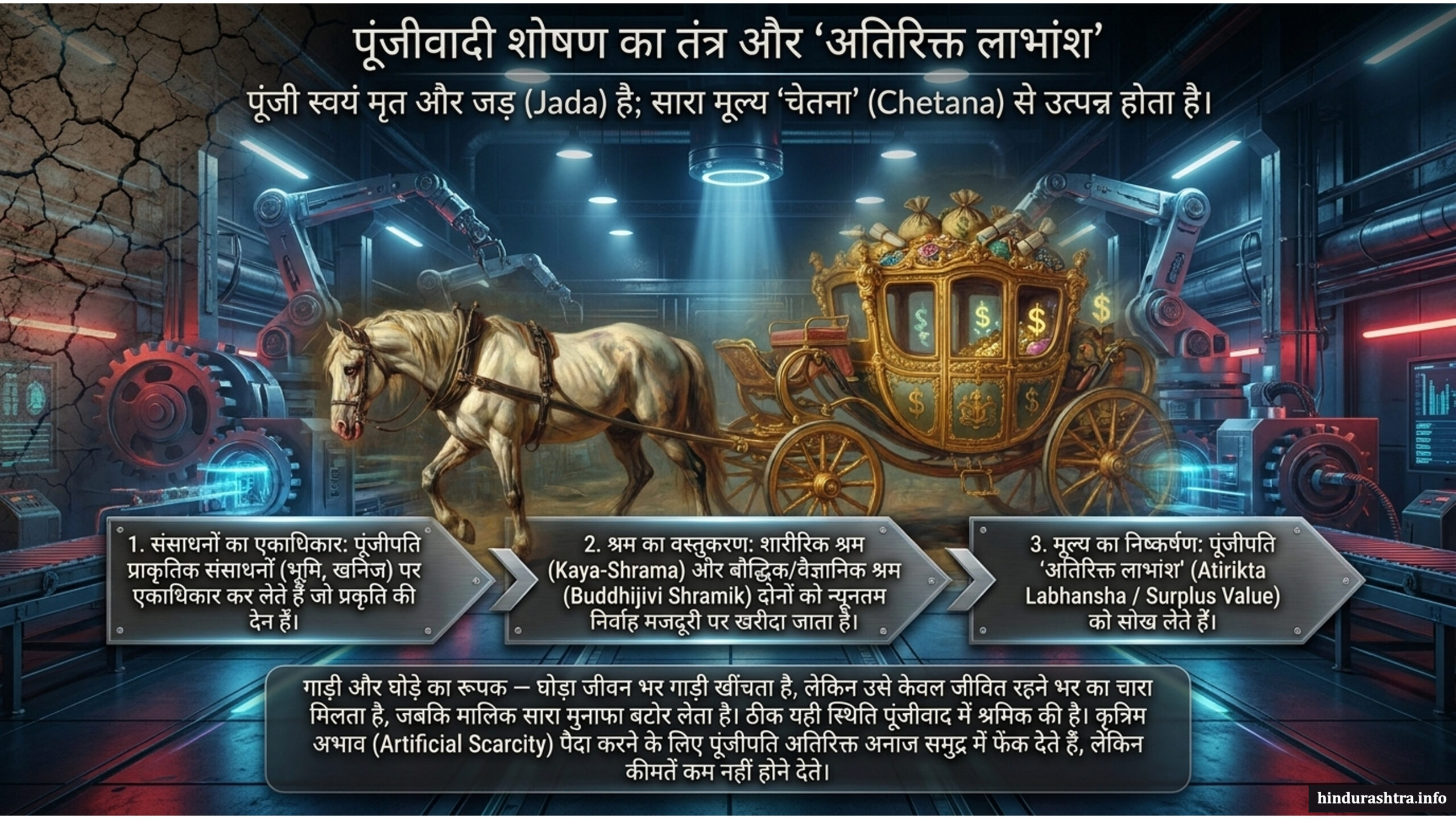
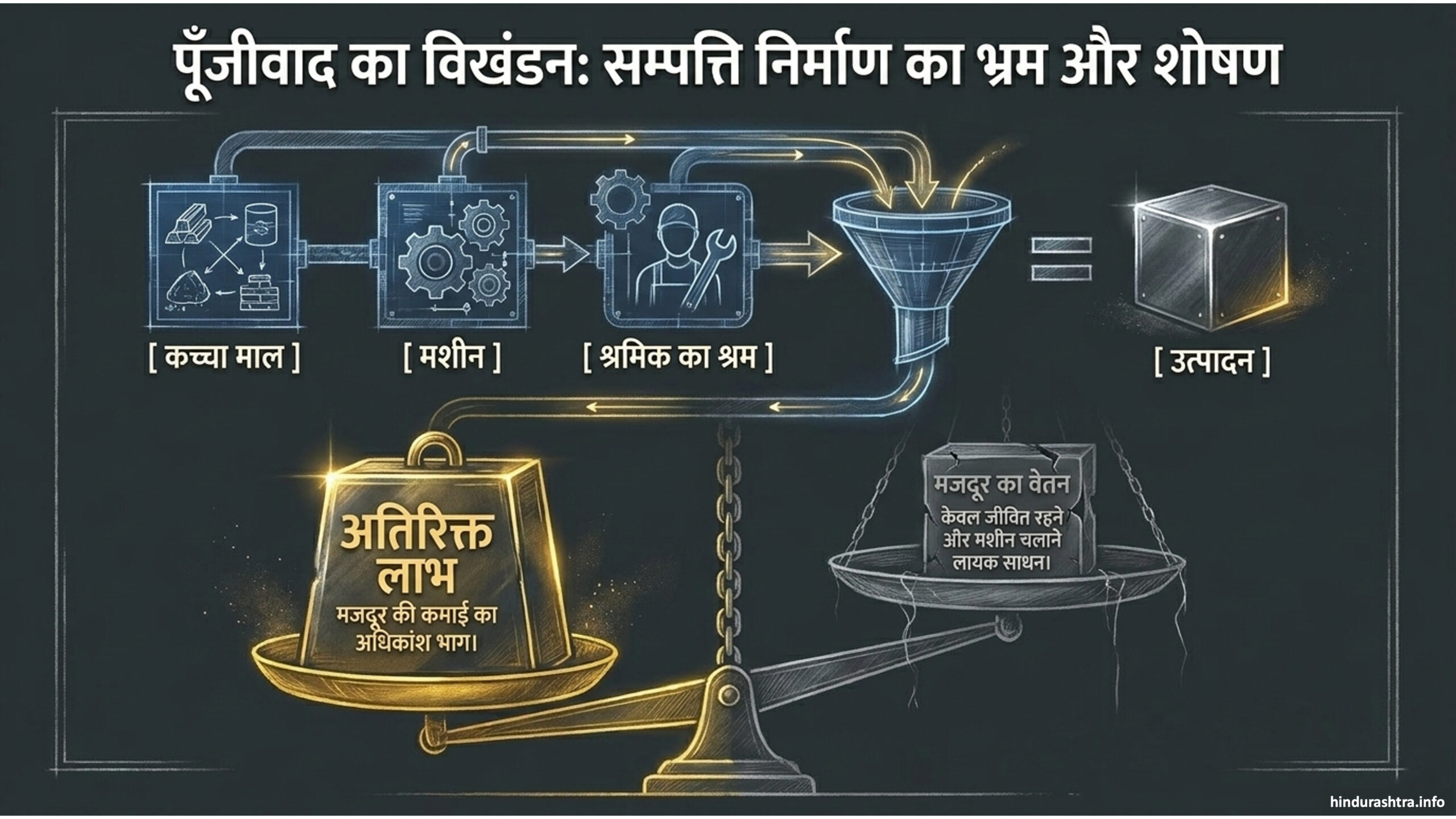
Capitalist accumulation operates by retaining surplus value (Atirikta Labhansha अतिरिक्त लाभांश). The capitalist purchases labour power at a minimal market wage, applies it to raw materials using machinery, and retains the net surplus generated by production. Karpatri Ji illustrated this dynamic using the metaphor of the carriage owner and the horse. The carriage owner uses the horse to pull passengers, generating substantial daily income. Out of these earnings, the owner provides the horse with just enough feed and water to keep it alive, healthy, and capable of pulling the cart the next morning, while pocketing the entire remaining profit. The horse, the actual source of physical labour, remains permanently tied to a minimal subsistence baseline, while the owner accumulates wealth from the surplus.
To protect these profits, unbridled capitalism engages in market manipulation and the creation of artificial scarcity. When hyper-industrialized production generates supply surpluses that threaten to lower market prices and reduce profit margins, capitalists actively destroy commodities rather than allow prices to fall to affordable levels for the poor. It is a documented reality of unrestrained market systems that corporations have dumped thousands of tons of grain, sugar, and milk directly into the ocean to maintain artificially high price levels, even while millions of citizens suffer from malnutrition and starvation.
Mechanics of Capitalist Exploitation:
- Raw Material Sourcing: Capitalists secure private monopoly over natural resources (Bhoomi भूमि, mineral minesखनिज, energy reserves) that rightfully belong to the public domain or nature.
- Labour Exploitation: Physical labour (Kaya-Shrama काया-श्रम) and intellectual labour (Buddhijivi Shramik बुद्धिजीवी श्रमिक) are commodified and purchased at subsistence wages, reducing conscious human exertion (Chetana) to a minimal input cost center.
- Surplus Value Capture (Atirikta Labhansha अतिरिक्त लाभांश): Capital extracts the net value generated by conscious labour beyond the cost of raw materials, machinery wear, and interest, retaining the vast majority of surplus value as private profit.
- Market Manipulation via Artificial Scarcity: To prevent falling prices during periods of overproduction, capitalists destroy surplus commodities (e.g., dumping grain and sugar into the sea) to artificially restrict supply and protect profit margins.
This relentless drive to maximize profit margins leads directly to unbridled automation and the widespread displacement of human labour.
2.2 Mechanization, Unemployment, and the Devaluation of Human Labour
The historical transition from manual production (hand-driven looms and water mills) to industrial automation (electricity, automated assembly lines, and advanced machinery) radically altered the relationship between human labour and capital. Under a capitalist framework, technology is deployed not to liberate workers from physical toil, but to dominate labour, force machine-paced work, reduce payroll costs, and eliminate labour strikes.
This dynamic creates a profound structural crisis within capitalism. As capitalists replace human labour with high-speed machinery to maximize output and cut costs, they inadvertently trigger mass technological unemployment (Bekari/Berozgari बेकारी/बेरोज़गारी). By displacing millions of physical and intellectual workers, the system destroys the wage base that sustains consumer purchasing power (Kraya-Shakti क्रय-शक्ति). This creates a severe structural contradiction: factories produce vast quantities of goods, but the displaced, jobless working class lacks the purchasing power to buy them. The ultimate result is market saturation, unsellable surpluses, factory shutdowns, financial panics, and economic collapse.
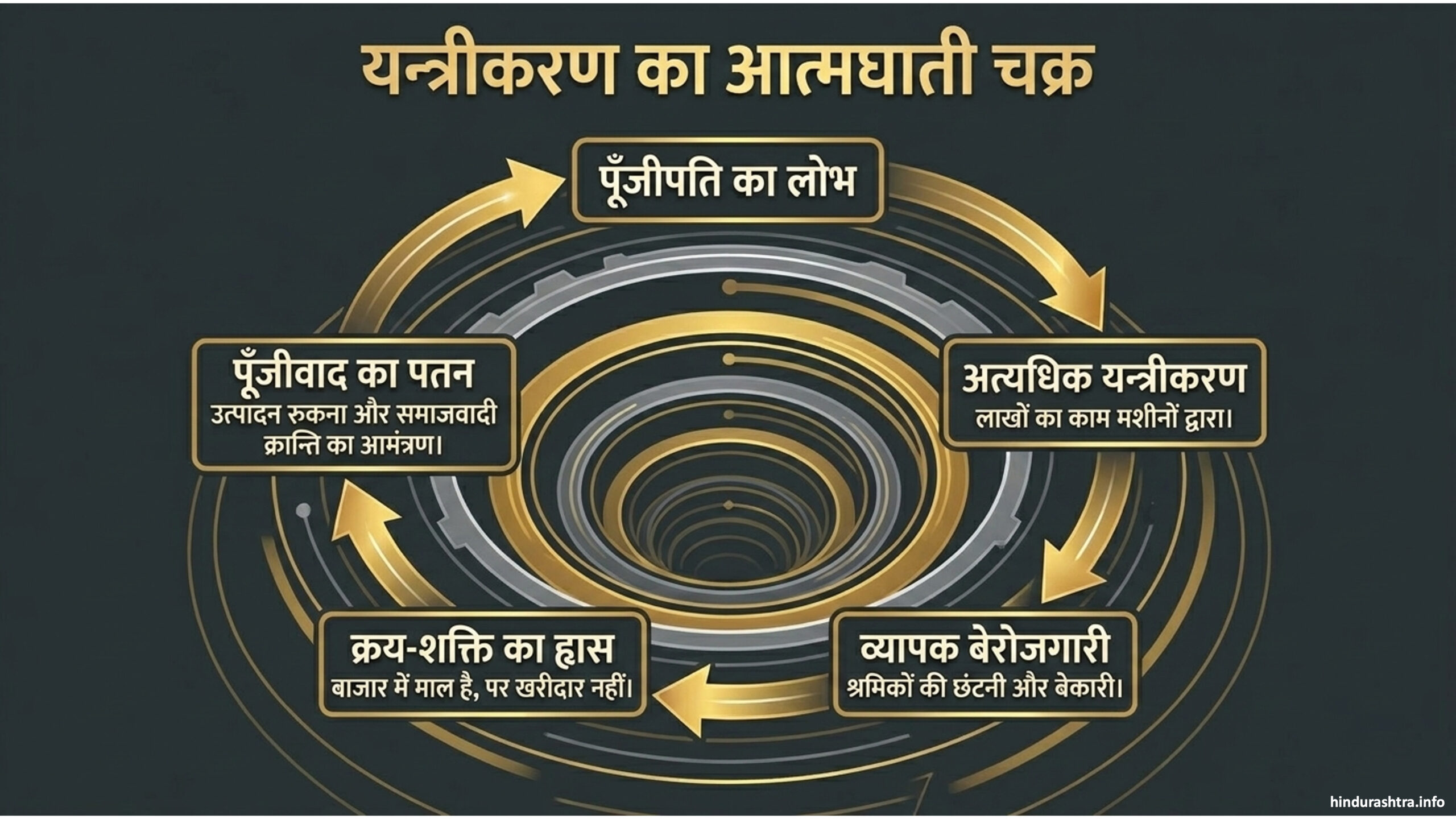
This structural reality refutes the optimistic assertions of neo-capitalist commentators like Rajneesh, who claimed that within fifty years, advanced machinery would make human labour completely obsolete, transforming every individual into a wealthy owner of capital. This claim ignores basic economic principles. If workers lose their employment to machines without possessing direct ownership of technology or natural resources, they are left with no income. Automation under private capital concentration does not transform workers into wealthy capital owners; it strips them of their livelihood, driving them into poverty and structural disenfranchisement.
This technological displacement of labour degrades not only economic stability, but also the democratic process itself.
2.3 The Illusion of Capitalist Democracy and Democratic Capture
In theory, capitalist societies claim to offer liberal political democracy (Loktantra लोकतन्त्र). In practice, authentic governance by the people is impossible when extreme financial asymmetry exists. Modern capitalist democracy inevitably undergoes “Democratic Capture,” wherein concentrated economic power consolidates control over the political apparatus.
When wealth is concentrated in a small corporate elite, money becomes the primary currency of political power. Capitalists use their financial reserves to finance expensive election campaigns, spend millions on legislative seats, deploy armies of lobbyists, purchase major media outlets, and hire political enforcers. Elected representatives are thus reduced to puppets (Kathputli कठपुतली), bound to serve the interests of their financial backers rather than the needs of the public. Legislative agendas, tax policies, and regulatory frameworks are systematically engineered to protect capital accumulation while working-class populations are left politically powerless.
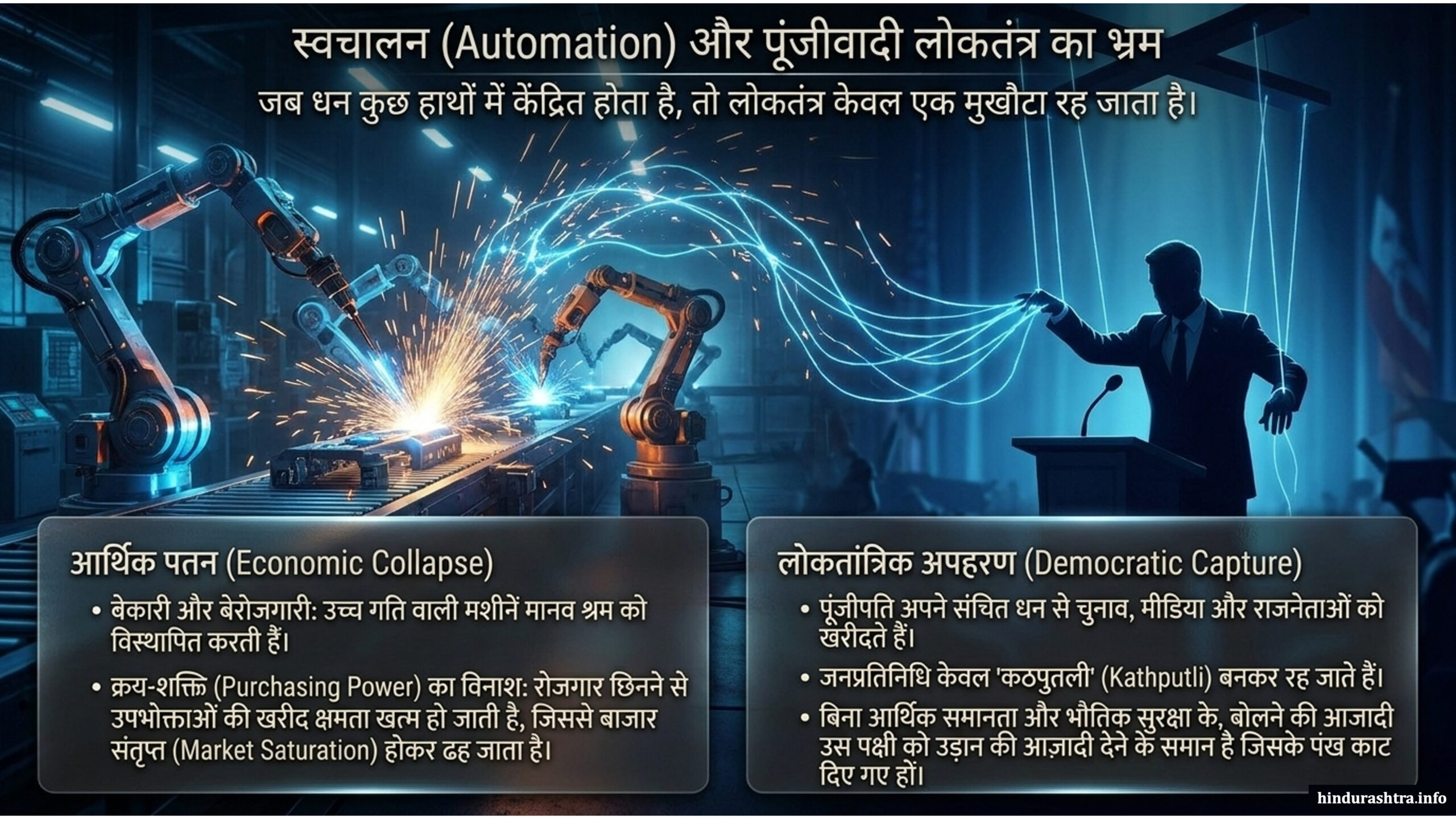
Democratic Capture by Financial Capital: Under capitalist democracy, the formal right to vote is rendered ineffective by financial asymmetry. Corporate monopolies utilize surplus capital to fund political campaigns, purchase media networks, and influence legislative bodies. Elected officials function as administrative puppets (Kathputli कठपुतली), serving corporate backers while the electorate is offered only the illusion of political choice.
Offering theoretical democratic rights such as freedom of speech or the freedom to run for public office to citizens who lack basic necessities like food, clothing, shelter, and medical care is inherently hollow. As Swami Karpatri Ji Maharaj observed, offering abstract political rights to a destitute individual is like “granting a bird whose wings have been clipped the absolute freedom to fly.” Without material security, economic equity, and moral regulation, capitalist democracy remains an oligarchic illusion.
The systemic breakdowns and inequalities of capitalism naturally give rise to socialism as a dialectical reaction.
Section 3: The Tyranny and Incompleteness of Materialist Socialism
3.1 Dialectical Emergence and the Mechanics of Socialist Revolution
Materialist socialism does not arise in a vacuum; it emerges directly out of the socio-economic conditions generated by industrial capitalism. Understanding the dialectical nature of socialism reveals both its historical necessity as a reaction to capitalism and its operational failures when implemented.
Karl Marx’s framework of dialectical materialism accurately diagnosed how capitalism creates its own internal opposition. By concentrating production in large urban factories, capitalism gathers thousands of industrial workers under one roof. Faced with common exploitation, these workers develop class consciousness (Varga Chetana वर्ग चेतना), organize into unions, and engage in class struggle (Varga Sangharsha वर्ग संघर्ष) against the capitalist class.
However, a fundamental distinction exists between early utopian socialist movements and Marxist scientific socialism:
- Early French / Utopian Socialism (Saint-Simon): Respected legitimate personal property, viewed arbitrary state expropriation as morally wrong, and sought to establish social harmony through voluntary cooperation and moral persuasion.
- Marxist Scientific Socialism / Communism: Mandates the forcible, revolutionary expropriation of all private property and the total state nationalization (Rashtriyakarana राष्ट्रीयकरण) of all means of production, land, mines, and capital.
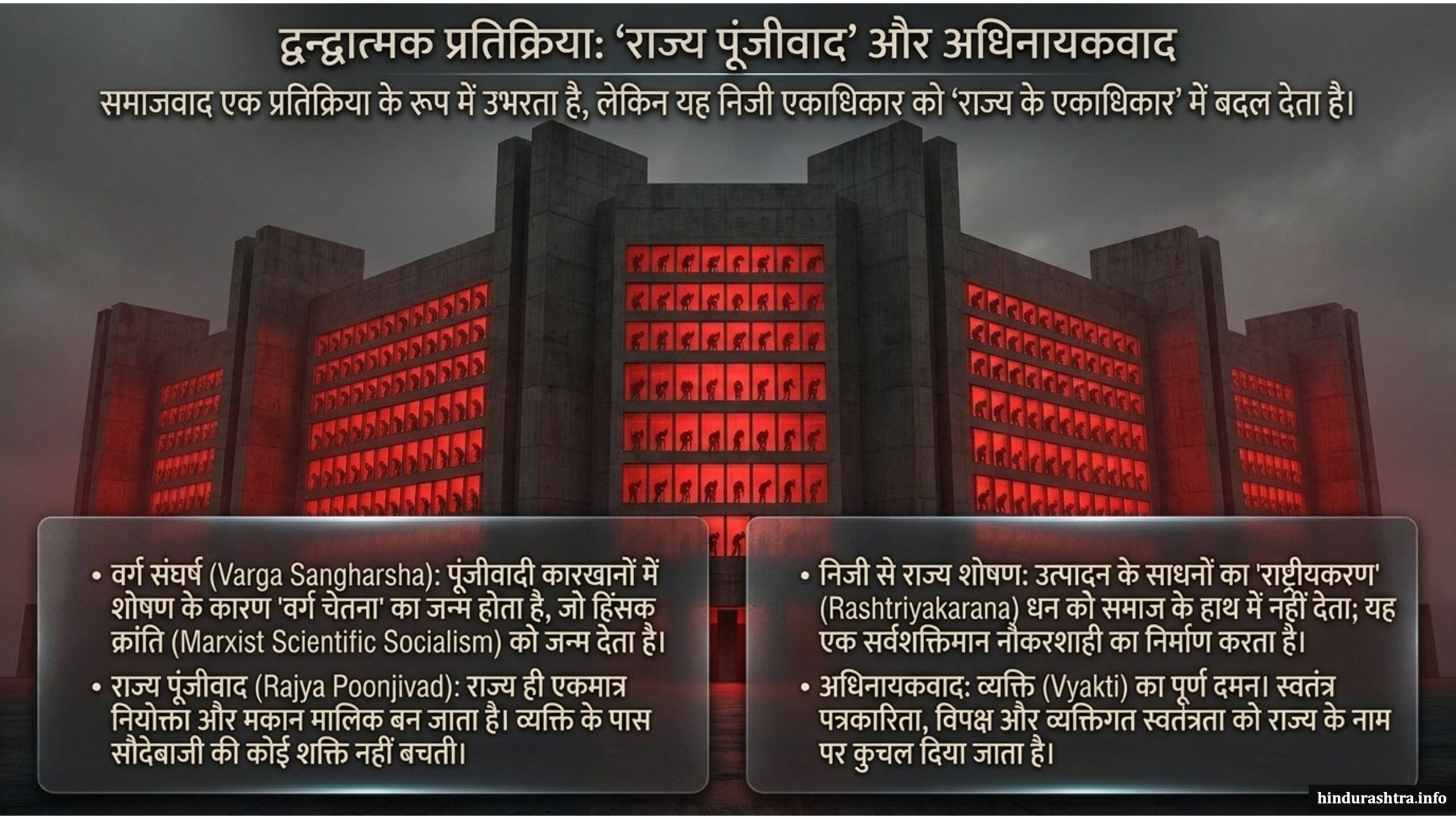
The implementation of Marxist scientific socialism in historical revolutions such as those in Russia and China demonstrated the human cost of this doctrine. Revolutionary leaders framed mass violence, severe social upheaval, and widespread casualties as the necessary “birth pangs” (Prasava Peeda प्रसव पीड़ा) of a new social order.
Yet, the state apparatus created by socialist revolutions ultimately failed to deliver human liberation, replacing private exploitation with state coercion.
3.2 State Capitalism, Totalitarianism, and the Erasure of the Individual
The core operational failure of materialist socialism lies in its concept of nationalization. In practice, transferring the means of production to the state does not put wealth into the hands of “society.” Instead, it creates a total economic and political monopoly managed by the state; a system accurately described as State Capitalism (Rajya Poonjivad राज्य पूँजीवाद).
Under State Capitalism, the private capitalist is simply replaced by an all-powerful state bureaucracy. Rather than abolishing exploitation, the state becomes the sole employer, landlord, and distributor of goods. When the state holds a monopoly over both political power and economic survival, the individual worker loses all bargaining power, alternative employment options, and legal recourse. Political power concentrates within a small ruling elite, a central council of party leaders or a single dictator (such as Stalin or Mao) exercising unchecked coercion over the population without public accountability or judicial redress.
|
Metric |
Capitalist Exploitation (Private Monopoly) |
Socialist Oppression (State Monopoly) |
|
Property Ownership |
Concentrated in private corporate monopolies and oligarchs. |
Monopolized completely by the State (Rajya Poonjivad राज्य पूँजीवाद). |
|
Individual Liberty |
Theoretical political freedoms; real choices curtailed by poverty. |
Total suppression of civil rights, political dissent, and expression. |
|
Governance Structure |
Oligarchic capture of democratic institutions via wealth. |
Totalitarian dictatorship of party elites or a supreme leader. |
|
Labour Coercion |
Economic compulsion driven by fear of poverty and unemployment. |
Direct coercive force, state-mandated labour, and punishment (Danda दण्ड). |
This concentration of power leads to the total erasure of individual liberty. State socialism abolishes private property, eliminates independent journalism, bans opposition parties, subordinates the judiciary, and deploys pervasive surveillance systems where family members spy on one another for the state.
Philosophically, this stems from the fundamental materialist error of socialism: reducing the living human individual (Vyakti व्यक्ति) to a mere disposable tool serving an abstract construct called “Society” (Samaj समाज) or the “State” (Rajyaराज्य). By asserting that the individual has no intrinsic value outside their utility to the collective, socialism justifies totalitarian coercion in the name of political expediency.
This institutional failure is further highlighted by the structural impossibility of socialism’s promised transitional phase.
3.3 The Perpetual “Transition Phase” and the Illusion of the Withered State
When early communist critics challenged Vladimir Lenin regarding the Soviet state’s failure to dismantle coercive apparatuses such as standing armies, state police, courts, and secret intelligence services, Lenin articulated the doctrine of the perpetual “Transitional Phase” (Sankramana Kala संक्रमण काल).
According to orthodox Marxist theory, the coercive state apparatus is a temporary necessity required to crush capitalist resistance. Once capitalism is eliminated, the state is supposed to “wither away,” ushering in a stateless, classless communist society. However, Lenin introduced a significant condition: as long as capitalism exists anywhere in the world, the socialist state cannot dismantle its military, police, or judicial apparatus.
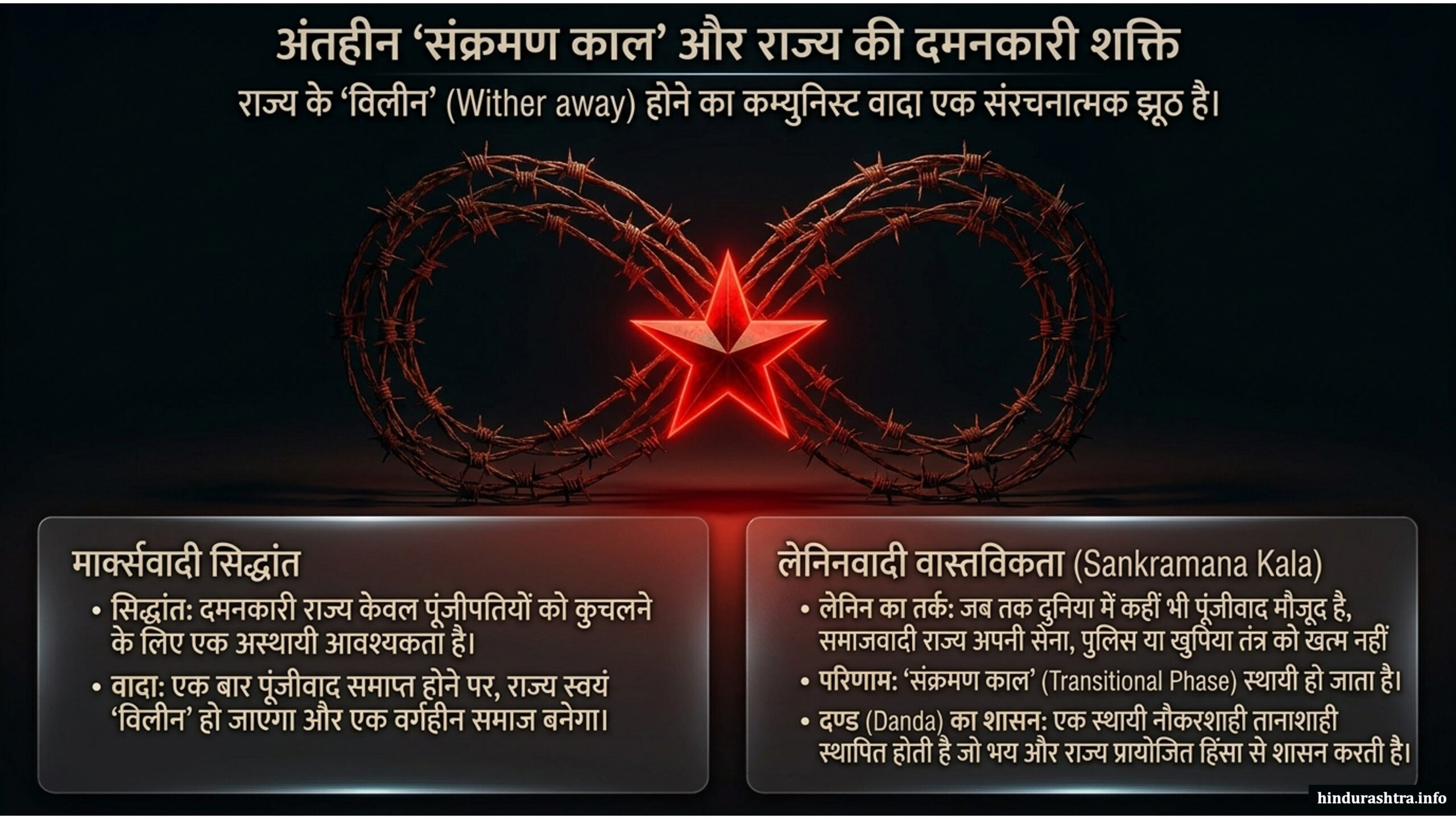
Because global capitalism persists, this “transitional phase” (Sankramana Kala संक्रमण काल) becomes permanent. The state apparatus does not wither away; instead, it expands and entrenches its authority. State socialism settles into a permanent bureaucratic dictatorship that maintains control through fear, state-sanctioned violence, and mandatory compliance (Danda दण्ड).
To fully understand why both capitalist and socialist materialist models fail, we must turn to the epistemological and philosophical refutations articulated by Swami Karpatri Ji Maharaj.
Section 4: Epistemological & Philosophical Refutations: The Karpatri Critique
4.1 Refutation of the Allegory of the Emperor’s Clothes (Deconstructing Rajneesh)
To re-establish philosophical clarity in political economy, Swami Karpatri Ji rigorously addressed neo-capitalist polemics, particularly Rajneesh’s use of the “Emperor’s New Clothes” allegory. Rajneesh used this story to brand socialism as an absolute lie (Khapushpa खपुष्प) maintained solely by mass delusion.
Using classical Indian epistemological frameworks (Vedanta वेदान्त, Panchadashi पञ्चदशी, Yogavasistha योगवासिष्ठ), Karpatri Ji Maharaj exposed the logical impossibility of Rajneesh’s position. In Vedantic epistemology, a clear distinction is made between three levels of reality:
- Absolute Unreality (Atyanta Asat): Concepts that have no empirical substrate and can never manifest in transactional reality, such as a “sky-flower” (Khapushpa खपुष्प), a “rabbit’s horn” (Shashashringa शशशृंग), or the “son of a barren woman” (Vandhya-Putra वन्ध्या-पुत्र).
- Empirical Manifestation (Vyavaharika Sat व्यवहारिक सत्): The world of functional, transactional reality experienced in daily life, governed by cause and effect.
- Ultimate Reality (Paramarthika Sat परमार्थिक सत्): The immutable, transcendent source of all existence (Brahmanब्राह्मण).
Swami Karpatri Ji pointed out that an absolute unreality (Atyanta Asat अत्यन्त असत्) cannot produce real-world, functional consequences. A non-existent entity cannot mobilize millions of citizens, reorganize national industrial production, or drive global geopolitical rivalries (such as the USSR challenging US economic dominance).
|
Analytical Metric |
Rajneesh’s Allegorical Premise |
Swami Karpatri Ji’s Vedantic Refutation |
|
Categorization of Socialism |
Absolute Non-existence (Atyanta Asat / Khapushpa / Emperor’s Fake Clothes). |
Empirical Reality (Vyavaharika Sat); a tangible socio-economic force. |
|
Cause of Global Movement |
Mass foolishness, collective delusion, and cheap political trickery. |
Concrete structural response to private capital concentration and labour exploitation. |
|
Epistemological Basis |
Illusions exist without an underlying substrate or cause. |
Illusions require a real substrate (Adhisthana अधिष्ठान); errors of perception reflect misdirected real forces. |
|
Internal Consistency |
Claims socialism is a complete illusion, yet calls it the evolutionary child of capitalism. |
Exposes logical contradiction: an absolute unreality cannot be born from a real economic system. |
Furthermore, Vedantic logic establishes that perceptual errors require a real underlying substrate (Adhisthana अधिष्ठान). For example, mistaking a rope for a snake requires the actual existence of the rope. Socialism’s drive to nationalize capital is a tangible operational force reacting to the real structural oppressions of capitalism, not a hallucinatory illusion.
Next, we address the common misconception that traditional Indian civilization was materially impoverished or opposed to economic prosperity.
4.2 Debunking the Myth of Historical Indian Anti-Materialism and Poverty
A frequent claim made by modern commentators is that India’s civilizational genius was exclusively ascetical and otherworldly, rendering it incapable of generating material wealth, scientific advancement, or economic infrastructure. Swami Karpatri Ji refuted this historical narrative by demonstrating that traditional Indian civilization achieved mastery in both material prosperity and spiritual realization.
Ancient India produced spiritual renunciates (Dattatreya, the Sanatana Rishis, Gautama Buddha, Adi Shankara) alongside world-conquering sovereigns (Chakravarti Samrats चक्रवर्ती सम्राट such as Mandhata, Dilipa, Raghu, and Ram) and prosperous merchant guilds (Vaishyas वैश्य). Material prosperity (Artha अर्थ) was recognized as a vital pillar of human life, provided it was regulated by moral responsibility (Dharma धर्म).
This historical reality was affirmed by European commentators such as Count Keyserling, who noted: “India is a rich country inhabited by poor people.” Count Keyserling’s observation highlighted that India’s natural resource potential, agricultural capacity, and civilizational architecture were historically vast, though its populations suffered temporary impoverishment due to political instability and foreign exploitation.
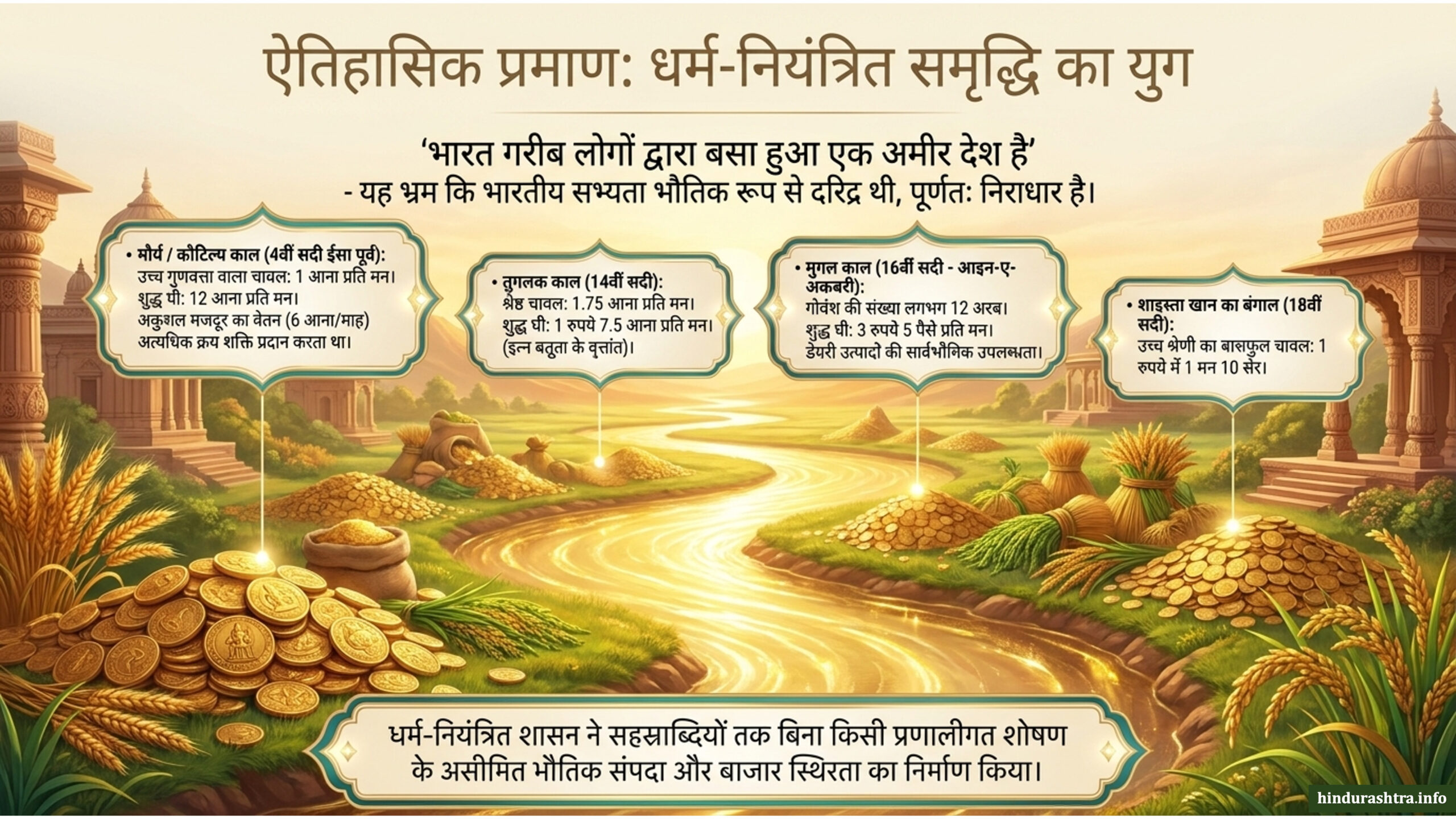
Primary historical documentation demonstrates India’s extraordinary material prosperity across different historical epochs:
- Mauryan / Kautilyan Period (Arthashastra अर्थशास्त्र, c. 4th Century BCE):
- High-quality rice: 1 anna per maund.
- Sesame oil: 8 annas per maund.
- Pure ghee: 12 annas per maund.
- Pulses: 1 rupee per maund.
- Salt: 2 paise per maund.
- Refined sugar: 10 annas per maund.
- Cotton cloth: 1 anna for 5 thans (rolls).
- Average wage of an unskilled labourer: 6 annas per month (providing high real purchasing power).
- Fourteenth Century (Tughlaq Period / Ibn Battuta’s Accounts):
- Superior rice: 1.75 annas per maund.
- Sesame oil: 7.5 annas per maund.
- Pure ghee: 1 rupee 7.5 annas per maund.
- Refined sugar: 1 rupee 7.5 annas per maund.
- Fine cotton cloth: 2 rupees for 65 yards.
- Sixteenth Century (Mughal Period / Ain-i-Akbari आइन-ए-अकबरी):
- Cattle population estimated at 12 billion cows, ensuring universal availability of dairy.
- Superior rice: 12 annas per maund; ordinary rice: 10 annas per maund.
- Pulses: 13.5 annas per maund.
- Pure ghee: 3 rupees 5 paise per maund.
- Salt: 8 annas per maund.
- Sugar/Khand: 5 rupees 11 annas per maund.
- Eighteenth Century (Bengal / Administration of Shaista Khan):
- High-grade Basful rice: 1 rupee for 1 maund 10 seers.
- Karamsali rice: 1 rupee for 7 maunds 20 seers.
- Fine oil: 1 rupee for 21 seers; ordinary oil: 1 rupee for 34 seers.
- Pure ghee: 1 rupee for 10.5 seers.
These empirical datasets confirm that traditional Indian governance generated vast material abundance. India’s economic challenges were the result of external exploitation and systemic disruption, not an intrinsic civilizational aversion to wealth creation.
However, historical experience also shows that material wealth alone, without moral regulation, cannot secure human happiness or social equilibrium.
4.3 The Insatiability of Desire (Trishna) and the Limits of Wealth Accumulation
Both capitalism and socialism share the materialist assumption that infinite economic output and material abundance will eventually satisfy human desire, eliminate social conflict, and create lasting peace. Indian philosophy refutes this premise, pointing to the psychological reality of human desire (Trishna तृष्णा).
As articulated in ancient Vedic and Puranic literature (Matasya Puran 34.11 मत्स्य पुराण ३४.११):
यत्पृथिव्यां व्रीहि यवं हिरण्यं पशवः स्त्रियः। सर्वं नैकस्य पर्याप्त मित्यभिसम्प्रेक्ष्य शमं व्रजेत् ॥
“Not all the food grains, barley, gold, animals, or pleasures on earth are sufficient to satisfy the desire of a single individual. Recognizing this inherent insatiability of material consumption, the wise person attains tranquility through ethical self-restraint (Shama शम).”
Material desire (Trishna तृष्णा) expands exponentially with gratification. Increasing physical production on a finite planet cannot bring psychological contentment or social stability if desire remains unrestrained. When economic systems operate without moral boundaries, hyper-production feeds hyper-consumerism, resulting in resource depletion, environmental degradation, and social alienation.
To address these structural and spiritual limitations, we turn to the comprehensive alternative offered by Ramrajya (रामराज्य).
Section 5: The Blueprint of Ramrajya: Dharma-Regulated Socio-Economic Framework
5.1 Spiritual Foundation: Moral Accountability and Vaivasvata Yam
The governance model of Ramrajya रामराज्य (Dharma-Niyantrit Governance धर्म-नियन्त्रित शासन) offers an alternative structure by integrating transcendent moral law with practical political, legal, and economic administration.
Unlike secular materialist systems which rely exclusively on external legal enforcement, police power, and bureaucratic oversight, Dharma-bound governance instills internal moral accountability within the individual citizen. Secular legal codes can only punish crimes that are caught and proven through evidence; they cannot prevent hidden transgressions (Prachhanna Papa प्रच्छन्न पाप) committed when law enforcement is absent or corruptible.
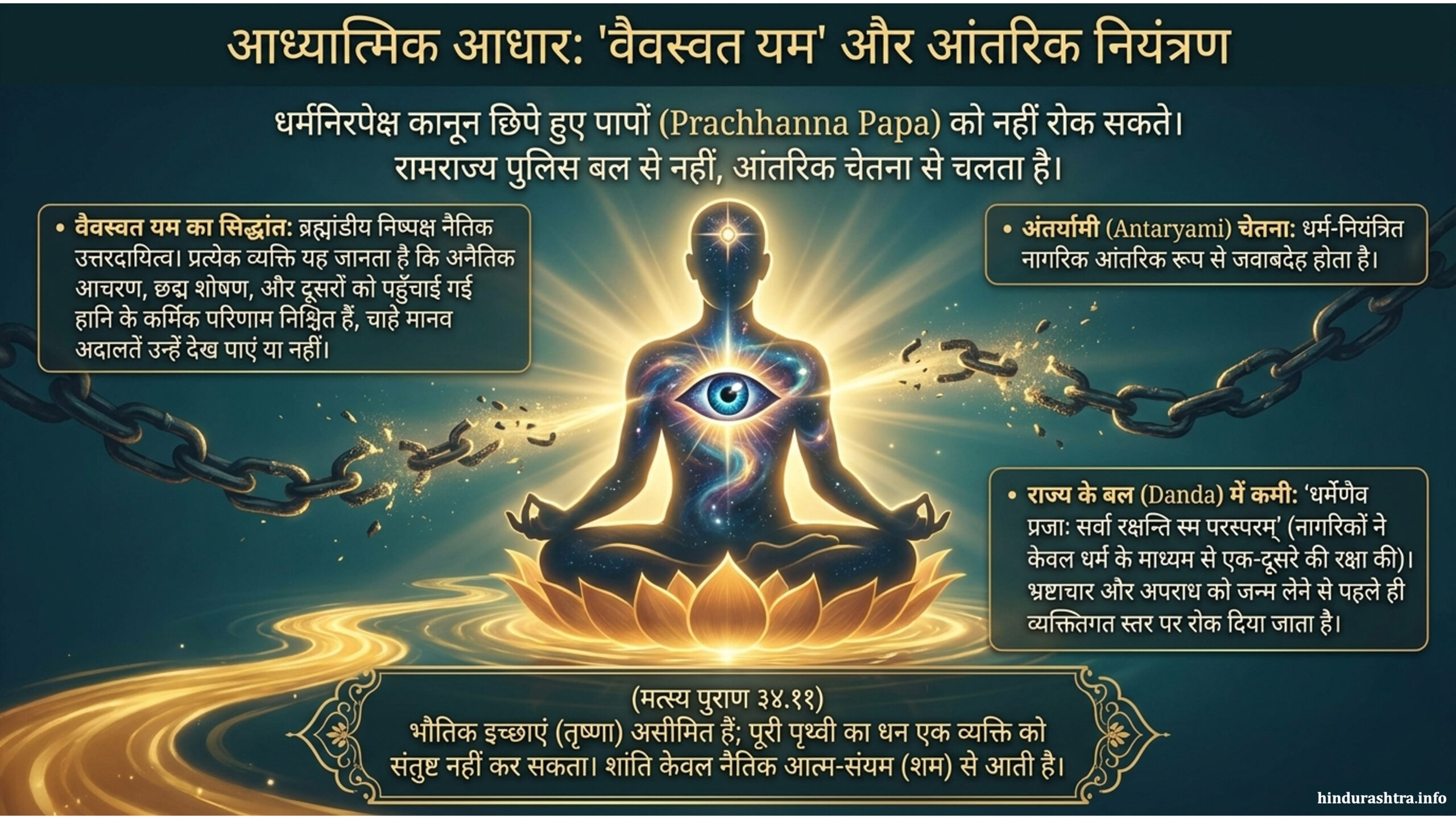
Ramrajya operates on the understanding of Vaivasvata Yam (वैवस्वत यम), the cosmic principle of impartial moral accountability that tracks every hidden human action. A citizen educated in a Dharmic framework understands that unethical conduct, predatory accumulation, and harm inflicted on others carry inevitable moral and karmic consequences, regardless of whether human courts detect them.
This internal moral orientation (Antaryami अन्तर्यामी) reduces the need for aggressive state policing, preventing corruption and exploitation at the individual level before law enforcement intervention is required (“Dharmanaiva Prajah Sarvah Rakshanti Sma Parasparam” धर्मेणैव प्रजाः सर्वा रक्षन्ति स्म परस्परम्; “The citizens protected one another through Dharma alone”).
Building on this spiritual foundation, Ramrajya provides a practical framework for managing wealth accumulation and economic distribution.
5.2 Economic Equilibrium: Wealth Decentralization and the Panchadha Vibhajana Formula
Ramrajya’s economic philosophy is built on the principle of Balanced Inequality (Santulit Vaishamya सन्तुलित वैषम्य). It rejects both the extreme wealth concentration of unchecked capitalism and the enforced, artificial equality of state socialism.
Natural variations in human capacity, effort, and talent naturally lead to varying economic outcomes. This is illustrated by the hand-and-fingers analogy: the fingers on a human hand are naturally unequal in size, yet they operate in complete structural balance. If one finger swells to fifty times its natural size while the others wither from lack of blood, this does not represent natural variation; it is a serious medical condition (such as dropsy or Jalodara जलोदर). Similarly, a society where a dozen oligarchs control billions in assets while millions lack basic sustenance reflects socio-economic disease.
This normative principle is demonstrated in the Mahabharata narrative of Maharshi Agastya seeking financial contributions for public welfare. Agastya visited Kings Shrutarva, Bradhnashwa, and Trasadasyu (son of Purukutsa). Upon examining their financial ledgers, Agastya found that their state revenues precisely matched their expenditures for administration, public works, and social security, leaving no unallocated surplus. Realizing that taking funds from their balanced budgets would force them to levy additional taxes on their subjects (praja-pida प्रजा-पीड़ा), Agastya refused to accept donations from these righteous kings. Instead, they proceeded together to the wealthy demon king Ilvala (इल्वल दानव), who possessed vast extra-systemic wealth outside the state budget. Accepting wealth from Ilvala funded public welfare without imposing predatory tax burdens on citizens.
To maintain economic balance across society, Ramrajya establishes the Panchadha Vibhajana (पञ्चधा विभाजन Five-Fold Division of Surplus Wealth):
धर्माय यशसेऽर्थाय कामाय स्वजनाय च। पञ्चधा विभजन् वित्तमिहामुत्र च मोदते ॥
“A wise and righteous person divides their net surplus wealth into five distinct components: for ethical/spiritual works (Dharma धर्म), public glory/infrastructure (Yashas यश), economic reinvestment (Artha अर्थ), personal/family enjoyment (Kama काम), and the welfare of dependents and workers (Swajana स्वजन); thereby attaining happiness in this world and the beyond.”
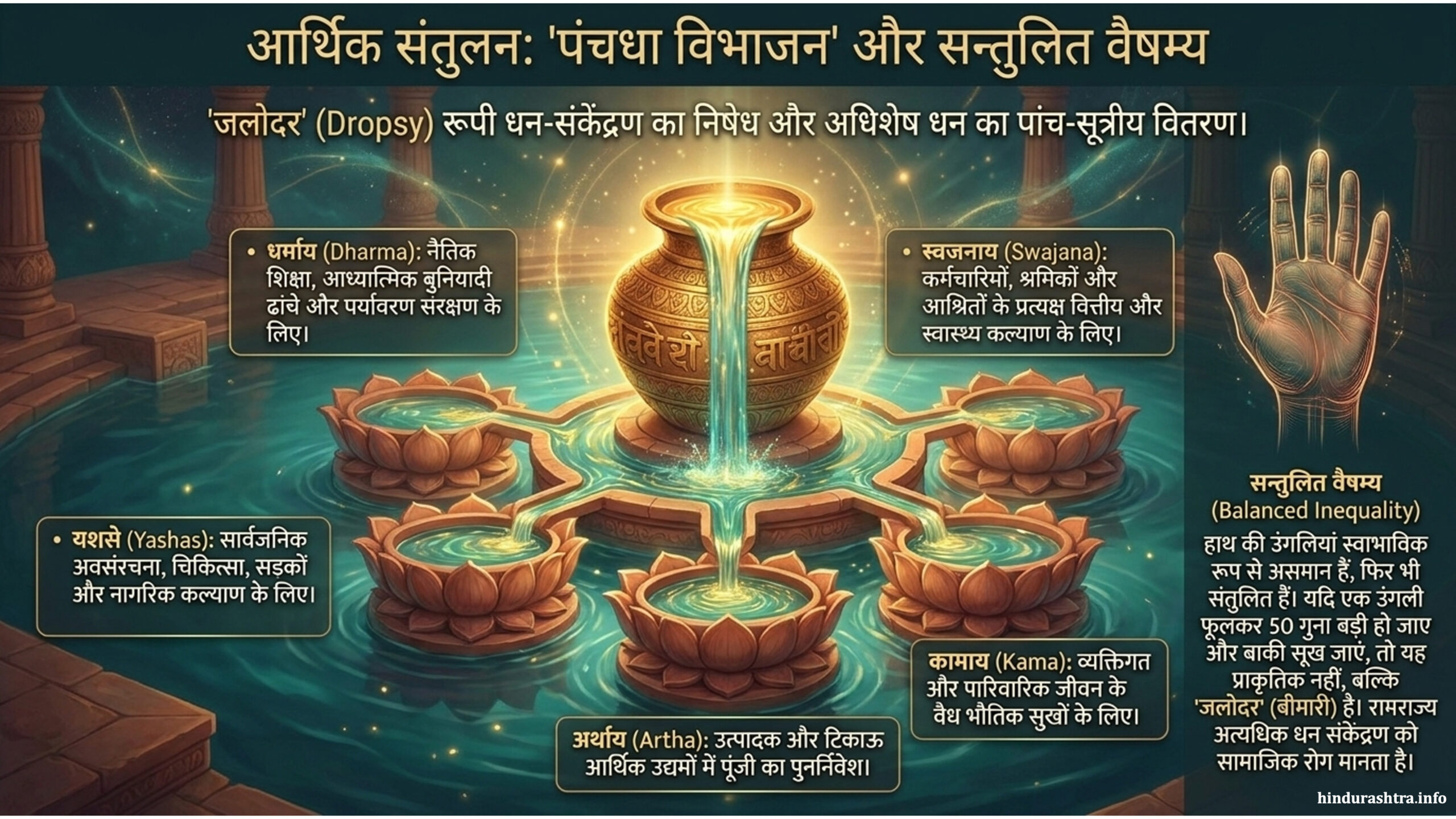
The Five-Fold Allocation Architecture:
- Dharmaya (धर्माय Ethical and Spiritual Works): Directing surplus wealth toward funding moral education, spiritual infrastructure, environmental conservation, and public ethical institutions.
- Yashase (यशसे Civic Glory and Public Infrastructure): Investing in community welfare, medical facilities, educational institutions, roads, water reservoirs, and public amenities.
- Arthaya (अर्थाय Economic Reinvestment): Reinvesting capital into productive, sustainable economic ventures to generate legitimate employment and community wealth.
- Kamaya (कामाय Legitimate Personal Consumption): Fulfilling personal and family needs, cultural engagement, aesthetic enjoyment, and legitimate physical comfort.
- Swajanaya (स्वजनाय Worker Welfare and Dependents): Providing direct financial security, health support, profit-sharing, and care for employees, extended family, and vulnerable dependents.
This distribution model is enforced alongside a clear ethical boundary on personal property accumulation (Srimad Bhagavatam 7.14.8 श्रीमद्भागवत महापुराण ७.१४.८):
यावत् भ्रियेत जठरं तावत् स्वत्वं हि देहिनाम्। अधिकं योऽभिमन्येत् स स्तेनो दण्डमर्हति ॥
“A person has a legitimate moral right to only as much wealth as is required to sustain their household; whoever claims private ownership over wealth far beyond their legitimate needs extracts from society and requires institutional regulation.”
This balanced economic model extends directly to labour rights, profit distribution, and technological deployment.
5.3 Labour Rights, Fair Surplus, and Balanced Technology Deployment
In a Dharma-regulated economy, human labour (Shrama श्रम) is not treated as a commodified cost center to be minimized. It is recognized as a living, conscious contribution (Chetana चेतना) entitled to moral respect and economic equity. Furthermore, Ramrajya recognizes that labour encompasses both physical exertion (Kaya-Shrama काया-श्रम) and intellectual/scientific innovation (Buddhijivi Shramik बुद्धिजीवी श्रमिक).
Ramrajya establishes clear principles governing wages and surplus sharing:
- Market Wages vs. Risk Capital: If workers receive standard market wages without sharing in operational risks, capital receives a fair return on its investment.
- Surplus Value Sharing (Atirikta Labha अतिरिक्त लाभ): When industrial production generates substantial surplus profits, economic justice requires that both physical workers (Kaya-Shramik काया-श्रमिक) and intellectual workers (Buddhijivi Shramik) receive a fair share of that surplus value beyond their baseline wages, recognizing labour’s direct role in wealth creation.
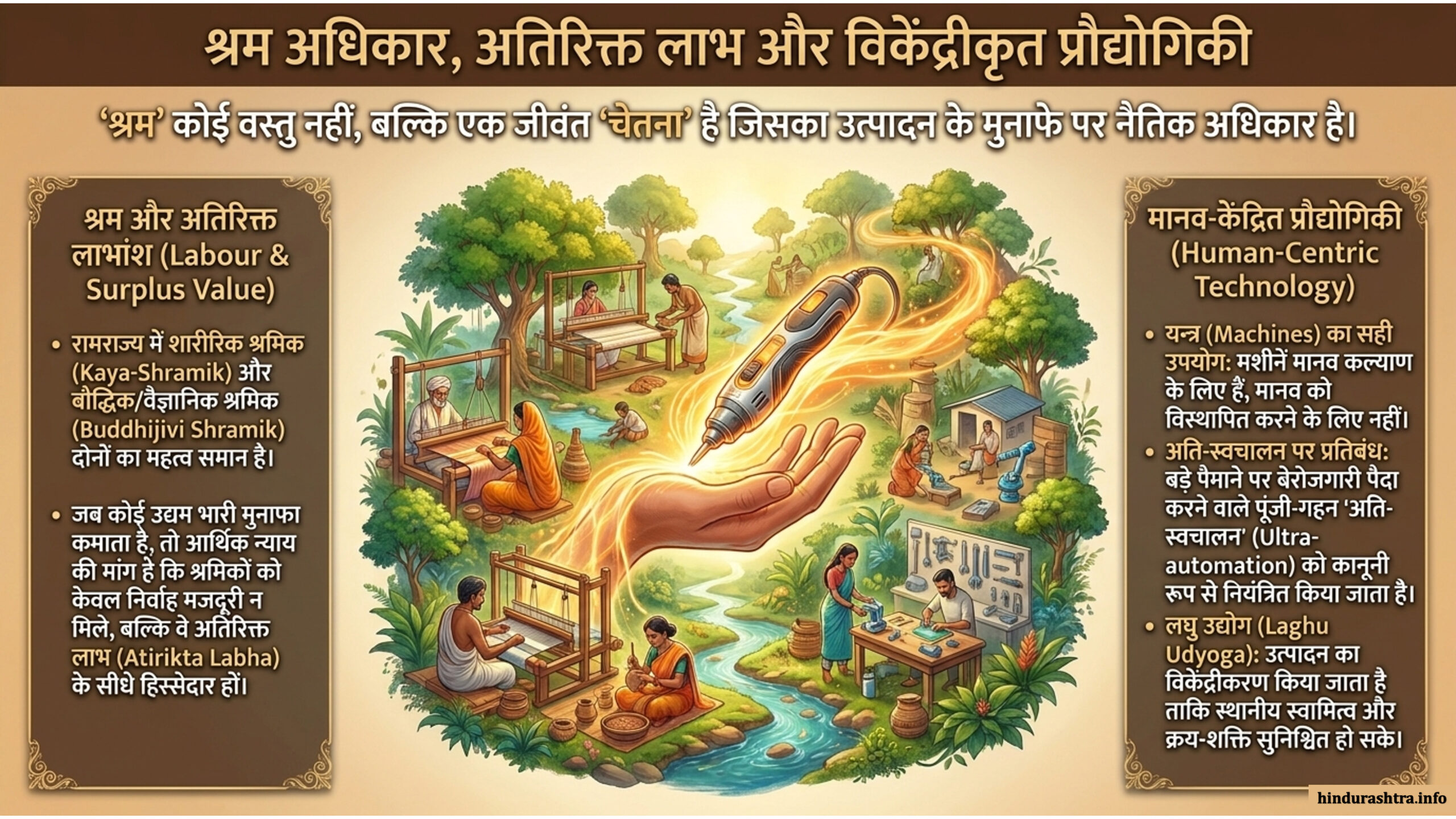
Regarding technology, Ramrajya (रामराज्य) sets clear guidelines for machine deployment (Yantra यन्त्र):
- Human-Centric Technology: Machinery must function as a tool that serves human well-being, reduces physical strain, and enhances productivity without displacing human employment.
- Restrictions on Ultra-Automation: Capital-intensive, job-destroying ultra-automation is legally restricted in sectors where it generates mass unemployment and erodes consumer purchasing power.
- Decentralized Industrial Production: Decentralized, small-scale cottage industries (Laghu Udyoga लघु उद्योग) are actively promoted to guarantee local ownership, fair wages, and widespread economic security for every citizen.
This decentralized economic foundation provides the basis for authentic political democracy.
5.4 Authentic Democracy vs. Oligarchic Manipulation
Secular electoral democracy often succumbs to moneyed interests and political capture. In contrast, Ramrajya establishes an authentic, resilient democratic framework (Dharma-Niyantrit Loktantra धर्म-नियन्त्रित लोकतन्त्र).
To prevent financial capital from capturing the political process, Ramrajya (रामराज्य) enforces strict structural limits on election mechanisms:
- Low-Cost, Decentralized Elections: Campaign costs are kept minimal by state regulation, prohibiting expensive mass media campaigns, political advertising, and paid enforcers.
- Protection of Universal Candidacy: Any virtuous citizen (regardless of personal liquid wealth) can stand for public office, ensuring that political leadership is selected based on character, wisdom, and public service rather than financial backing.
- Constitutional Subordination to Dharma: State authority is strictly bound by transcendent ethical principles (Dharma धर्म), protecting society from both populist majoritarianism and autocratic overreach.
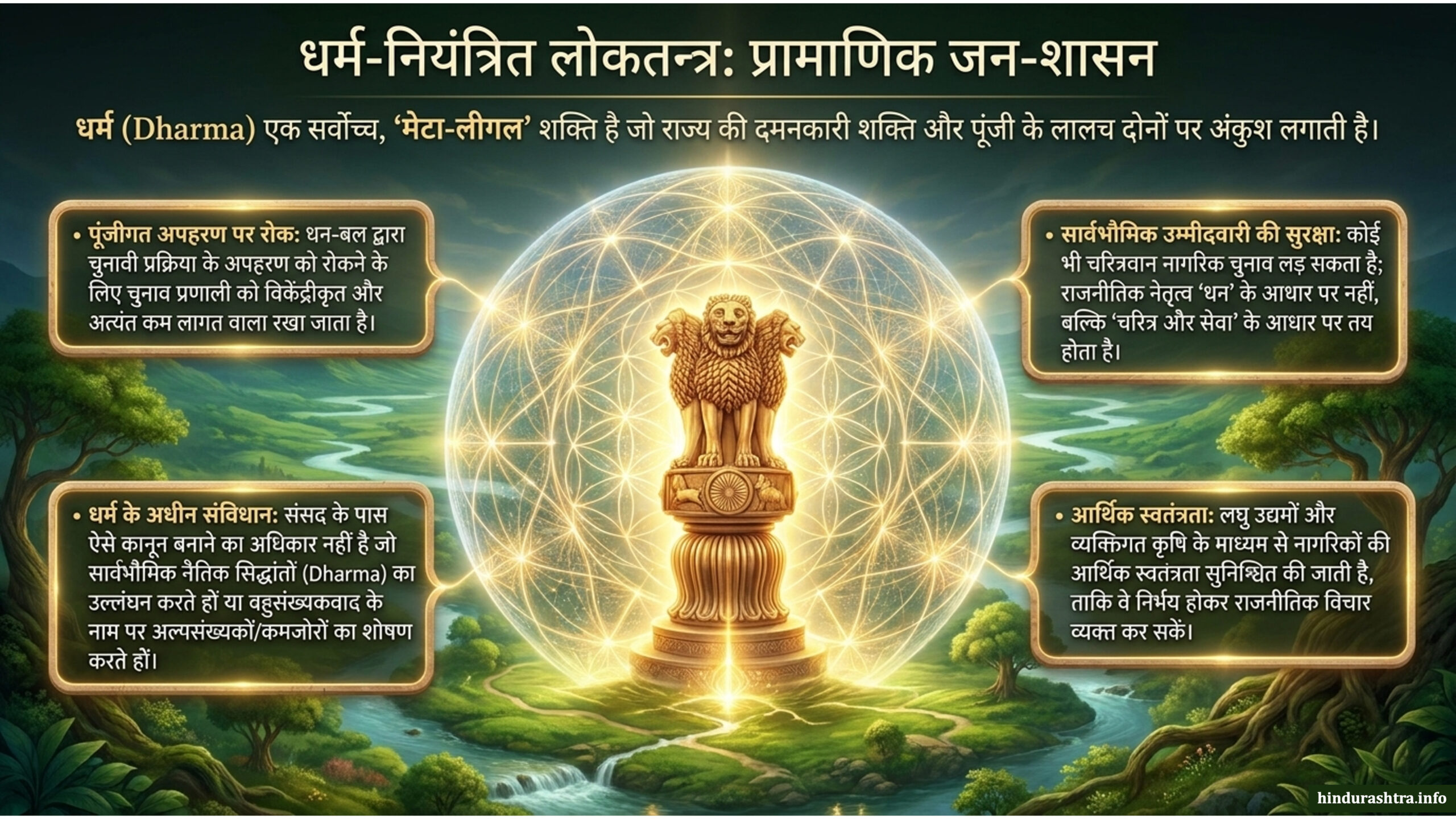
Crucially, Ramrajya preserves individual ownership of productive property such as small family farms, artisanal workshops, and local enterprise. Decentralized economic independence provides citizens with the material security required to express their political views and critique government policy without fear of starvation or economic retaliation.
We now turn to historical paradigms that demonstrate the practical viability of this model.
Section 6: Historical Paradigms, Harmonization, and Global Application
6.1 Historical Paradigms of Prosperity Under Dharma Governance
Far from being an unverified utopian theory, Dharma-regulated governance represents an empirically demonstrated historical model that delivered centuries of social equilibrium and economic abundance.
Historical texts document periods of Dharmic governance under sovereigns such as Maharaj Prithu, Ramachandra, and the Yadu dynasty. During these eras, essential commodities, food grains, and basic necessities were abundant and accessible without predatory market pricing (“Vastu Binu Gatha Pahiye” वस्तु बिनु गाथा पहिये; “Essential goods were obtained easily without oppressive cost”).
Key historical and civilizational metrics include:
- Educational Infrastructure: Puranic records document that during the Yadu governance framework in Dwaraka, the educational system maintained 38.8 million teachers (Yadukulacharyas यदुकुल आचार्य) dedicated to instructing youth in practical sciences, ethics, and humanities, reflecting an institutional commitment to universal education.
- Institutional Philanthropy (Sadavarta): Wealthy citizens and merchant guilds established permanent public philanthropy systems, including free food distribution centers (Sadavarta सदावर्त), municipal dining facilities, water reservoirs, and medical halls. Excess wealth was voluntarily directed toward community welfare out of moral duty (Dharma) rather than state coercion.
- Resource Equilibrium: Agricultural and industrial systems operated without resource depletion, generating stable prosperity that supported civilizational achievements across centuries.
This historic success was rooted in the balanced harmonization of all human pursuits.
6.2 Harmonization of the Four Purusharthas: Integrated Human Fulfillment
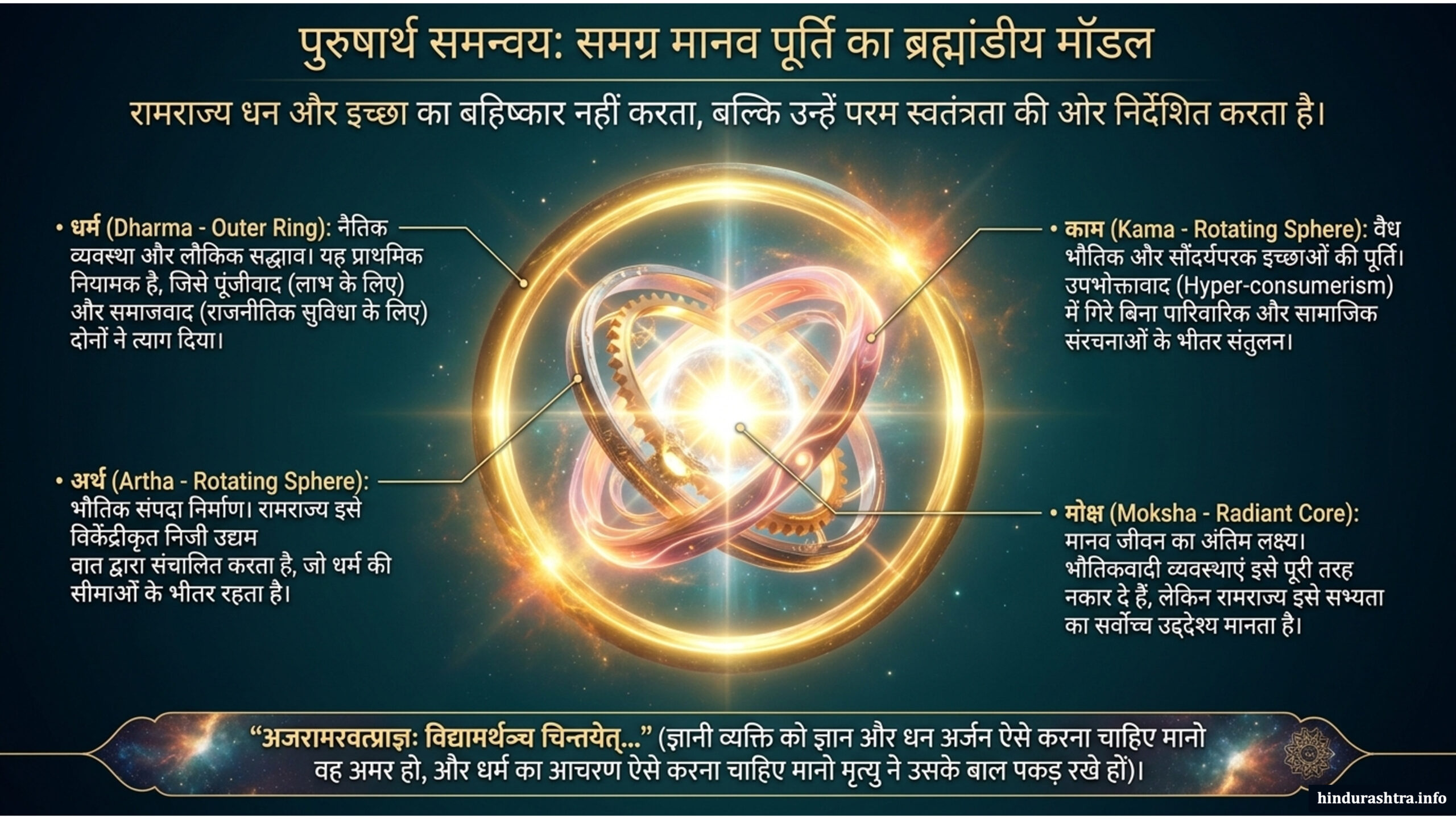
The ultimate objective of Ramrajya is the balanced integration of the four fundamental human pursuits (Purusharthasपुरुषार्थ): Dharma (धर्म ethics), Artha (अर्थ wealth), Kama (काम fulfillment of desire), and Moksha (मोक्ष spiritual liberation).
Materialist ideologies isolate Artha (wealth) and Kama (consumption) while discarding Dharma (ethics) and Moksha(spiritual liberation). This imbalance leads directly to social fragmentation, hyper-consumerism, and moral decline. Ramrajya restores equilibrium by embedding economic growth (Artha) and personal fulfillment (Kama) within an ethical framework (Dharma), directed toward ultimate spiritual realization (मोक्ष Moksha).
|
Purushartha |
Purpose & Scope |
Regulating Force |
Capitalist Failure |
Socialist Failure |
Ramrajya Integration |
|
Dharma |
Ethical order, moral duty, cosmic harmony. |
Supreme meta-legal framework. |
Discarded for market utility and maximum private profit. |
Replaced by state ideology and political expediency. |
Functions as the primary regulator for all economic and state actions. |
|
Artha |
Material wealth generation, infrastructure. |
Regulated by Dharma. |
Unchecked accumulation; wealth concentrated in private monopolies. |
Monopolized by the State (Rajya Poonjivad राज्य पूँजीवाद); suppresses enterprise. |
Decentralized private enterprise directed toward civic prosperity. |
|
Kama |
Legitimate desire, aesthetic joy, cultural expression. |
Regulated by Dharma. |
Degenerates into hyper-consumerism and commercial exploitation. |
Subordinated to state quotas and collective production targets. |
Balanced fulfillment within stable family and community structures. |
|
Moksha |
Transcendent liberation, self-realization. |
Ultimate goal of human life. |
Completely ignored; human existence reduced to consumption. |
Denied; spiritual aspirations suppressed by materialist state logic. |
Preserved as the ultimate civilizational goal of human existence. |
This integrated outlook is summarized in the classic Sanskrit injunction:
अजरामरवत्प्राज्ञः विद्यामर्थञ्च चिन्तयेत्। गृहीत इव केशेषु मृत्युना धर्ममाचरेत् ॥
“A wise person should pursue learning and wealth creation as if they were immortal; yet they should practice righteousness (Dharma) with urgency, as if death had already seized them by the hair.”
This synthesis offers a practical roadmap for addressing contemporary global crises.
6.3 Global Strategic Roadmap: Resolving Modern Socio-Economic Crises
As modern societies grapple with stagflation, automation-driven unemployment, severe wealth inequality, political polarization, and rising authoritarianism, Ramrajya provides a clear, actionable blueprint for systemic reform.
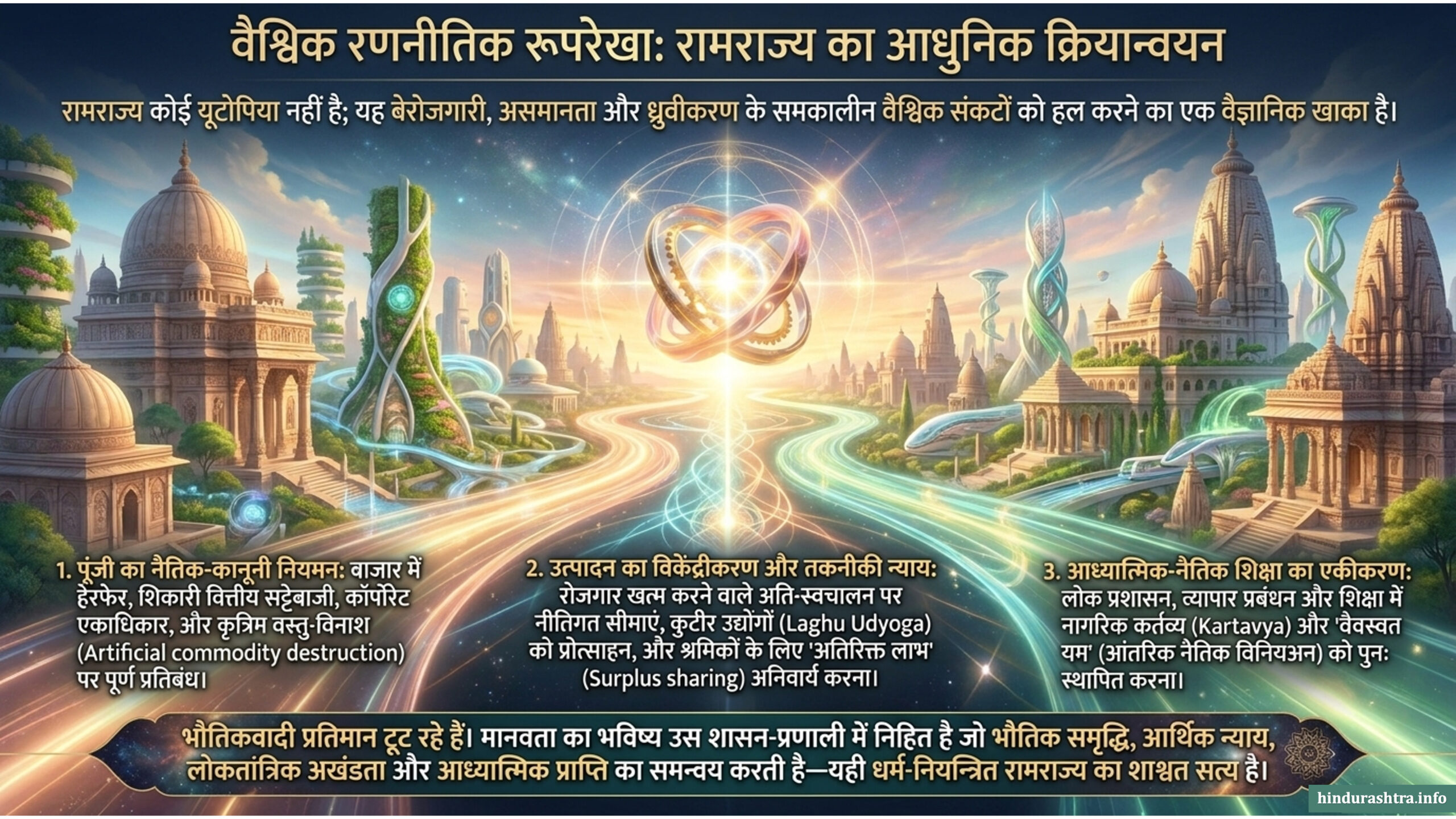
Modern political economy can implement this model through three core policy pillars:
Policy Pillars for Modern Dharma-Regulated Governance:
- Moral-Legal Regulation of Capital: Enforcing absolute ethical and legal limits on market manipulation, predatory financial speculation, corporate monopolies, natural resource exploitation, and artificial commodity destruction.
- Decentralized Production & Technological Equity: Implementing policy limits on job-destroying ultra-automation, incentivizing decentralized cottage industries (Laghu Udyoga लघु उद्योग), and mandating worker surplus sharing (Atirikta Labha) for physical (Kaya-Shramik) and intellectual (Buddhijivi Shramik) workers in high-productivity enterprises.
- Spiritual-Ethical Education: Re-integrating moral accountability, civic duty (Kartavya कर्तव्य), and ethical self-regulation (Vaivasvata Yam वैवस्वत यम) into public administration, business management, and public education.
Far from being an outdated historical ideal or a secular utopian fantasy, Ramrajya (रामराज्य) represents a timeless, scientifically grounded blueprint for human governance: a model that harmonizes material prosperity with economic justice, democratic integrity, and spiritual realization. Adopting Dharma-regulated governance offers a viable, enduring path forward for modern political economy.