
Systemic Failures of Kshatra Dharma
A Philosophical Investigation into India’s Historic defeat
- Theoretical Foundations: Re-defining Kshatra Dharma and Rajadharma
To rigorously analyze the historical trajectories, political fragmentation, and civilizational vulnerabilities of the Indian subcontinent, scholarship must transcend localized tactical assessments, technical military commentary, and emotional post-mortems. Historical catastrophes and long cycles of foreign subjugation cannot be comprehensively comprehended through the isolated outcomes of decisive battles, nor through reductive moralizing regarding the martial bravery of individual warriors. Instead, an adequate analytical inquiry demands a structural, institutional, and philosophical investigation into the governing architecture of classical statecraft: the conceptual system of Kshatra Dharma (क्षात्रधर्म) and Rajadharma (राजधर्म). Within classical Indian political philosophy, political failure is not defined merely as a tactical defeat on the field of combat; rather, it is diagnosed as a systemic breakdown of the protective, organizational, and normative apparatus designed to sustain civilizational continuity. By shifting the analytical framework from mere battlefield mechanics to the holistic institutional capacity of the state, one uncovers how civilizational vulnerability develops when the primary protective mechanisms of Kshatra (क्षत्र) cease to operate in alignment with Dharma (धर्म).
1.1 Classical Framework of Swami Karpatri Ji and Jagadguru Puri Shankaracharya Swami Nischalananda Saraswati
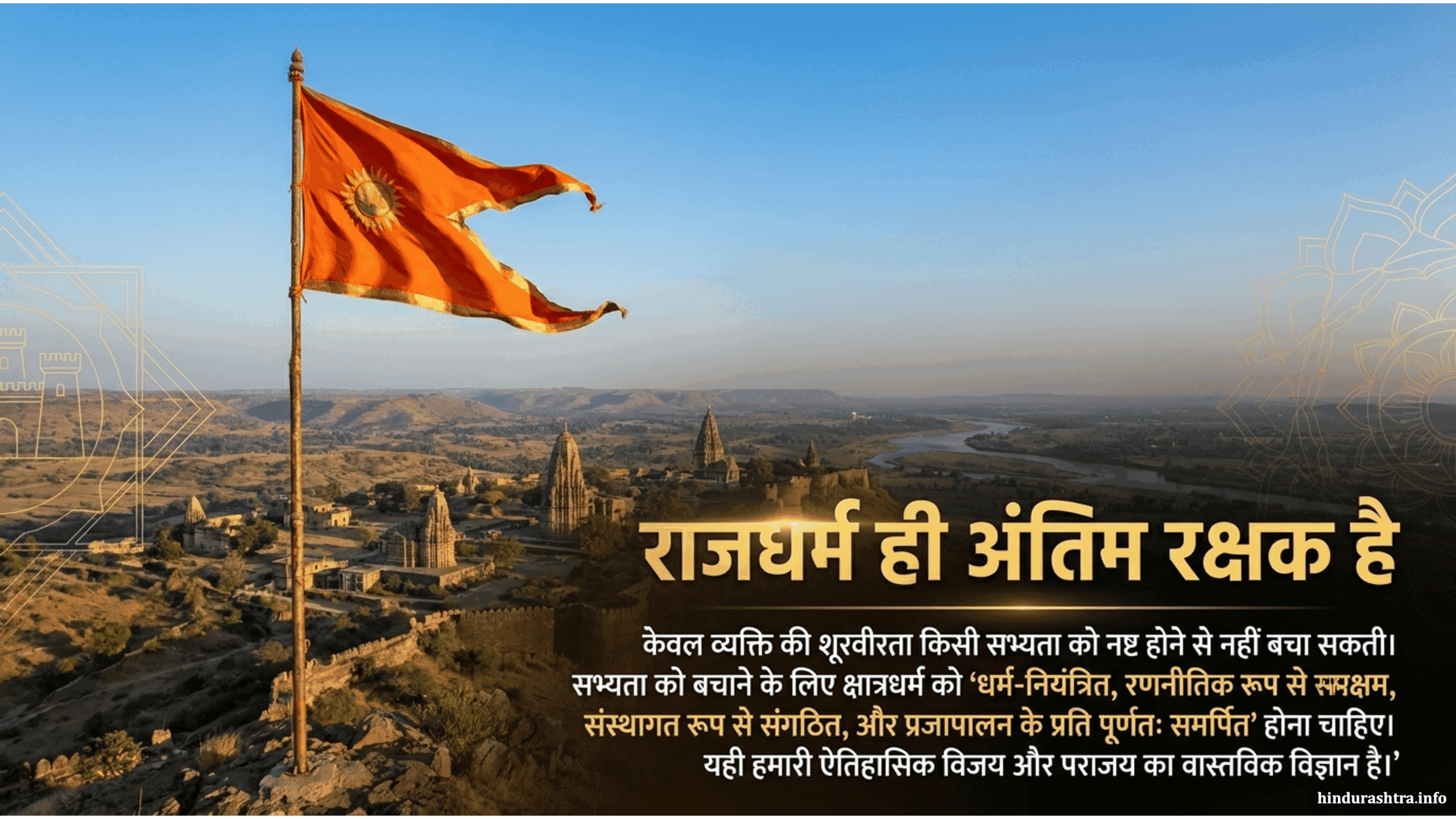
In the traditional political and philosophical framework articulated by the scholar-ascetic Swami Karpatri Ji in his monumental texts, most notably Marxvad aur Ramrajya (मार्क्सवाद और रामराज्य); and continuously expanded in the contemporary era by Jagadguru Puri Shankaracharya Swami Nischalananda Saraswati of the Govardhan Math, the historical and contemporary setbacks of Indian civilization are interpreted primarily as systemic failures of Kshatra Dharma (क्षात्रधर्म). Crucially, their diagnostic model explicitly rejects simplistic, individualized explanations such as the notion that “Kshatriyas simply ceased to be brave.” Within their formalization, Kshatra Dharma is neither an individualized physical attribute nor a quality restricted to personal martial courage displayed during combat. Rather, Kshatra Dharma denotes the proper, integrated, and institutionalized functioning of the entire protective, governing, legislative, and coercive power of society. It encompasses the structural obligation to safeguard Dharma, the human population, civilizational assets, sovereign territory, and the overarching social order under the normative control of Dharma and the intellectual-moral guidance of learned Acharyas and Brahmins.
Karpatri Ji explicitly equates Kshatra Dharma with Rajadharma (राजधर्म), the science of politics (राजनीति Rājanīti), and the total governing function of the political apparatus. In his political commentaries and textual exegesis, Karpatri Ji provides an explicit Sanskrit definition that delineates the complete multi-dimensional scope of the governing mandate:
“व्यक्ति, समाज, राष्ट्र तथा विश्वको लौकिक-पारलौकिक-विनाशसे बचाना… व्यक्ति, समाज, राष्ट्र तथा विश्वको … अभ्युदय, नि:श्रेयस-प्राप्तिसे वंचित होनेसे बचाना क्षात्र या राजाका धर्म है। वही क्षात्रधर्म है, वही राजनीति है।”
(To protect the individual, society, the nation, and the world from worldly and otherworldly destruction… to prevent the individual, society, the nation, and the world from being deprived of material flourishing [Abhyudaya] and spiritual liberation [Niḥśreyasa] is the Dharma of the Kshatra or the King. That precisely is Kshatra Dharma; that precisely is politics.)
A rigorous philosophical dissection of this formulation reveals the extensive, nested institutional architecture inherent to Kshatra (क्षत्र):
- Multi-Tiered Operational Scope (रक्षा-क्षेत्र Rakṣā-Kshetra): The political authority is held directly responsible for four nested operational spheres: the individual (vyakti), collective society (samāja), the sovereign polity or nation (rāṣṭra), and the broader global or cosmic order (viśva). Political failure at any of these levels ripples through the entire structure, rendering the state dysfunctional.
- Comprehensive Mitigation of Destruction (विनाश-प्रतिबंध Vināśa-Pratibhandha): The state must eliminate destructive forces operating on two distinct existential planes: temporal or worldly destruction (लौकिक विनाश laukika-vināśa) [encompassing physical violence, invasion, economic ruin, starvation, and social collapse] and spiritual, moral, or transcendental destruction (पारलौकिक-विनाश pāralaukika-vināśa), which occurs when the structural conditions required for moral living, sacred rites, and traditional learning are annihilated.
- Institutional Guarantee of Teleological Goals: The governing apparatus must actively construct and preserve the socio-political infrastructure that prevents individuals and collective society from being deprived of their twin teleological ends: temporal flourishing (अभ्युदय Abhyudaya) and ultimate spiritual liberation (निःश्रेयस Niḥśreyasa).
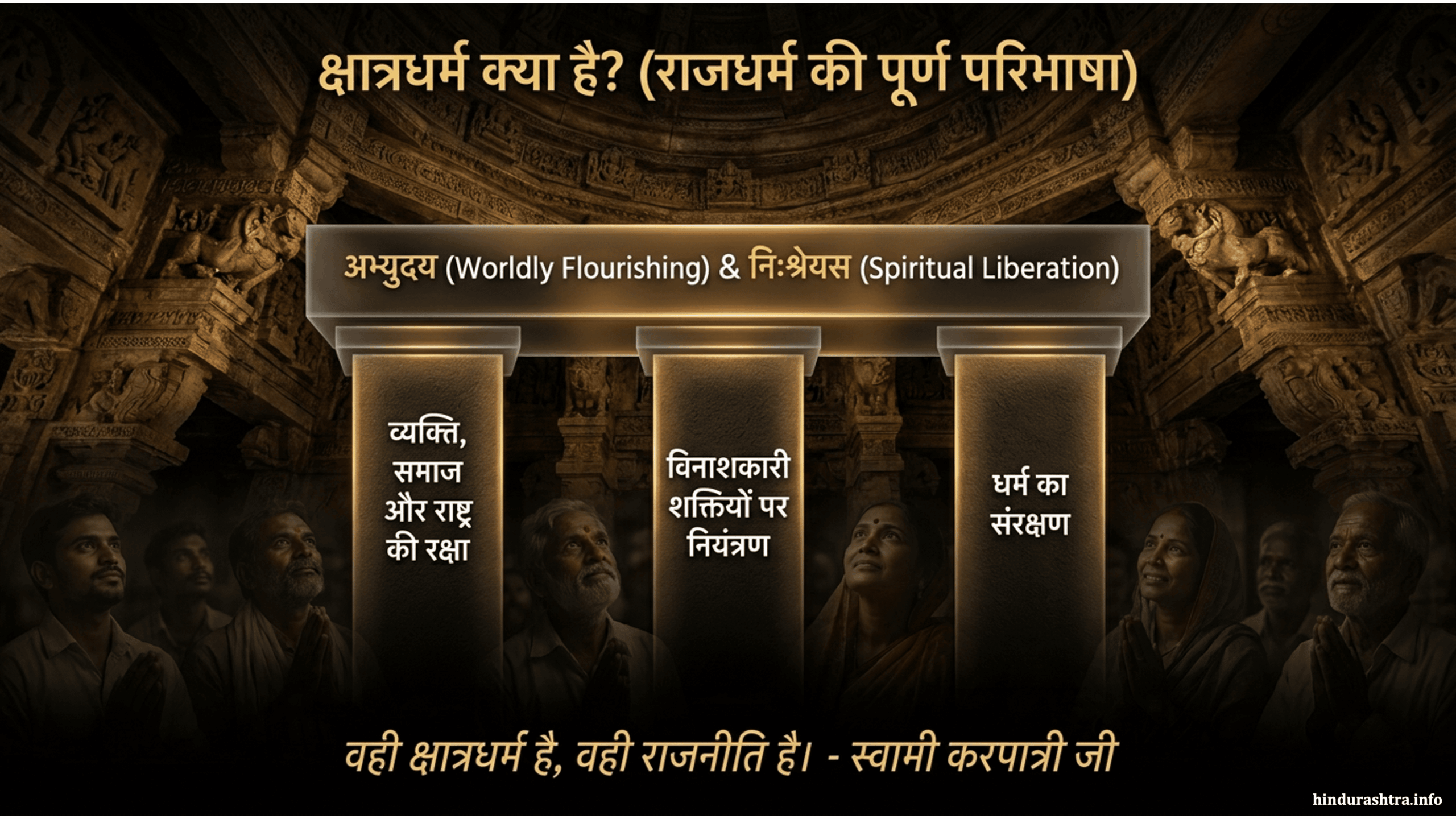
Philosophically, this definition establishes that the failure of state power in the laukika (लौकिक temporal) realm directly compromises and destroys the pāralaukika (पारलौकिक spiritual) realm. When a state suffers military defeat, territorial occupation, or internal anarchy, the immediate physical insecurity (laukika-vināśa) renders it impossible for citizens to execute their systemic duties (स्वधर्म Svadharma), pursue sacred studies, maintain ritual purity, or sustain pedagogical lineages. Temporal political collapse directly precipitates spiritual decay. Thus, Karpatri Ji establishes that Rajadharma(राजधर्म) is far more than military defense or border maintenance; it represents the complete, legitimate science of political power (राजनीति Rājanīti). Consequently, any conceptualization of political failure that reduces state performance to mere military heroism misses the core structural mandate of classical Indian governance.
1.2 The Dual Mandate: Worldly Flourishing (Abhyudaya) and Spiritual Liberation (Niḥśreyasa)
Under the classical architecture of Rajadharma, political power derives its legitimacy from its structural ability to fulfill a dual mandate: facilitating Abhyudaya (अभ्युदय material, economic, and administrative flourishing) while simultaneously safeguarding Niḥśreyasa (निःश्रेयस the ultimate spiritual good, moral order, and liberation). Within classical Advaitic (अद्वैतिक) political philosophy, state power does not exist as an end in itself, nor does it exist merely to organize physical survival or economic consumption; its ultimate justification is the creation and preservation of socio-political conditions within which human beings can pursue both temporal prosperity and spiritual realization without external disruption, internal chaos, or ideological subversion.
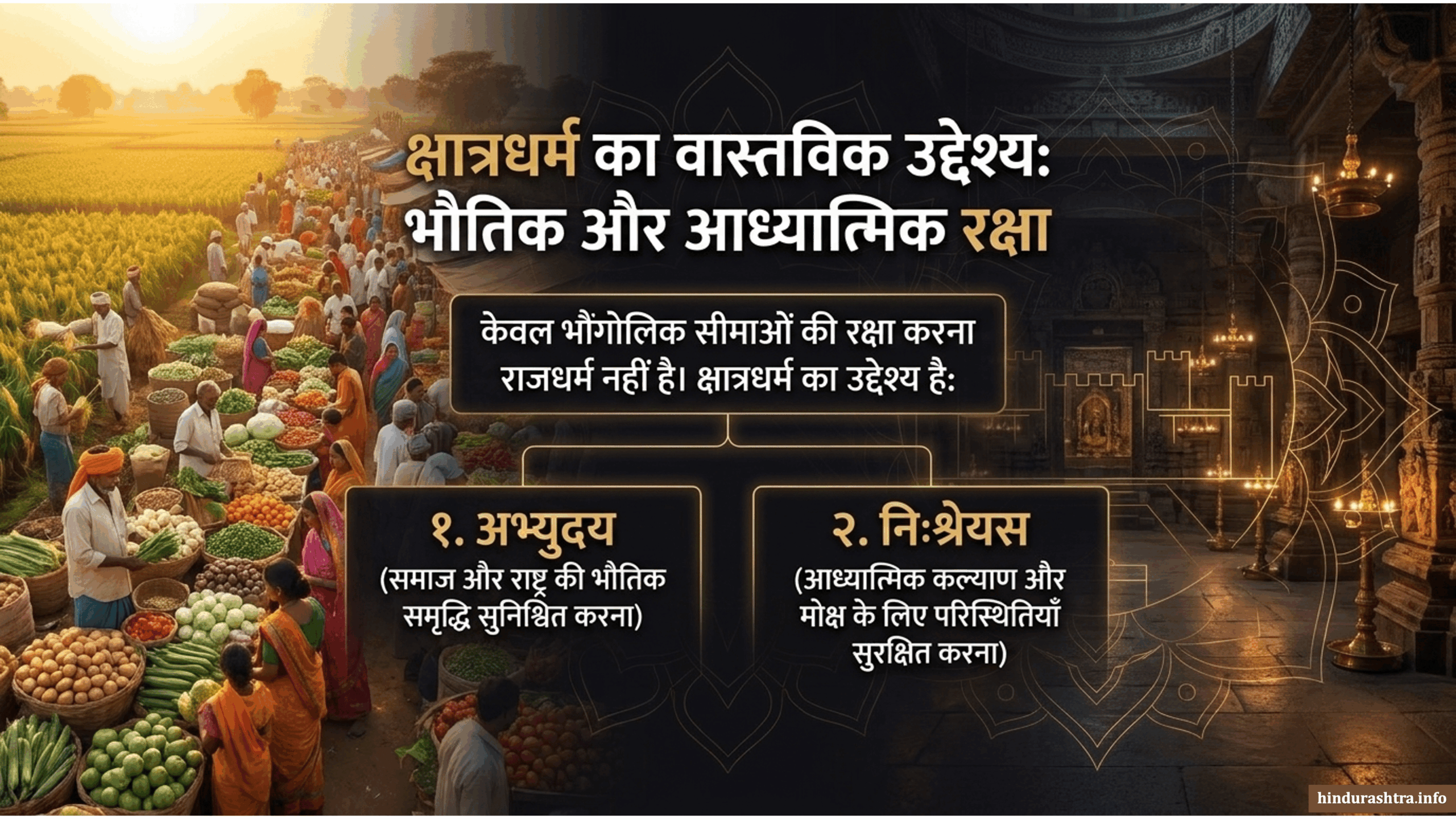
The Dual Mandate of Political Legitimacy Under Rajadharma
- Abhyudaya (अभ्युदय) Material, Temporal & Economic Flourishing: The political obligation of the state to guarantee physical security, territorial sovereignty, internal law and order, infrastructure, commercial vitality, public health, and social stability. The failure to secure Abhyudaya manifests as poverty, lawlessness, administrative paralysis, foreign subjugation, and societal collapse.
- Niḥśreyasa (निःश्रेयस) Spiritual Liberation, Moral Order & Civilizational Continuity: The political obligation of the state to protect sacred spaces, pedagogical traditions (गुरुकुल Gurukulas), religious practices, ethical duties (Dharma), intellectual scholarship, and cultural transmission. The failure to secure Niḥśreyasa manifests as moral degradation, institutional destruction, ideological disorientation, and the loss of civilizational memory.
Analytical Annotation: Within the intellectual tradition of the Govardhan Math, a state apparatus that manages to foster material prosperity (Abhyudaya) while permitting the systematic dismantling of spiritual institutions (Niḥśreyasa) has committed a critical failure of Kshatra Dharma. Conversely, a polity that purports to champion spiritual ideals while failing to provide physical defense, military deterrence, and material stability (Abhyudaya) is equally dysfunctional. Legitimate Kshatra requires the simultaneous, institutional protection of both domains.
1.3 The Primacy of Rajadharma in Civilizational Architecture
To demonstrate why the political state bears this extensive responsibility over human existence, Jagadguru Puri Shankaracharya Swami Nischalananda Saraswati frequently invokes a foundational axiom from the Sāntiparva of the Mahabharata (महाभारत शान्तिपर्व ६३.२७):
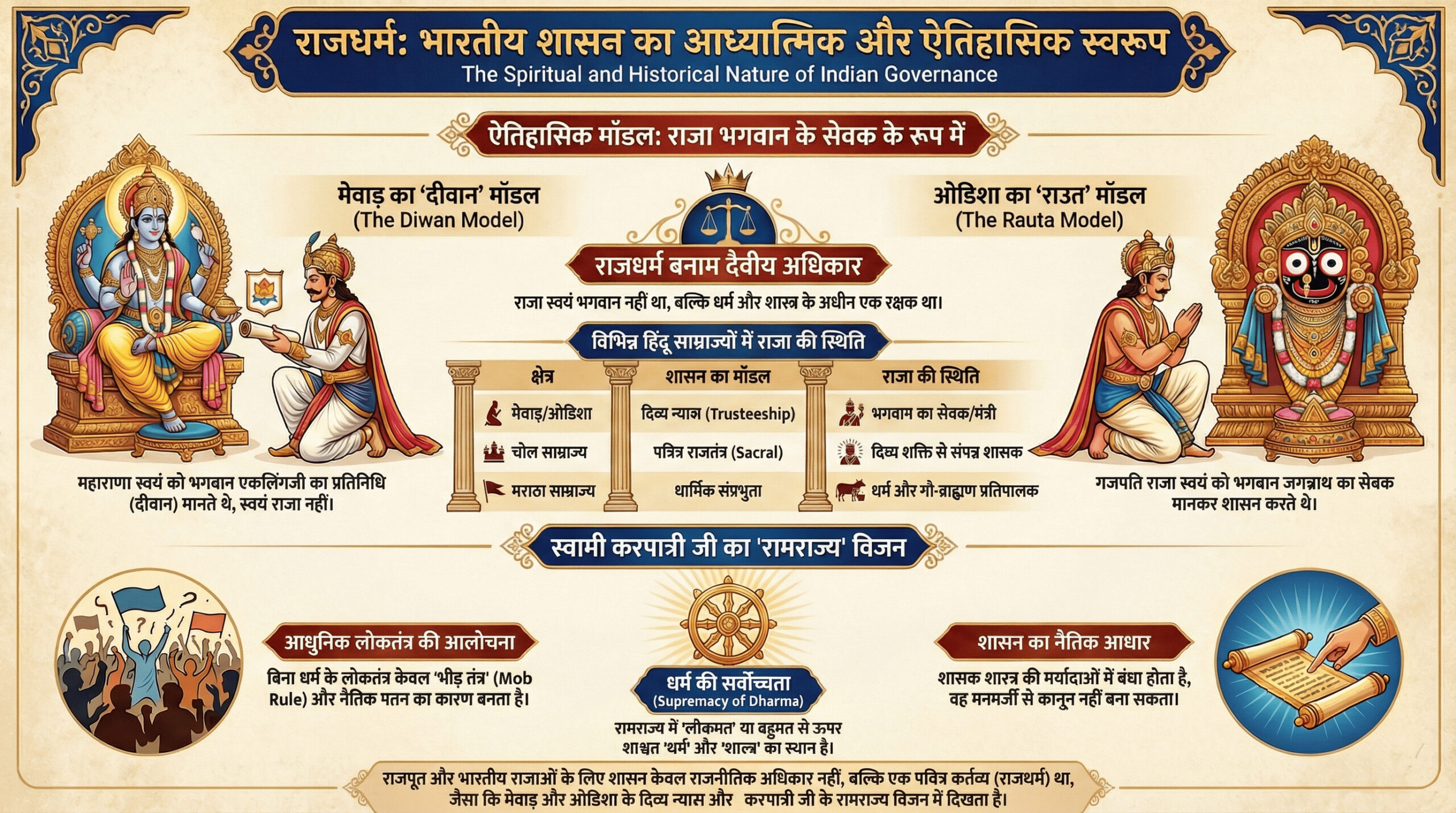
“सर्वे धर्मा राजधर्मप्रधाना:” (All Dharmas are subordinate to, dependent upon, and anchored within Rajadharma.)
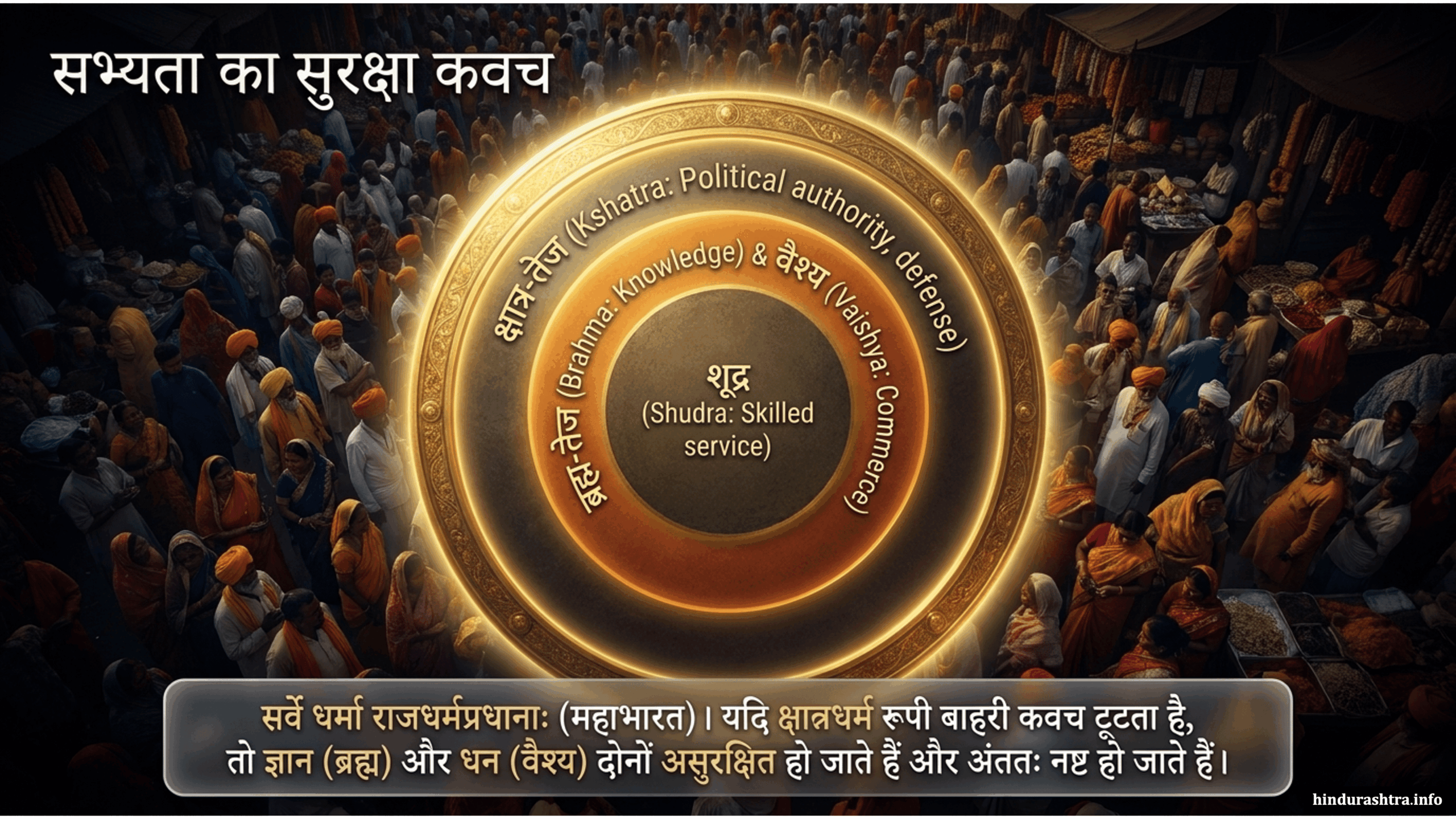
This principle establishes that Rajadharma (राजधर्म) holds an irreplaceable, foundational position over all other societal functions, acting as the structural umbrella without which social order collapses. While distinct social groups, scholars, merchants, agrarian producers, and service providers possess their respective localized duties (स्वधर्म Svadharma), their ability to execute those duties depends entirely upon the structural stability guaranteed by the state. If the governing apparatus (Rajadharma) falters, the protective shield (छत्र Chhatra) is removed, and all other social duties are rendered impossible to sustain.
When Rajadharma disappears or deteriorates into arbitrary tyranny or state weakness, the structural integrity of society breaks down entirely. Citing classical texts, Karpatri Ji notes that when the protective power of the state vanishes, the Veda-based societal order collapses, pedagogical lineages are broken, economic wealth is plundered by internal or external predators, and religious practices are systematically suppressed. Rajadharma is thus not merely one sector of society among many; it is the master architectural canopy that enables civilization itself to exist, develop, and endure.
Having established that Rajadharma functions as the indispensable protective shield for civilizational continuity, it becomes necessary to examine the precise operational modes through which this protective architecture falters, decomposes, and collapses.
- The Sevenfold Typology of Rajadharma Failure
To move beyond superficial historical explanations that attribute civilizational collapse solely to unexpected military setbacks, tactical intelligence failures, or personal moral failings of individual monarchs, the theoretical framework developed by Swami Karpatri Ji provides a multi-dimensional taxonomy of political failure. By categorizing political collapse into seven distinct, interrelated failure modes, this typology demonstrates how civilizational vulnerability is systematically generated when specific structural functions of Kshatra are compromised.
2.1 Type I: Failure to Protect Territory and Population (Rakṣā)
The most immediate, visible, and catastrophic failure of Kshatra Dharma is the inability to safeguard the sovereign territory, borders, and population of the realm from foreign invasions, predatory raids, and catastrophic military incursions. However, within the Karpatri framework, military defeat is analyzed not merely as an unfortunate tactical event, but as an absolute forfeiture of political legitimacy.
In Marxvad aur Ramrajya, Karpatri Ji cites a scriptural warning from the Mahabharata concerning the explicit, conditional contract of rulership (महाभारत अनुशासनपर्व ९६.३५):
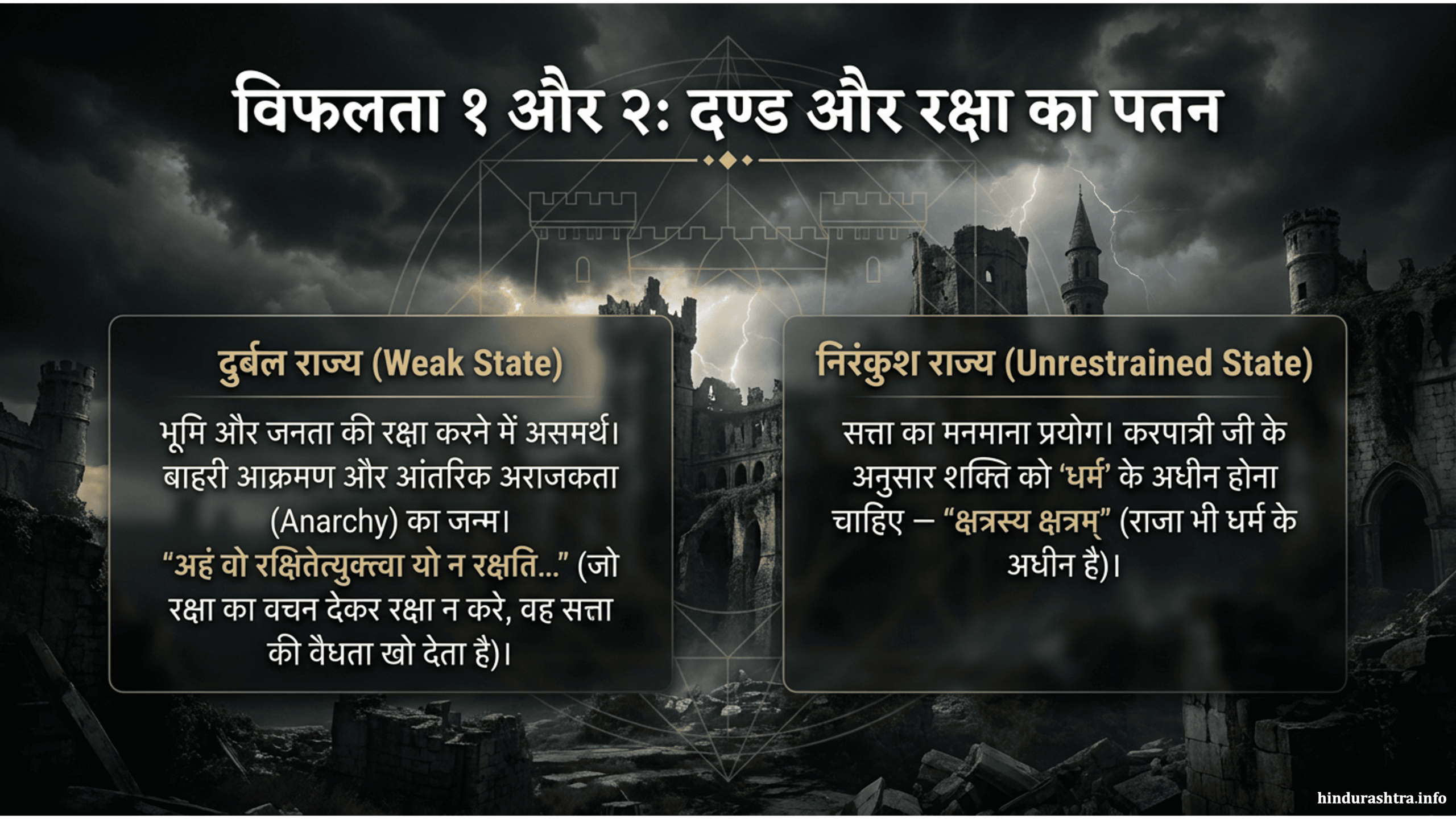
“अहं वो रक्षितेत्युक्त्वा यो न रक्षति भूमिपः। स संहत्य निहन्तव्यो स्वकेव उन्मत्त आतुरः॥”
(The ruler who promises “I shall protect you,” but subsequently fails to protect his people, should be collectively renounced or destroyed like a diseased or crazed dog.)
The philosophical implication of this passage is unequivocal: protection (रक्षा Rakṣā) is the explicit condition upon which the right to rule is granted, coercive power is recognized, and taxation is collected. The state collects revenue (Bali or Kara बलि/कर) specifically as compensation for providing absolute security. When a ruler or ruling class undertakes the solemn obligation to protect the populace but fails to deliver physical security against external aggressors or hostile invaders, the ruler forfeits the moral and legal legitimacy of governance (राज्य Rājya). Military defeat is thus diagnosed as a primary structural failure of Kshatra (क्षत्र) obligation, proving that the state’s primary defensive architecture was fundamentally inadequate.
2.2 Type II: Failure to Maintain Internal Order and the Misuse of Coercive Power (Daṇḍa)
A Kshatriya state is not defined merely by its external defense force; it is equally defined by its internal administration of justice and law enforcement. Karpatri Ji describes the core function of Rajadharma as Kaṇṭaka-śodhana (कंटक-शोधन); the systematic removal of internal “thorns” (such as criminals, subversives, corrupt officials, extortionists, and predatory elements) that obstruct the peaceful flourishing of individuals, society, and the nation. When internal order breaks down, society devolves into lawlessness, internal violence, economic extortion, and social paralysis; a state traditionally characterized in classical political philosophy as Mātsyanyāya (मत्स्यन्याय the law of the fish, wherein the larger fish violently devour the smaller fish).
To prevent anarchy, the state must wield Daṇḍa (दण्ड legitimate, disciplined coercive force). However, classical Advaitic (अद्वैतिक) political thought sharply distinguishes between the righteous exercise of Daṇḍa and arbitrary tyranny. Coercive power cannot be wielded according to the personal whims, emotional impulses, or unchecked desires of the sovereign. Karpatri Ji emphasizes the foundational maxim:
“राजा भी धर्म के अधीन है।” (The King himself is strictly subject to Dharma.)
To reinforce this structural limitation on state power, Karpatri Ji invokes the foundational formulation from the Bṛhadāraṇyaka Upaniṣad 1.4.14 (बृहदारण्यक उपनिषद १.४.१४): “क्षत्रस्य क्षत्रम् यद्धर्मः” (Dharma is the Kshatra of the Kshatra). This establishes that Dharma functions as the supreme governing principle over political and military power itself. Political power is not the ultimate authority; it is merely the executive instrument of Dharma. A state that is too weak or paralyzed to enforce law fails in its Kshatra obligation through impotence; equally, a state that uses its coercive power arbitrarily, corruptly, or tyrannically has abandoned Dharma and represents an inverse failure of Kshatra.
|
State Condition |
Structural Characteristics |
Status of Daṇḍa (Coercive Power) |
Impact on Kshatra Dharma |
|
Weak State |
Inability to enforce law; internal anarchy (Mātsyanyāya); proliferation of criminal elements; administrative paralysis; unprotected citizens. |
Absent, impotent, or unapplied; structural failure to punish destructive conduct and remove societal thorns (Kaṇṭaka-śodhana). |
Systemic Failure: State fails its protective mandate (Rakṣā) through powerlessness and structural incompetence. |
|
Unrestrained / Arbitrary State |
Governance by personal whim; tyranny; economic exploitation; state apparatus acts as a predatory entity upon its own citizens. |
Misused, arbitrary, and tyrannical; detached from normative Dharmicboundaries and institutional oversight. |
Systemic Failure: State violates Kṣatrasya Kṣatram; political power becomes illegitimate and destructive. |
|
Dharma-Controlled State |
Maintenance of internal order; systematic removal of obstacles; protection of the weak against the strong; objective, rule-bound justice. |
Legitimate, disciplined, bounded by Dharma, and executed impartially for the protection and welfare of the people (Prajāpālana). |
Optimal Function: Full alignment with Rajadharma, fulfilling both Abhyudaya and Niḥśreyasa. |
2.3 Type III: Fracture of the Intellectual-Political Axis (Brahmin-Kshatriya Symbiosis)
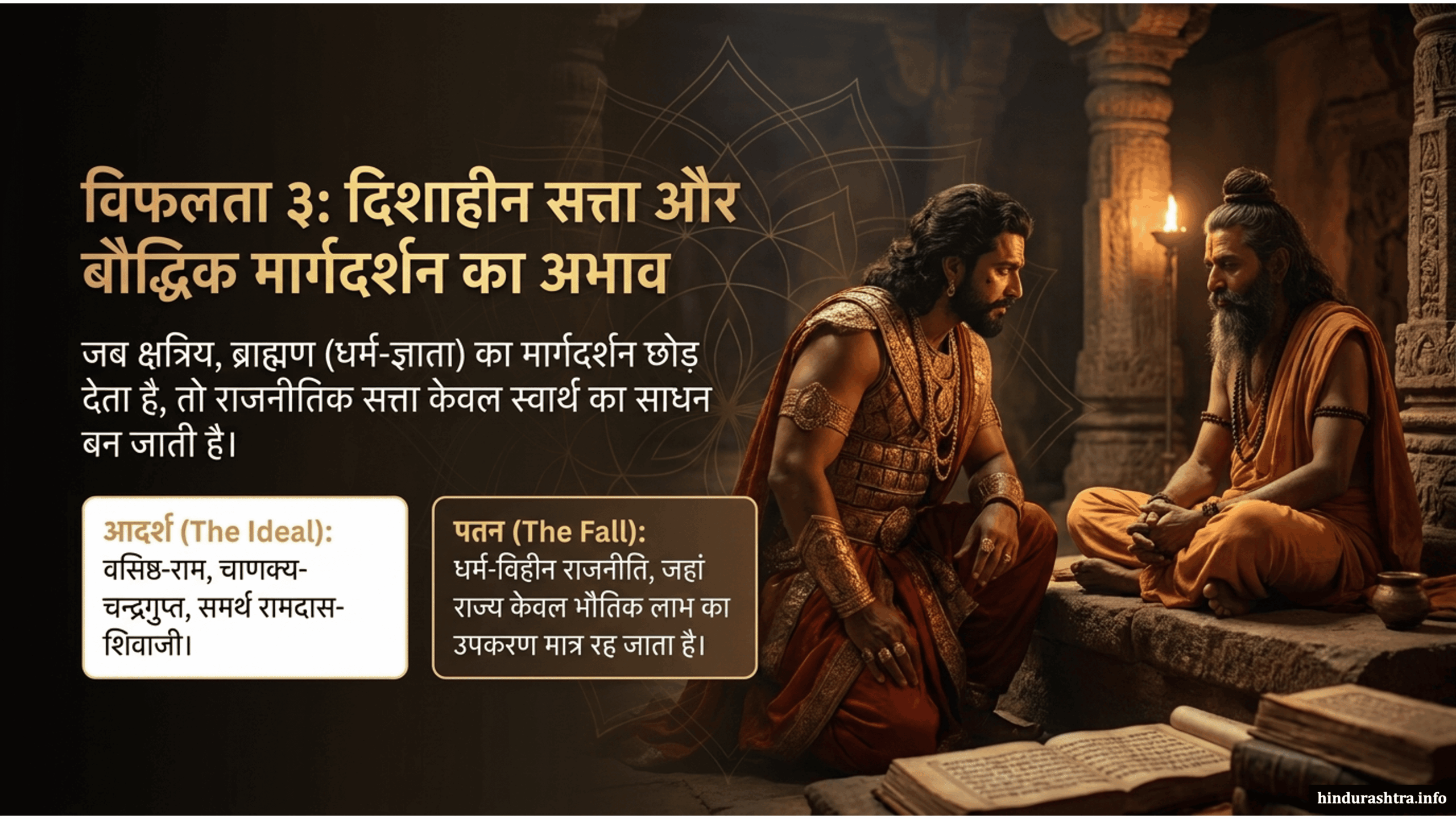
A pivotal feature of the Karpatri-Nischalananda theoretical framework is the insistence that executive political power (Kshatra) cannot function effectively, strategically, or legitimately in isolation from qualified intellectual and moral authority (ब्रह्म Brahma). The classical paradigm dictates a precise functional relationship:
- Brahmin Authority (Brahma): Determines, interprets, preserves, and teaches Dharma; provides disinterested strategic, moral, and legal counsel.
- Kshatriya Authority (Kshatra): Protects, enforces, implements, and institutionalizes Dharma through executive state power and military force.
Karpatri Ji demonstrates that throughout Indian history, successful, enduring political orders were consistently built upon a symbiotic relationship between disciplined, impartial, and Dharma-conscious intellectuals and executable executive power. He explicitly highlights four historical and scriptural paradigms to illustrate this interdependence:
- Vasiṣṭha and Rāma (वसिष्ठ और श्रीराम): The ideal, exemplary rule of Ayodhyā (रामराज्य Rāmarājya) guided by the supreme spiritual wisdom, legal counsel, and moral authority of Sage Vasiṣṭha over the sovereign executive.
- Vyāsa, Kṛṣṇa, Vidura, and Yudhiṣṭhira (व्यास, श्रीकृष्ण, विदुर और युधिष्ठिर): The establishment of righteous governance in the Mahabharata through the combined philosophical, strategic, ethical, and legal guidance of sages and statesmen over the ruler.
- Cāṇakya and Candragupta (चाणक्य और चन्द्रगुप्त): The unification of the Indian subcontinent, the eradication of corrupt domestic tyranny, and the expulsion of foreign occupation forces through the strategic genius of an unattached scholar directing sovereign executive power.
- Samartha Rāmadāsa and Śivājī (समर्थ रामदास और शिवाजी): The seventeenth-century civilizational resurgence and establishment of Hindavī Svarājya (हिन्दवी स्वराज्य) forged through the spiritual-ideological leadership of a saint directing the martial prowess of a monarch.
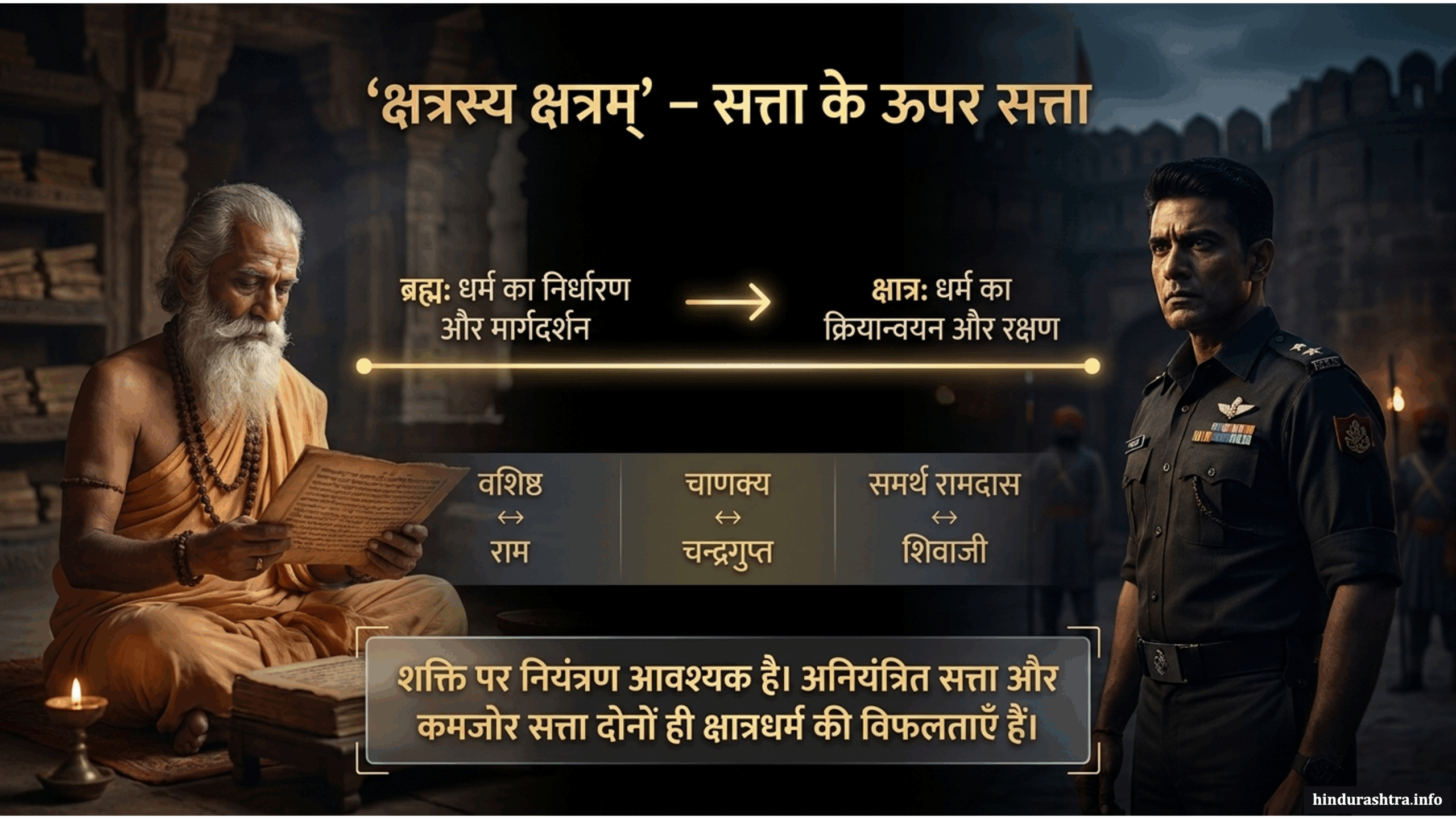
Puri Shankaracharya Swami Nischalananda Saraswati reinforces this historical imperative by stating that protecting the “Brahminhood of Brahmins”; meaning the preservation of an uncorrupted, disciplined, scholarly, and independent intellectual class, is a primary duty of the Kshatriya. When the political class detaches itself from Dharma-conscious intellectual authority, political power becomes intellectually directionless, strategically shortsighted, morally bankrupt, and reduced to a mere instrument for material self-aggrandizement.
2.4 Type IV: Deficit of Political Foresight (Dūradarśitā) and Strategic Coordination
Courage without strategic vision is fundamentally insufficient for state survival. Jagadguru Puri Shankaracharya Swami Nischalananda Saraswati repeatedly identifies long-term foresight (दूरदर्शिता Dūradarśitā) as an essential, indispensable requirement of legitimate governance. Official perspectives from the Govardhan Math regarding his discourse highlight that short-sightedness, petty power-seeking, and dynastic narcissism are fatal corruptions of political power.
Even if a ruler or military commander exhibits extraordinary personal valor, he systematically fails in Kshatra Dharma if his administration exhibits:
- Strategic unpreparedness and total reliance on reactive military measures;
- Inability to anticipate long-term external threats and geopolitical shifts;
- Severe political fragmentation and petty regional rivalries;
- Failure to forge durable strategic alliances across neighboring states;
- Neglect of long-term economic strength and logistics;
- Inability to think beyond dynastic survival or immediate territorial control.
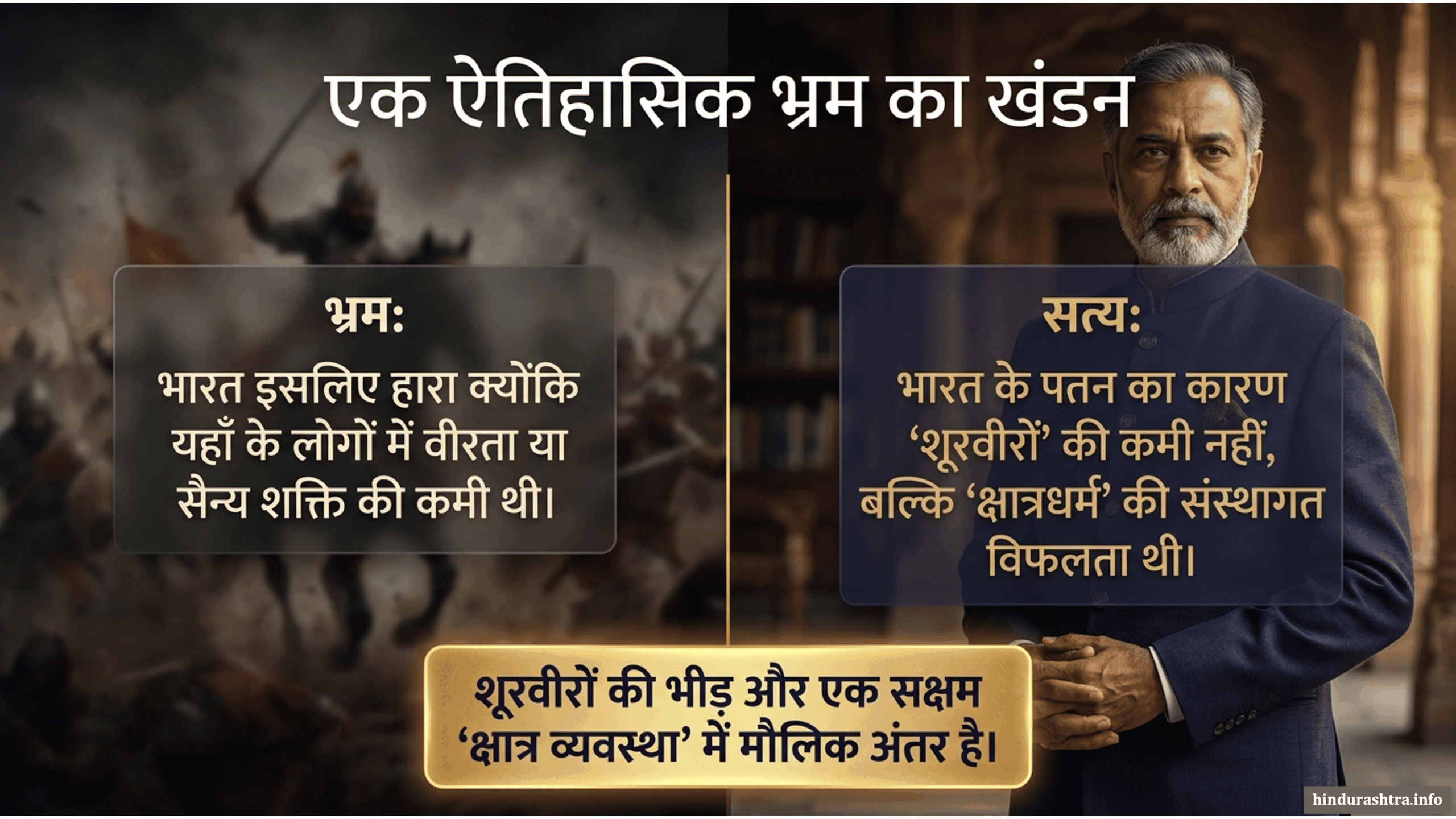
A collection of individually brave rulers operating without unified strategic foresight does not constitute a functional Kshatra system.
2.5 Type V: Institutional Deficit and Inability to Reproduce Political Structures
A critical insight offered by Karpatri Ji regarding India’s historical vulnerabilities concerns the structural failure to build reproducible political institutions. Karpatri Ji explicitly argues that when proper political actors and state instruments are absent or destroyed, the obligation of Kshatra does not vanish from the earth; rather, it becomes the imperative duty of intellectuals and scholars to actively search for, design, and construct new political instruments.
He cites the actions of Cāṇakya and Samartha Rāmadāsa (चाणक्य और समर्थ रामदास) as classical demonstrations of this duty: when functional state power was absent, these thinkers did not remain passive; they created the political practitioners and organized the state apparatus required to protect society.
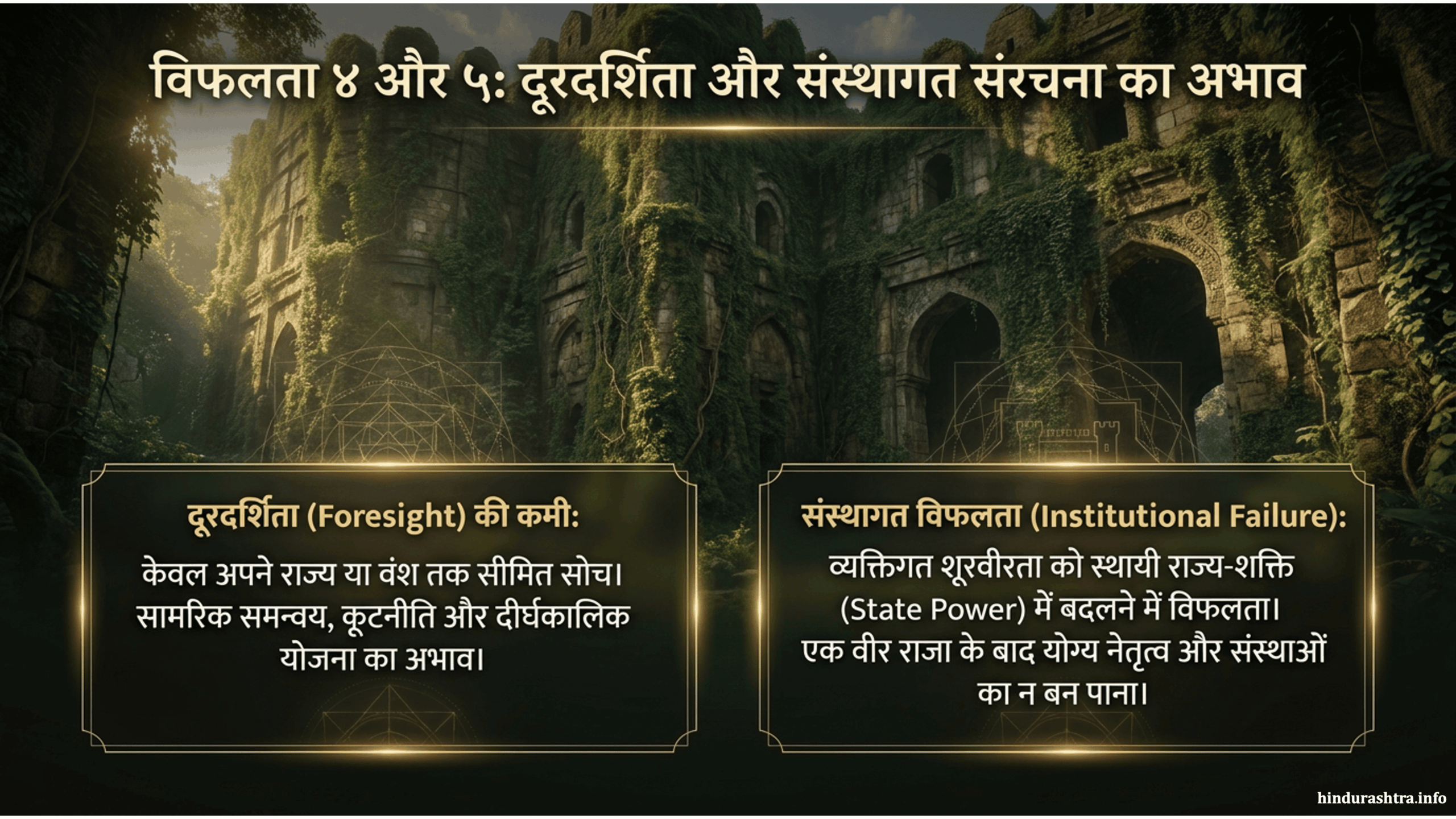
Applying this logic to historical political failures shifts the diagnostic focus away from individual moralizing:
- Superficial Question: “Why did a particular king or commander fail to fight harder on a specific day?”
- Structural Kshatra Question: “Why did the civilization repeatedly fail to build durable, reproducible political structures and administrative institutions capable of converting individual courage into sustained state power across successive generations?”
A civilizational failure of Kshatra Dharma (क्षत्र विफलता) occurs when a society fails to reproduce the institutional mechanisms, political culture, administrative continuity, rigorous training, and leadership pipelines necessary to exercise state power effectively over centuries.
2.6 Type VI: Subordination of Rajadharma to Personal and Dynastic Interest
The final major failure mode within the classical taxonomy is the degeneration of political power from a sacred trust into a vehicle for personal luxury, private wealth, and dynastic vanity. The foundational ideal of the Kshatriya is Prajāpālana; the selfless protection, maintenance, and welfare of the populace.
In his extensive treatise Ramayana Mimamsa, Karpatri Ji contrasts degenerate political rule with the paradigm of Śrī Rāma. In Rāmarājya, the personal conduct of the monarch sets the absolute moral standard for the state, and personal desires are completely subordinated to the demands of Kshatra Dharma and public service. Śrī Rāma’s willingness to sacrifice personal happiness, familial comfort, and private interests to uphold the integrity of Rajadharma represents the pinnacle of classical statecraft.
When governance degenerates, the operational equation shifts radically:
- Degenerate Governance: State Power (Rājya) = Treated as Personal Property / Private Luxury / Dynastic Vanity / Vehicle for Self-Aggrandizement.
- Authentic Kshatra Dharma: State Power (Rājya) = Treated as a Sacred Trust (Prajāpālana) Governed by Dharma and Directed Toward Social Welfare.
Whenever a ruling class treats state power as personal property, using national resources for private luxury rather than institutional defense and social protection, Kshatra Dharma suffers a profound internal collapse.
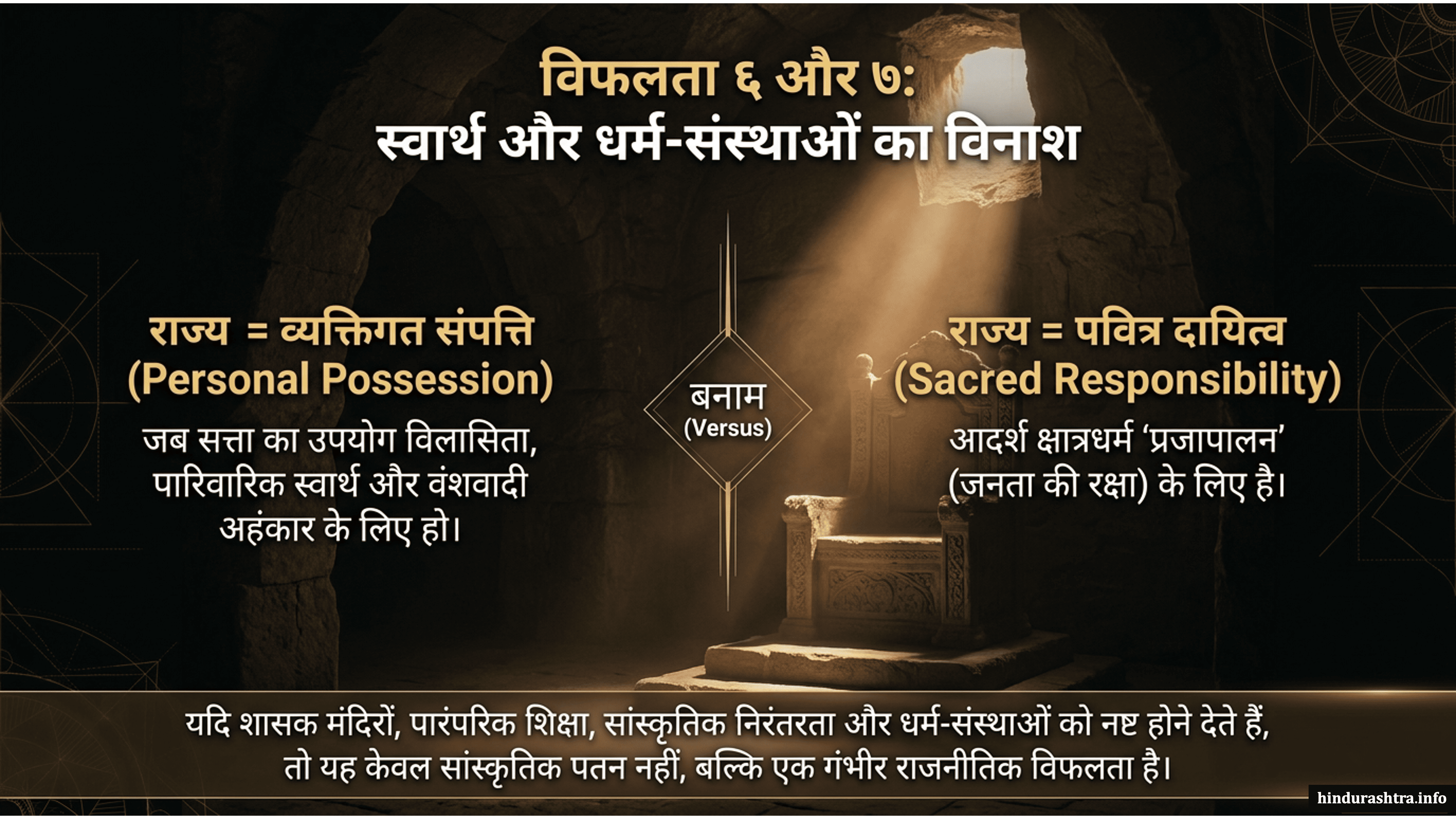
2.7 Type VII: Failure to Safeguard Dharma Institutions and Civilizational Continuity
For Karpatri Ji, the sovereign political apparatus does not exist merely to guarantee the physical survival or material subsistence of the population. Its ultimate purpose is civilizational: creating the structural environment in which both worldly prosperity (अभ्युदय Abhyudaya) and spiritual liberation (निःश्रेयस Niḥśreyasa) can be continuously realized.
Consequently, if political rulers allow the systemic destruction of Dharma institutions; including sacred temples, traditional educational centers (Gurukulas and Pāṭhaśālās, गुरुकुल और पाठशाला), social duties, religious rites, and indigenous cultural continuity, the diagnostic framework does not view this merely as a passive or inevitable “cultural decline.” Within the Karpatri conceptual system:
Destruction of Civilizational & Religious Institutions = Direct Political Failure of Kshatra Dharma
When foreign aggressors or internal subversives dismantle the sacred institutions of a society while the political apparatus remains passive, paralyzed, or subservient, the state has committed a primary failure of Rajadharma (राजधर्म). The state has failed to protect the civilizational infrastructure required for Niḥśreyasa.
Understanding these seven distinct structural failure modes clarifies why political defense cannot be evaluated through battlefield courage alone, leading directly to the vital distinction between individual heroism and comprehensive statecraft.
- Conceptual Antithesis: Heroism (Vīratā) Versus Systemic Statecraft (Kṣātradharma)
A central thesis emerging from the Karpatri-Puri Shankaracharya framework is the absolute conceptual distinction between isolated personal valor and the comprehensive institutional reality of Kshatra Dharma. Historical analyses of Indian political history have repeatedly confused martial courage with civilizational security, leading to tragic misdiagnoses of historical collapse.
3.1 The Illusion of Individual Courage as Civilizational Security
The core philosophical axiom formulated within this tradition is:
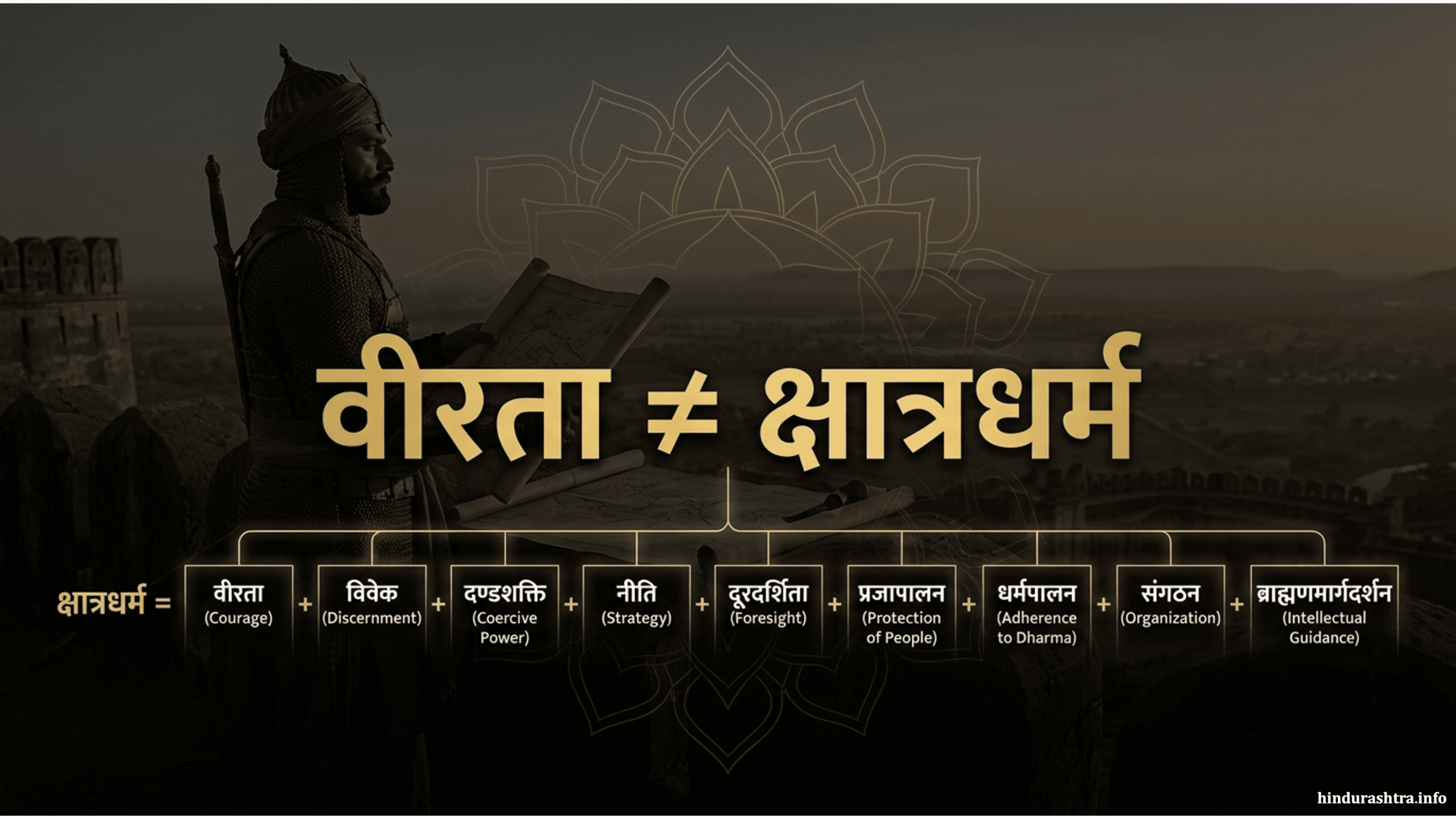
वीरता ≠ क्षात्रधर्म (Heroism does not equal Kshatra Dharma.)
Individual heroism (वीरता Vīratā) is an affective, personal attribute; a psychological willingness to face death and display martial bravery on the field of combat. Kshatra Dharma, conversely, is a holistic, multi-dimensional, institutional science of systemic statecraft, strategic organization, and civilizational defense.
History provides numerous instances of extraordinary individual courage displayed by Rajput warriors, Maratha commanders, Sikh martyrs, and Chola monarchs. Individual rulers and generals frequently fought with unmatched valor, sacrificing their lives against overwhelming odds. Yet, despite this abundance of personal bravery, these polities repeatedly failed to prevent long-term foreign subjugation, the systematic plunder of economic resources, and the destruction of indigenous institutions.
The Karpatri-Nischalananda framework explains this paradox: a collection of individually courageous rulers does not equate to a functioning Kshatra system. When individual bravery is unorganized, strategically fragmented, intellectually disconnected from Dharma, and destitute of institutional continuity, it cannot provide civilizational security. Heroism at the individual level can never compensate for structural deficits in political foresight, intelligence gathering, diplomacy, alliance-building, and organizational statecraft (Rājanīti and Daṇḍanīti राजनीति और दण्डनीति).
3.2 The Tenfold Matrix of Integrated Kshatra Dharma
To fully articulate what true Kshatra Dharma requires beyond mere physical bravery, Karpatri Ji’s political writings synthesize ten indispensable, interconnected components. True political defense exists only when all ten elements operate as an integrated system:
|
# |
Constituent Element |
Sanskrit Term |
Strategic Function within Statecraft |
|
1 |
Martial Courage |
Vīratā (वीरता) |
Physical bravery, tactical aggressiveness, and the willingness to face lethal force in defense of the realm. |
|
2 |
Moral Discernment |
Viveka (विवेक) |
Intellectual sharpness, moral clarity, and the capacity to distinguish righteous action from destructive expedience. |
|
3 |
Coercive Capacity |
Daṇḍa-śakti (दण्डशक्ति) |
Monopoly on legitimate, disciplined physical force to enforce law, protect the weak, and deter external aggression. |
|
4 |
Political Strategy |
Nīti (नीति) |
Diplomatic statecraft, sophisticated maneuvers, intelligence gathering, and realistic political calculus. |
|
5 |
Strategic Foresight |
Dūradarśitā (दूरदर्शिता) |
Long-term vision, anticipation of future geopolitical threats, multi-generational planning, and proactive defense. |
|
6 |
Populace Protection |
Prajāpālana (प्रजापालन) |
Unwavering commitment to the physical welfare, economic security, and holistic development of all citizens. |
|
7 |
Preservation of Order |
Dharmapālana (धर्मपालन) |
Active defense and structural support of the moral, cultural, and spiritual institutions of the civilization. |
|
8 |
Systemic Organization |
Saṅghaṭana (संगठन) |
Institutionalization of political power, organizational cohesion, alliance networks, and reproducible governance. |
|
9 |
Selfless Sacrifice |
Tyāga (त्याग) |
Absolute subordination of individual ego, personal luxury, family wealth, and dynastic vanity to the state. |
|
10 |
Intellectual Guidance |
Brāhmaṇa-mārgadarśana(ब्राह्मणमार्गदर्शन) |
Alignment of state power with the guidance of independent, learned, disciplined, and Dharma-conscious scholars. |
When political power relies exclusively on Element 1 (Vīratā) while neglecting Elements 2 through 10, the governing structure is inherently fragile and vulnerable to systemic collapse.
This breakdown of the integrated components of statecraft directly triggers the structural mechanics that cause an entire civilizational architecture to collapse.
- Structural Mechanics of Civilizational Collapse
Civilizational integrity relies upon the harmonious execution of specialized social functions. Within the traditional Indian sociological model, society functions as an interconnected organism requiring intellectual clarity, defensive capacity, economic production, and specialized labor. When the protective political function (Kshatra) collapses, the structural balance of society is destroyed.
4.1 Functional Dysfunctions Across the Four Varna-Functions
Swami Karpatri Ji and Jagadguru Puri Shankaracharya Swami Nischalananda Saraswati diagnose civilizational weakness as an organic dysfunction occurring across the four foundational capacity domains (Varṇa-kāryas):
- Brahma-tejas (ब्रह्मतेजस्): The capacity for deep learning, pedagogical preservation, philosophical innovation, moral authority, and strategic-ideological guidance.
- Kshatra-tejas (क्षात्रतेजस्): The capacity for sovereign political governance, coercive deterrence (Daṇḍa), military defense, institutional organization, and administrative order. (The Protective Enabling Shield)
- Vaishya Function (वैश्य धर्म): The capacity for wealth generation, agricultural production, commercial networks, trade, and financial sustainability.
- Shudra / Seva Function (शूद्र या सेवा कार्य): The capacity for skilled labor, artisanal craftsmanship, industrial service, and operational support.
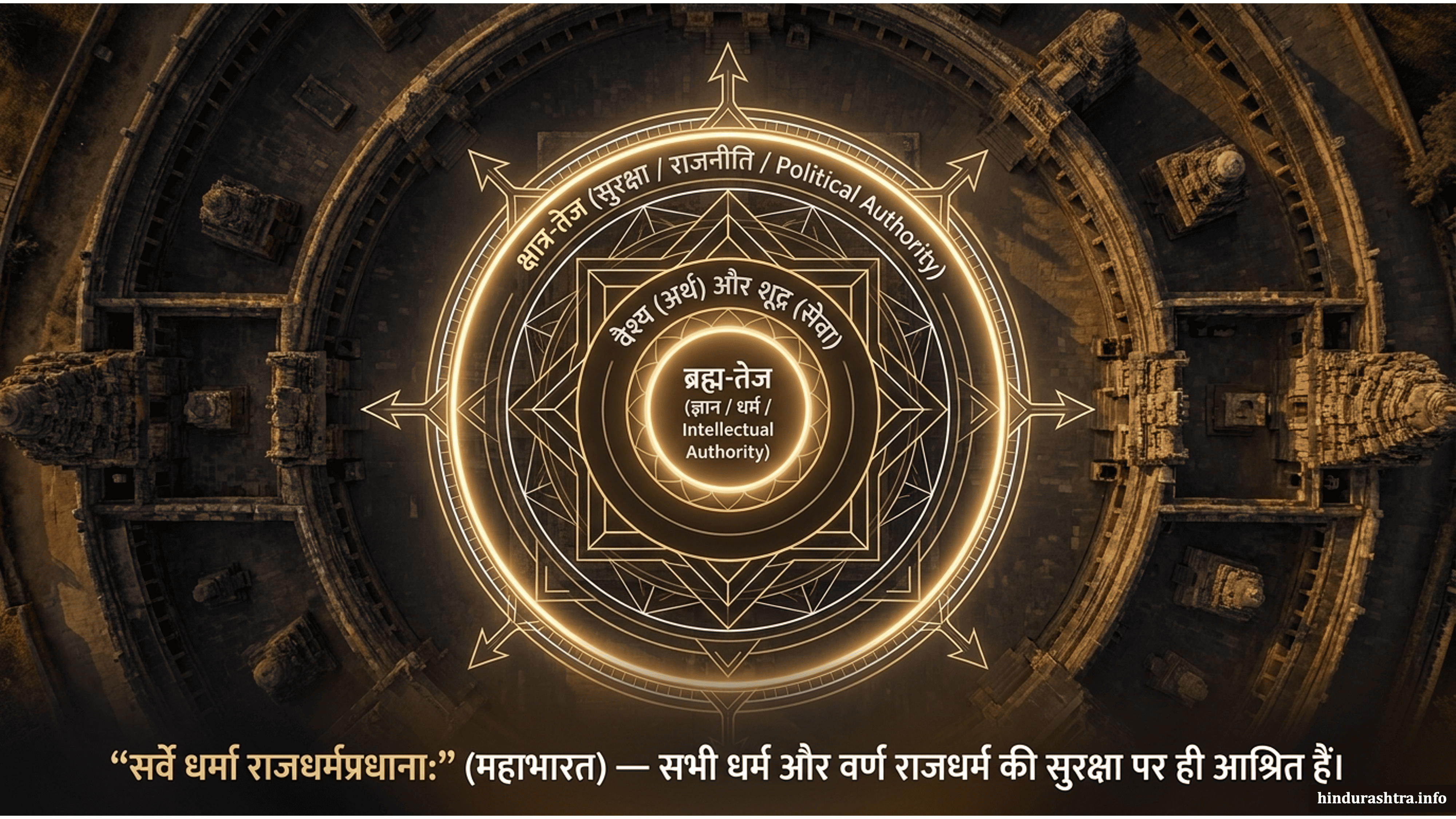
While all four functions are vital, the Kshatra function occupies a uniquely critical position within this systemic matrix. Citing the Mahabharata axiom: “सर्वे धर्मा राजधर्मप्रधाना:”, Puri Shankaracharya stresses that Rajadharma (राजधर्म) is primary because it provides the indispensably necessary protective umbrella under which Brahma, Vaishya, and Shudra functions can safely operate. If Kshatra-tejas fails, the remaining three functional domains are left completely exposed to hostile external and internal forces.
4.2 The Vulnerability of Unprotected Assets
The central logical formulation derived from Karpatri Ji’s political philosophy demonstrates the direct causality between political/military failure and total civilizational degradation:
- Brahma without Kshatra (क्षत्र के बिना ब्रह्म) → Knowledge without Protection: High intellectual achievements, profound philosophy, and sacred texts are rendered helpless against violent physical eradication. Universities, libraries, and pedagogical lineages (Gurukulas) are burned and liquidated when there is no state force to defend them.
- Vaishya without Kshatra (क्षत्र के बिना वैश्य) → Wealth without Security: Commercial prosperity, agricultural abundance, and financial capital become immediate targets for plunder by predatory foreign forces or internal criminals in the absence of a sovereign protective shield.
- Dharma without Kshatra (क्षत्र के बिना धर्म) → Ideals without Institutional Protection: High ethical standards, religious customs, and sacred traditions cannot survive in practice if the political power actively hostile to them is allowed to dismantle their physical infrastructure (temples, pilgrim routes, social regulations).
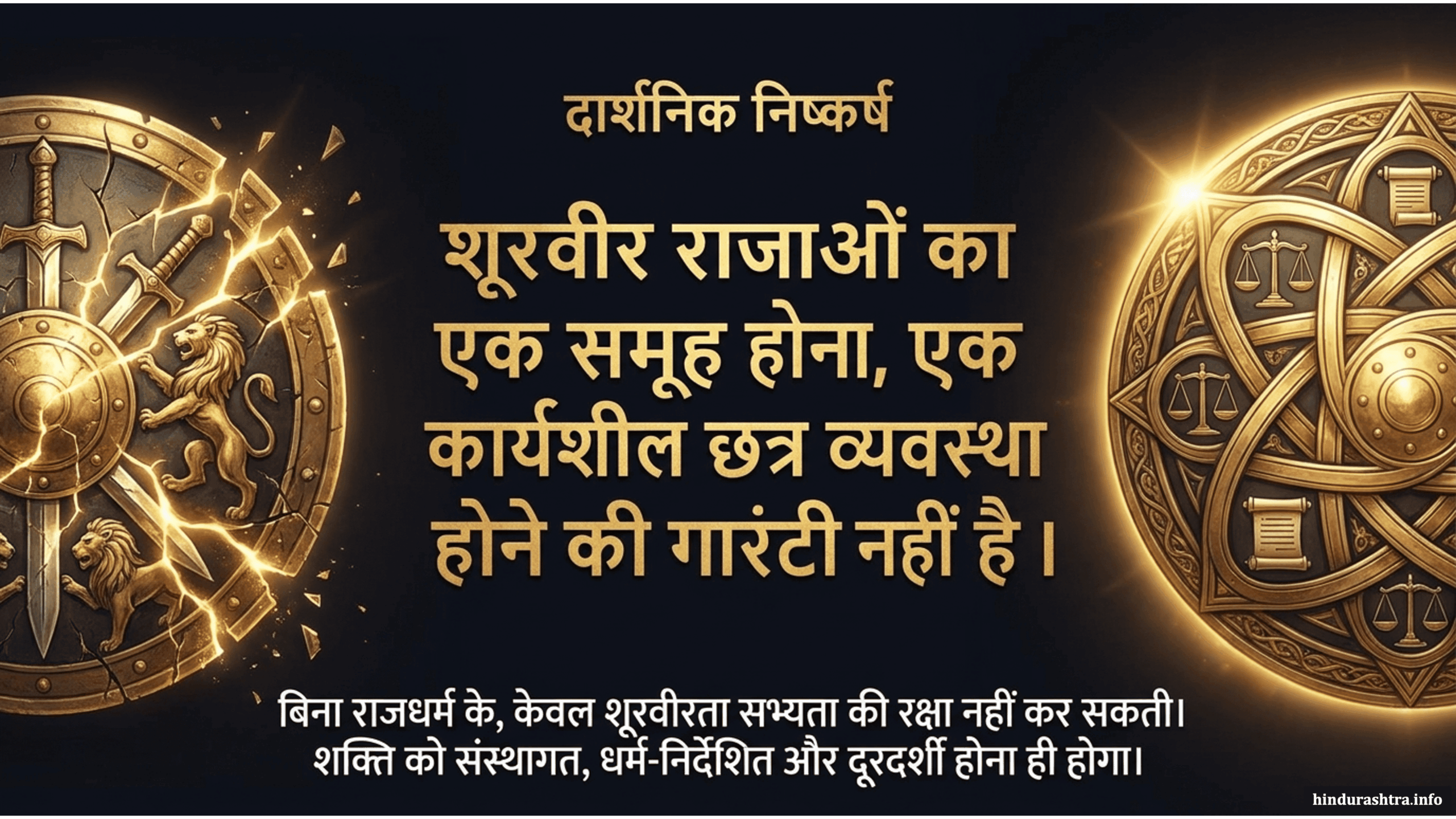
When Kshatra fails, civilizational assets (no matter how advanced, wealthy, or morally elevated) are systematically plundered, subordinated, or annihilated by external powers possessing superior organizational political force.
4.3 The Recurring Cycle of Political Fragmentation
By applying the insights of Karpatri Ji and Puri Shankaracharya to historical trends, a clear, recurring cycle of political fragmentation and civilizational vulnerability can be delineated:
- Strong Localized Kshatra: Rulers focus on regional kingdoms, dynastic pride, and localized defense.
- Political Fragmentation: Regional polities enter into petty rivalries, failing to maintain central coordination.
- Absence of Coordinated Strategic Authority: Long-term foresight (Dūradarśitā) disappears; no durable alliance networks are built.
- Exploitation by External Powers: Aggressive external forces exploit regional divisions, structural voids, and strategic unpreparedness.
- Catastrophic Military & Political Defeat: Tactical heroism on the battlefield fails to overcome deep strategic and organizational deficits.
- Loss of Sovereign Territory & Dharma Institutions: Sacred temples are destroyed, wealth is plundered, and traditional education is dismantled.
- Deep Cultural & Economic Subordination: Society enters long historical cycles of structural decay, intellectual disorientation, and impoverishment.
This systemic model proves that historical vulnerabilities were fundamentally structural: localized individual heroism consistently succumbed to organized, strategically unified external power structures.
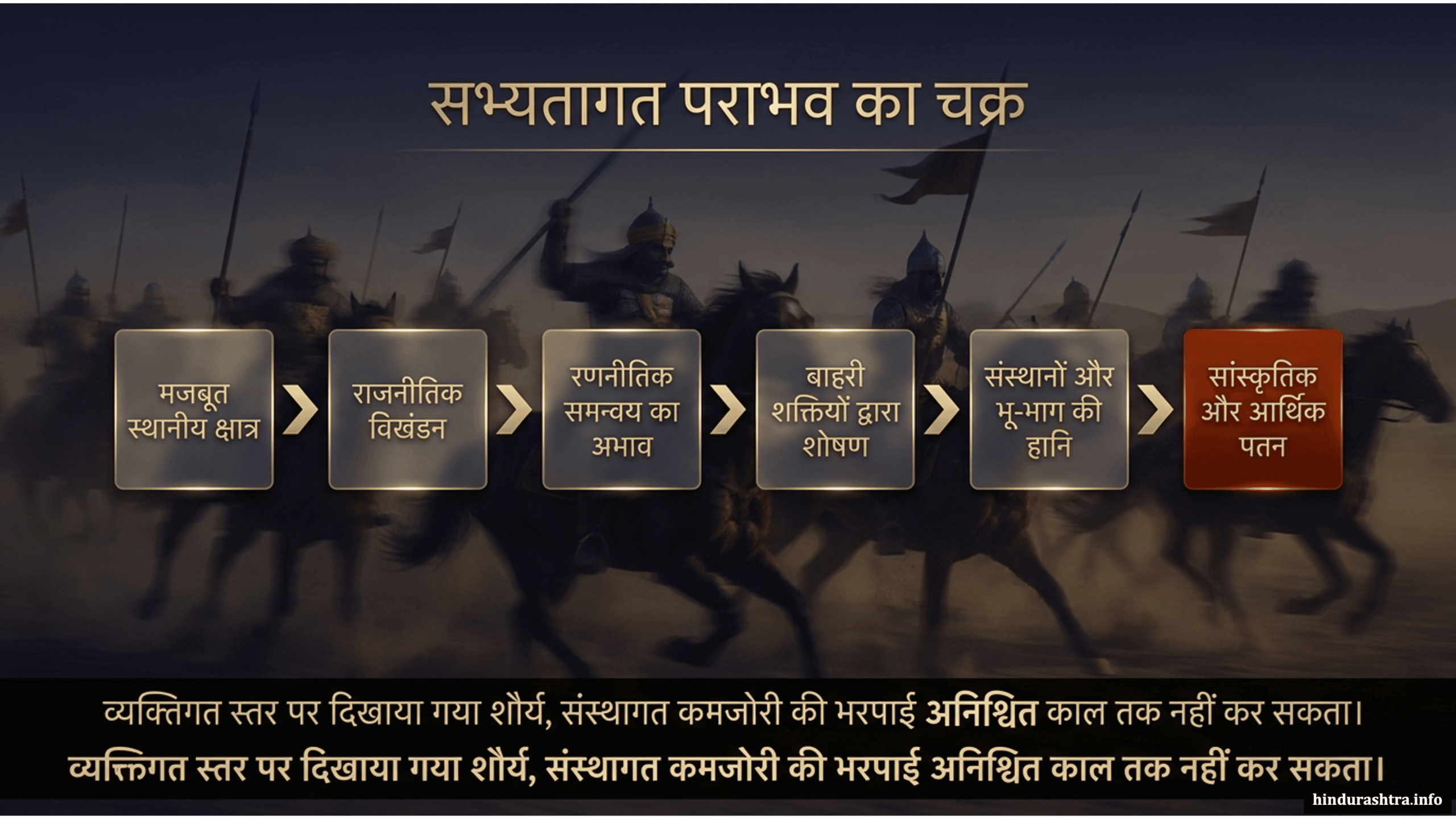
This structural model of civilizational collapse allows for the formulation of a precise, multi-variable analytical tool to evaluate specific historical periods.
- Comparative Historical Evaluation Framework
To evaluate historical eras without resorting to simplistic monocausal claims or emotional tropes, the theoretical insights of Karpatri Ji and Puri Shankaracharya Swami Nischalananda Saraswati can be operationalized into a rigorous, comparative diagnostic framework.
5.1 Application of the Five-Fold Diagnostic Questions (Pañca-Kṣātra-Parīkṣā)
This historical evaluation framework consists of five fundamental diagnostic criteria (पञ्च-क्षात्र-परीक्षा Pañca-Kṣātra-Parīkṣā) derived from the core functions of Kshatra Dharma. Rather than asking whether individual kings were personally brave, scholars must apply these five criteria to analyze the functional health of the state apparatus across distinct historical periods:
- Rakṣā (रक्षा) Defensive Capability: Could the state apparatus successfully protect its population, sovereign territory, and borders from external invasions and devastating internal raids?
- Daṇḍa (दण्ड) Internal Order & Rule of Law: Could the state maintain public order, prevent internal anarchy (मत्स्यन्याय Mātsyanyāya), eliminate predatory elements, and execute justice governed by Dharma without devolving into tyranny?
- Nīti (नीति) Strategic Statecraft & Diplomacy: Did the ruling class possess realistic political strategy, effective intelligence networks, diplomatic maneuvering, and sophisticated statecraft?
- Saṅghaṭana (संगठन) Institutional Organization & Alliance-Building: Could multiple political units, regional polities, and social sectors coordinate across large territories to form unified, reproducible defense structures?
- Dharmapālana (धर्मपालन) Institutional Protection of Civilization: Did political authority actively safeguard the physical infrastructure of the civilization; its temples, educational institutions, sacred sites, and cultural traditions?
This methodological diagnostic template evaluates state performance across distinct historical eras based on these structural categories.
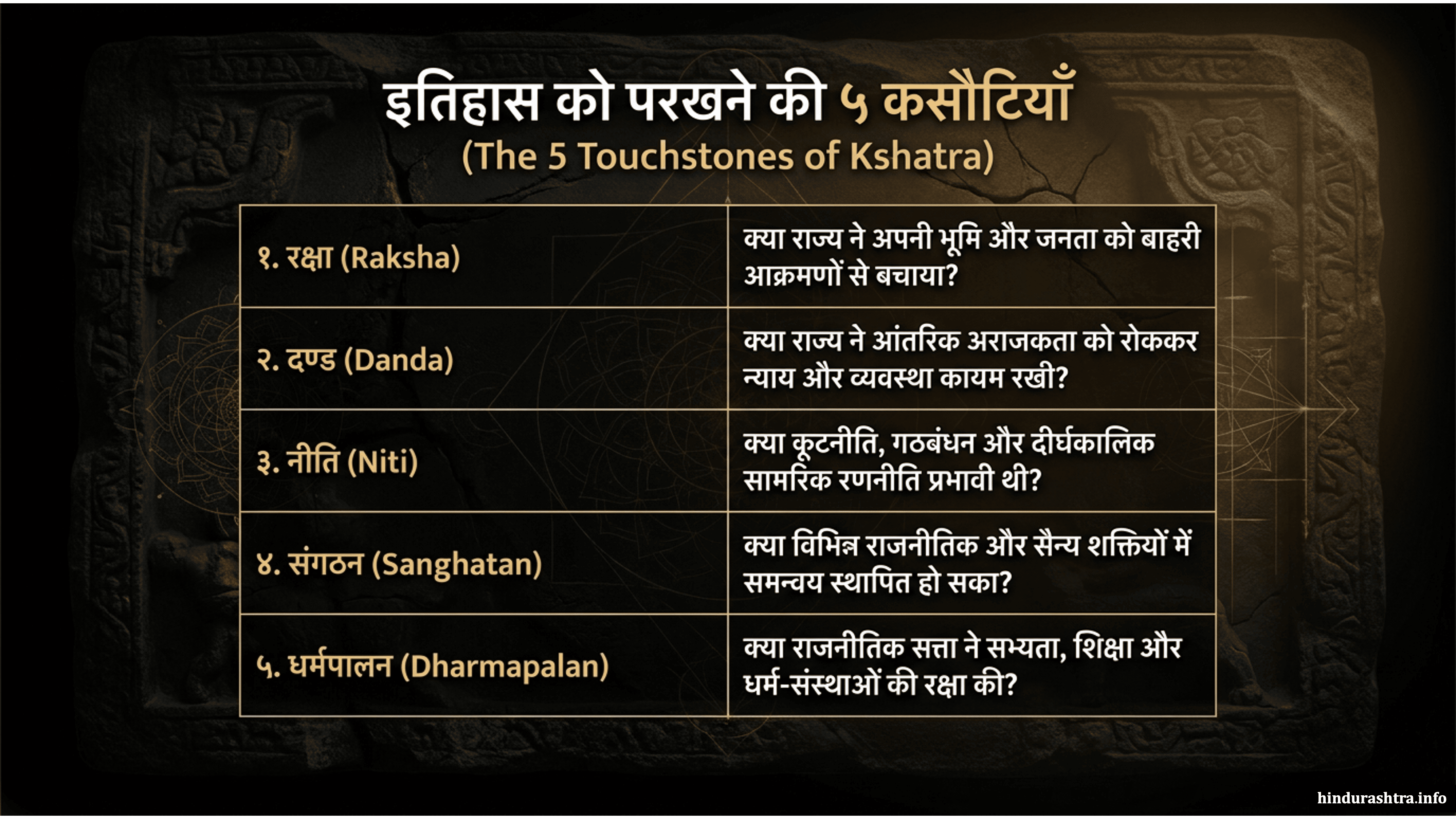
Application of this diagnostic template allows historians to clearly differentiate a localized, event-based military defeat from a deep, systemic failure of Kshatra Dharma. A military defeat is an isolated event; a failure of Kshatra is a deep, structural condition of political, strategic, and institutional breakdown.
5.2 Institutional Regeneration and the Duty of Intellectuals
A profound principle stressed in Karpatri Ji’s political writings is that when legitimate political actors disappear or political institutions fail, the duty of Kshatra does not vanish. Political defense is an absolute necessity for civilizational existence. Therefore, when the ruling class fails or is annihilated, the intellectual and spiritual leaders (Brahma) possess an imperative duty to intervene and actively invent, organize, and establish new political instruments.
This principle is supported by key historical precedents:
- The Chanakya Paradigm: When the ruling Nanda dynasty degenerated into corruption and proved incapable of organizing defense against foreign invaders, Chanakya (a scholar) actively sought out, trained, and elevated Candragupta Maurya, forging a new imperial state to secure the nation.
- The Samartha Ramadasa Paradigm: During a period of widespread cultural degradation and political subjection, Samartha Ramadasa provided the ideological foundation, moral energy, and organizational networks that guided Śivājī (शिवाजी) Maharaj in constructing Hindavī Svarājya (हिन्दवी स्वराज्य).
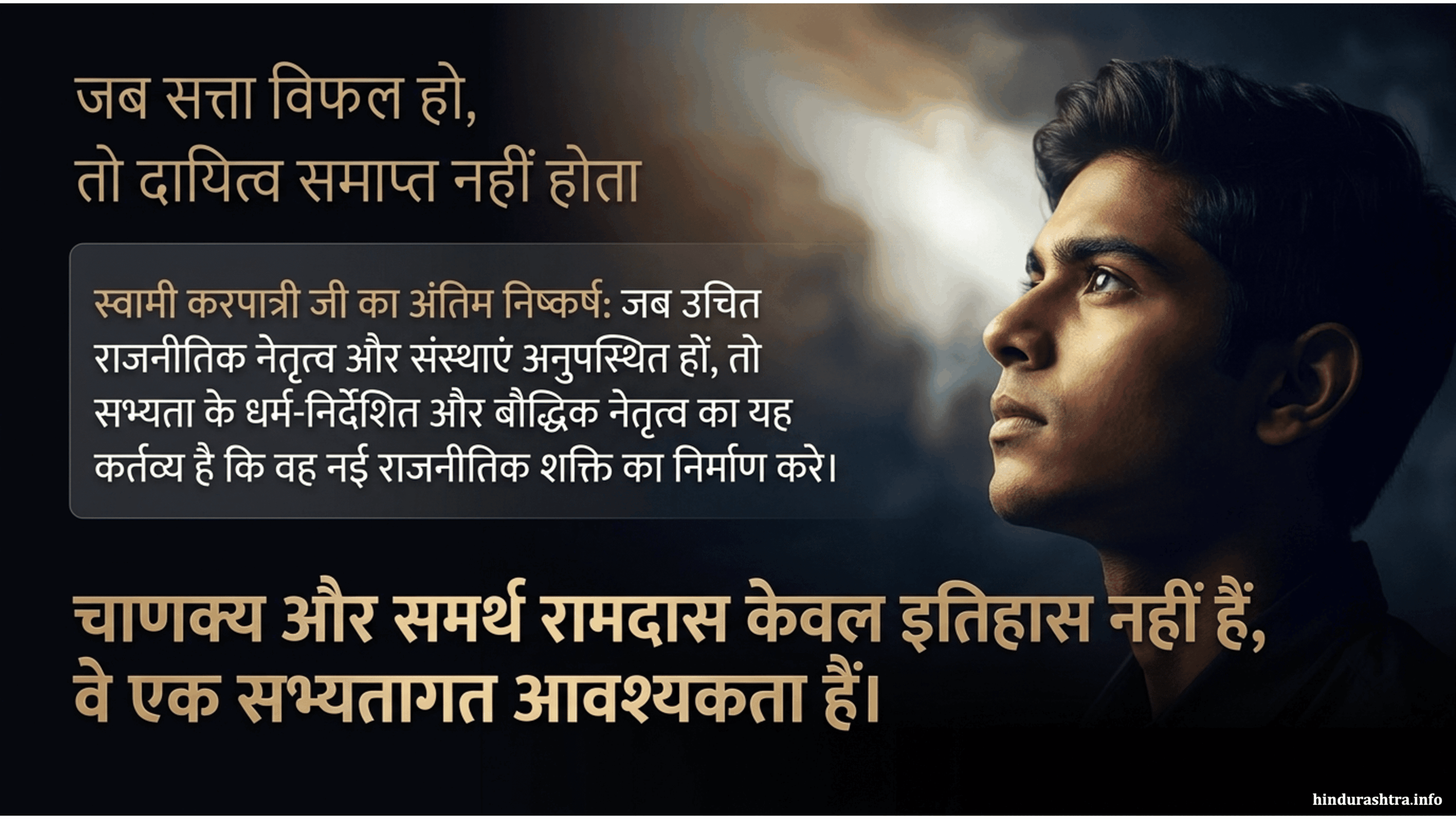
Thus, within the Karpatri-Nischalananda framework, the ultimate response to political collapse is not passive fatalism, but the active, deliberate creation of new political structures capable of re-establishing Dharma-governed state power. This historical and institutional duty of intellectuals to invent political instruments when state structures fail provides the direct conceptual bridge to analyzing the contemporary political landscape and modern statecraft.
- Contemporary Implications and Conclusions
The analytical model constructed by Swami Karpatri Ji and Jagadguru Puri Shankaracharya Swami Nischalananda Saraswati is not merely an academic framework for interpreting medieval history; it possesses direct, critical relevance for evaluating the modern nation-state and the contemporary political landscape.
6.1 Modern Political Structures and the Absence of Dharma-Controlled Authority
In Marxvad aur Ramrajya, Swami Karpatri Ji presents an incisive critique of modern political models. He contrasts arbitrary monarchy (स्वेच्छाचारी राजतन्त्र Svechāchārī Rājantantra) and unrestricted popular politics (अनियन्त्रित लोकतन्त्रAniyantrit Lokatantra) with the classical ideal of Dharma-controlled political authority (धर्म-नियन्त्रित राजसत्ता Dharma-niyantrit Rājasaattā). Karpatri Ji argues that modern democratic systems, when operating purely through electoral arithmetic, majoritarian impulses, or materialist ideologies (such as Marxism or radical secularism), remain fundamentally incomplete because they lack a normative anchor in Dharma.
Continuing this intellectual tradition, Jagadguru Puri Shankaracharya Swami Nischalananda Saraswati argues that modern state performance cannot be evaluated solely through abstract patriotism, economic growth metrics, or procedural democracy. National security, territorial integrity, and civilizational survival require organized, long-term social and political efforts explicitly dedicated to preserving the cultural identity and sacred institutions of the land.
To operationalize this vision in the contemporary era, the Puri Shankaracharya established dedicated organizational structures through the Govardhan Math:
- Peeth Parishad (पीठ परिषद): The core intellectual and policy body tasked with providing ideological leadership, policy analysis, and guidance on socio-political issues in accordance with Dharma.
- Aditya Vahini (आदित्य वाहिनी): An organized cadre of youth and citizens dedicated to active social service, cultural preservation, and national defense awareness.
- Ananda Vahini (आनन्द वाहिनी): The organizational wing focused on socio-cultural upliftment, social cohesion, and the active preservation of traditional family and community values.
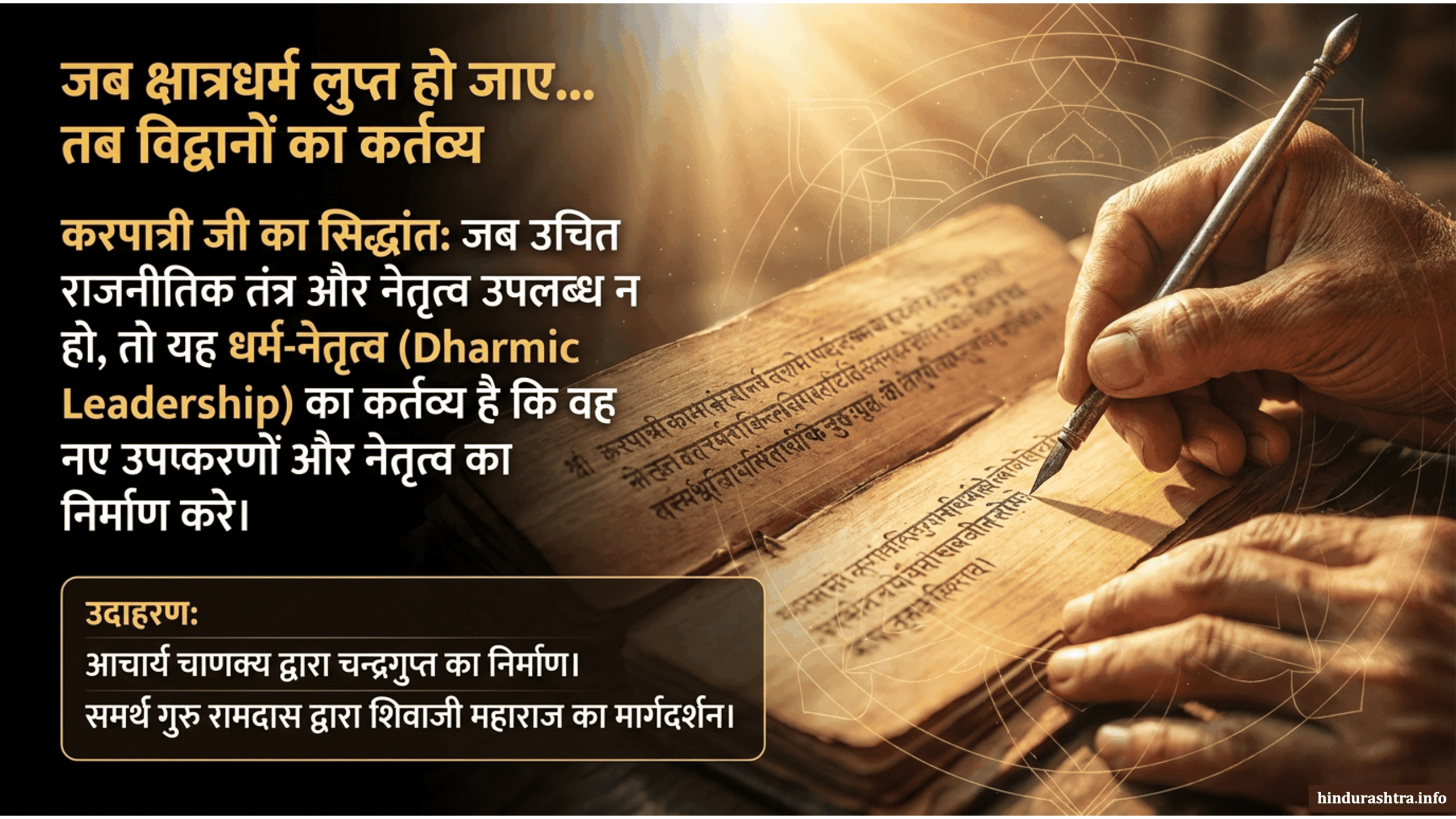
These modern initiatives underscore a core thesis of the Karpatri-Nischalananda tradition: a modern failure of Kshatra Dharma does not imply that contemporary soldiers are failing on the battlefield. Rather, it diagnoses a broader, systemic failure of the political apparatus as a whole to perform the holistic civilizational functions traditionally mandated by Rajadharma; specifically, the failure to protect indigenous educational structures, sacred institutions, cultural continuity, and strategic autonomy from subversion.
6.2 Synthesis of Findings and Nuanced Qualification
To maintain scholarly rigor, an important analytical qualification must be articulated:
Analytical Qualification: It would be historically inaccurate and intellectually simplistic to claim that every historical defeat suffered on the Indian subcontinent was caused exclusively by a failure of Kshatra Dharma. Political collapse is rarely monocausal. Throughout history, societies have succumbed to complex combinations of economic disruptions, technological imbalances, ecological disasters, succession crises, epidemiological shocks, and broader geopolitical shifts. The concept of “Failure of Kshatra Dharma” must therefore be understood as a profound, traditional civilizational diagnosis; a theoretical lens for evaluating state capacity, strategic alignment, and institutional health, rather than an empirical, monocausal explanation for every historical event.
When formulated with maximum analytical clarity and scholastic integrity, the central thesis of the Karpatri-Nischalananda framework can be distilled into a definitive conclusion:
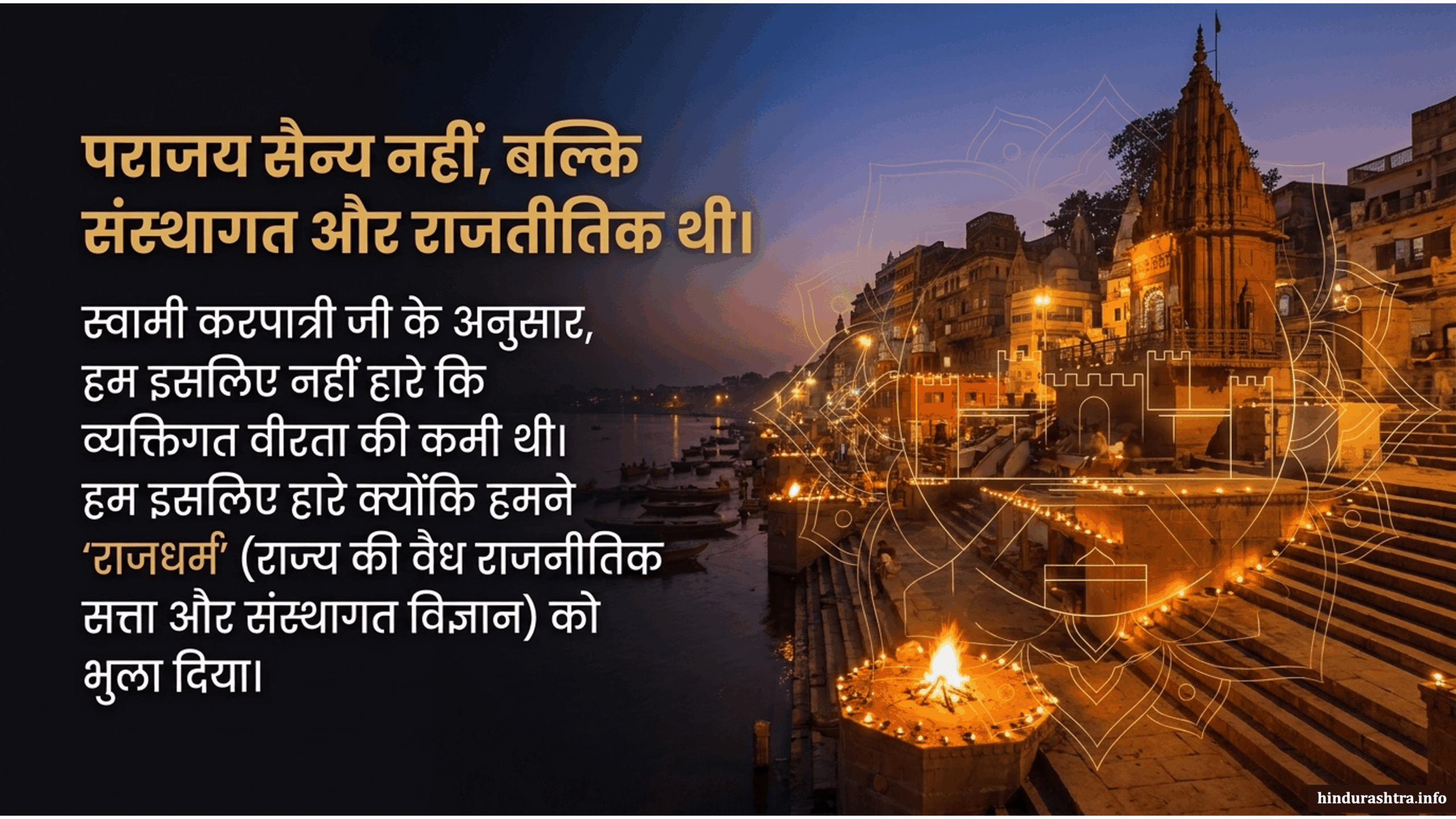
HISTORICAL DIAGNOSIS OF CIVILIZATIONAL VULNERABILITY
India’s recurring historical vulnerability was not a shortage of brave individuals, but the periodic failure to organize courage, knowledge, wealth, and social power under a Dharma-governed political authority capable of protecting civilizational continuity.
Ultimately, when political power (Kshatra) detaches itself from normative moral guidance (Dharma), strategic foresight (Dūradarśitā), structural organization (Saṅghaṭana), and the selfless protection of the populace (Prajāpālana), the protective shield of society dissolves. In the absence of that sovereign shield, the finest intellectual achievements, economic wealth, and cultural treasures of a civilization remain tragically exposed to fragmentation, plunder, and historic decay.